FUNCTIONAL Cognitive functions Social function CAPACITY ij M, - - PDF document

functional
SMART_READER_LITE
LIVE PREVIEW

FUNCTIONAL Cognitive functions Social function CAPACITY ij M, - - PDF document

7.2.2016 Content Functional ability of When we are old? Age definitions older people What is functional ability? Different dimensions What is the evidence from the research? Marja ij PhD, Principal Disablement


slide-1
SLIDE 1

7.2.2016 1

Functional ability of

  • lder people

Marja Äijö PhD, Principal lecturer Savonia University of Applied Sciences, Kuopio Finland

Content

  • When we are old?

– Age definitions

  • What is functional

ability?

– Different dimensions – What is the evidence from the research?

  • Disablement process
  • Measurements, some

examples

Äijö M, Savonia UAS 2

DIMENSONS OF FUNCTIONAL CAPACITY

Four dimensions

  • Physical function
  • Psychological

functions

  • Cognitive functions
  • Social function

Äijö M, Savonia UAS 4

Physical function

  • Physiological basic

functions

– For example: muscles strength, balance, aerobic capacity, joint mobility, body composition, status of health

Äijö M, Savonia UAS 5

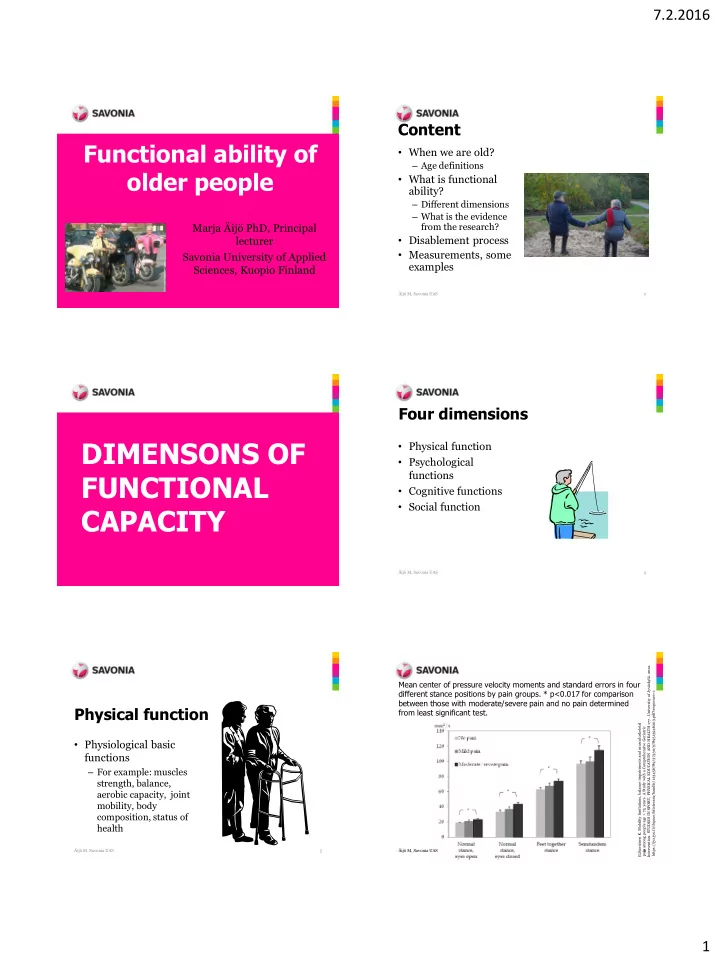
Mean center of pressure velocity moments and standard errors in four different stance positions by pain groups. * p<0.017 for comparison between those with moderate/severe pain and no pain determined from least significant test.

(Lihavainen K. Mobility limitations, balance impairments and musculoskeletal pain among people age > 75 years. A Study with a Comprehensive Geriatric

  • Intervention. STUDIES IN SPORT, PHYSICAL EDUCATION AND HEALTH 177 . University of Jyväskylä. 2012.

https://jyx.jyu.fi/dspace/bitstream/handle/123456789/37330/9789513946203.pdf?sequence=1 Äijö M, Savonia UAS 6

slide-2
SLIDE 2

7.2.2016 2

Coimpairments: strength and balance as predictors of severe walking disability.

  • 25 years prospective study,

6089 healthy men

10 20 30

Walking speed <0.4 m/s Chair raise Wash Dressing Eating Use of toilet heavy housework raise the weight 4.5 kg 800 m walk 10 steps climb Highest Medium Lowest

Hand grip strength

%

(Rantanen et al. 1999. Midlife hand grip strength as a predictor of old age disability. JAMA 10;281(6): 558-60)

Functional impairments Functional difficulties

Äijö M, Savonia UAS 7

The conceptual model illustrates important factors that can affect physical function during aging and ultimately maintenance of health and independence in older adults

Äijö M, Savonia UAS 8

(Anton SD. 2015. Successful ageing: Advancing the sience of physical independence in older adults. Ageing Reseach Reviews 24 (part B), 304-327, doi: 10.1016/j.arr.2015.09.005. Epub 2015 Oct 14.)

Psychological functions

  • Mental health
  • Life satisfaction
  • Psychological well-

being

  • Self-evaluation
  • Mood
  • Own resources
  • Coping strategies

Äijö M, Savonia UAS 9

Risk factors for social isolation and loneliness among older adults

Äijö M, Savonia UAS 10 (Valtorta N. & Hanratty B. 2012. Loneliness, isolation and the health of older adults: do we need a new research agenda? JRSM 105(12): 518-522, doi: 10.1258/jrsm.2012.120128)

What are the causes of late-life depression?

Rehan A & Steffens, D. Psychiatric Clin North Am. 2013, 36(4): 497- 516, doi:10.1016/j.psc.2013.08.001

  • Depressive symptoms in elders have been associated with

impairment similar to that of major depressive disorder.

  • Late-onset depression has been prominently linked to

cerebrovascular compromise.

  • Depression likely serves as both a risk factor and potentially

an early sign of dementia.

  • The most significant psychosocial factors leading to

depression are bereavement;

– perceived social support; neuroticism; personality disorders; loneliness; disability; total number of life events; total number of daily hassles; and impaired social support, including lack of a confidante.

Äijö M, Savonia UAS 11

Psychological approach to successful ageing

  • Psychological approach

independently predicted quality of life (QoL)

  • Successful ageing:

– Not only maintenance of health – Maximizing one’s psychological resources

  • Self-efficacy
  • Resilience
  • Increasing use of preventive

care, better medical management of morbidity, and changing lifestyles in older people may have beneficial effects on health and longevity, but may not improve their QoL.

  • Follow-up health status,

number of supporters and social activities, and self-rated active ageing also significantly predicted QoL at follow-up.

Äijö M, Savonia UAS 12 (Bowling A, Iliffe S. 2011. Psychological approach to successful ageing predicts future queslity of life in older adults. Health Qual Life Outcomes. 2011 Mar 9;9:13. doi: 10.1186/1477-7525-9-13. )
slide-3
SLIDE 3

7.2.2016 3 Cognitive functions

  • Cognition = the

cognitive functions of information processing

– perception – attention – decision – awareness – linguistic functions – learning – problem solving – thinking

Äijö M, Savonia UAS 13

Cognitive function and physical disability

  • Cognitive function significantly contribute to functional

decline and eventual development of physical disability – Age-related (e.g. memory and attention) (Atkinson et

  • al. 2005)

– Transient decline (e.g. delirium) (Brummel et al. 2014) – Increased rates of injury, hospitalization, dependence

  • n assistive living and mortality (Boockvar et al. 2013,

Brummel et al. 2014)

Äijö M, Savonia UAS 14 (H.H. Atkinson, M. Cesari, S.B. Kritchevsky, B.W. Penninx, L.P. Fried, J.M. Guralnik, J.D. Williamson. Predictors of combined cognitive and physical decline J. Am. Geriatr. Soc., 53 (2005), pp. 1197–1202

  • K. Boockvar, D. Signor, R. Ramaswamy, W. Hung Delirium during acute illness in nursing home residents J. Am. Med. Dir. Assoc., 14 (2013), pp. 656–

660 N.E. Brummel, J.C. Jackson, P.P. Pandharipande, J.L. Thompson, A.K. Shintani, R.S. Dittus, T.M. Gill, G.R. Bernard, E.W. Ely, T.D. Girard Delirium in the ICU and subsequent long-term disability among survivors of mechanical ventilation Crit. Care Med., 42 (2014), pp. 369–377)

Social functions

  • Relations with family

members and friends

  • Responsibility for the

family members and friends

  • Quality of social

relationship

  • The sense of life
  • Roles

Äijö M, Savonia UAS 15

Potential functional ability

  • What is possible to do?
  • The potential consists of an individual's social

functioning and various individual factors (e.g. social skills, temperament, motives, goals, values) and the social network

  • It is dynamic interaction between environment and
  • lder person
  • It is dynamic interaction with the provision of

services within the framework of opportunities and constraints.

(Jyrkämä 2003; TOIMIA asiantuntijaverkosto 2011: http://www.thl.fi/toimia/tietokanta/suositus/18/)

Äijö M, Savonia UAS 16

Actual functional ability

  • What is possible to do this environment?
  • Emphasizes the context: department

performance

  • The ability to respond to the physical and social

setting

  • For example:

– Experiencing inclusion – Performance of the roles: e.g. patient – Experiences: good / bad

Äijö M, Savonia UAS 17

(Jyrkämä 2003; TOIMIA asiantuntijaverkosto 2011: http://www.thl.fi/toimia/tietokanta/suositus/18/)

The disablement process

slide-4
SLIDE 4

7.2.2016 4

The model of the disablement process Verbrugge and Jette (1994)

EXTRA-INDIVIDUAL FACTORS RISK FACTORS INTRA-INDIVIDUAL FACTORS PATHOLOGY IMPAIRMENT FUNCTIONAL LIMITATION DISABILITY The main pathway:

Äijö M, Savonia UAS 19 (Verbrugge L & Jette A. 1994. The disablement process. Soc.Sci.Med. 38(1): 1-14)

Diseases Cardiac infarction, stroke Impairment Strength and endurance decrease , balance decline Functional limitation Slow walking ability Disability ADL and IADL problems Problems in social interaction

(Verbrugge & Jette 1994)

Äijö M, Savonia UAS 20

Preclinical mobility limitations

(Mänty 2010; Early signs of mobility decline and physical activity counseling as a preventive intervention in older people. Studies in sport, physical education and health 147. University of Jyväskylä https://jyx.jyu.fi/dspace/bitstream/handle/123456789/23586/9789513938826.pdf?sequence=1) Äijö M, Savonia UAS 21

How to measure?

Basic activity of daily living

  • The ability to perform

physically:

– ADL functions – IADL functions – AADL –functions (meaningful leisure time, physical activity)

Äijö M, Savonia UAS 23

How to measure?

ADL

  • Katz index
  • IADL-index
  • The Barthel index

Physical function

  • Rivermead mobility index
  • Short Physical Performance

Battery (SPPB)

  • The timed Up and Go (TUG)

Test

  • Chair stand, 5 or 10 times
  • The 30-Second Chair Stand

Test

Äijö M, Savonia UAS 24

slide-5
SLIDE 5

7.2.2016 5 How to measure?

Psychological function

  • The Center for

Epidemiologic Studies Depression Scale

  • Geriatric Depression

Scale, GDS-15

Social function

  • The Social Provisions

Scale

  • Perceived loneliness

Äijö M, Savonia UAS 25

How to measure?

Cognitive function

  • Mini-Mental State

Examination (MMSE)

Äijö M, Savonia UAS 26

FUNCTIONAL ABLITY /

  • ptimal functionality

Marja Äijö1

1 Principal lectures, Gerontology, Savonia, University of Applied Sciences, Unit of Health Care, Kuopio, Finland

Different frameworks, some examples

  • Optimal functionality
  • ICF - The International classification of

functioning, disability and health

  • Active ageing
  • Healthy ageing
  • Successful ageing

Äijö M, Savonia UAS 28

How to support

  • ptimal functionality

in different environments?

Äijö M, Savonia UAS 30

(JAMA. 2011;306(16):1782-1793)

slide-6
SLIDE 6

7.2.2016 6