SLIDE 1
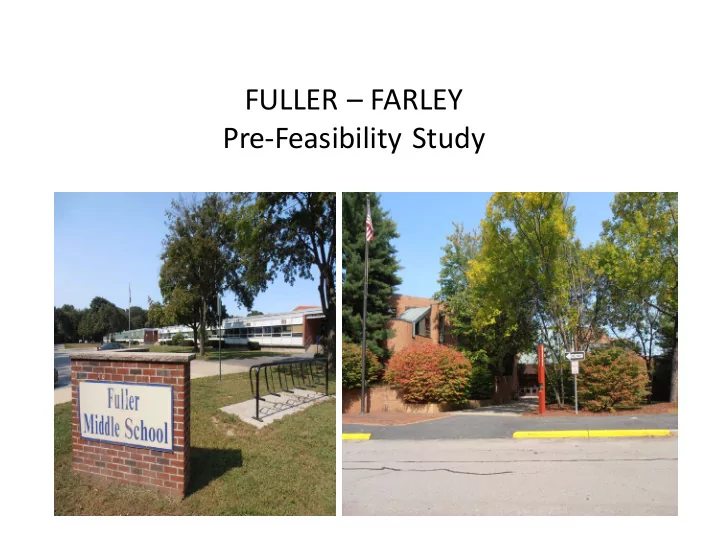
FULLER – FARLEY Pre-Feasibility Study
SLIDE 2
Pursuant to the Fuller-Farley pre-feasibility study initial findings, prepared by architectural firm bh+a, and in conjunction with preliminary enrollment projections provided by the New England School Development Council (NESDEC), the following indicators are presented.
SLIDE 3 WHAT ARE THE INDICATORS OF NEED AT THE ELEMENTARY LEVEL?
- 1. Significant overcrowding at the elementary level.
- 2. Projections in increased elementary student
population.
- 3. Current utilization and inefficient use of space, as
buildings are currently designed results in a sense
- f overcrowding.
- 4. Decommission modular classroom units at Brophy
(2) and Hemenway (4) Elementary Schools
SLIDE 4
1. Hallway and under stairwell space used as breakout instruction space 2. Closets have been converted to smaller group or pullout instructional space 3. Areas used were not designed with appropriate ventilation for instructional space use 4. No windows (below ground or at ground level) 5. Often connecting to hallway (no secondary means of egress) 6. Locker rooms have been converted to classroom space (music, art, etc.)
SLIDE 5 7. Some are connected to gymnasium (no secondary means
8. Use of mechanical rooms as small instructional space or
9. Media centers have been constructed in libraries, thus detracting from library space
- 10. Custodial storage closets have been converted into areas
for one-to-one instruction/tutoring and /or office space
- 11. Dish-rooms used as small instructional space
- 12. Modular units, erected in 2004, approaching end of useful
life.
SLIDE 6
Multiple Schools
Hallway space being used as instructional space 1
SLIDE 7
Multiple Schools
Utility closet converted into instructional space 2
SLIDE 8
Multiple Schools
Areas not designed with appropriate ventilation for instructional space use 3
SLIDE 9
Multiple Schools
No windows (below ground or at ground level) 4
SLIDE 10 Multiple Schools
Food Services dish-room converted into literacy center (no secondary means of egress)
5
SLIDE 11
Multiple Schools
Locker rooms converted into art and music storage rooms 6
SLIDE 12 Multiple Schools
Gymnasium storage room converted to instructional space (no appropriate secondary
means of egress) 7
SLIDE 13
Multiple Schools
Custodial space/utility room converted into teacher room 8
SLIDE 14
Multiple Schools
Libraries split into libraries/computer labs 9
SLIDE 15
Multiple Schools
Storage room converted into instructional breakout space 10A
SLIDE 16
Multiple Schools
Shower rooms converted into storage/small breakout rooms 10B
SLIDE 17
Multiple Schools
Food Services dish-room converted into literacy center 11
SLIDE 18
Brophy School
“Temporary” modular classrooms (2) erected in 2004 12A
SLIDE 19
Hemenway School
“Temporary” modular classrooms (4) erected in 2004 12B
SLIDE 20 WHAT ARE THE INDICATORS OF NEED FOR FULLER MIDDLE SCHOOL?
- 1. Fuller facility initial findings from a building analysis
(Bargmann Hendrie Archetype, Inc. or bh+a) indicate that in
- rder to keep the building in useable condition, significant
improvements will need to be made.
- 2. Fuller Middle School classrooms are under the MSBA
recommended size.
- 3. Recent infrared scan results of the roof indicated widespread
issues.
- The entire roof structure needs to be replaced including all
new steel decking.
SLIDE 21 WHAT ARE THE OPTIONS FOR FULLER MIDDLE SCHOOL? OPTION A
1.Renovate the existing building
- Assume phased construction and no
place to house students
$47,433,202
SLIDE 22 OPTION B
- 1. Move students/2nd and 3rd floor footprint
- More parking
- More land for athletic fields
- 2. Possibly move bus yard from Park and
Recreation property and leased CSX property
- 3. Building would be separated at Buildings and
Grounds wing
$35,535,462.00
SLIDE 23 OPTION C
- 1. Partial Demolition/Partial Renovation
- A. Retain cafeteria
- B. Retain gymnasium
- C. Retain auditorium
- 2. 120,000 square foot footprint (Current footprint:
198,000 square feet)
- 3. Classrooms would be designed at the correct size
(according to MSBA guidelines.)
$33,047,800
SLIDE 24 CLOSING THOUGHTS
- 1. The NESDEC Facilities Best Educational Use Meta-Study is
pending.
- 2. Renovate Fuller or tear down?
- 3. FPS has already submitted a Statement of Interest (SOI) for a
total roof replacement at Fuller Middle School.
- A. Amend current SOI to include a building renovation?
- B. Continue to pursue MSBA reimbursement for roof only?
- C. Begin new SOI process of Fuller renovation?
- 4. Custom re-build versus MSBA model?
- A. MSBA reimburses an additional 5% for model school.
- 5. Temporary facility
- A. Use of Farley hinges on MBCC vacating Farley.
SLIDE 25 RECOMMENDATIONS
- 1. Partially renovate Farley, reconstruct bathrooms making them ADA compliant
and accessible for both elementary and middle school students.
- 2. Renovate the pool area.
- 3. Create a cafetorium and kitchen.
- 4. Once complete, move Fuller students into Farley.
- 5. Renovate Fuller cafeteria and auditorium, gymnasium.
- 6. Demolish and replace all classrooms, administrative wings of the building as
well as all mechanical, electrical and plumbing systems and replace with new. The MSBA will not provide any funds for temporary student housing.
SLIDE 26 NEXT STEPS 1. Bh+a presentation to Framingham School Committee Buildings and Grounds Sub-committee and then School Committee, which includes MSBA process and critical timeline. 2. School Committee decision on which option, if any, to present to Town Officials. 3. Develop a strategy for political campaign and ultimate presentation to Town Meeting. 4. Submit a Statement of Interest (SOI) to the MSBA in January 2013. 5. If approved, start in-house improvements at Farley School in 2015. 6. Complete in-house renovations at Farley in 2016. 7. Move student population out of Fuller in 2016. 8. Complete renovation/construction at Fuller in 2018. 9. Move Fuller student population out of Farley and back to Fuller in 2018.
- 10. Farley becomes available as elementary or “swing” space in 2019.
SLIDE 27 FULLER SCHOOL Relocate students to Farley School Renovate pool area/ create new cafetorium and kitchen Least disruptive
Phased construction Students occupy Fuller during construction Single floor design Gym,cafeteria and auditorium retained Multi-level design Gym, cafeteria, auditorium retained
SLIDE 28 Cost Estimates for Fuller School Construction Options
Fuller students relocated at Farley Fuller students remain at Fuller during construction $ 3,000,000 Construct cafe/kitchen at Farley $ 500,000 Replace roof $ 500,000 Bathroom ADA $ 1,000,000 Other $33,000,000 Fuller construction (Option C) $38,000,000 Estimated total cost *Note: This option results in Fuller and Farley Schools returning to full future use. $47,500,000 Single level construction
$35,500,000 Multi-level construction