
SLIDE 1
From the Delors White Paper (1993) to the EU Pillar of Social Rights - - PowerPoint PPT Presentation
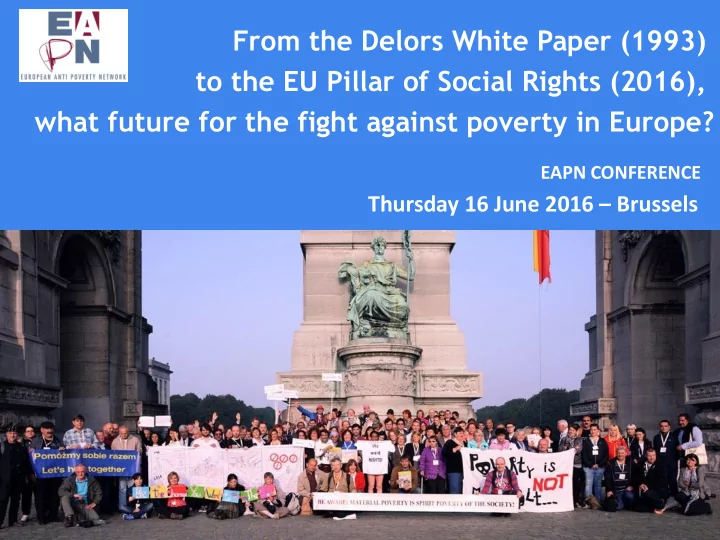
From the Delors White Paper (1993) to the EU Pillar of Social Rights (2016), what future for the fight against poverty in Europe? EAPN CONFERENCE Thursday 16 June 2016 Brussels From the Delors White Paper (1993) to the EU Pillar of Social
Brussels, 16 June 2016
„resulting from the financial and sovereign debt crisis‟? Or these problems are consequence of deeper system‟s failure, TOGETHER with financial and sovereign debt crisis?
quality of life and convergence if it is „part of our work to strengthen Economic and Monetary Union‟? What is the purpose of Economic and Monetary Union? Have we confused means for objectives?
Economic and Monetary Union without Social Union is faced with severe
market integration. They are grounded in our basic understanding of what socially just system is and how responsibilities and benefits should be distributed across different groups, societies and across the European Union. Is it possible to build common market, or protect labour force when we see the crash of solidarity, xenophobia, lack of integration of minorities, segregation in housing, schools, on the labour market?
Equal opportunities and access to the labour market Fair working conditions Adequate and sustainable social protection Skills, education and life-long learning Conditions of employment Integrated social benefits and services Flexible and secure labour contracts Wages Health care and sickness benefits Secure professional transitions Health and safety at work Pensions Active support for employment Social dialogue and safety of workers Unemployment benefits Gender equality and work-life balance Minimum income Equal opportunities Disability benefits Long-term care Childcare Housing Access to essential services
relevant policies?
remains a “shopping list” of principles? Will the implementation of social pillar interventions lead to concrete outcomes in policy and practice?
related and coordinated?
1. Skills, education and life-long learning: Nothing is said about inclusive education, combating segregation and discrimination, second chance education, and financial support to ensure these.
‘Flexibility in the conditions of employment can offer a gateway to the labour market and maintain employers’ ability to swiftly respond to shifts in demand; however, the transition towards open-ended contracts shall be ensured’. An absence of choice or limited options to choose where to work and under what conditions (i.e. full time or part time) is a core characteristic of precariousness.
3. Secure professional transitions: It worryingly mentions that some of the entitlements of jobseekers or inactive persons should not become disincentives to re-staring work, which may be used as a gateway for negative activation with sanctions and conditionality. Income support (including unemployment benefits) and access to services are not mentioned. Nothing is said about vulnerable groups, needing specific support, or about holistic, comprehensive approaches.
0.0 5.0 10.0 15.0 20.0 25.0 30.0 35.0 40.0 45.0 2006 2007 2008 2009 2010 2011 2012 2013 2014 2015 Total Male Female
Source: Eurostat
Source: Eurostat
0.0 10.0 20.0 30.0 40.0 50.0 60.0 2006 2007 2008 2009 2010 2011 2012 2013 2014 2015 Total 15-24 Total 25-49 Total 50-64 Male 25-49
4. Wages: It does not clarify how adequate wages are to be set, and it recommends the evolution of wages in line with productivity, decoupled from inflation. 5. Integrated social benefits and services: It is unclear whether the proposed integrated approach will not effectively reduce access to benefits and services, as the text also speaks of aligning eligibility and coverage. It mentions that better integration can improve the cost-effectiveness of social protection, but nothing is said about the quality of the services, the adequacy
6. Health care and sickness benefits: It is not said how the promised universal access will be ensured and financed.
How social pillar domains will be mainstreamed into the main policy drivers and prevent potentially negative macroeconomic policies? Will funding be allocated (i.e. European Structural and Investment Funds)? Example: Gender equality and work-life balance are not achievable without full promotion of equal opportunities, improvement of childcare.
Gender equality and work-life balance Equal
Childcare
Employment rate of women, age 15-64, 2014, %
0.0 10.0 20.0 30.0 40.0 50.0 60.0 70.0 80.0 EL IT MT HR ES RO SK PL HU IE BE BG SL CY EU28 PT FR LU CZ LV LT AT FI EE UK NL DE DK SE 10 20 30 40 50 60 70 HR PL RO EL UK BG LU SK CZ LV CY LT FI EU28 HU AT NL DE IE PT SL IT ES EE DK SE FR BE MT
Share of children old 3-compulsory preschool out of formal childcare, 2014, %
There is an EU Commission‟s proposal „New start to address the challenges
envisaged in legal and policy domains.