(from Chapter 10/11 of the text) Everything you ever wanted to know - - PDF document

from chapter 10 11 of the text
SMART_READER_LITE
LIVE PREVIEW

(from Chapter 10/11 of the text) Everything you ever wanted to know - - PDF document

IT350 Web and Internet Programming SlideSet #10: JavaScript Arrays, Objects, & Cookies (from Chapter 10/11 of the text) Everything you ever wanted to know about arrays function initializeArrays() { var n1 = new Array( 5 ); //


slide-1
SLIDE 1

1

(from Chapter 10/11 of the text)

IT350 Web and Internet Programming SlideSet #10: JavaScript Arrays, Objects, & Cookies

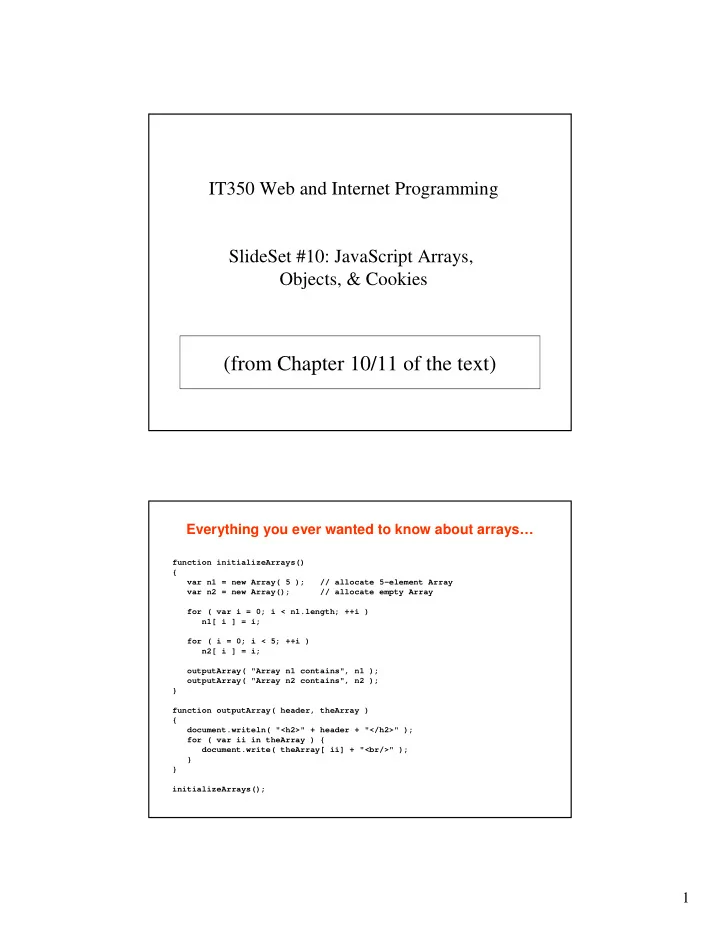
Everything you ever wanted to know about arrays…

function initializeArrays() { var n1 = new Array( 5 ); // allocate 5-element Array var n2 = new Array(); // allocate empty Array for ( var i = 0; i < n1.length; ++i ) n1[ i ] = i; for ( i = 0; i < 5; ++i ) n2[ i ] = i;

  • utputArray( "Array n1 contains", n1 );
  • utputArray( "Array n2 contains", n2 );

} function outputArray( header, theArray ) { document.writeln( "<h2>" + header + "</h2>" ); for ( var ii in theArray ) { document.write( theArray[ ii] + "<br/>" ); } } initializeArrays();

slide-2
SLIDE 2

2

…but were afraid to ask.

Scope – Revisited

function mystery( x, y ) { for ( var ii = 0; ii < x.length; ++ii ) x[ii] = x[ii] * y; y = 7; document.writeln("<br/> x: ",x); document.writeln("<br/> y: ",y); } var myArray = [3, 4, 5]; var factor = 2; document.writeln ("<br/> myArray: ", myArray); mystery(myArray, factor); document.writeln ("<br/> myArray: ", myArray); document.writeln ("<br/> factor : ", factor);

Arguments are passed ______________, so original argument values in caller are ________________ BUT array/object arguments are a “reference”, so contents may be ___________

slide-3
SLIDE 3

3

Exercise #1

a.) Write a function “sumArray” as follows: Input: an array Output: the sum of that array b.) Write test code to create an array and call “sumArray” on it.

Exercise #2 – What’s the output?

function printme( z ) { document.writeln("<br/> z is ",z); } var array1 = [17, 21, 42]; var array2 = [14, 19]; var x = 1; printme (array1); printme (array2[1]); printme (x); array1[x] = 57; printme (array1);

slide-4
SLIDE 4

4

Exercise #3 – What’s the output? (Hint: assume JavaScript ignores any errors it finds)

function changeMe1( z ) { z[0] = 75; } function changeMe2( a, b) { a = b; } var array1 = [17, 21, 42]; var array2 = [14, 19]; var array3 = [7, 8, 9]; var x = 63; changeMe1 (array1); document.writeln("<br/> array1: ", array1); changeMe1 (array2[1]); document.writeln("<br/> array2: ", array2); changeMe1 (x); document.writeln("<br/> x: ", x); array1 = array2; document.writeln("<br/> array1: ", array1); changeMe2 (array1, array3); document.writeln("<br/> array1: ", array1);

Exercise #4

  • Write a function perfect(N) that returns an array of size N containing

the first N perfect squares. So perfect(4) would return [0, 1, 4, 9].

slide-5
SLIDE 5

5

Exercise #5

a.) Write a function dotProduct(x, y) that takes two arrays of size n and returns the sum: x[0]*y[0] + x[1]*y[1] + … + x[n-1]*y[n-1] b.) Look ahead to “Cookie Example #1” (but don’t peek at #2!). Can you find the bug?

Functions as Arguments

function start() { var a = [ 10, 1, 9, 2, 8, 3, 7, 4, 6, 5 ]; document.writeln( "<h1>Sorting an Array</h1>" ); document.writeln( "Data items in original order: ", a ); a.sort( compareIntegers ); // sort the array document.writeln( "Data items in ascending order: ", a ); } // comparison function for use with sort function compareIntegers( value1, value2 ) { return parseInt( value1 ) - parseInt( value2 ); }

slide-6
SLIDE 6

6

Sorting Output 11.7

  • Object

Method or property Description id Returns the DOM node representing the XHTML element whose attribute matches id. string Writes the string to the XHTML document as XHTML code. string Writes the string to the XHTML document as XHTML code and adds a newline character at the end.

  • A string containing the values of all the cookies stored on

the user’s computer for the current document. See Section 11.9, Using Cookies.

  • The date and time that this document was last modified.
slide-7
SLIDE 7

7

11.8 window Object

Method or property Description

  • urlnameoptions

Creates a new window with the URL of the window set to url, the name set to name to refer to it in the script, and the visible features set by the string passed in as

  • ption.
  • prompt, default

Displays a dialog box asking the user for input. The text

  • f the dialog is prompt, and the default value is set to

default.

  • Closes the current window and deletes its object from

memory.

  • This method gives focus to the window (i.e., puts the

window in the foreground, on top of any other open browser windows).

  • This method takes focus away from the window (i.e.,

puts the window in the background).

  • This property contains the object

representing the document currently inside the window.

  • This property contains a boolean value that is set to true

if the window is closed, and false if it is not.

  • This property contains the object of the

window that opened the current window, if such a window exists.

11.9 Using Cookies

  • Cookie

– Data stored on user’s computer to maintain information about client during and between browser sessions – Can be accessed through property – Set expiration date through property – Use function to convert non-alphanumeric characters to hexadecimal escape sequences

function converts hexadecimal escape sequences

back to English characters

slide-8
SLIDE 8

8

Storing Cookies – Simple Version

document.writeln("<br/>Cookie is: "+document.cookie); document.cookie = "name=" + escape("J Smith"); document.writeln("<br/>Cookie is: "+document.cookie); document.cookie = "rank=" + escape("Captain"); document.writeln("<br/>Cookie is: "+document.cookie);

Cookie Example #1

// reset the document's cookie if wrong person function wrongPerson() { // reset the cookie document.cookie= "name=null;" + " expires=Thu, 01-Jan-95 00:00:01 GMT"; // after removing the cookie reload the page to get a new name location.reload(); } // determine whether there is a cookie if ( document.cookie ) { var myCookie = unescape( document.cookie ); // split the cookie into tokens using = as delimiter var cookieTokens = myCookie.split( "=" ); // set name to the part of the cookie that follows the = sign name = cookieTokens[ 1 ]; } else { // if there was no cookie then ask the user to input a name name = window.prompt( "Please enter your name", “Paul" ); document.cookie = "name=" + escape( name ); } document.writeln("<h1>Hello, " +name + ". </h1>" ); document.writeln( "<a href= ‘javaScript:wrongPerson()’ > " + "Click here if you are not " + name + "</a>" );

slide-9
SLIDE 9

9

Cookie Example #2

// reset the document's cookie if wrong person function wrongPerson() { // reset the cookie document.cookie= "name=null;" + " expires=Thu, 01-Jan-95 00:00:01 GMT"; // after removing the cookie reload the page to get a new name location.reload(); } // determine whether there is a cookie if ( document.cookie ) { var cookie = document.cookie; var cookieTokens = cookie.split( "=" ); // set name to the part of the cookie that follows the = sign name = cookieTokens[ 1 ]; name = unescape(name); } else { // if there was no cookie then ask the user to input a name name = window.prompt( "Please enter your name", “Paul" ); document.cookie = "name=" + escape( name ); } document.writeln("<h1>Hello, " +name + ". </h1>" ); document.writeln( "<a href= ‘javaScript:wrongPerson()’ > " + "Click here if you are not " + name + "</a>" );

Storing Cookies – More Realistic

  • By default, cookies expire when close browser
  • Set “expires” attribute to make stick around longer

function createCookie(name,value,days) { if (days) { var date = new Date(); date.setTime(date.getTime()+(days*24*60*60*1000)); var expires = "; expires="+date.toGMTString(); } else var expires = ""; document.cookie = name+"="+escape(value)+expires; } function eraseCookie(name) { createCookie(name,"",-1); }

(modified from http://www.quirksmode.org/js/cookies.html)

slide-10
SLIDE 10

10

Parsing Cookies – More Realistic

// Return the 'value' of the cookie variable with name 'desiredVar' // returns null if no match found. function parseCookie(desiredVar) { // First split the pairs apart on ';' var pairs = document.cookie.split(";"); // Now split each pair on '='. Check if have a match for (var i=0; i < pairs.length; i++) { var aPair = pairs[i]; // remove any leading spaces while (aPair.charAt(0) == ' ') aPair = aPair.substring(1, aPair.length ); // split into desired parts and check for match var cookieTokens = aPair.split("="); var name = cookieTokens[0]; var value = cookieTokens[1]; if (name == desiredVar) { // found desired variable -- return value return unescape(value); } } return null; // no match; }