Fourth Meeting of the Scientific Committee Yokohama, Japan 25-29 - - PowerPoint PPT Presentation

fourth meeting of the scientific committee
SMART_READER_LITE
LIVE PREVIEW

Fourth Meeting of the Scientific Committee Yokohama, Japan 25-29 - - PowerPoint PPT Presentation

Fourth Meeting of the Scientific Committee Yokohama, Japan 25-29 March 2019 Including outcomes from 1 st Protected Areas and Ecosystems Working Group (PAEWG1) 1 st Stock and Ecological Risk Assessment Working Group (SERAWG1) Dr Ilona


slide-1
SLIDE 1

Fourth Meeting of the Scientific Committee

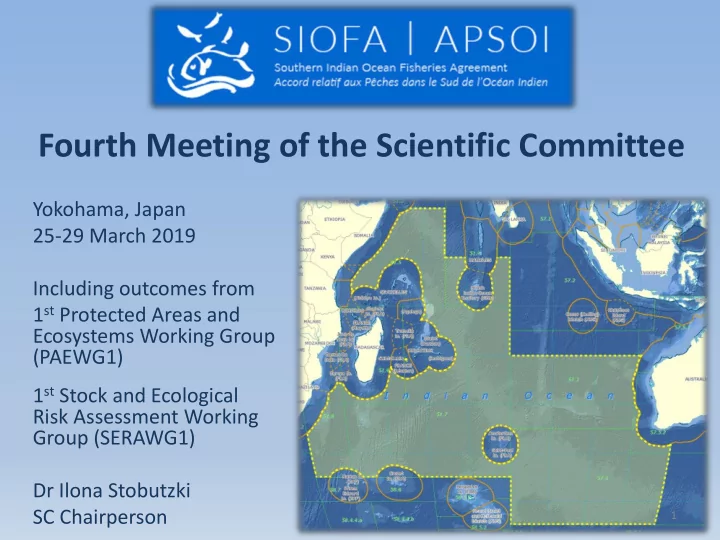
Yokohama, Japan 25-29 March 2019 Including outcomes from 1st Protected Areas and Ecosystems Working Group (PAEWG1) 1st Stock and Ecological Risk Assessment Working Group (SERAWG1) Dr Ilona Stobutzki SC Chairperson

1

slide-2
SLIDE 2

Outline

  • 1. Overview of SIOFA fisheries
  • 2. Historical catch and effort data
  • 3. Scientific data standards
  • 4. Vulnerable marine ecosystems (VMEs)
  • 5. Stock assessment and ecological risk assessment
  • 6. Impacts of fishing on associated and dependent species
  • 7. Review and development of CCMs
  • 8. Cooperation
  • 9. SC work plan and research activity budget

(SC4 Report paragraph number)

Recommendation Request

2

slide-3
SLIDE 3
  • 1. Overview of SIOFA fisheries

Number of vessels 2018 Number of vessels 2011-2018 Fishing effort 2012-2017 All vessels (reported) 7 7 - 77 Trawl (deepwater, midwater, shallow) 3 3 - 64 856 - 3,250 hrs [Australia, Japan, Korea] Bottom longline 2 2 - 25 2.3 million – 7.2 million hooks Pots/traps 1 0 - 2 10 – 50 traps Gillnet 0 - 1 0 – 5,442 km Light purse seine 0 - 8 0 – 10,000 hrs

Seychelles report 0 vessels 2012 – 17; Mauritius have not reported Comoros report 2 mother vessels for handlines

3

slide-4
SLIDE 4

Overview of SIOFA fisheries

Key species Gear Participants (reported 2000 to 2018) Patagonian toothfish Demersal longline, traps EU-Spain, France (Territories), Japan, Korea Orange roughy Demersal trawl Australia, Cook Islands, China Alfonsino Midwater trawl Australia, Cook Islands, Japan, Korea Sauries and scads Demersal trawl, traps Thailand Shallow-water (<200m) snappers, emperors and groupers Demersal longline, hook and line, demersal trawl, traps EU-France, Mauritius, Seychelles (?), Thailand Deep-water snappers, lutjanids, Hapuku Demersal longline, dropline Australia, EU, China Deepwater sharks – Portuguese dogfish Demersal gillnets, demersal longline EU-Spain Mackerel and Brama spp Purseseine with lights China Squid Jigs China (authorised since 2003 but no fishing)

4

slide-5
SLIDE 5

Catches do not include non-contracting parties

Overview of SIOFA fisheries

Reported annual catch (tonnes) – All species

5

slide-6
SLIDE 6

SC requests (50) CCPs use draft Annual National Report template (Annex D) SC recommends (50) MoP consider whether, if a CCP has not fished in the previous calendar year and there have been no substantive changes to their fisheries-related activities, they can provide a simple statement of this fact, rather than having to submit a full National report

Overview of SIOFA fisheries

Questions?

6

slide-7
SLIDE 7

SC3 requested Data Manager prepare annual data holdings report CMM 2018/02 Data Standards, para 10: CCPs shall provide by 31 Jan 2018, historical catch, effort data and, if available observer data from 2000 to 2015 and any previous years where available CMM 2018/01 Interim Bottom Fishing, para 13: CCPs, prior to 2018 SC, shall submit spatial extent of its historical fishing bottom effort at least 20 minutes resolution, or if available, a finer scale Inputs to:

  • stock assessments
  • ecological risk assessments
  • bottom fishing footprint
  • SIOFA BFIA
  • protect area consideration
  • 2. Historical catch and effort data

7

slide-8
SLIDE 8

Annex E Status of submissions and spatial resolution

Historical catch and effort data

Some CPs submitted historical effort data at a coarser scale where in some cases they collected data at a finer spatial scale SC welcomed CPs’ intention to submit at the highest spatial scale

8

slide-9
SLIDE 9

Historical catch and effort data

CMM 2018/01 Interim Bottom Fishing, para 7: by 2020, SC to provide advice on an appropriate SIOFA bottom fishing footprint and SIOFA BFIA SC requested (59-62) Secretariat prepare maps of the spatial distribution of effort (2000-15) to be considered by the PAEWG intersessionally

  • longline, trawl and other gears separately

Questions?

9

slide-10
SLIDE 10
  • 3. Scientific data standards

SIOFA database

  • Database Manager implemented protocols for secure transfer
  • f confidential data
  • SC requested (71) Database Manager resolve species coding

issues before SC5

  • Templates for data submission (finalised May 2019)
  • SC requested (71) Secretariat continue to refine and consolidate

the annual data holdings report and data inventory. This would capture data challenges and assist SC to understand data gaps.

10

slide-11
SLIDE 11

Scientific data standards - Observer coverage

CMM 2018/01 Data Standards, para 32: consistent with CMM 2018/02 Data Standards, para 13, directs SC to review observer coverage levels (para 31) by 2018 SC3 advised MoP that the SC cannot review the appropriateness of current observer coverage levels, as there is little observer coverage data being provided at this point in time and the question

  • f the appropriateness of coverage levels is dependent on the

specific scientific needs and uses for these data. SC3 requested an inventory of observer data held by CPs, noting resourcing would be required.

11

slide-12
SLIDE 12

Scientific data standards - Observer coverage

SC (83-86): Agreed for non-trawl fisheries there are situations where higher levels of observer coverage should be considered, such as potential interactions with rare and/or species of concern and high risk areas. Noted in SIOFA where fisheries were often data limited, high levels of observer coverage could facilitate more comprehensive data collection to inform science and management Agreed coverages needs to represent the spatial and temporal scope of fisheries, agreed to consider at SC5 Requested SERAWG and PAEWG continue to consider the levels of coverage needed to provide advice to MoP

12

slide-13
SLIDE 13

Thailand noted electronic observer coverage and intention to submit a proposal for SC5 to evaluate its use for scientific data collection, in line with Guidelines (adopted MoP4) and requested resources to support. CMM 2018/02 Interim Bottom Fishing, para 14: SC to review Annex B (Observer data) by 2020 SC requested (89) Secretariat compile an inventory of submitted

  • bserver data by CP (as requested in SC3 Report, para 90) prior to

SC5

Scientific data standards - Observer data

13

slide-14
SLIDE 14

Spatial resolution for the collection and reporting of data CMM2018/02 Data Standards, para 5: SC to review and provide advice on an appropriate spatial resolution for the collection and reporting of data to facilitate effective stock assessment by 2019 SC recommends (91), that with respect to stock assessment data needs, the collection and reporting of data should be done at the finest spatial scale as possible, preferably at the level of each fishing

  • peration with latitude and longitude location information.

Scientific data standards Questions?

14

slide-15
SLIDE 15
  • 5. Vulnerable marine ecosystems (VMEs)

PAEWG1 Chaired by France (Territories) Collaboration with FAO Deep Sea Project to provide multi-regional perspective

15

slide-16
SLIDE 16

Vulnerable marine ecosystems (VMEs)

CMM 2018/01 Interim Bottom Fishing, para 3: VME means a marine ecosystem identified using the criteria outlined in paragraph 42 of the FAO International Guidelines for the Management of Deep-Sea Fisheries in the High Seas CMM 2018/01 Interim Bottom Fishing, para 6: criteria for what constitutes evidence of an encounter with a VME, in particular threshold levels and indicator species by 2019 VME indicator species SC considered PAEWG1 recommendation to adopt VME indicator taxa list adapted from CCAMLR VME taxa classification guide 2009, based on a review of relevance to SIOFA

16

slide-17
SLIDE 17

Vulnerable marine ecosystems (VMEs)

Indicator species

SC recommends (104) MoP adopt the VME indicator taxa list (Annex J)

17

Chemosynthetic organisms (CXV) (no taxa specified) Cnidaria (CNI), which can be, if possible, detailed in recording as: Gorgonacea (GGW) (Order), Anthoathecatae (AZN) (Order), Stylasteridae (AXT) (Family), Scleractinia (CSS) (Order), Antipatharia (AQZ) (Order), Zoantharia (ZOT) (Order), Actiniaria (ATX) (Order), Alcyonacea (AJZ) (Order), Pennatulacea (NTW) (Order) Porifera (PFR), which can be, if possible, detailed in recording as: Hexactinellida (HXY) (Class), Demospongiae (DMO) (Class) Ascidiacea (SSX) (Class) Bryozoans (BZN) (Phylum) Brachiopoda (BRQ) (Phylum) Pterobranchia (HET) Serpulidae (SZS) (Family) Xenophyophora (XEF) (Phylum) Bathylasmatidae (BWY) (Family) Stalked crinoids (CWD) (Class) Euryalida (OEQ) (Order) Cidaroida (CVD) (Order)

Requests (104) Secretariat develops a pictorial VME Indicator taxa guide based

  • n that used by CCAMLR,

to assist observers and fishers Notes (104) Thailand’s request for capacity building on identification

  • f VME indicator taxa
slide-18
SLIDE 18

Most longline fleets use CCAMLR threshold levels SC agreed (107) on the appropriateness of the CCAMLR threshold used to trigger closure of a ‘VME risk area’ in CCAMLR SC recommends (111) setting the catch/recovery of 10 or more VME-indicator units in a single line segment as the threshold that triggers the encounter protocol for longline fishing. ‘VME-indicator unit’ means either one litre of those VME indicator organisms that can be placed in a 10-litre container, or one kilogram of those VME indicator

  • rganisms that do not fit into a 10-litre container.

‘Line segment’ means a 1000-hook section of line or a 1 200m section of line, whichever is shorter.

18

Vulnerable marine ecosystems (VMEs)

Evidence of an VME encounters, threshold levels

slide-19
SLIDE 19

Trawl gears SC noted (111) CCPs currently use different thresholds and some CPs expressed concern that some of these thresholds may not be sufficiently precautionary SC could not reach consensus on consistent thresholds for trawl gears SC requests (112) parties work intersessionally to identify a suitable threshold for trawl gears, including:

  • reviewing methods used by CPs to establish existing

thresholds

  • development of a consistent threshold based on

consolidated records of benthic bycatch

19

Vulnerable marine ecosystems (VMEs)

Evidence of an VME encounters, threshold levels

slide-20
SLIDE 20

CMM 2018/01 Interim Bottom Fishing, para 12: Until MoP has acted on SC’s advice on the most appropriate response to a VME encounter pursuant to paragraph 6(c), CCPs shall require any vessel flying their flag to cease bottom fishing activities within…[gear specific]

SC recommends (112)

  • If VME encounter threshold is triggered, this should be considered

evidence of the potential presence of VME. To avoid SAI, an appropriately-sized area should be closed to fishing by all fishing gears and a review by the SC undertaken, to determine, based on the best available science, whether or not there is a VME. Review should consider cumulative impacts using all available data.

  • SC periodically review all benthic bycatch data to inform its

consideration of the location of potential VMEs, and potential impacts thereon.

20

Vulnerable marine ecosystems (VMEs)

Appropriate response to VME encounters

Questions?

slide-21
SLIDE 21

CMM 2018/01 Interim Bottom Fishing, para 5: tasks SC develop maps of where VMEs are known to occur, or likely to occur, by 2017

21

Vulnerable marine ecosystems (VMEs)

Mapping

slide-22
SLIDE 22

SC (101): Recommends attempts are made to model habitat suitability to investigate their use in providing maps of VME habitat; Noted VME indicator taxa list (Annex J) could be used in conjunction with information on physico-chemical and geological features (such as vents and cold water seeps) to inform protection of potential VMEs Recommends reviewing the locations of hydrothermal vents, seamounts and other VME elements and id areas where VMEs are ‘likely to occur’ Recommends that, for consistent estimation of VME taxa quantity, CPs consider recording by weight only and provide guidance to

  • bservers on how to convert volume to weight.

22

Vulnerable marine ecosystems (VMEs)

Mapping

slide-23
SLIDE 23

SC developed a work plan to be done by SC5 Annex I provides details on:

  • Data types
  • Data sources
  • Data verification
  • Modelling
  • PAEWG Meetings (x2)
  • Timeline

23

Vulnerable marine ecosystems (VMEs)

Mapping

Questions?

slide-24
SLIDE 24

2017 SC2 recommended Standard protocol for future protected areas designation, noting it contained draft criteria that should be reviewed after SC considered the first proposed protected area. MoP4 adopted Standard protocol and requested SC consider that there are various management measures possible 2018 SC3 reviewed and refined the Standard protocol criteria and ‘tested’ against proposals. SC3 requested MoP define the objectives to be included. SC3 recommends to the MoP that it adopts the revised Standard protocol. MoP5 adopted the Standard protocol as an interim protocol. Requested the SC review the interim protocol and in particular, clarify use of the criteria and provide in particular a ranking and key for using these criteria in view to developing appropriate management plans/measures.

Standard protocol for future protected area designation

24

slide-25
SLIDE 25

SC reviewed and revised the SIOFA Standard Protocol for Future Protected Areas Designation (Annex L). SC agreed (115) that the criteria in the protocol have no particular ranking of importance SC recommends (116) that he MoP adopt the revised protocol (Annex L) Change:

  • Para 8, Best available information should be used to support

proposals…

  • b. Data derived from international reference databases…

Standard protocol for future protected area designation

25

Questions?

slide-26
SLIDE 26

CMM 2018/02 Interim Bottom Fishing, Annex 2 Para 6: advice and recommendations on research and management plans for areas

Protected areas

26

slide-27
SLIDE 27

Atlantis Bank and Fools Flat protected areas SC recommends (118 & 120) MoP consider that fishing with all gears were identified as activities that degrade the biodiversity value of the area, noting that different gears typically have different levels of impact. SC noted that fishing using trawl gears in not currently permitted in the area and a closure to trawl fishing has been observed by Australian and Cook Island vessels since 2006. Information on the use of non-trawl gears in this area is lacking. Coral and Walters Shoal protected areas SC recommends (119 & 122) MoP consider that fishing with all gears were identified as activities that degrade the scientific and biodiversity value of the area, noting that different gears typically have different levels of impact. SC noted that fishing using trawl gears in not currently permitted in the area and a closure to trawl fishing has been observed by Australian and Cook Island vessels since 2006. Information on the use of non-trawl gears in this area is lacking.

Protected areas

27

slide-28
SLIDE 28

Middle of What protected areas, SC noted fishing using trawl gears in not currently permitted in the area and a closure to trawl fishing has been

  • bserved by Australian and Cook Island vessels since 2006. Information on

the use of non-trawl gears in this area is lacking.

Protected areas

28

slide-29
SLIDE 29

Research and management plans for the five areas SC recalled from Interim Protocol: If the proposal documents the necessary data and scientific information to support a protected area using protocol, different measures could be applied, such as management measures, technical measures, closures. In case of an area becoming protected, a management and research plan shall be associated to it on the year to come: It will include:

  • The measures in place in the protected area;
  • The time of review of the protected area;
  • If needed, the research that should be undertaken in the
  • area. To this end, parties should consider to ask for

international funds.

Protected areas

29

slide-30
SLIDE 30

Research and management plans for the five areas: SC (123) Recommends any fishing-related or research activity planned requires a research plan for review by the PAEWG and SC, that specifies: 1. How the activity furthers the objectives of the protected area, 2. An assessment of impacts, and 3. Proposed measures to prevent or minimise those impacts. Recommends ‘non-destructive’ monitoring in the form of scientific research (eg camera-based systems) should be required within protected areas and PAEWG-01-14 could be a useful guide for informing monitoring and scientific research within areas. ‘Non-destructive’ is defined as research that does not cause SAI on VMEs but may include the collection of minimal benthos Recommends MoP adopt the research and management plans for the five areas (Annexes M-Q).

Protected areas

30

Questions?

slide-31
SLIDE 31

CMM 2018/01 Interim Bottom Fishing, para 14: any CCP that authorise or seek to authorise vessels to bottom fish, shall, at least 30 days prior to SC 2018, submit a Bottom Fishing Impact Assessment (BFIA) Para 15: the SC shall consider all BFIAs at 2018, or at the next

  • rdinary meeting and provide advice to MoP

BFIA were submitted in 2018 by Japan, Cook Islands, Thailand, Australia, EU (EU-Spain and EU-France) and France (Territories) In 2019, Comoros submitted BFIA for the proposed registration of their flotilla. The SC acknowledged the work by Comoros and update the Gap Analysis of BFIAs against the BFIA standards (Annex R) and the Summary of BFIAs presented, completed by the CCPs.

Bottom Fishing Impact Assessments (BFIA)

31

slide-32
SLIDE 32

CMM 2018/01 Interim Bottom Fishing, para 15: the SC shall consider all BFIAs and provide advice as to the likely cumulative impacts of bottom fishing impact activity from CCP vessels SC discussed potential research to assess the cumulative impact of trawl gears and longline gears. The SC requested the PAEWG identify the tasks and resource needs for their work plan (Annex T) and present to SC5:

  • 1. Collation of historical spatial data
  • 2. Review and agree methods for estimating spatial foot

print and cumulative impacts

  • 3. Implement agreed methods (resourcing required)
  • 4. Finalise report and provide cumulative BFIA in accordance

with SIOFA BFIA Standard

32

Bottom Fishing Impact Assessments (BFIA)

slide-33
SLIDE 33

CMM 2018/01 Interim Bottom Fishing, para 15: the SC shall consider all BFIAs and provide advice as to the likely cumulative impacts of bottom fishing impact activity from CCP vessels SC reaffirmed that, in accordance with CMM 2018/01 Interim Bottom Fishing, para 18e, a BFIA shall be updated when a substantial change in the fishery has occurred.

Questions?

33

Bottom Fishing Impact Assessments (BFIA)

slide-34
SLIDE 34
  • 5. Stock assessment and ecological risk assessment

2018 agreed to combine the Stock Assessment Working Group and the Ecological Risk Assessment Working Group to create Stock and Ecological Risk Assessment Working Group (SEAWG1) co-chaired by Japan and Australia

34

slide-35
SLIDE 35

Stock assessment and ERA

CMM 2018/01 Interim Bottom Fishing, para 6: SC by 2019, provide advice and recommendations to MoP on the status of principal deep-sea fishery resources targeted, and to the extent possible, taken as bycatch and caught incidentally in these deep-sea fisheries, including straddling fishery resources: SIOFA Tiered Stock Assessment framework to prioritise stocks for status assessment. SC acknowledged the preliminary work done to categorise SIOFA species within the framework. SC agreed (132) to continue and support the work to use ERA to categorise species into appropriate tiers

35

slide-36
SLIDE 36

Issues to resolve before integrated assessment

  • Potential biomass indicators:

Acoustic data, collected but most not analysed or reviewed CPUE, concerns about robustness due to aggregating nature of the species and fishery operations

Stock assessment – Alfonsino

36

1000 2000 3000 4000 5000 6000 7000 8000 2007 2008 2009 2010 2011 2012 2013 2014 2015 2016 2017

Alfonsino catch (t)

  • Data at fine scale

from all CCPs

  • Age – length keys for

fleets/areas

slide-37
SLIDE 37

To progress stock assessment by 2020 SC5, SC (135):

  • Agreed selection of stock assessment model be based on data availability
  • Requested Cook Islands provide inventory of acoustic survey data
  • Agreed acoustic survey inventory be considered to inform whether to

proceed with expert review of the usefulness of acoustic data

  • Agreed that if such data were useful, an acoustics expert should be

engaged to investigate whether these data could be used to inform abundance indices for a stock assessment

  • Noted Japan developing age-length keys for its fishery and recommends

ageing and analysing 100-150 otoliths per year per area for three areas (Walter’s Shoal, South Indian Ridge, 90 degrees east)

  • Agreed to the SERAWG proposed work plan (Annex V)
  • Agreed to develop a potential acoustics survey protocol after review of

previous survey data.

Stock assessment – Alfonsino

37

slide-38
SLIDE 38

Since SC4, SERAWG has:

  • Considered Cook Islands inventory of acoustic survey data:
  • Spatial and temporal coverage poor but can potentially be used,

as per Orange Roughy assessments

  • Use of acoustic survey data would require specialist expertise

and resourcing, not currently available Next steps:

  • Fine-scale data submission (catch, effort etc)
  • CPUE data - propose stock assessment consultant examines data

and standardisation approach

  • Decide stock assessment approach depending on CPUE data

evaluation

  • Ageing of otoliths for age-length key

Stock assessment – Alfonsino

38

Questions?

slide-39
SLIDE 39

Scoping study completed and assistance and cooperation provided by CCAMLR acknowledged SC considered advice provided by SERAWG Focus on areas adjacent to CCAMLR in SIOFA Area 7 (William’s Ridge) and SIOFA Area 3b (Del Carno Rise)

Stock assessment – Patagonian toothfish

39

20 40 60 80 100 120 140 160 180 200 2007 2008 2009 2010 2011 2012 2013 2014 2015 2016 2017

Patagonian toothfish catch (t)

slide-40
SLIDE 40

CCAMLR Division 58.5.1 and French EEZ around Kerguelen Island CCAMLR Division 58.5.2 and Australian EEZ around Heard Island and McDonald Islands (HIMI)

Stock assessment - Patagonian toothfish Northern Kerguelen Plateau

40

‘William’s Ridge’ – William’s Seamount, Drygalski Ridge, Chun Spur and surrounding features extending into SIOFA Statistical Area 7

slide-41
SLIDE 41

SC noted (140):

  • Large catches taken on William’s Ridge in 2018 by one fishing
  • vessel. In 2019, there has been further fishing by a second fishing

vessel

  • First time fishing has occurred in this area since early 2000

SC agreed (141):

  • Based on genetic information, catch composition and tag-

recapture from the French and Australian toothfish fisheries, toothfish on the northern plateau are continuously distributed and populations are linked;

  • Population linkages between AUS and French EEZ are accounted

for in the CCAMLR assessments as well as the estimation of catch limits in the AUS EEZ, and yield fully taken within CCAMLR waters

Stock assessment - Patagonian toothfish Northern Kerguelen Plateau

41

slide-42
SLIDE 42

SC agreed (142):

  • Fish population is well studied, with a large amount of fishery-

dependent and independent data available

  • CCAMLR stock assessments are subject to a rigorous review

process

  • Movement of 5 toothfish, released in the AUS or French EEZ and

recaptured on William’s Ridge in 2018, is consistent with the

  • bserved movement patterns across the Plateau
  • Given continuous toothfish habitat across the northern Plateau,

the proximity of William’s Ridge to the AUS EEZ, and the known movement patterns, toothfish on William’s Ridge are part of the same population as those in the AUS EEZ

Stock assessment - Patagonian toothfish Northern Kerguelen Plateau

42

slide-43
SLIDE 43

SC agreed (141):

  • Toothfish catches on the SIOFA part of William’s Ridge are likely to

result in total fishing mortality exceeding the fishing mortality used by CCAMLR to determine the catch limit and may undermine the CCAMLR management objectives for this population

  • Given the large catches taken on William’s Ridge over a short

period, there is also a high risk of localised depletion in this relatively small area

  • There is potential for further unrestricted toothfish catches to be

taken on Williams Ridge, without any management measure on catch limits

  • Any additional catches in excess of the already established catch

limit for this population should be avoided

Stock assessment - Patagonian toothfish Northern Kerguelen Plateau

43

slide-44
SLIDE 44

SC agreed (141):

  • To help ensure the long-term sustainability of this toothfish

population, data from fishing activities in the CCAMLR and SIOFA areas should be incorporated into the stock assessment model, and SIOFA should collaborate with CCAMLR as outlined in the MoU between the two organisations in exchanging data and scientific information and cooperating with each other’s conservation and management measures

Stock assessment - Patagonian toothfish Northern Kerguelen Plateau

44

slide-45
SLIDE 45

SC recommends (143) that the MoP urgently considers adopting temporary measures to regulate toothfish fishing on William’s Ridge at levels commensurate with fishing activities reported in 2016 SC requested (144) that the EU provide their fishing data from 2018 and 2019 to Australia so these data can be included in the stock assessment for this population undertaken in 2019.

Stock assessment - Patagonian toothfish Northern Kerguelen Plateau

45

slide-46
SLIDE 46

Stock assessment - Patagonian toothfish Del Cano Rise

46

slide-47
SLIDE 47

SC noted (145):

  • Toothfish catch in the SIOFA part of Del Cano Rise increased

dramatically from 2016 to 2018

  • Del Cano Rise is spread over SIOFA, CCAMLR waters, French EEZ of

Crozet and South African EEZ of Marion and Prince Edward Islands. Most of the catches in the SIOFA area are taken adjacent to the CCAMLR area and French EEZ. SC agreed (146):

  • Based on tag-recapture from the French toothfish fisheries and

biological knowledge of the reproduction, toothfish populations of the Del Cano Rise and the Crozet plateau are linked

  • 5 toothfish released in the French EEZ (2 around Crozet Island, 3

around Kerguelen Islands) were recaptured on SIOFA part of the Rise which is consistent with movement patterns in the region

Stock assessment - Patagonian toothfish Del Cano Rise

47

slide-48
SLIDE 48

SC agreed (146):

  • Toothfish show size and sex specific habitat preference. In

particular, the juvenile phase relies on shallow waters (<6000m) while large adult, mostly female, are distributed in deep-sea habitats (1200m – 2300m+). As there is only deep area in the Del Cano Rise, and based on the oceanography of the area (West to East), the population of the Rise is likely to rely on Crozet and Marion-Prince Edwards plateau for its juvenile phase.

  • CCAMLR assessment estimates the catch limits for the toothfish

population in French EEZ of Crozet-Del Cano, and the yield is fully taken within CCAMLR waters.

  • This CCAMLR stock assessment is subject to a rigorous review

process

Stock assessment - Patagonian toothfish Del Cano Rise

48

slide-49
SLIDE 49

SC agreed (146):

  • Toothfish catches from the Del Cano Rise in SIOFA are likely to

result in catch limits being exceeded for the Crozet-Del Cano toothfish population, which may undermine the CCAML management objectives for this population

  • Catches from the Del Cano Rise in SIOFA are also likely to impact

the recruitment of the population of Crozet-Del Cano. Since there are no observations of recruitment at Crozet through, for example, a trawl survey, any impact on recruitment would only be observed with a large delay which may put the sustainability of the population of Crozet-Del Cano at risk.

Stock assessment - Patagonian toothfish Del Cano Rise

49

slide-50
SLIDE 50

SC agreed (146):

  • To help ensure the long-term sustainability of this toothfish

population, data from fishing activities in the CCAMLR and SIOFA areas should be incorporated into the stock assessment model, and SIOFA should collaborate with CCAMLR as outlined in the MoU between the two organisations in exchanging data and scientific information and cooperating with each other’s conservation and management measures SC recommends (147) that the MoP urgently considers adopting temporary measures to regulate toothfish fishing on the Del Cano Rise in the SIOFA area at levels commensurate with fishing activities reported up to 2016.

Stock assessment - Patagonian toothfish Del Cano Rise

50

Questions?

slide-51
SLIDE 51

SC recalled SC3 advice to MoP (SC3 Report, para 234), in particular:

  • All three assessment approaches indicated that ss17 for the 7

sub-regions assessed was likely to be above 50%SSB0

  • The median estimates for the Walter’s Shoal Region from the

base model and 8 sensitivities evaluated varied between 63%SSB0 and 85%SSB0. The median estimate of the Base model was 76%SSB0

Stock assessment – Orange roughy

51

500 1000 1500 2000 2500 3000 2007 2008 2009 2010 2011 2012 2013 2014 2015 2016 2017

Orange Roughy catch (t)

slide-52
SLIDE 52

Stock assessment – Orange roughy

52

SC noted (151) 2018 stock assessment for Walters Shoal Region provided deterministic estimates of BMSY, assuming a Beverton and Holt stock recruitment relationship, a combination of assumed steepness and natural mortality, and maturity parameters. BMSY estimate using the base model parameters was 23.6%B0 (Assuming a 50% age-at-maturity of 37 years and 12 years to reach 95% after 50%) SC noted (152) stock assessment report advice (SC-03-07.1.1(04)) that Deterministic BMSY has not been found to be a useful reference point for NZ orange roughy stocks. It is highly dependent on the stock recruitment relationship and is therefore very uncertain SC agreed (153) that deterministic estimates of BMSY were highly uncertain and therefore not suitable to be used as a reference point for management advice for this stock.

Questions?

slide-53
SLIDE 53

SC considered an updated ERA for 174 species of deepwater chondrichthyans (157 & 158):

  • Noted missing data for certain gears in certain years, which may

result in underestimating the vulnerability of certain

  • Noted results should be considered in the context of annual

levels of catch by gear type and SC reviewed annual catch in a closed session

  • Noted most of the catch is taken by demersal longline, this

replaced a demersal gillnet fishery since 2015 and most taken by

  • ne CP

ERA – Deepwater chondrichthyans

53

slide-54
SLIDE 54

SC noted (159) ‘key species of concern’ in the longline fishery include:

  • Portuguese dogfish (Centroscymnu coelolepis – SAFE risk low)
  • Gulper shark (Centrophorus granulosus – SAFE risk extreme)
  • Brier shark (Deania calcea – SAFE risk extreme)
  • Black shark (Dalatias licha – SAFE risk extreme)
  • Velvet shark (Zameus squamulosus – SAFE risk extreme)
  • Plunket’s dogfish (Scymnodon plunketi – SAFE risk extreme)
  • Golden dogfish (Centroselachus crepidater – SAFE risk extreme)

Three newly described species also at SAFE high risk in longline assessment: Chimaera willwatchi, C. buccanigella and C. didierae SC noted (160) that as well as a number of species assessed to be at high or extreme vulnerability for all gears, most species were assessed to be at the lower end of the vulnerability spectrum

ERA – Deepwater chondrichthyans

54

slide-55
SLIDE 55

SC noted annual catch information was available to inform consideration

  • f ERA results, for:
  • Portuguese dogfish (Centroscymnu coelolepis – SAFE risk low)
  • Gulper shark (Centrophorus granulosus – SAFE risk extreme)
  • Brier shark (Deania calcea – SAFE risk extreme)
  • Black shark (Dalatias licha – SAFE risk extreme)

And Etmopterus granulosus – SAFE risk low

ERA – Deepwater chondrichthyans

55

  • 200,000

400,000 600,000 800,000 1,000,000 1,200,000 1,400,000 1,600,000 1,800,000 2,000,000 2013 2014 2015 2016 2017

DWS catch (Kg) 2013-2017

Centrophorus granulosus Centroscymnus coelolepis Dalatias licha Deania calcea Etmopterus granulosus Other

SC noted (162) for 2013 –16 annual catch indicate these are from targeted fishing for Portuguese dogfish in longline and gillnet
slide-56
SLIDE 56

SC noted additional analysis of the spatial and depth distribution

  • f catches of the main target species and species of concern in the

longline fishery would be useful so that catch rate and trend information could be considered in the context of the ERA In summary, the SC (164):

  • Agreed there is limited catch, effort and biological information

for many species

  • Agreed the ERA analyses have identified a number of species at

high or extreme relative vulnerability to fishing using demersal trawl, demersal longline and demersal gillnet

ERA – Deepwater chondrichthyans

56

slide-57
SLIDE 57

In summary, the SC (164):

  • Noted that based on the ERA results and understanding of

vulnerability to fishing, four ‘key species of concern’ for which catch data are available (Portuguese dogfish, Gulper shark, Brier shark and Black shark ) are caught in relatively high volumes

  • Recommends the collection and submission of more detailed
  • bserver data (eg. Improved species identification, biological

samples to enable genetic research..) for species of concern (e.g. those at high or extreme vulnerability to fishing using certain gears) and all other data in accordance with CMM 2018/02 Data Standards

  • Requests the MoP urgently consider measures to mitigate the

potential for overexploitation of ‘key species of concern’ that has been seen in similar fisheries globally.

ERA – Deepwater chondrichthyans

57

Questions?

slide-58
SLIDE 58

Mauritius and MRAG conducted assessments of some Saya de Malha Bank fisheries – SC requested (165) Secretariat follow up with MRAG

Saya de Malha Bank Fisheries & Other teleosts Questions?

58

SC recommends (166) various longline fisheries be treated separately in future ERAs Preliminary ERA has been undertaken for SIOFA teleosts but currently cannot be used for management advice SC requests (172) further work to improve the analysis and included resourcing in the workplan (Annex W)

Thailand reported catch (tonnes)

slide-59
SLIDE 59

MoP5 para 52-53, requested SC provide advice on candidate target (TRP) and limit reference points (LRP) for orange roughy, alfonsino and toothfish and develop a framework and work plan for the establishment of harvest strategies for key SIOFA stocks SC agreed (174):

  • Scientific work was required to inform SC advice on TRps and LRPs. SC

requests the SERAWG form a group of key interested parties to work intersessionally with a consultant to draft a technical working paper for submission to next SERAWG

  • To develop a generic approach for dterimining reference points for

current and future stocks

  • That candidate reference points should take into account the level of

data uncertainty in stocks, noting the data-limited nature of some fisheries/stocks

  • That for straddling stocks consistent reference points should be

applied across the stock.

Harvest strategies

59

slide-60
SLIDE 60

SC recommends (175) that MoP consider including six elements when developing harvest strategies, and the SC begin work to populate those elements: (i) Operational objectives (ii) Reference points (iii) An acceptable level of risk of breaching reference points (iv) Monitoring strategy (v) Decision rules for achieving reference points (vi) Process for evaluating harvest strategies SC agreed (176) to a work plan (Annex X) that includes scientists – fishery managers – stakeholders dialogues to discuss key concepts

Harvest strategies

60

Questions?

slide-61
SLIDE 61

Discussed the potential risk of seabird bycatch, especially in areas adjacent t CCAMLR areas, where seabird bycatch has been assessed at high or extreme risk. SC: Noted (218) some CPs have mandatory bycatch mitigation measures in place Requested (219) Secretariat summarise data on bycatch for next SC Agreed (220) there was a need to understand the risk of bycatch across the SIOFA Area and to seek advice from other RFMOs, such as CCAMLR and IOTC, and ACAP

  • 6. Impacts of fishing on associated and

dependent species – Seabird bycatch

61

slide-62
SLIDE 62

SC recommends (221) MoP consider bycatch mitigation measures for areas of high risk as identified by other RFMOs whose areas of competence are adjacent to or overlap with SIOFA. Measures successfully used in CCAMLR longline fisheries include:

  • Streamer lines during setting
  • Weight integrated lines only to increase sink speed
  • White line only to increase visibility
  • Brickle curtain in place during hauling
  • Setting only at night between nautical twilights
  • Limitation of light emitted by the ship during operations
  • Discards forbidden during setting and hauling
  • Closure of fishing season during periods of high risk

Impacts of fishing on associated and dependent species – Seabird bycatch

62

Questions?

slide-63
SLIDE 63

SC3 considered and discussed 2018 proposal and recommended a revised draft take into account guidance and requests, SC3 report, para 289 Information paper with updated proposal SC encouraged (199) CPs to continue to hold intersessional discussions and further refine the proposal to reflect the advice of SC3 and encouraged submission of a working paper to SC5 for more substantive discussion

  • 7. Review and development of CMMs

Draft CMM on fishing research

63

slide-64
SLIDE 64

SC recognised increasing concern from whale depredation in the toothfish fishery, and importance of assessing the amount of fish lost, and incorporating into stock assessment. SC encouraged (201) CPs with longline fleets to collect whale depredation data if possible and encouraged CPs to submit working papers for establishment of formal data collection guidelines to SC5, when SC is scheduled to review Annex B (Observer data)

Review and development of CMMs CMM 2018/02 Data Standards

64

slide-65
SLIDE 65

Secretariat noted some areas would benefit from clarification SC acknowledged some paragraphs could be reviewed/rephrased to provide greater clarity, in particular para 2 c) SC agreed (204) that their interpretation was that it intended to facilitate the work of the SC and working groups, in particular para 2 e), while managing confidentiality SC suggested Secretariat could develop process guidelines for their implementation

Review and development of CMMs CMM 2016/03 Data Confidentiality

65

Questions?

slide-66
SLIDE 66
  • FAO ABNJ Deep Seas Project
  • Acknowledged the value of elements of the project and the

contribution to SC and CP activities

  • SC agreed (184) continued engagement in a future phase was

valuable given the proposed themes would contribute to key activities in the SC Research Plan (Annex G)

  • FAO SIOFA-FIRMS Potential partnership
  • Joining FIRMS should enable SIOFA to more effectively

disseminate SIOFA’s work as an RFMO to global stakeholders

  • SC discussed the resourcing implications, with the Secretariat

required to provide data submissions and potentially participate in meetings

  • SC recommends (189) MoP consider that the SC supported, in

principle joining FIRMS as a Partnership Arrangement, noting resourcing implications

  • 8. Cooperation with other RFMOs and

international bodies

66

slide-67
SLIDE 67
  • CCAMLR
  • Welcomed the Arrangement, particularly the potential efficiencies

encouraged by information and experience sharing between secretariats

  • SC agreed (193) an increased level of interaction was timely given

the increased interest in fishing for Patagonian toothfish in SIOFA in areas adjacent to CCAMLR fisheries with full assessments

Cooperation with other RFMOs and international bodies Questions?

67

slide-68
SLIDE 68

Long term research plan SC recommends (194) that the MOP adopt the updated plan to include the impacts of climate change as priority theme (Annex G)

  • Scientific data standards for the collection, reporting,

verification and exchange of data

  • Advice on vulnerable marine ecosystems
  • Current and historical status of fishing activities
  • Stock assessments
  • Advice on the impacts of fishing on associated and dependent

species

  • Climate change impacts on fishery resources and ecosystems
  • Any other advice that the MoP requests.

2018-21 Operational work plan Annex W updated 2018-21 work plan adopted

  • 9. SC Work plan

68

slide-69
SLIDE 69

SC recommends MoP consider research activities (Annex H) for inclusion in the SIOFA budget

SC Work plan - Budget

69

Questions?

slide-70
SLIDE 70

SIOFA SC Official contacts SC requests (207) MoP require CPs to include in the SIOFA Official Contacts List their SC representatives, identifying the SC HoD and an alternative SC Chairperson and Vice-Chairperson Dr Ilona Stobutzki was appointed as Chairperson and Dr Tsutomu Nishida was appointed as Vice-Chairperson for an additional 12 months SC noted that in line with the RoP these would be the final terms for these individuals in these roles.

70

slide-71
SLIDE 71

Th Thank you ank you

➢ Delegates from all CCPs ➢ Executive Secretary and Database Manager ➢ Chairs of PAEWG and SEAWG ➢ FAO and regional experts ➢ CCAMLR ➢ Researchers commissioned to undertake work ➢ CCPs that progressed papers and research ➢ Observers ➢ Fishers, scientists, data managers, fishery managers and teams who provided data, analyses and inputs ➢ Rapporteurs

71

slide-72
SLIDE 72

72