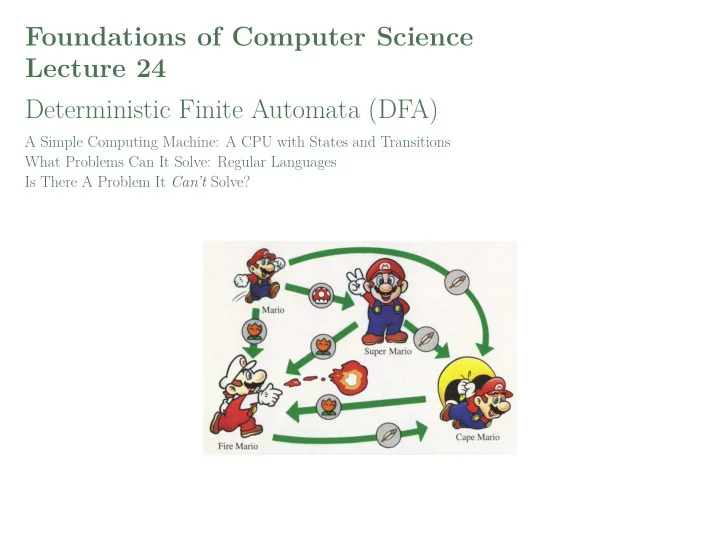
Foundations of Computer Science Lecture 24 Deterministic Finite - - PowerPoint PPT Presentation
Foundations of Computer Science Lecture 24 Deterministic Finite Automata (DFA) A Simple Computing Machine: A CPU with States and Transitions What Problems Can It Solve: Regular Languages Is There A Problem It Cant Solve? Computing Problems
Computing Problems and Their Difficulty
Decision Problem Computing Problem Decision Problem Computing Problem How hard is the problem?
?
How complex is L? How hard is it to test membership in L? How complex is L? How hard is it to test membership in L? Language L: yes-set of finite binary strings
A problem can be harder in two ways.
1 The problem needs more resources. For example, the problem can be solved with a
similar machine to ours, except with more states.
2 The problem needs a different kind of computing machine, with superior capabilities.
The first type of “harder” is the focus of a follow-on algorithms course. We focus on what can and can’t be solved on a particular kind of machine.
Creator: Malik Magdon-Ismail Deterministic Finite Automata (DFA): 2 / 15 Today →
Today: Deterministic Finite Automata (DFA)
1
A simple computing machine.
States. Transitions. No scratch paper.
2
What computing problems can this simple machine solve?
Vending machine.
3
Regular languages. Closed under all the set operations: union, intersection, complement, concatenation, Kleene-star.
4
Are there problems that cannot be solved?
Creator: Malik Magdon-Ismail Deterministic Finite Automata (DFA): 3 / 15 A Simple Computing Machine →
A Simple Computing Machine
q0 q7 q6 q5 q4 q3 q2 q1
yes
- r
no
1 1 1 1
q0 q1 q2 1 1 0,1 states → q0 no q1 yes q2 no transitions 1 : q0 0 q1 ← In state q0, if you read
0, transition to q1
2 : q0 1 q2 3 : q1 0 q1 4 : q1 1 q2 5 : q2 0 q2 6 : q2 1 q2
1: Process the input string (left-to-right) starting from the initial state q0. 2: Process one bit at a time, each time transitioning from the current state to the next state according to the transition instructions. 3: When done processing every bit, output yes if the final resting state of the DFA is a yes-state; otherwise output no .
Creator: Malik Magdon-Ismail Deterministic Finite Automata (DFA): 4 / 15 Running the Machine →
Running the Machine on an Input
0 1 0 q0 q1 q2 1 1 0,1 q0|⊲010 0 1 0 q0 q1 q2 1 1 0,1 q0|⊲010
M
→ q1|0⊲10
M is the name
- f our “Machine”
- 0 1 0
q0 q1 q2 1 1 0,1 q0|⊲010
M
→ q1|0⊲10
M
→ q2|01⊲0 0 1 0 q0 q1 q2 1 1 0,1 q0|⊲010
M
→ q1|0⊲10
M
→ q2|01⊲0
M
→ q2|010⊲ no, reject
Pop Quiz. Give computation trace for ε, 010, 000. What strings does the machine accept and say yes ? Pop Quiz. Determine yes or no if you can from partial traces. q0 |
? ⊲ 0000;
q1 |
? ⊲ 0000;
q2 |
? ⊲ 0000.
Creator: Malik Magdon-Ismail Deterministic Finite Automata (DFA): 5 / 15 Computing Problem Solved by a DFA →
Computing Problem Solved by a DFA
The computing problem solved by M is the language L(M) = {w | M(w) = yes}.
L(M) is the automaton’s yes-set. For our automaton M L(M) = {0, 00, 000, 0000, . . .} = {0•n | n > 0}.
1 For an automaton M, what is the computing problem L(M) solved by M? 2 For a computing problem L, what automaton M solves L, i.e., L(M) = L?
- Practice. Exercise 24.2 gives you lots of training in question 1.
Creator: Malik Magdon-Ismail Deterministic Finite Automata (DFA): 6 / 15 The Vending Machine →
The Vending Machine
Vending machine takes nickels and dimes and dispenses a soda when it has 25¢.
0¢ 5¢ 10¢ 15¢ 20¢
5¢ transition 5¢ transition plus dispense soda 10¢ transition 10¢ transition plus dispense soda
Input sequence: 10¢, 10¢, 5¢, 10¢, 10¢, 10¢.
0¢ 10¢ 20¢ 0¢ (+ soda) 10¢ 20¢ 5¢ (+ soda).
Creator: Malik Magdon-Ismail Deterministic Finite Automata (DFA): 7 / 15 DFA for a Finite Language →
DFA for a Finite Language
L = {10}.
q0 e q1 q2 1 0,1 1 0,1
0 means move to a rejecting error state and stay there 1 is partial success. Another 1 puts you into error since you want 0; 0 from q1 and you are ready to accept . . . unless . . . More bits arrive, in which case move to error.
- Practice. Try random strings other than 01 and make sure our DFA rejects them.
Creator: Malik Magdon-Ismail Deterministic Finite Automata (DFA): 8 / 15 DFAs for Infinite Languages →
DFAs for Infinite Languages
L1 = ∗0∗ = {strings with a 0} = {0, 00, 01, 10, 000, 001, 010, 011, 100, . . .} q0 q1 M1 1 0,1 L2 = ∗1
(wildcard ∗ = Σ∗)
= {strings ending in 1} = {1, 01, 11, 001, 011, 101, 111, . . .} s0 s1 M2 1 1
- Complement. Consider L1:
Must accept strings M1 rejects.
q0 q1 M 1 0,1
← flip yes and no-states.
Creator: Malik Magdon-Ismail Deterministic Finite Automata (DFA): 9 / 15 Two DFAs in One →
Two DFAs in One: Union and Intersection
L1 = ∗0∗ q0 q1 M1 1 0,1 L2 = ∗1
(wildcard ∗ = Σ∗)
s0 s1 M2 1 1
The Joint-DFA has product states {q0s0, q0s1, q1s0, q1s1}:
q0s0 q0s1 q1s0 q1s1 1 1 1 1
q0s0: M1 is in state q0 and M2 is in state s0. q0s1: M1 is in state q0 and M2 is in state s1. q1s0: M1 is in state q1 and M2 is in state s0. q1s1: M1 is in state q1 and M2 is in state s1.
Pop Quiz.
1
Run the joint and individual DFAs for ε, 0100, 11, 101. What are the final states of each DFA?
2
If you want to solve L1 ∪ L2, what should the accept states of the joint-DFA be?
3
If you want to solve L1 ∩ L2, what should the accept states of the joint-DFA be?
Creator: Malik Magdon-Ismail Deterministic Finite Automata (DFA): 10 / 15 Concatenation and Kleene Star →
Concatenation and Kleene Star
L1 = {1} (M1) q0 q1 e 1 0,1 0,1 L2 = {0} (M2) s0 s1 e 1 0,1 0,1
L1 •L2:
q0 q1s0 e1 s1 e2 1 0,1 1 0,1 0,1
L∗
1:
q0 q1 e 1 1 0,1
Creator: Malik Magdon-Ismail Deterministic Finite Automata (DFA): 11 / 15 The Power of DFAs →
The Power of DFAs: What can they Solve?
Finite languages.
(building blocks of regular expressions)
Complement, intersection, union.
(operations to form complex regular expressions)
Concatenation and Kleene-star (little more complicated, see text).
(operations to form complex regular expressions)
That’s what we need for regular expressions. DFAs solve languages (computing problems) expressed as regular expressions.
(That is why the languages solved by DFAs are called regular languages.)
Creator: Malik Magdon-Ismail Deterministic Finite Automata (DFA): 12 / 15 What Can’t DFAs Solve? →
Is There Anything DFAs Can’t Solve?
Pop Quiz. Give a DFA to solve {0}∗ •{1}∗ = {0•n1•k | n ≥ 0, k ≥ 0}.
What about “equality,”
L0n1n = {0•n1•n | n ≥ 0}.
- Theorem. There is no DFA that solves L0n1n
Proof.
- Contradiction. Suppose a DFA M with k states solves {0n1n}.
What happens to this DFA when you keep feeding it 0’s? q0 = state(0•0)
M
→ state(0•1)
M
→ state(0•2)
M
→ · · ·
M
→ state(0•k−1)
M
→ state(0•k) After k 0’s, k + 1 states visited. There must be a repetition (pigeonhole). state(0•i) = state(0•j) = q, i < j ≤ k. Consider the two input strings 0•i1•i ∈ L0n1n and 0•j1•i ∈ L0n1n. After M has processed the 0s in both strings, it is in state q, and the traces of the two computations are q | 0•i⊲1•i and q | 0•j⊲1•i. q |
? ⊲1•i
and q |
? ⊲1•i.
Same number of 1’s remain, from state q. Either both rejected or both accepted. FISHY!
Intuition: The DFA has no “memory” to remember n.
Creator: Malik Magdon-Ismail Deterministic Finite Automata (DFA): 13 / 15 Our First Computing Machine →
Our First Computing Machine
DFAs can be implemented using basic technology, so practical. Powerful (regular languages), but also limited.
Computing Model Rules to:
- 1. Construct machine;
- 2. Solve problems.
Analyze Model
- 1. Capabilities: what can be solved?
- 2. Limitations: what can’t be solved?
Do we need a new model?
DFAs fail at so simple a problem as equality. That’s not acceptable. We need a more powerful machine.
Creator: Malik Magdon-Ismail Deterministic Finite Automata (DFA): 14 / 15 Adding Memory →
Adding Memory
DFAs have no scratch paper. It’s hard to compute entirely in your head.
q0 q7 q6 q5 q4 q3 q2 q1
yes
- r
no
1 1 1 1 1
Stack Memory. Think of a file-clerk with a stack of papers. The clerk’s capabilities: see the top sheet; remove the top sheet (pop) push something new onto the top of the stack. no access to inner sheets without removing top. DFA with a stack is a pushdown automaton (PDA)
How does the stack help to solve {0•n1•n | n ≥ 0}?
1: When you read in each 0, write it to the stack. 2: For each 1, pop the stack. At the end if the stack is empty, accept.
The memory allows the automaton to “remember” n.
Creator: Malik Magdon-Ismail Deterministic Finite Automata (DFA): 15 / 15