Foundations of algebraic surgery ANDREW RANICKI (Edinburgh) - - PDF document

foundations of algebraic surgery
SMART_READER_LITE
LIVE PREVIEW

Foundations of algebraic surgery ANDREW RANICKI (Edinburgh) - - PDF document

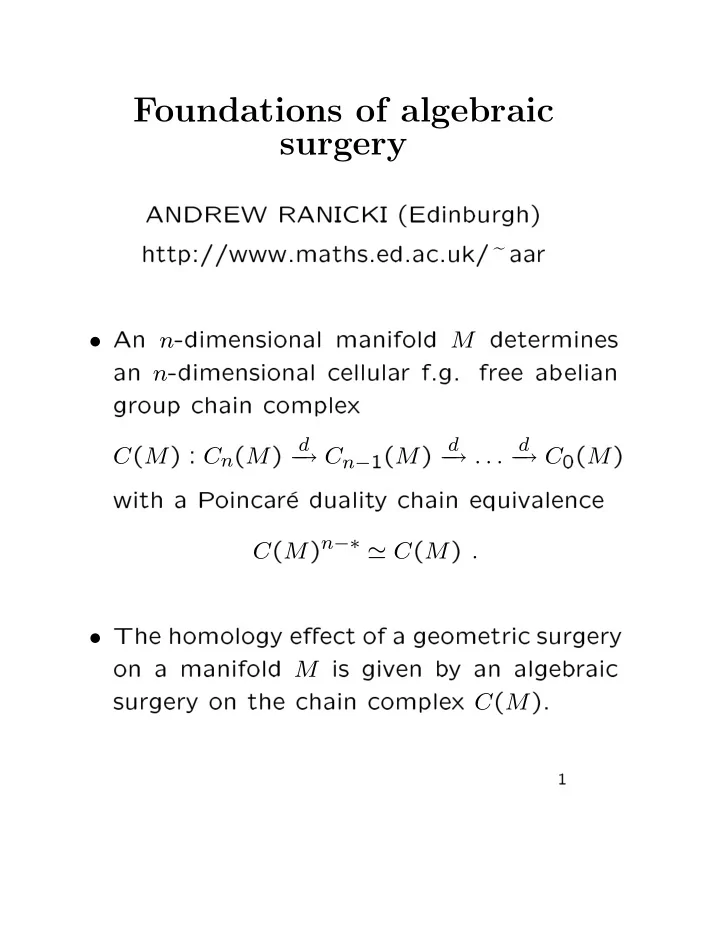
Foundations of algebraic surgery ANDREW RANICKI (Edinburgh) http://www.maths.ed.ac.uk/ aa r An n -dimensional manifold M determines an n -dimensional cellula r f.g. free ab elian group chain complex ) d ) d . . . d ( M


slide-1
SLIDE 1

Foundations of algebraic surgery

ANDREW RANICKI (Edinburgh) http://www.maths.ed.ac.uk/ aa r
  • An n-dimensional
manifold M determines an n-dimensional cellula r f.g. free ab elian group chain complex

C

(M ) : Cn (M ) d

− → Cn−

1 (M ) d

− → . . . d − → C

(M ) with a P
  • inca
r
  • e
dualit y chain equivalence

C

(M )n−∗ ≃ C (M ) .
  • The
homology eect
  • f
a geometric surgery
  • n
a manifold M is given b y an algeb raic surgery
  • n
the chain complex C (M ). 1
slide-2
SLIDE 2 The algeb raic surgery machine
  • The
algeb raic pa rt
  • f
the machine stud- ies chain complexes with P
  • inca
r
  • e
dualit y , which a re quadratic fo rms
  • n
chain com- plexes. Algeb raic surgery
  • n
such
  • bjects
mo dels the surgery
  • f
manifolds and no r- mal maps.
  • The
geometric pa rt reduces top
  • logical
surgery p roblems to algeb raic
  • nes.
  • F
  • r n-dimensional
no rmal maps with n ≥ 5 there is a
  • ne-one
co rresp
  • ndence
b et w een algeb raic and geometric surgery b elo w and in the middle dimensions. 2
slide-3
SLIDE 3 Symmetric and quadratic P
  • inca
r
  • e
dualit y
  • General
theo ry applies to chain complexes

C

  • ver
any ring with involution A. There a re t w
  • t
yp es
  • f
P
  • inca
r
  • e
dualit y Cn−∗ ≃ C , co rresp
  • nding
to t yp e I and t yp e I I sym- metric fo rms.
  • Use
symmetric P
  • inca
r
  • e
dualit y fo r surgery
  • n
manifolds. In general, cannot realize symmetric P
  • inca
r
  • e
surgeries
  • n
manifolds.
  • Use
quadratic P
  • inca
r
  • e
dualit y fo r surgery
  • n
no rmal maps.
  • Theo
rem The W all surgery
  • bstruction
group

Ln

(Z [π ]) is the cob
  • rdism
group
  • f n-dimensional
quadratic P
  • inca
r
  • e
complexes
  • ver Z
[π ]. 3
slide-4
SLIDE 4 Geometric surgery
  • The n-dimensional
manifold
  • btained
from an n-dimensional manifold M b y surgery
  • n

Si × Dn−i ⊂ M

is

M′

= (M\Si × Dn−i ) ∪ Di+1 × Sn−i− 1 . Call this the eect
  • f
the surgery .
  • Can
  • btain M′
from M b y surgery
  • n

Di+1 × Sn−i−

1 ⊂ M′ .
  • Example
View Sn = ∂ (Di+1 × Dn−i ) as

Sn

= Si × Dn−i ∪ Di+1 × Sn−i− 1 . Surgery
  • n Si × Dn−i ⊂ Sn
gives

Di+1×Sn−i−

1∪Di+1×Sn−i− 1 = Si+1×Sn−i− 1 . 4
slide-5
SLIDE 5 Cob
  • rdism
eect
  • f
surgery
  • The
trace
  • f
surgery
  • n Si × Dn−i ⊂ M
with eect M′ is the cob
  • rdism
(W ; M, M′ )
  • btained
from M × [0, 1] b y attaching an (i + 1)-handle at Si × Dn−i × {1} ⊂ M × {1}

W

= M × [0, 1] ∪ Di+1 × Dn−i .
  • Theo
rem (Thom, Milno r) Every (n+1)-dimensional cob
  • rdism
(L ; M, N ) is a union
  • f
the traces
  • f
surgeries. Pro
  • f
A Mo rse function

f

: (L ; M, N ) → ([0, 1]; {0}, {1}) determines a handle decomp
  • sition
  • f L
  • n M

L

= M × [0, 1] ∪

n

+1
  • k
=0
  • Dk × Dn
+1−k with
  • ne k
  • handle
fo r each critical p
  • int
  • f
in- dex k . 5
slide-6
SLIDE 6 Homotop y eect
  • f
surgery
  • The
mapping cone
  • f
a map x : Si → M is the adjunction space M ∪x Di+1
  • btained
from M b y attaching an (i + 1)-cell.
  • Prop
  • sition
If (W ; M, M′ ) is the trace
  • f
a surgery
  • n Si ×Dn−i ⊂ M
there a re dened homotop y equivalences

W ≃ M ∪x Di+1 ≃ M′ ∪x′ Dn−i

with x : Si = Si × {0} ⊂ Si × Dn−i ⊂ M .
  • Surgery
  • n
an n-dimensional manifold at- taches an (i + 1)-cell and then detaches an (n − i)-cell.
  • Example
The trace (W ; Sn, Si+1 × Sn−i− 1 )
  • f
the surgery
  • n Si × Dn−i ⊂ Sn
has

W ≃ Sn ∨ Si+1 .

6
slide-7
SLIDE 7 Homology eect
  • f
attaching a cell
  • The
algeb raic mapping cone
  • f
a chain map

f

: C → D is the chain complex C (f ) with

C

(f )r = Cr− 1⊕Dr , dC (f ) =
  • dC

±f dD

  • .
  • F
  • r i ≥
dene the chain complex

SiZ

:

· · · →

0 → Z → 0 → . . . concentrated in dimension i.
  • The
homology eect
  • f
attaching an (i + 1)-cell to M at x : Si → M is to attach an algeb raic (i + 1)-cell to C (M ) : if W = M ∪x Di+1 then

C

(W ) = C (x : SiZ → C (M ))
  • In
pa rticula r, Hi (W ) = Hi (M )/x is
  • b-
tained from Hi (M ) b y killing x ∈ Hi (M ). 7
slide-8
SLIDE 8 Homology eect
  • f
surgery
  • If
(W ; M, M′ ) is the trace
  • f
a surgery
  • n

Si ×Dn−i ⊂ M

then there a re dened chain equivalences

C

(W ) ≃ C (x : SiZ → C (M ))

C

(W ) ≃ C (x′ : Sn−i− 1Z → C (M′ )) .
  • C
(M′ )
  • btained
from C (M ) b y an algeb raic surgery which kills x ∈ Hi (M ), b y rst at- taching an algeb raic (i + 1)-cell and then detaching an algeb raic (n − i)-cell.
  • Need
P
  • inca
r
  • e
dualit y to describ e the re- lationship b et w een x ∈ Hi (M ) and x′ ∈

Hn−i−

1 (M′ ). 8
slide-9
SLIDE 9 P
  • inca
r
  • e
dualit y
  • Cap
p ro duct with fundamental class [M ] ∈

Hn

(M ) is a chain equivalence [M ] ∩ − : C (M )n−∗ → C (M ) inducing the P
  • inca
r
  • e
dualit y isomo rphisms

Hn−∗

(M ) ∼ = H∗ (M ) .
  • P
  • inca
r
  • e-Lefschetz
dualit y fo r any cob
  • r-
dism (W ; M, M′ )

Hn

+1−∗ (W, M ) ∼ = H∗ (W, M′ ) .
  • Can
use P
  • inca
r
  • e
dualit y to decide which elements in Hi (M ) can b e rep resented b y

Si × Dn−i ⊂ M

and so killed b y surgery . Rega rding dualit y as a quadratic fo rm, can
  • nly
kill isotropic elements. 9
slide-10
SLIDE 10 Principle
  • f
Algeb raic Surgery
  • F
  • r
any cob
  • rdism
  • f n-dimensional
mani- folds (W ; M, M′ ) the chain homotop y t yp e
  • f C
(M′ ) and its P
  • inca
r
  • e
dualit y can b e
  • btained
from { the chain homotop y t yp e
  • f C
(M ) and its P
  • inca
r
  • e
dualit y { the chain homotop y class
  • f
the chain map j : C (M ) → C (W, M′ ) { j [M ] = 0 ∈ Hn (W, M′ )
  • n
the chain level using algeb raic surgery
  • n
symmetric P
  • inca
r
  • e
complexes.
  • An
algeb raic surgery co rresp
  • nds
to a se- quence
  • f
geometric surgeries. 10
slide-11
SLIDE 11 Symmetric P
  • inca
r
  • e
complexes
  • An n-dimensional
symmetric P
  • inca
r
  • e
complex (C, φ ) is an n-dimensional f.g. free chain complex C with mo rphisms

φs

: Cr = HomZ (Cr, Z ) → Cn−r +s (s ≥ 0) such that (up to signs)

dφs

+φsd∗ +φs− 1 +φ∗

s−

1 = : Cr → Cn−r +s− 1 with s ≥ 0, φ− 1 = and

φ

: Cn−∗ = HomZ (C, Z )n−∗ → C is a chain equivalence.
  • Symmetric
fo rm
  • n
chain complex.
  • Theo
rem (Mishchenk
  • )
An n-dimensional manifold M determines an n-dimensional symmetric P
  • inca
r
  • e
complex (C (M ), φ ), with

φ

= [M ] ∩ − : C (M )n−∗

− → C

(M ) 11
slide-12
SLIDE 12 Symmetric algeb raic surgery
  • An
algeb raic surgery
  • n
(C, φ ) has input a chain map j : C → D with chain homotop y

δφ

: jφ 0j∗ ≃ : Dn−∗ → D . The eect is the n-dimensional symmetric P
  • inca
r
  • e
complex (C′, φ′ ) with

C′

r

= Cr ⊕ Dr +1 ⊕ Dn−r +1 ,

dC′

=

  

dC ±φ

0j∗

±j dD δφ

(dD )∗

  

  • Generalization
  • f
the
  • p
eration which re- places a symmetric fo rm (K, λ = λ∗ : K →

K∗

) fo r any x ∈ K with λ (x )(x ) = (isotropic) b y the sub quotient fo rm (K′, λ′ ) = ({y ∈ K | λ (x )(y ) = 0}/x, [λ ]) 12
slide-13
SLIDE 13 Algeb raic and geometric surgery
  • Surgery
  • n Si × Dn−i ⊂ M
determines al- geb raic surgery
  • n
(C (M ), φ ) with input

j

: C (M ) → Sn−iZ a co cycle rep resenting the P
  • inca
r
  • e
dual j ∈ Hn−i (M )
  • f x
= [Si ] ∈ Hi (M ), and δφ determined b y fram- ing
  • f Si ⊂ M
.
  • Theo
rem The symmetric P
  • inca
r
  • e
complex (C (M′ ), φ′ )
  • f
the geometric eect M′ is the eect
  • f
the algeb raic surgery
  • n
(C (M ), φ ).
  • Exercise
W
  • rk
  • ut
the algeb raic surgery co rresp
  • nding
to the geometric surgery
  • n

Si × Dn−i ⊂ Sn

with eect Si+1 × Sn−i− 1 . 13
slide-14
SLIDE 14 The algeb raic eect
  • f
a surgery
  • The
Theo rem is an example
  • f
the Alge- b raic Surgery Principle in action.
  • If
(W ; M, M′ ) is the trace
  • f
surgery
  • n Si×

Dn−i ⊂ M

then

j

: C (M ) → C (W, M′ ) ≃ Sn−iZ .
  • W
rite C (M ) = C , and let x ∈ Ci b e cycle b eing killed, y = j ∈ Cn−i the dual co cycle.
  • The
chain complex C (M′ ) is chain equiva- lent to

C′

: · · · → Cn−i

d⊕y

− − → Cn−i−

1 ⊕ Z d⊕

− − − → Cn−i−

2

→ · · · → Ci+2

d⊕

− − − → Ci+1 ⊕ Z d⊕x − − − → Ci → . . .

14
slide-15
SLIDE 15 Comp
  • sition
  • f
surgeries
  • Supp
  • se
given a surgery
  • n Si × Dn−i ⊂ M
with eect M′ and trace (W ; M, M′ ), and then a surgery
  • n Sk × Dn−k ⊂ M′
with ef- fect M′′ and trace (W ′ ; M′, M′′ ). Can apply the Principle to the union cob
  • rdism
(W ′′ ; M, M′′ ) = (W ; M, M′ ) ∪ (W ′ ; M′, M′′ ) to recover C (M′′ ) from C (M ) and C (W ′′, M′′ ).
  • If k
= i + 1 then C (W ′′, M′′ ) is chain equiv- alent to

· · · →

0 → Z λ

− → Z →

0 → . . . concentrated in dimensions n − i, n − i + 1, with λ ∈ Z the algeb raic intersection num- b er
  • f
the co co re {0} × Sn−i− 1 ⊂ M′ and the co re Si+1 × {0} ⊂ M′
  • f
the surgeries. 15
slide-16
SLIDE 16 Handle cancellation
  • Surgery
  • n

Si × Dn−i ⊂ Si × Dn−i ∪Di+1 × Sn−i−

1 = Sn has trace (W ; Sn, Si+1 × Sn−i− 1 ) a punc- tured Si+1 × Dn−i . Reverse the roles
  • f

i

+ 1, n − i − 1. Surgery
  • n

Si+1 × Dn−i−

1 ⊂ Si+1 × Sn−i− 1 has trace (W ′ ; Si+1 × Sn−i− 1, Sn ) a punc- tured Di+2 × Sn−i− 1 .
  • The
union W ∪ W ′ is a double punctured

Sn

+1 = Si+1 × Dn−i ∪ Di+2 × Sn−i− 1
  • In
this case λ = 1, and there is an isomo r- phism (W ∪ W ′ ; Sn, Sn ) ∼ = Sn × ([0, 1]; {0}, {1}) The t w
  • surgeries
have cancelled each
  • ther
  • ut.
Dra w the picture fo r i = 0, n = 1 ! 16
slide-17
SLIDE 17 Surgery and the
  • rthogonal
group
  • Can
va ry extension
  • f x
: Si ⊂ M to Si ×

Dn−i ⊂ M

b y maps ω : Si → O (n − i). Co r- resp
  • nds
to dierent δφ 's. Given ω : Si →

O

(n − i) dene emb edding

: Si × Dn−i → Sn = Si × Dn−i ∪ Di+1 × Sn−i− 1 ; (x, y ) → (x, ω (x )(y )) .
  • Surgery
  • n Sn
killing eω gives sphere bundle

S

(ω )
  • f
the (n−i)-plane vecto r bundle
  • ver

Si+1

with clutching map ω

ω ∈ πi

(O (n − i)) = πi+1 (BO (n − i)) ,

Sn−i−

1 → S (ω ) → Si+1 ,

S

(ω ) = Di+1 × Sn−i− 1 ∪ω Di+1 × Sn−i− 1 . The trace
  • f
the surgery is cl (E (ω )\Dn +1 ), with Dn−i → E (ω ) → Si+1 the disk bundle.
  • Exercise
W
  • rk
  • ut
the algeb raic eect! 17
slide-18
SLIDE 18 Quadratic P
  • inca
r
  • e
complexes
  • An n-dimensional
quadratic P
  • inca
r
  • e
complex (C, ψ ) is an n-dimensional f.g. free chain complex C with mo rphisms

ψs

: Cr → Cn−r−s (s ≥ 0) such that (up to signs)

dψs

+ψsd∗ +ψs+1 +ψ∗

s+1

= : Cr → Cn−r−s− 1 and

ψ

+ (ψ )∗ : Cn−∗ → C a chain equivalence.
  • Quadratic
fo rm
  • n
chain complex.
  • Can
dene algeb raic surgery as in the sym- metric case. 18
slide-19
SLIDE 19 Cob
  • rdism
  • f
quadratic P
  • inca
r
  • e
complexes
  • The n-dimensional
quadratic P
  • inca
r
  • e
com- plexes (C, ψ ), (C′, ψ′ ) a re cob
  • rdant
if there exists an algeb raic surgery
  • n
(C ⊕ C′, ψ ⊕ −ψ′ ) with eect (C′′, ψ′′ ) such that H∗ (C′′ ) = 0. (This is equivalent to the P
  • inca
r
  • e-Lefschetz
dualit y denition).
  • Theo
rem The W all surgery
  • bstruction
group

Ln

(A)
  • f
a ring with involution A is iso- mo rphic to the group
  • f
cob
  • rdism
classes
  • f n-dimensional
quadratic P
  • inca
r
  • e
com- plexes
  • ver A.
  • L
2i (A) is the Witt group
  • f
nonsingula r (−)i
  • quadratic
fo rms
  • ver A.
Such fo rms a re p recisely the 2i-dimensional quadratic P
  • inca
r
  • e
complexes (C, ψ )
  • ver A
with Cr = fo r r = i. Simila rly fo r L 2i+1 (A) and fo r- mations, with Cr = fo r r = i, i + 1. 19
slide-20
SLIDE 20 The algeb raic surgery
  • bstruction
  • Theo
rem An n-dimensional no rmal map (f, b ) :

M → X

determines an n-dimensional quadratic P
  • inca
r
  • e
complex (C, ψ )
  • ver Z
[π 1 (X )] with homology the k ernel mo dules

H∗

(C ) = K∗ (M ) = k er(

f∗

: H∗ (

M

) → H∗ (

X

)) . The surgery
  • bstruction
  • f
(f, b ) is the cob
  • r-
dism class
  • f
(C, ψ )

σ∗

(f, b ) = (C, ψ ) ∈ Ln (Z [π 1 (X )]) . Thus (C, ψ ) = if (and fo r n ≥ 5
  • nly
if ) (f, b ) is no rmal b
  • rdant
to a homotop y equivalence.
  • Half
the p ro
  • f
is b y the no rmal map ver- sion
  • f
the Principle
  • f
Algeb raic Surgery: a surgery
  • n
(f, b ) determines a quadratic P
  • inca
r
  • e
surgery
  • n
the k ernel complex (C, ψ ). The
  • ther
half is b y the geometric realiza- tion fo r n ≥ 5
  • f
quadratic surgeries b elo w and in the middle dimension. 20