Formal Systems Architectures for Biology Nature Precedings : - - PowerPoint PPT Presentation

formal systems architectures for biology
SMART_READER_LITE
LIVE PREVIEW

Formal Systems Architectures for Biology Nature Precedings : - - PowerPoint PPT Presentation

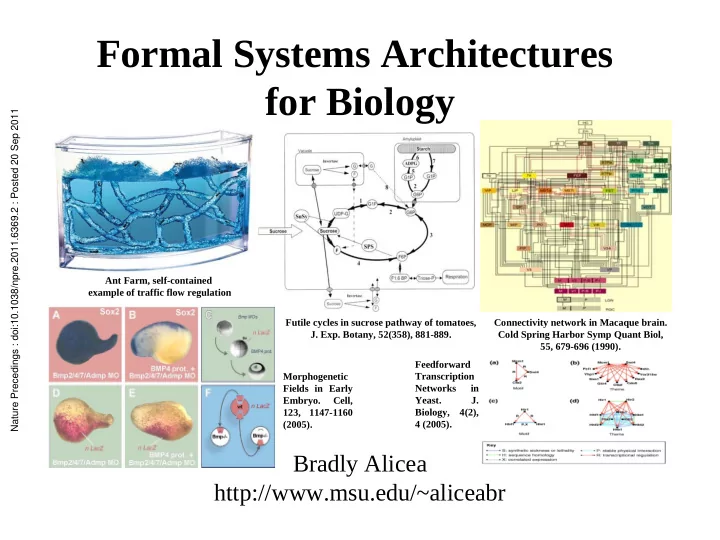
Formal Systems Architectures for Biology Nature Precedings : doi:10.1038/npre.2011.6369.2 : Posted 20 Sep 2011 Ant Farm, self-contained example of traffic flow regulation Futile cycles in sucrose pathway of tomatoes, Connectivity network in


slide-1
SLIDE 1

Formal Systems Architectures for Biology

Bradly Alicea http://www.msu.edu/~aliceabr

Futile cycles in sucrose pathway of tomatoes,

  • J. Exp. Botany, 52(358), 881-889.

Connectivity network in Macaque brain. Cold Spring Harbor Symp Quant Biol, 55, 679-696 (1990). Ant Farm, self-contained example of traffic flow regulation Morphogenetic Fields in Early Embryo. Cell, 123, 1147-1160 (2005). Feedforward Transcription Networks in Yeast. J. Biology, 4(2), 4 (2005). Nature Precedings : doi:10.1038/npre.2011.6369.2 : Posted 20 Sep 2011

slide-2
SLIDE 2

Formal Architectures: where to start?

Motif #1: Dominoes and Clocks * how can we describe the function of cellular oscillations in cell cycle (dominoes) and embryogenesis (clocks)? Motif#2: Futile Cycles * what is the function and origin of futile cycles, and what is there effect on the broader biological system? Motif #3: Complex Feedforward * what are the dynamics of control without feedback, and how does this drive

  • bserved complexity?

Additional Feedback, Feedforward Mechanisms * interconnected futile cycles, networks of flows, controllability of evolvability.

Nature Precedings : doi:10.1038/npre.2011.6369.2 : Posted 20 Sep 2011

slide-3
SLIDE 3

Linear and Recursive Architectures

#1. Clock model, Embryogenesis: Murray, A.W. & Kirschner, M.W (1989). Dominoes and Clocks: The Union of Two Views

  • f the Cell Cycle. Science, 246(4930), 614-621.

#2. Futile Cycle, enzymatic pathway: Samoilov, M., Plyasunov, S., & Arkin, A.P. (2005). Stochastic amplification and signaling in enzymatic futile cycles through noise-induced bistability with oscillations. PNAS USA, 102(7), 2310-2315.

A B #1 #2

Nature Precedings : doi:10.1038/npre.2011.6369.2 : Posted 20 Sep 2011

slide-4
SLIDE 4

Linear and Recursive Architectures

#1. Cell cycle (domino model) * example: path-dependent. Signaling pathways. * example: circular. Cell cycle (mitosis). #3. Complex Feedforward * example: competitive inhibition. Two enzymes binding to the same product. * example: Daisyworld. Evolution/regulation of the biosphere. Path-dependent Circular Competitive Inhibition Daisyworld

Nature Precedings : doi:10.1038/npre.2011.6369.2 : Posted 20 Sep 2011

slide-5
SLIDE 5

Motif #1: Dominoes and Clocks

Cell cycle: set of events responsible for the duplication of the cell. * geneticists (G, mutations that arrest cell cycle) and embryologists/physiologists (E/P, arrest/facilitation of cell cycle) have provided two different perspectives. * G approach has done well at describing linear, path-dependent processes. * E/P approach has done well at describing oscillating processes. Study of mutants: * how individual cell cycle steps are coordinated so that things occur in the right

  • rder.

* each step is dependent on the previous one. * explains coordinated cell size regulation (doubling time and number of steps involved can be decoupled).

Nature Precedings : doi:10.1038/npre.2011.6369.2 : Posted 20 Sep 2011

slide-6
SLIDE 6

Motif #1: Dominoes and Clocks

Cyclin is stable in cells that are arrested in meiosis or mitosis:

* cyclin degradation required to exit cell cycle. * synthesis of cyclin required for activation of MPF in mitosis/meiosis. * cyclin protein accumulates until rate of MPF activation by cyclin exceeds rate of MPF inactivation by enzyme, leading to overall MPF activation. * MPF is a kinase, phosphorylates proteins involved in cell morphology and posttranslational modifications, lead to cyclin degradation. * cyclin lost, MPF also deactivated via inactivase. * no MPF activity turns off cyclin degradation, resets cyclin accumulation.

Nature Precedings : doi:10.1038/npre.2011.6369.2 : Posted 20 Sep 2011

slide-7
SLIDE 7

Motif #1: Dominoes and Clocks

Right: clock-like mechanism of the somatic cell cycle. * activity of MPF oscillates with specific spikes (analog-like) across cell cycle phases. Left: switch-like mechanism of the embryonic cell cycle. * activity of MFP oscillates between high and low (switch-like) across cell cycle phases.

vs.

Nature Precedings : doi:10.1038/npre.2011.6369.2 : Posted 20 Sep 2011

slide-8
SLIDE 8

Motif #1: Dominoes and Clocks

Evolutionary Perspective: * cell cycle as a set of dependent reactions. Therefore, cell cycle should be evolutionarily conserved, both between oocyte and somatic cells, and across species. * compare the evolvability of cell cycle (highly constrained) with the evolvability

  • f Hox genes and phenotypic modularity (highly constrained).

* cell cycle as set of dominoes. Process highly (historical) contingent on previous step. Noise Perspective: * cell cycle as a clock-like process (time- dependent). Clocks are deterministic, is there room for stochastic processes? * chaotic systems are oscillatory (attractors sensitive to initial condition).

Lorentz Attractor and Logistic Map

Nature Precedings : doi:10.1038/npre.2011.6369.2 : Posted 20 Sep 2011

slide-9
SLIDE 9

Motif #1: dominoes and clocks

One

  • utstanding

problem remains: path-dependent phenomena that occur in a loop (top). Recursion that enforces balance between two entities (seesaw model, bottom). * does this resemble futility? Running in place? * does this resemble autoregulation? Homeostasis? Perhaps there are elements of both…….

Nature Precedings : doi:10.1038/npre.2011.6369.2 : Posted 20 Sep 2011

slide-10
SLIDE 10

Motif #2: futile cycles

Futile cycles: two processes running at the same time in opposite directions, and have no output product other than entropy and heat energy.

Technological futile cycles? Top: biomechanical energy harvester, Bottom: human batteries

Samoilov, Plysunov, and Arkin (2005). PNAS USA, 102(7), 2310-2315. * also observed in signal transduction, metabolism, MAPK cascades, GTPase cycles, produces bimodal output. * alternative explanation for Menten-Michaelis (linear) kinetics with feedbacks. * authors propose analytical framework using Langevin SDEs governed by M-M kinetics and driven by noise. Two effects: 1) stochastic signal amplification and 2) mechanism for multistability (dynamic switching between states).

Nature Precedings : doi:10.1038/npre.2011.6369.2 : Posted 20 Sep 2011

slide-11
SLIDE 11

Motif #2: futile cycles

Top Left: stationary state response curves for a range of values (p). Ranges from p=0 (deterministic, sigmoidal) to p = 1 (maximum noise, S-curve). Bottom Left: signal response histograms (x, y axes = top left. Evolution of PDF (points and contours):

* external noise introduced (graph A) = induced bistability (bimodal distribution on axis z). * internal noise only (graph B) = no induced bistability.

Real-world example: Control and Regulatory Mechanisms Associated with Thermogenesis in Flying Insects and Birds. Bioscience Reports, 25(3/4), 2005.

* facultative thermogenesis: ability to generate body heat on demand -- product of futile cycle reactions in fat pads.

Nature Precedings : doi:10.1038/npre.2011.6369.2 : Posted 20 Sep 2011

slide-12
SLIDE 12

Motif #2: futile cycles

Qian and Beard, IEE Proc. Systems Biology, 153(4), 192-200 (2006). Main idea: understand steady-state concentrations of c1, c2 (intermediates) w.r.t. net flux J at fixed enzyme activities. * how can we increase/reduce stochiometric sensitivity of c1 (regulator/control agent of process x) w.r.t. J? c0, J at steady state Stochiometric sensitivity coefficients ( ) ƞ c c

1

c

2

kfwd kfwd krev krev High grade chemical energy converted to low grade heat energy (but does it retain information content?)

Nature Precedings : doi:10.1038/npre.2011.6369.2 : Posted 20 Sep 2011

slide-13
SLIDE 13

Motif #2: futile cycles

Interesting findings:

* sensitivity increases as one moves downstream (c0 → c2). * change in Gibbs free energy (∆GDE, free energy = concentration) with increased sensitivity means less backward flux (when backward flux > J).

Observations for ∆GDE:

* at equilibrium, ∆GDE = 0. * for ∆GDE > 0, futile cycle driven in clockwise

  • direction. Reaction driven away from equilibrium.

* for ∆GDE < 0, futile cycle driven in counterclockwise

  • direction. Reaction driven away from equilibrium.

c c

1

c c

1

D D E E ∆GDE < 0 ∆GDE > 0

D, E are coupled to reaction between C0, C1, creates a directional futile cycle that can be driven to edge of chaos.

Nature Precedings : doi:10.1038/npre.2011.6369.2 : Posted 20 Sep 2011

slide-14
SLIDE 14

Motif #2: futile cycles

Common Form of Motif #2: multisite phosphorylation-dephosphorylation cycle: Wang and Sontag, J. Mathematical Biology, 57, 29-52 (2008).

* can generate several dynamic behaviors (bistability, ultrasensitivity). * futile cycles = enzymatic interconversions.

MAPK cascades (see Biophysical Journal, 92, 1–9, 2007) = three tiers of similar structures with multiple feedbacks.

* each level is a futile cycle.

Steady states in futile cycles:

* futile cycles are sequential, not random. * futile cycle is processive (kinase facilitates 2+ phosphorylations). * dual phosphorylation/dephosphorylation in MAPK are distributive (kinase facilitates 1 phosphorylation). * dual phosphorylation/dephosphorylation in futile cycles are distributive, otherwise they exhibit a unique steady state (does not = experiment).

Nature Precedings : doi:10.1038/npre.2011.6369.2 : Posted 20 Sep 2011

slide-15
SLIDE 15

Motif #2: futile cycles

Evolutionary perspective: Natural selection favors switches (discrete dynamics) over dials (analog dynamics). * evolution of a novel control system in cell. * noise “filtering” as a form of regulation. “Noise” perspective: Noise-induced bistability is possible (switch case). * two parameters influence stochastically-driven enzymatic cycles:

* strength of external driving (magnitude). * exact distribution of noise (e.g. 1/f varieties- white, pink, brown, black).

1/xγ noise – larger value for γ, PDF has longer tail, less support, and higher kurtosis

Nature Precedings : doi:10.1038/npre.2011.6369.2 : Posted 20 Sep 2011

slide-16
SLIDE 16

Motif #3: complex feedforward

Mangan and Alon. PNAS USA, 100(21), 11980-11985 (2003). * feedforward control mechanism found in E.coli and yeast. * tested eight (8) FF network configurations (using Boolean rules). Rein Control Inhibitory

* sign-sensitivity: (+) is acceleration, (-) is delay w.r.t. stimulus input at discrete steps. * X and Y are transcription factors, Sx, Sy are binding proteins, cofactors, etc.

Nature Precedings : doi:10.1038/npre.2011.6369.2 : Posted 20 Sep 2011

slide-17
SLIDE 17

Motif #3: complex feedforward

Incoherent FF systems: signs on the direct (e.g. Y-Z) and indirect (e.g. X-Z) pathways are opposite. Harvey, Homeostasis and Rein Control. Artificial Life 9. * “cut-down” model: external source independently drives each state (e.g. rein control), which keeps proportions of each state in the system stable.

Nature Precedings : doi:10.1038/npre.2011.6369.2 : Posted 20 Sep 2011

slide-18
SLIDE 18

Motif #3: complex feedforward

Saunders, Koeslag, Wessels. Integral Rein Control in Physiology. J. Theoretical Biology, 194, 163-173 (1998). * rein control: two inputs directly provide an input – competition/coordination between the two results in control (e.g. achieving equilibrium). 1) Competitive binding: two enzymes that compete for binding sites on a substrate * produces an equilibrium through inhibition

  • f one input.

2) Daisyworld: two inputs (black and white daisies that absorb/reflect sunlight) * proportion of each population determines properties of atmosphere (e.g. temperature).

Nature Precedings : doi:10.1038/npre.2011.6369.2 : Posted 20 Sep 2011

slide-19
SLIDE 19

Additional Feedback, Feedforward Mechanisms

Del Vecchio and Sontag. Engineering Principles in Biomolecular Systems. European Journal of Control, vol. 15 (3-4), 2009 What is the relationship between modularity and feedback (in synthetic biology)? * interconnected systems: behavior of an upstream component is affected by presence of downstream component (counter to idea of mutually exclusive modules). * retroactivity example: oscillator as a source that synchronizes several downstream transcriptional processes, but oscillator dynamics affects by downstream elements using up its product. * conventional control theory = inputs,

  • utputs, and states (internal and mutually

exclusive). * with retroactivity, two additional components: retroactivity to input, retroactivity to output.

Nature Precedings : doi:10.1038/npre.2011.6369.2 : Posted 20 Sep 2011

slide-20
SLIDE 20

Additional Feedback, Feedforward Mechanisms

Discrete dynamics (geometric) in development and regeneration

COURTESY: Winfree (1980). Geometry of Biological Time.

A: FB off (FB < FF) B: decay off (D < FB, FF) C: FF off (FF < FF) Discrete dynamics (regulation, above): BL = baseline (control value). BL → TST, BL → TLT: 0d → nd. TLT → TST: n + 1d. Discrete dynamics (emergent, right): * simple rules + intrinsic randomness = complex patterns. * combine rules, can we “control” very complex self- assembly processes?

Nature Precedings : doi:10.1038/npre.2011.6369.2 : Posted 20 Sep 2011

slide-21
SLIDE 21

Additional Feedback, Feedforward Mechanisms

Traffic flow and regulation in networks: Flows consist of particles (cars, ants, platelets). Particles follow pathways of variable width, number at variable velocities. Jamming parameter: when threshold is reached (.75), phase transition occurs (from free-flowing to solid). Multiple FB and FF mechanisms: velocity of particles relative to other particles (FB), autonomous velocity (FF), cycles in network (FB), outbound paths (FF). Flow control: * how does FF component get regulated (by FB, initial inputs, connectivity)? * what are the collective (aggregate) effects of particle behavior on flow dynamics?

Nature Precedings : doi:10.1038/npre.2011.6369.2 : Posted 20 Sep 2011

slide-22
SLIDE 22

Future Directions

How do “top-down” control mechanisms constrain the function of “bottom-up” emergent structures? Evolutionary systems are not goal-oriented (only respond to fitness constraints locally in time). * one aspect of evolvability = exploratory behavior (relaxed linkage of parts). Parts = motifs. Signaling pathways are “emergent” structures -- Bhalla and Iyengar, Science, 381, 283 (1999). Decoupling FB and aggregations within pathways = altered function. Controllability: ability to move system around entire configuration space (ergodic) using finite repertoire. * can controllability act to “push” individuals towards fitness maxima (fitness landscape, upper left)? * do diffusive (neutral) processes contribute to observed natural diversity in pathways?

Nature Precedings : doi:10.1038/npre.2011.6369.2 : Posted 20 Sep 2011

slide-23
SLIDE 23

Future Directions

Feedback control with feedforward, decay

PLANT PLANT

I O FB FF

The system at left has two plants and a SISO (single input, single output) architecture.

* input and feedback serves as convergent input on first plant – how do we parse this effect? * what about MIMO (multiple input, multiple output) systems?

Parallel architectures are needed (CUDA example, feedforward).

* way to better model polygenic systems, pleiotropic effects (one gene, many products)? * what about the effects of, interactions between scale (e.g. multiscalar systems)? Gather transformation, CUDA programming

Nature Precedings : doi:10.1038/npre.2011.6369.2 : Posted 20 Sep 2011