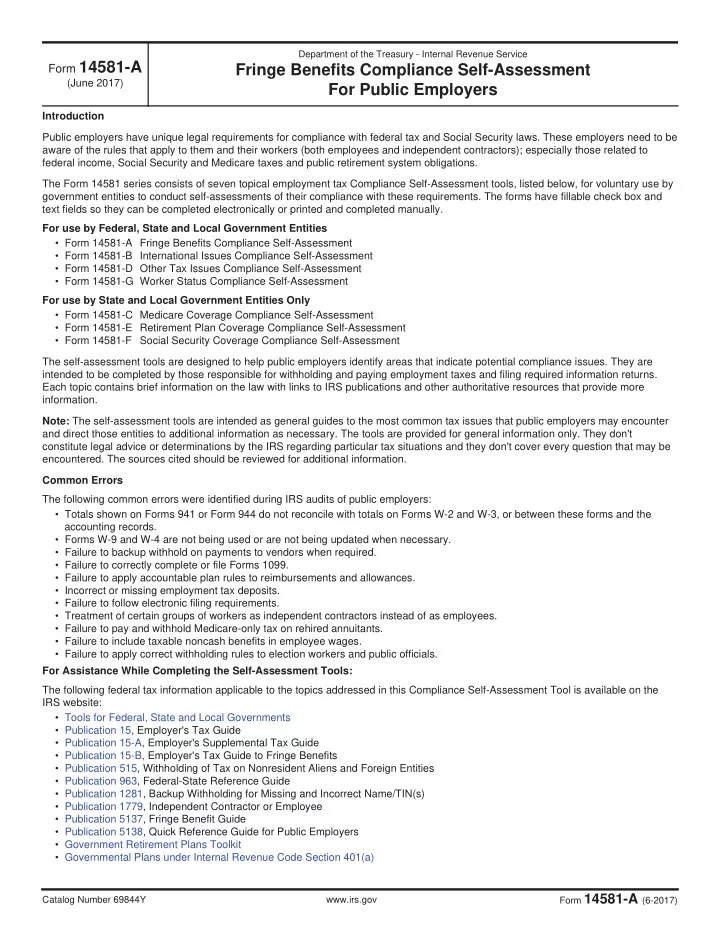
SLIDE 1 Catalog Number 69844Y www.irs.gov Form 14581-A (6-2017)
Form 14581-A
(June 2017)
Department of the Treasury - Internal Revenue Service
Fringe Benefits Compliance Self-Assessment For Public Employers
Introduction Public employers have unique legal requirements for compliance with federal tax and Social Security laws. These employers need to be aware of the rules that apply to them and their workers (both employees and independent contractors); especially those related to federal income, Social Security and Medicare taxes and public retirement system obligations. The Form 14581 series consists of seven topical employment tax Compliance Self-Assessment tools, listed below, for voluntary use by government entities to conduct self-assessments of their compliance with these requirements. The forms have fillable check box and text fields so they can be completed electronically or printed and completed manually. For use by Federal, State and Local Government Entities
- Form 14581-A Fringe Benefits Compliance Self-Assessment
- Form 14581-B International Issues Compliance Self-Assessment
- Form 14581-D Other Tax Issues Compliance Self-Assessment
- Form 14581-G Worker Status Compliance Self-Assessment
For use by State and Local Government Entities Only
- Form 14581-C Medicare Coverage Compliance Self-Assessment
- Form 14581-E Retirement Plan Coverage Compliance Self-Assessment
- Form 14581-F Social Security Coverage Compliance Self-Assessment
The self-assessment tools are designed to help public employers identify areas that indicate potential compliance issues. They are intended to be completed by those responsible for withholding and paying employment taxes and filing required information returns. Each topic contains brief information on the law with links to IRS publications and other authoritative resources that provide more information. Note: The self-assessment tools are intended as general guides to the most common tax issues that public employers may encounter and direct those entities to additional information as necessary. The tools are provided for general information only. They don't constitute legal advice or determinations by the IRS regarding particular tax situations and they don't cover every question that may be
- encountered. The sources cited should be reviewed for additional information.
Common Errors The following common errors were identified during IRS audits of public employers:
- Totals shown on Forms 941 or Form 944 do not reconcile with totals on Forms W-2 and W-3, or between these forms and the
accounting records.
- Forms W-9 and W-4 are not being used or are not being updated when necessary.
- Failure to backup withhold on payments to vendors when required.
- Failure to correctly complete or file Forms 1099.
- Failure to apply accountable plan rules to reimbursements and allowances.
- Incorrect or missing employment tax deposits.
- Failure to follow electronic filing requirements.
- Treatment of certain groups of workers as independent contractors instead of as employees.
- Failure to pay and withhold Medicare-only tax on rehired annuitants.
- Failure to include taxable noncash benefits in employee wages.
- Failure to apply correct withholding rules to election workers and public officials.
For Assistance While Completing the Self-Assessment Tools: The following federal tax information applicable to the topics addressed in this Compliance Self-Assessment Tool is available on the IRS website:
- Tools for Federal, State and Local Governments
- Publication 15, Employer's Tax Guide
- Publication 15-A, Employer's Supplemental Tax Guide
- Publication 15-B, Employer's Tax Guide to Fringe Benefits
- Publication 515, Withholding of Tax on Nonresident Aliens and Foreign Entities
- Publication 963, Federal-State Reference Guide
- Publication 1281, Backup Withholding for Missing and Incorrect Name/TIN(s)
- Publication 1779, Independent Contractor or Employee
- Publication 5137, Fringe Benefit Guide
- Publication 5138, Quick Reference Guide for Public Employers
- Government Retirement Plans Toolkit
- Governmental Plans under Internal Revenue Code Section 401(a)
SLIDE 2 Catalog Number 69844Y www.irs.gov Form 14581-A (6-2017)
Form 14581-A
(June 2017)
Department of the Treasury - Internal Revenue Service
Fringe Benefits Compliance Self-Assessment For Public Employers
Fringe Benefits – Publication 15-B and Publication 5137 1. Does the entity follow “accountable plan” rules for reimbursement of business expenses incurred by employees Yes No Follow Up Note: Generally, reimbursements or advances for expenses paid by the employer on behalf of the employee are taxable unless they are working condition fringe benefits and are ordinary and necessary employee business expenses that would otherwise qualify for a deduction by the employee and the reimbursements or advances are made under accountable plan rules. For payments to be considered to be made under accountable plan rules, the employee must: a) Incur the expenses in the performance of work, b) Substantiate the expenses within a reasonable period of time, and c) Return any amounts in excess of expenses within a reasonable period of time. If accountable plan rules are met, no tax reporting is necessary. If the rules are not met, the reimbursements or advances are included in wages on Form W-2 and are subject to withholding and payment of employment taxes. Employees may deduct expenses as miscellaneous itemized deductions on their Form 1040. Comments 2. Does the entity include the taxable amount of the following fringe benefits as wages when applicable
- a. Personal use of a government-owned vehicle
Yes No Follow Up Note: Two types of written policy statements relating to a vehicle provided by the employer qualify as sufficient evidence corroborating the employer’s own statement, and therefore will satisfy the substantiation requirements if initiated and kept by an employer to implement a policy of either: a) No personal use – see the requirements of Treas. Reg. Section 1.274-6T(a)(2), or b) No personal use except for commuting – see the requirements of Treas. Reg. Section 1.274-6T(a)(3). Note: Unless it is excludable as a qualified non-personal use vehicle, the personal use of a government-owned vehicle is a taxable fringe benefit. Personal use includes the value of commuting to and from work in a government-owned vehicle, even if the vehicle is taken home for the convenience of the employer. The fair market value of the fringe benefit must be included in wages and is subject to income and employment taxes. However, employee use of a qualified non-personal use vehicle qualifies as a working condition fringe. You can exclude the value of that use from the employee's income. A qualified non-personal use vehicle is any vehicle the employee is not likely to use more than minimally for personal purposes because of its design. Comments The value of the use of the vehicle is determined using one of the following methods: a) General valuation rule: the fair market value of a fringe benefit is defined as the price a willing buyer would pay to a willing seller in an arm’s-length transaction. b) Alternate valuation rules: each of the following may be used under certain circumstances:
- i. Lease value rule: Benefit determined based on annual lease value of the vehicle,
- ii. Cents-per-mile rule: Personal use included in wages at the standard mileage rate for the year, or
- iii. Commuting rule: An amount of $1.50 per one-way commute is a taxable fringe benefit.
Note: A discussion of the valuation rules is included in Publication 15-B.
- b. Other listed property or reimbursement of travel expenses to any workers
Yes No Follow Up Note: The employer is not required to have a separate written policy to meet the substantiation requirements for these items. Adequate accounting for these items by employees means the submission to the employer of an account book, diary, log, statement of expense, trip sheet or similar record maintained by the employer in which the required information for each element of expenditure or use is recorded at or near the time of the expenditure or use in a manner that conforms to the listed property requirements. Comments
SLIDE 3 Page 3
Catalog Number 69844Y www.irs.gov Form 14581-A (6-2017)
- c. Group-term life insurance provided by the employer
Yes No Follow Up Note: The annual cost of $50,000 of group-term life insurance may be excludable from Social Security, Medicare and income tax for each employee. The table for determining the cost of additional insurance is included in Publication 15-B. The cost of group-term life insurance in excess of $50,000 is subject to Social Security and Medicare, but not to income tax withholding. Comments
- d. Meals provided by the employer
Yes No Follow Up Note: Meals may be excludable from income in the following cases: a) “De minimis” meals, for example, occasional group meals, or b) Meals for the convenience of the employer, provided on the business premises. Comments
- e. Lodging provided for workers
Yes No Follow Up Note: Lodging may be excludable if for employer’s convenience as a condition of employment, if on the employer’s business premises. Lodging costs may also be excludable if paid for or reimbursed as working condition fringe. See Publication 15-B for information on lodging as a fringe benefit. Comments
- f. Educational assistance provided to workers
Yes No Follow Up Note: Educational assistance may be excludable if the plan is in writing and meets certain other tests: a) Under educational assistance program (up to $5,250 per year), or b) As a working condition fringe benefit. See Publication 15-B and Publication 970, Tax Benefits for Education, for more information. Comments
- g. Achievement awards or length of service awards given to workers
Yes No Follow Up Note: For more information, see Publication 535, Business Expenses. Comments
- h. Membership fees paid for any workers
Yes No Follow Up Excludable if: a) For professional and business-related organizations and reasonable business purpose; or b) Use of athletic or recreation facilities, on employer premises by current or former employees or their family members. Employer's payment of fees for employees' use of third-party owned facilities is generally taxable. Comments
SLIDE 4 Page 4
Catalog Number 69844Y www.irs.gov Form 14581-A (6-2017)
- i. Moving expenses paid for any workers
Yes No Follow Up Note: Exempt (up to limits) if expenses would be deductible if the employee had paid them. These rules are further illustrated in Publication 521, Moving Expenses. Comments
- j. Gift Certificates given to any workers
Yes No Follow Up Note: Gift certificates that are cash equivalent are not excludable from income as de minimis fringe benefits. Comments Notes/Follow-up You have completed the Fringe Benefits Compliance Self-Assessment.
SLIDE 5 Catalog Number 69845J www.irs.gov Form 14581-B (6-2017)
Form 14581-B
(June 2017)
Department of the Treasury - Internal Revenue Service
International Issues Compliance Self-Assessment For Public Employers
Introduction Public employers have unique legal requirements for compliance with federal tax and Social Security laws. These employers need to be aware of the rules that apply to them and their workers (both employees and independent contractors); especially those related to federal income, Social Security and Medicare taxes and public retirement system obligations. The Form 14581 series consists of seven topical employment tax Compliance Self-Assessment tools, listed below, for voluntary use by government entities to conduct self-assessments of their compliance with these requirements. The forms have fillable check box and text fields so they can be completed electronically or printed and completed manually. For use by Federal, State and Local Government Entities
- Form 14581-A Fringe Benefits Compliance Self-Assessment
- Form 14581-B International Issues Compliance Self-Assessment
- Form 14581-D Other Tax Issues Compliance Self-Assessment
- Form 14581-G Worker Status Compliance Self-Assessment
For use by State and Local Government Entities Only
- Form 14581-C Medicare Coverage Compliance Self-Assessment
- Form 14581-E Retirement Plan Coverage Compliance Self-Assessment
- Form 14581-F Social Security Coverage Compliance Self-Assessment
The self-assessment tools are designed to help public employers identify areas that indicate potential compliance issues. They are intended to be completed by those responsible for withholding and paying employment taxes and filing required information returns. Each topic contains brief information on the law with links to IRS publications and other authoritative resources that provide more information. Note: The self-assessment tools are intended as general guides to the most common tax issues that public employers may encounter and direct those entities to additional information as necessary. The tools are provided for general information only. They don't constitute legal advice or determinations by the IRS regarding particular tax situations and they don't cover every question that may be
- encountered. The sources cited should be reviewed for additional information.
Common Errors The following common errors were identified during IRS audits of public employers:
- Totals shown on Forms 941 or Form 944 do not reconcile with totals on Forms W-2 and W-3, or between these forms and the
accounting records.
- Forms W-9 and W-4 are not being used or are not being updated when necessary.
- Failure to backup withhold on payments to vendors when required.
- Failure to correctly complete or file Forms 1099.
- Failure to apply accountable plan rules to reimbursements and allowances.
- Incorrect or missing employment tax deposits.
- Failure to follow electronic filing requirements.
- Treatment of certain groups of workers as independent contractors instead of as employees.
- Failure to pay and withhold Medicare-only tax on rehired annuitants.
- Failure to include taxable noncash benefits in employee wages.
- Failure to apply correct withholding rules to election workers and public officials.
For Assistance While Completing the Self-Assessment Tools: The following federal tax information applicable to the topics addressed in this Compliance Self-Assessment Tool is available on the IRS website:
- Tools for Federal, State and Local Governments
- Publication 15, Employer's Tax Guide
- Publication 15-A, Employer's Supplemental Tax Guide
- Publication 15-B, Employer's Tax Guide to Fringe Benefits
- Publication 515, Withholding of Tax on Nonresident Aliens and Foreign Entities
- Publication 963, Federal-State Reference Guide
- Publication 1281, Backup Withholding for Missing and Incorrect Name/TIN(s)
- Publication 1779, Independent Contractor or Employee
- Publication 5137, Fringe Benefit Guide
- Publication 5138, Quick Reference Guide for Public Employers
- Government Retirement Plans Toolkit
- Governmental Plans under Internal Revenue Code Section 401(a)
SLIDE 6 Catalog Number 69845J www.irs.gov Form 14581-B (6-2017)
Form 14581-B
(June 2017)
Department of the Treasury - Internal Revenue Service
International Issues Compliance Self-Assessment For Public Employers
International Issues – Publication 515 1. Did the entity make payments to a foreign person of any item of income that is subject to withholding Yes No Follow Up If not, indicate “NO” and skip the International Issues section. Note: Employees or independent contractors who are not U.S. citizens may be required to furnish their employer with a Form I-9, Employment Eligibility Verification, Form W-4, Employee’s Withholding Allowance Certificate or a W-8 series form. P.O. Boxes from a foreign country are acceptable.
- W-8BEN, Certificate of Foreign Status of Beneficial Owner for United States Tax Withholding;
- W-8ECI, Certificate of Foreign Person’s Claim That Income Is Effectively Connected With the Conduct of a Trade or Business in
the United States;
- W-8EXP, Certificate of Foreign Government or Other Foreign Organization for United States Tax Withholding; and
- W-8IMY, Certificate of Foreign Intermediary, Foreign Flow-Through Entity, or Certain U.S. Branches for United States Tax
Withholding. Comments The Form W-8 series includes: 2. Did the entity employ resident aliens Yes No Follow Up If yes, were withholding income, Social Security and Medicare taxes followed in the same way as for U.S. citizens Yes No Follow Up If no, skip the rest of the International Issues Compliance Self-Assessment. Note: For information on determining who is a nonresident or resident alien, see Publication 519, U.S. Tax Guide for Aliens. Comments
- a. Did any of the nonresident aliens (NRAs) holding an F-1, J-1, M-1 or Q-1 Visa provide
documentation, including copies of the visa and Form I-9 with supporting documents to support exemption from Social Security and Medicare taxes Yes No Follow Up Note: If this documentation was not provided, Social Security and Medicare taxes should be withheld from the wages paid to these
- NRAs. However, a NRA student may be eligible for the student FICA exception under Internal Revenue Code (IRC)
Section 3121(b)(10). Comments
- b. Did any NRAs have a visa status other than F-1, J-1, M-1 or Q-1
Yes No Follow Up If yes, were Social Security and Medicare taxes withheld as required Yes No Follow Up Note: NRAs holding other visas, such as an H-1 or any secondary visa are subject to Social Security and Medicare withholding. Comments
SLIDE 7 Page 3
Catalog Number 69845J www.irs.gov Form 14581-B (6-2017)
- c. Is federal income tax withheld as required
Yes No Follow Up Note: NRAs should compete a Form W-4, using Notice 1392, Supplemental Form W-4 Instructions for Nonresident Aliens and Form 8233, Exemption From Withholding on Compensation for Independent (and Certain Dependent) Personal Services of a Nonresident Alien Individual, to claim tax treaty benefits. The employer should include procedures for completing Form W-4 and use of Form 8233 to claim a treaty exemption. See Publication 15 for the rules for completing Form W-4 and claiming a tax treaty exemption
Comments
- d. Do any NRAs claim a treaty exemption using Form 8233
Yes No Follow Up If yes, were federal income taxes withheld using the current treaty provisions Yes No Follow Up See Publication 901, U.S. Tax Treaties, for treaty information. Comments
- e. For NRAs who did not claim a treaty exemption, were federal income taxes withheld
using the presumption rules described in Publication 515 Yes No Follow Up Note: If the NRA did not claim a treaty exemption, federal withholding taxes must be computed based on the completed Form W-4 for the NRA and by following the steps outlined in Chapter 9 of Publication 15. Comments 3. Does the entity have vendors or outside contractors that are NRAs Yes No Follow Up Note: Generally, withholding is required at 30% (or lower treaty rate) from the gross amount paid to a NRA. Use Form 1042-S, Foreign Person’s U.S. Source Income Subject to Withholding, to report payments to NRAs. Comments 4. Are payments to NRAs subjected to NRA Withholding and reported on Form 1042-S Yes No Follow Up If withholding was required, was Form 1042, Annual Withholding Tax Return for U.S. Source Income of Foreign Persons, filed Yes No Follow Up Comments Notes/Follow-up You have completed the International Issues Compliance Self-Assessment.
SLIDE 8 Catalog Number 69846U www.irs.gov Form 14581-C (6-2017)
Form 14581-C
(June 2017)
Department of the Treasury - Internal Revenue Service
Medicare Coverage Compliance Self-Assessment For State and Local Government Employers
Introduction Public employers have unique legal requirements for compliance with federal tax and Social Security laws. These employers need to be aware of the rules that apply to them and their workers (both employees and independent contractors); especially those related to federal income, Social Security and Medicare taxes and public retirement system obligations. The Form 14581 series consists of seven topical employment tax Compliance Self-Assessment tools, listed below, for voluntary use by government entities to conduct self-assessments of their compliance with these requirements. The forms have fillable check box and text fields so they can be completed electronically or printed and completed manually. For use by Federal, State and Local Government Entities
- Form 14581-A Fringe Benefits Compliance Self-Assessment
- Form 14581-B International Issues Compliance Self-Assessment
- Form 14581-D Other Tax Issues Compliance Self-Assessment
- Form 14581-G Worker Status Compliance Self-Assessment
For use by State and Local Government Entities Only
- Form 14581-C Medicare Coverage Compliance Self-Assessment
- Form 14581-E Retirement Plan Coverage Compliance Self-Assessment
- Form 14581-F Social Security Coverage Compliance Self-Assessment
The self-assessment tools are designed to help public employers identify areas that indicate potential compliance issues. They are intended to be completed by those responsible for withholding and paying employment taxes and filing required information returns. Each topic contains brief information on the law with links to IRS publications and other authoritative resources that provide more information. Note: The self-assessment tools are intended as general guides to the most common tax issues that public employers may encounter and direct those entities to additional information as necessary. The tools are provided for general information only. They don't constitute legal advice or determinations by the IRS regarding particular tax situations and they don't cover every question that may be
- encountered. The sources cited should be reviewed for additional information.
Common Errors The following common errors were identified during IRS audits of public employers:
- Totals shown on Forms 941 or Form 944 do not reconcile with totals on Forms W-2 and W-3, or between these forms and the
accounting records.
- Forms W-9 and W-4 are not being used or are not being updated when necessary.
- Failure to backup withhold on payments to vendors when required.
- Failure to correctly complete or file Forms 1099.
- Failure to apply accountable plan rules to reimbursements and allowances.
- Incorrect or missing employment tax deposits.
- Failure to follow electronic filing requirements.
- Treatment of certain groups of workers as independent contractors instead of as employees.
- Failure to pay and withhold Medicare-only tax on rehired annuitants.
- Failure to include taxable noncash benefits in employee wages.
- Failure to apply correct withholding rules to election workers and public officials.
For Assistance While Completing the Self-Assessment Tools: The following federal tax information applicable to the topics addressed in this Compliance Self-Assessment Tool is available on the IRS website:
- Tools for Federal, State and Local Governments
- Publication 15, Employer's Tax Guide
- Publication 15-A, Employer's Supplemental Tax Guide
- Publication 15-B, Employer's Tax Guide to Fringe Benefits
- Publication 515, Withholding of Tax on Nonresident Aliens and Foreign Entities
- Publication 963, Federal-State Reference Guide
- Publication 1281, Backup Withholding for Missing and Incorrect Name/TIN(s)
- Publication 1779, Independent Contractor or Employee
- Publication 5137, Fringe Benefit Guide
- Publication 5138, Quick Reference Guide for Public Employers
- Government Retirement Plans Toolkit
- Governmental Plans under Internal Revenue Code Section 401(a)
SLIDE 9 Catalog Number 69846U www.irs.gov Form 14581-C (6-2017)
Form 14581-C
(June 2017)
Department of the Treasury - Internal Revenue Service
Medicare Coverage Compliance Self-Assessment For State and Local Government Employers
Medicare Coverage – Publication 963 1. Are any employees exempt from Medicare under the continuing employment exception Yes No Follow Up Note: Almost all state and local government employees are covered by Medicare. All employees covered under a Section 218 Agreement are covered and employees covered by mandatory Social Security provisions are covered, unless the employee meets the continuing employment exception under Internal Revenue Code (IRC) Section 3121(u). The continuing employment exception applies to an employee hired or rehired by a state or political subdivision employer before April 1, 1986, only if the employee is a member of a public retirement system within the meaning of IRC Section 3121(b)(7)(F) and meets all of the following requirements:
- The employee was performing regular and substantial services for remuneration for the state or political subdivision employer
before April 1, 1986;
- The employee was a bona fide employee of that employer on March 31, 1986;
- The employment relationship with that employer was not entered into for purposes of avoiding the Medicare tax; and
- The employment relationship with that employer been continuous since March 31, 1986.
Note: The IRC also exempts employees performing the following services from mandatory Social Security and Medicare taxes:
- Services performed by individuals hired to be relieved from unemployment.
- Services performed in a hospital, home or other institution by a patient or inmate thereof as an employee of a state or local
government.
- Services performed by an employee hired on a temporary basis in case of fire, storm, snow, earthquake, flood or similar
emergency.
- Services performed by a nonresident alien temporarily residing in the U.S. holding an F-1, J-1, M-1 or Q-1 visa, when the services
are performed to carry out the purpose for which the alien was admitted to the U.S.
- Services in positions compensated solely by fees received directly from the public are subject to SECA (Self-Employment
Contributions Act) taxes, unless a Section 218 Agreement covers these services.
- Services performed by a student enrolled and regularly attending classes at the school, college or university for which they are
working, unless a section 218 Agreement covers these services. Refer to www.socialsecurity.gov/slge/student_coverage_chart.htm for the student exclusions for each state.
- Services performed by election officials or election workers paid less than the calendar year threshold amount mandated by law
unless a Section 218 Agreement covers election workers.
- Services that would be excluded if performed for a private employer because they are not work defined as employment under
Section 210(a) of the Social Security Act Contact the State Social Security Administrator with any questions pertaining to the foregoing. Comments 2. Are there any employees from whom Medicare is not withheld, other than those who meet the exceptions identified above Yes No Follow Up Comments 3. Does the entity employ any rehired annuitants Yes No Follow Up Note: Rehired annuitants are retired individuals who are rehired by their employer or another employer that participates in the same retirement system as the former employer. This includes a former participant in a state retirement system who has previously retired and who is either:
- 1. Receiving retirement benefits under the retirement system, or
- 2. Has reached the normal retirement age under the retirement system.
Comments
SLIDE 10 Page 3
Catalog Number 69846U www.irs.gov Form 14581-C (6-2017)
- a. If the employer has rehired annuitants, is Social Security tax withheld and paid on
those employees as applicable Yes No Follow Up Comments
- b. If yes, is Medicare tax withheld and paid on those employees
Yes No Follow Up Note: When an employee retires, the employee has terminated employment for purposes of the continuing employment exception. Thus, if that former employee is rehired, the employee will be subject to Medicare tax, even if the employee was previously exempt because of the continuing employment exception. Comments Notes/Follow-up You have completed the Medicare Coverage Compliance Self-Assessment.
SLIDE 11 Catalog Number 69847F www.irs.gov Form 14581-D (6-2017)
Form 14581-D
(June 2017)
Department of the Treasury - Internal Revenue Service
Other Tax Issues Compliance Self-Assessment For Public Employers
Introduction Public employers have unique legal requirements for compliance with federal tax and Social Security laws. These employers need to be aware of the rules that apply to them and their workers (both employees and independent contractors); especially those related to federal income, Social Security and Medicare taxes and public retirement system obligations. The Form 14581 series consists of seven topical employment tax Compliance Self-Assessment tools, listed below, for voluntary use by government entities to conduct self-assessments of their compliance with these requirements. The forms have fillable check box and text fields so they can be completed electronically or printed and completed manually. For use by Federal, State and Local Government Entities
- Form 14581-A Fringe Benefits Compliance Self-Assessment
- Form 14581-B International Issues Compliance Self-Assessment
- Form 14581-D Other Tax Issues Compliance Self-Assessment
- Form 14581-G Worker Status Compliance Self-Assessment
For use by State and Local Government Entities Only
- Form 14581-C Medicare Coverage Compliance Self-Assessment
- Form 14581-E Retirement Plan Coverage Compliance Self-Assessment
- Form 14581-F Social Security Coverage Compliance Self-Assessment
The self-assessment tools are designed to help public employers identify areas that indicate potential compliance issues. They are intended to be completed by those responsible for withholding and paying employment taxes and filing required information returns. Each topic contains brief information on the law with links to IRS publications and other authoritative resources that provide more information. Note: The self-assessment tools are intended as general guides to the most common tax issues that public employers may encounter and direct those entities to additional information as necessary. The tools are provided for general information only. They don't constitute legal advice or determinations by the IRS regarding particular tax situations and they don't cover every question that may be
- encountered. The sources cited should be reviewed for additional information.
Common Errors The following common errors were identified during IRS audits of public employers:
- Totals shown on Forms 941 or Form 944 do not reconcile with totals on Forms W-2 and W-3, or between these forms and the
accounting records.
- Forms W-9 and W-4 are not being used or are not being updated when necessary.
- Failure to backup withhold on payments to vendors when required.
- Failure to correctly complete or file Forms 1099.
- Failure to apply accountable plan rules to reimbursements and allowances.
- Incorrect or missing employment tax deposits.
- Failure to follow electronic filing requirements.
- Treatment of certain groups of workers as independent contractors instead of as employees.
- Failure to pay and withhold Medicare-only tax on rehired annuitants.
- Failure to include taxable noncash benefits in employee wages.
- Failure to apply correct withholding rules to election workers and public officials.
For Assistance While Completing the Self-Assessment Tools: The following federal tax information applicable to the topics addressed in this Compliance Self-Assessment Tool is available on the IRS website:
- Tools for Federal, State and Local Governments
- Publication 15, Employer's Tax Guide
- Publication 15-A, Employer's Supplemental Tax Guide
- Publication 15-B, Employer's Tax Guide to Fringe Benefits
- Publication 515, Withholding of Tax on Nonresident Aliens and Foreign Entities
- Publication 963, Federal-State Reference Guide
- Publication 1281, Backup Withholding for Missing and Incorrect Name/TIN(s)
- Publication 1779, Independent Contractor or Employee
- Publication 5137, Fringe Benefit Guide
- Publication 5138, Quick Reference Guide for Public Employers
- Government Retirement Plans Toolkit
- Governmental Plans under Internal Revenue Code Section 401(a)
SLIDE 12
Catalog Number 69847F www.irs.gov Form 14581-D (6-2017)
Form 14581-D
(June 2017)
Department of the Treasury - Internal Revenue Service
Other Tax Issues Compliance Self-Assessment For Public Employers
Other Tax Issues – Publication 15 1. Employment Tax Returns Yes No Follow Up a. Were required tax returns, for example, Form 941 or Form 944 and Form 945 (if applicable) filed b. Were the required tax returns from a. filed by the due date c. Were the required tax returns from a. complete and accurate d.i. Do wage and withholding amounts for income, Social Security and Medicare reconcile between Forms W-3, W-2 and 941 d.ii. Do the amounts reported on the forms reconcile to the accounting records 2. Form W-4, Employee's Withholding Allowance Certificate Yes No Follow Up a. Is a valid Form W-4 on file for each employee b. Are Forms W-4 secured prior to initial payment c. Are all Forms W-4 properly completed d. Is a new Form W-4 secured by February 15 of each year from each individual who claimed an exemption from income tax withholding in the prior year 3. Tax and Information Returns Yes No Follow Up Are you required to file any of the following federal tax or Information Returns If yes, did you file timely and accurately a. Form W-2, Wage and Tax Statement b. Form W-3, Transmittal of Wage and Tax Statements c. Form CT-1, Employer's Annual Railroad Retirement Tax Return d. Form 720, Quarterly Federal Excise Tax Return e. Form 990, Return of Organization Exempt from Income Tax f. Form 990-T, Exempt Organization Business Income Tax Return g. Form 1096, Annual Summary and Transmittal of U.S. Information Returns h. Form 1099-G, Certain Government Payments i. Form 1099-INT, Interest Income j. Form 1099-MISC, Miscellaneous Income k. Form 1099-R, Distributions From Pensions, Annuities, Retirement or Profit-Sharing Plans, IRAs, Insurance Contracts, etc. l. Form 1098-E, Student Loan Interest Statement m. Form 1098-T, Tuition Statement n. Form 8300, Report of Cash Payments over $10,000 Received in a Trade or Business Note: All forms and instructions are available at www.irs.gov/forms-pubs
SLIDE 13
Page 3
Catalog Number 69847F www.irs.gov Form 14581-D (6-2017)
4. Independent Contractor Reporting Yes No Follow Up a. Does the entity make payments for services to independent contractors b. If yes, is Form W-9, Request for Taxpayer Identification Number and Certification, used to secure taxpayer identification numbers (TINs) from the independent contractors prior to initial payment Note: Form W-9, or its equivalent, should be secured from all contractors before any payments are made, to help ensure that the payee's name and taxpayer identification number are accurate. c. Are all Forms W-9 properly and thoroughly completed and signed d. Are Forms 1099-MISC filed for all independent contractors (except for some legally exempt ones) for payments aggregating $600 or more per year e. Does the entity file Form 1099-MISC for payments to individuals, partnerships and certain corporations f. Does the entity file Form 1099-MISC for attorney payments (including incorporated payees) g. Does the entity file Form 1099-MISC for medical and health care payments (including incorporated payees) 5. Backup Withholding Yes No Follow Up Did the entity backup withhold income tax on any reportable payments Backup withholding is required on reportable payments made to a U.S. person if: 1) The U.S. person did not provide its TIN in the manner required; or 2) The IRS notifies the payer that the TIN is incorrect. Generally, a TIN must be provided on Form W-9. A payer reports backup withholding on Form 945. Note: Payments subject to backup withholding at the source are reported on forms 1099-B, DIV, INT, K, MISC, PATR, OID. Note: Notice CP2100 is issued in situations where prior year information returns contained missing or incorrect TINs and name/ identification number mismatches. For additional information on backup withholding, see Publication 1281, Backup Withholding for Missing and Incorrect Name/TINs and Publication 15, (Circular E), Employer's Tax Guide. Notes/Follow-up You have completed the Other Tax Issues Compliance Self-Assessment.
SLIDE 14 Catalog Number 69848Q www.irs.gov Form 14581-E (6-2017)
Form 14581-E
(June 2017)
Department of the Treasury - Internal Revenue Service
Retirement Plan Coverage Compliance Self-Assessment For State and Local Government Entities
Introduction Public employers have unique legal requirements for compliance with federal tax and Social Security laws. These employers need to be aware of the rules that apply to them and their workers (both employees and independent contractors); especially those related to federal income, Social Security and Medicare taxes and public retirement system obligations. The Form 14581 series consists of seven topical employment tax Compliance Self-Assessment tools, listed below, for voluntary use by government entities to conduct self-assessments of their compliance with these requirements. The forms have fillable check box and text fields so they can be completed electronically or printed and completed manually. For use by Federal, State and Local Government Entities
- Form 14581-A Fringe Benefits Compliance Self-Assessment
- Form 14581-B International Issues Compliance Self-Assessment
- Form 14581-D Other Tax Issues Compliance Self-Assessment
- Form 14581-G Worker Status Compliance Self-Assessment
For use by State and Local Government Entities Only
- Form 14581-C Medicare Coverage Compliance Self-Assessment
- Form 14581-E Retirement Plan Coverage Compliance Self-Assessment
- Form 14581-F Social Security Coverage Compliance Self-Assessment
The self-assessment tools are designed to help public employers identify areas that indicate potential compliance issues. They are intended to be completed by those responsible for withholding and paying employment taxes and filing required information returns. Each topic contains brief information on the law with links to IRS publications and other authoritative resources that provide more information. Note: The self-assessment tools are intended as general guides to the most common tax issues that public employers may encounter and direct those entities to additional information as necessary. The tools are provided for general information only. They don't constitute legal advice or determinations by the IRS regarding particular tax situations and they don't cover every question that may be
- encountered. The sources cited should be reviewed for additional information.
Common Errors The following common errors were identified during IRS audits of public employers:
- Totals shown on Forms 941 or Form 944 do not reconcile with totals on Forms W-2 and W-3, or between these forms and the
accounting records.
- Forms W-9 and W-4 are not being used or are not being updated when necessary.
- Failure to backup withhold on payments to vendors when required.
- Failure to correctly complete or file Forms 1099.
- Failure to apply accountable plan rules to reimbursements and allowances.
- Incorrect or missing employment tax deposits.
- Failure to follow electronic filing requirements.
- Treatment of certain groups of workers as independent contractors instead of as employees.
- Failure to pay and withhold Medicare-only tax on rehired annuitants.
- Failure to include taxable noncash benefits in employee wages.
- Failure to apply correct withholding rules to election workers and public officials.
For Assistance While Completing the Self-Assessment Tools: The following federal tax information applicable to the topics addressed in this Compliance Self-Assessment Tool is available on the IRS website:
- Tools for Federal, State and Local Governments
- Publication 15, Employer's Tax Guide
- Publication 15-A, Employer's Supplemental Tax Guide
- Publication 15-B, Employer's Tax Guide to Fringe Benefits
- Publication 515, Withholding of Tax on Nonresident Aliens and Foreign Entities
- Publication 963, Federal-State Reference Guide
- Publication 1281, Backup Withholding for Missing and Incorrect Name/TIN(s)
- Publication 1779, Independent Contractor or Employee
- Publication 5137, Fringe Benefit Guide
- Publication 5138, Quick Reference Guide for Public Employers
- Government Retirement Plans Toolkit
- Governmental Plans under Internal Revenue Code Section 401(a)
SLIDE 15 Catalog Number 69848Q www.irs.gov Form 14581-E (6-2017)
Form 14581-E
(June 2017)
Department of the Treasury - Internal Revenue Service
Retirement Plan Coverage Compliance Self-Assessment For State and Local Government Entities
Retirement Plan Coverage – Publication 963 1. Does the entity have a public retirement system that qualifies as a replacement for Social Security coverage Yes No Follow Up Note: A governmental retirement plan must meet certain minimum benefit or contribution standards to qualify as a public retirement system, and thereby serve as a “replacement” plan exempting the participants from mandatory Social Security coverage. These standards are based solely on meeting a minimum benefit level either: 1) Provided to (defined benefit plan) the participant, or 2) Contributed by (defined contribution plan) the participant. Any person working for a public employer after July 1, 1991, who is not covered in a public retirement plan that meets the requirements discussed above and, if applicable, the defined benefit system safe harbor rules of Revenue Procedure (Rev. Proc.) 91-40, must be covered by Social Security and Medicare under the mandatory coverage provisions of Section 210 of the Social Security Act, except for exclusions from mandatory Social Security and Medicare. For more information about public retirement systems (Social Security replacement plans), see Chapter 6 of Publication 963, Federal- State Reference Guide. Comments 2. Is the public retirement plan offered to all employees Yes No Follow Up If not, specify categories of employees that are NOT covered. (Specify all that apply) Note: Employees in these categories must be covered for Social Security either under mandatory coverage or under a Section 218 Agreement. Comments 3. Are the contributions to retirement plans subject to applicable employment taxes Yes No Follow Up Comments
- a. Internal Revenue Code (IRC) Section 3121(b)(7)(F) retirement system
Yes No Follow Up
- Employee deferrals are exempt from federal income tax withholding but are subject to Social Security and Medicare taxes.
- Employer contributions are exempt from federal income tax withholding, Social Security and Medicare taxes. However, if the
retirement system is not an “exempt governmental deferred compensation plan,” employer contributions are subject to Social Security and Medicare withholding as of the later of when the services are performed or when there is no substantial risk of forfeiture. Comments
- b. IRC Section 401(a) and/or Section 403(b) plan
Yes No Follow Up
- Employee deferrals are exempt from federal Income tax withholding but are subject to Social Security and Medicare taxes.
- Employer contributions are exempt from federal Income tax withholding, Social Security and Medicare taxes.
Comments
SLIDE 16 Page 3
Catalog Number 69848Q www.irs.gov Form 14581-E (6-2017)
- c. IRC Section 457(b) plan
Yes No Follow Up
- Employee deferrals are exempt from federal income tax withholding but are subject to Social Security and Medicare taxes.
- Employer contributions are exempt from federal income tax withholding but are subject to Social Security and Medicare taxes
when no longer subject to substantial risk of forfeiture. Comments Notes/Follow-up You have completed the Retirement Plan Coverage Compliance Self-Assessment.
SLIDE 17 Catalog Number 69849B www.irs.gov Form 14581-F (6-2017)
Form 14581-F
(June 2017)
Department of the Treasury - Internal Revenue Service
Social Security Coverage Compliance Self-Assessment For State and Local Government Entities
Introduction Public employers have unique legal requirements for compliance with federal tax and Social Security laws. These employers need to be aware of the rules that apply to them and their workers (both employees and independent contractors); especially those related to federal income, Social Security and Medicare taxes and public retirement system obligations. The Form 14581 series consists of seven topical employment tax Compliance Self-Assessment tools, listed below, for voluntary use by government entities to conduct self-assessments of their compliance with these requirements. The forms have fillable check box and text fields so they can be completed electronically or printed and completed manually. For use by Federal, State and Local Government Entities
- Form 14581-A Fringe Benefits Compliance Self-Assessment
- Form 14581-B International Issues Compliance Self-Assessment
- Form 14581-D Other Tax Issues Compliance Self-Assessment
- Form 14581-G Worker Status Compliance Self-Assessment
For use by State and Local Government Entities Only
- Form 14581-C Medicare Coverage Compliance Self-Assessment
- Form 14581-E Retirement Plan Coverage Compliance Self-Assessment
- Form 14581-F Social Security Coverage Compliance Self-Assessment
The self-assessment tools are designed to help public employers identify areas that indicate potential compliance issues. They are intended to be completed by those responsible for withholding and paying employment taxes and filing required information returns. Each topic contains brief information on the law with links to IRS publications and other authoritative resources that provide more information. Note: The self-assessment tools are intended as general guides to the most common tax issues that public employers may encounter and direct those entities to additional information as necessary. The tools are provided for general information only. They don't constitute legal advice or determinations by the IRS regarding particular tax situations and they don't cover every question that may be
- encountered. The sources cited should be reviewed for additional information.
Common Errors The following common errors were identified during IRS audits of public employers:
- Totals shown on Forms 941 or Form 944 do not reconcile with totals on Forms W-2 and W-3, or between these forms and the
accounting records.
- Forms W-9 and W-4 are not being used or are not being updated when necessary.
- Failure to backup withhold on payments to vendors when required.
- Failure to correctly complete or file Forms 1099.
- Failure to apply accountable plan rules to reimbursements and allowances.
- Incorrect or missing employment tax deposits.
- Failure to follow electronic filing requirements.
- Treatment of certain groups of workers as independent contractors instead of as employees.
- Failure to pay and withhold Medicare-only tax on rehired annuitants.
- Failure to include taxable noncash benefits in employee wages.
- Failure to apply correct withholding rules to election workers and public officials.
For Assistance While Completing the Self-Assessment Tools: The following federal tax information applicable to the topics addressed in this Compliance Self-Assessment Tool is available on the IRS website:
- Tools for Federal, State and Local Governments
- Publication 15, Employer's Tax Guide
- Publication 15-A, Employer's Supplemental Tax Guide
- Publication 15-B, Employer's Tax Guide to Fringe Benefits
- Publication 515, Withholding of Tax on Nonresident Aliens and Foreign Entities
- Publication 963, Federal-State Reference Guide
- Publication 1281, Backup Withholding for Missing and Incorrect Name/TIN(s)
- Publication 1779, Independent Contractor or Employee
- Publication 5137, Fringe Benefit Guide
- Publication 5138, Quick Reference Guide for Public Employers
- Government Retirement Plans Toolkit
- Governmental Plans under Internal Revenue Code Section 401(a)
SLIDE 18 Catalog Number 69849B www.irs.gov Form 14581-F (6-2017)
Form 14581-F
(June 2017)
Department of the Treasury - Internal Revenue Service
Social Security Coverage Compliance Self-Assessment For State and Local Government Entities
Social Security – Publication 963 General Social Security information is available at the Social Security Administration's website and information specific to state and local government employers is available at www.ssa.gov/slge/. The National Conference of State Social Security Administrators (NCSSSA) website includes contact information for the state Social Security Administrators, who are responsible for maintaining and administering the states’ Section 218 Agreements and Modifications with the Social Security Administration. 1. Does the entity have Social Security coverage under a Section 218 Agreement and/or Modification (a modification is an amendment to the state's Section 218 Agreement) Yes No Follow Up If no, SKIP to question 4. Note: If an entity is uncertain whether it is covered by a Section 218 Agreement and/or a Modification and would like to obtain a copy of its Section 218 Agreement and any related modifications, contact the State Social Security Administrator at www.ncsssa.org/statessadminmenu.html. Comments 2. Have there been any Modifications to the Section 218 Agreement or to the original Modification that provided Section 218 coverage for the entity Yes No Follow Up It may be necessary to contact the State Social Security Administrator to answer this question. If “yes,” list all Modification numbers, dates and a description of changes to the Section 218 Agreement made by each Modification. If there have been no modifications, skip to Question 3. List the modifications Note: State Social Security Administrators prepare Section 218 Modifications to the states’ agreements to include additional coverage groups, to correct errors in other Modifications, to identify additional political subdivisions joining a covered retirement system or to
- btain Medicare coverage for public employees whose employment relationship with a public employer has been continuous since
March 31, 1986. To learn more, contact the State Social Security Administrator for the state. Comments
SLIDE 19 Page 3
Catalog Number 69849B www.irs.gov Form 14581-F (6-2017)
3. If the entity has a Section 218 Agreement and/or Modification, are services performed by any employees excluded from Social Security and/or Medicare coverage Yes No Follow Up Note: Federal law requires the exclusion of the following services from voluntary (Section 218) coverage under the Social Security Act (Section 218(c)(6)):
- Services performed by individuals hired to be relieved from unemployment.
- Services performed in a hospital, home or other institution by a patient or inmate thereof as an employee of a state or local
government.
- Services performed by an employee hired on a temporary basis in case of fire, storm, snow, earthquake, flood or similar
emergency.
- Services performed by a nonresident alien temporarily residing in the U.S., holding an F-1, J-1, M-1 or Q-1 visa, when the services
are performed to carry out the purpose for which the alien was admitted to the U.S.
- Covered transportation service as defined in SSA 210(k).
Note: Federal law allows for the optional exclusion of the following services from voluntary (Section 218) coverage under the Social Security Act:
- Services in positions compensated solely by fees received directly from the public are subject to SECA (Self-Employment
Contributions Act) taxes.
- Services performed by a student enrolled and regularly attending classes at the school, college or university for which they are
working.
- Services performed by election officials or election workers paid less than the calendar year threshold amount mandated by law.
- Services that would be excluded if performed for a private employer because they are not work defined as employment under
Section 210(a) of the Social Security Act. Note: The categories of employees excluded from a Section 218 Agreement may still be subject to Social Security and Medicare withholding under the mandatory Social Security provisions if they do not participate in a retirement plan that replaces Social Security. List the categories of workers excluded from coverage under the Section 218 Agreement or Modification See IRS Publication 963, Federal-State Reference Guide, for information on exclusions from Section 218 coverage. Comments
SLIDE 20 Page 4
Catalog Number 69849B www.irs.gov Form 14581-F (6-2017)
4. Is the entity subject to mandatory Social Security coverage Yes No Follow Up Note: After July 1, 1991, full-time, part-time, temporary and seasonal employees who are not participating in a qualifying retirement system made available through their employer must be covered by Social Security, pursuant to Internal Revenue Code (IRC) Section 3121(b)(7)(F). The IRC, however, exempts employees performing the following services from mandatory Social Security and Medicare taxes.
- Services performed by individuals hired to be relieved from unemployment.
- Services performed in a hospital, home or other institution by a patient or inmate thereof as an employee of a state or local
government.
- Services performed by an employee hired on a temporary basis in case of fire, storm, snow, earthquake, flood or similar
emergency.
- Services performed by a nonresident alien temporarily residing in the U.S. holding an F-1, J-1, M-1 or Q-1 visa, when the services
are performed to carry out the purpose for which the alien was admitted to the U.S.
- Services in positions compensated solely by fees received directly from the public are subject to SECA (Self-Employment
Contributions Act) taxes, unless a Section 218 Agreement covers these services.
- Services performed by a student enrolled and regularly attending classes at the school, college or university for which they are
working, unless a section 218 Agreement covers these services. Refer to www.socialsecurity.gov/slge/student_coverage_chart.htm for the student exclusions for each state.
- Services performed by election officials or election workers paid less than the calendar year threshold amount mandated by law
unless a Section 218 Agreement covers election workers.
- Services that would be excluded if performed for a private employer because they are not work defined as employment under
Section 210(a) of the Social Security Act See IRS Publication 963, Federal-State Reference Guide, for information on exclusions from mandatory Social Security coverage. Comments Notes/Follow-up You have completed the Social Security Compliance Self-Assessment.
SLIDE 21 Catalog Number 69850C www.irs.gov Form 14581-G (6-2017)
Form 14581-G
(June 2017)
Department of the Treasury - Internal Revenue Service
Employee or Independent Contractor Compliance Self-Assessment For Public Employers
Introduction Public employers have unique legal requirements for compliance with federal tax and Social Security laws. These employers need to be aware of the rules that apply to them and their workers (both employees and independent contractors); especially those related to federal income, Social Security and Medicare taxes and public retirement system obligations. The Form 14581 series consists of seven topical employment tax Compliance Self-Assessment tools, listed below, for voluntary use by government entities to conduct self-assessments of their compliance with these requirements. The forms have fillable check box and text fields so they can be completed electronically or printed and completed manually. For use by Federal, State and Local Government Entities
- Form 14581-A Fringe Benefits Compliance Self-Assessment
- Form 14581-B International Issues Compliance Self-Assessment
- Form 14581-D Other Tax Issues Compliance Self-Assessment
- Form 14581-G Worker Status Compliance Self-Assessment
For use by State and Local Government Entities Only
- Form 14581-C Medicare Coverage Compliance Self-Assessment
- Form 14581-E Retirement Plan Coverage Compliance Self-Assessment
- Form 14581-F Social Security Coverage Compliance Self-Assessment
The self-assessment tools are designed to help public employers identify areas that indicate potential compliance issues. They are intended to be completed by those responsible for withholding and paying employment taxes and filing required information returns. Each topic contains brief information on the law with links to IRS publications and other authoritative resources that provide more information. Note: The self-assessment tools are intended as general guides to the most common tax issues that public employers may encounter and direct those entities to additional information as necessary. The tools are provided for general information only. They don't constitute legal advice or determinations by the IRS regarding particular tax situations and they don't cover every question that may be
- encountered. The sources cited should be reviewed for additional information.
Common Errors The following common errors were identified during IRS audits of public employers:
- Totals shown on Forms 941 or Form 944 do not reconcile with totals on Forms W-2 and W-3, or between these forms and the
accounting records.
- Forms W-9 and W-4 are not being used or are not being updated when necessary.
- Failure to backup withhold on payments to vendors when required.
- Failure to correctly complete or file Forms 1099.
- Failure to apply accountable plan rules to reimbursements and allowances.
- Incorrect or missing employment tax deposits.
- Failure to follow electronic filing requirements.
- Treatment of certain groups of workers as independent contractors instead of as employees.
- Failure to pay and withhold Medicare-only tax on rehired annuitants.
- Failure to include taxable noncash benefits in employee wages.
- Failure to apply correct withholding rules to election workers and public officials.
For Assistance While Completing the Self-Assessment Tools: The following federal tax information applicable to the topics addressed in this Compliance Self-Assessment Tool is available on the IRS website:
- Tools for Federal, State and Local Governments
- Publication 15, Employer's Tax Guide
- Publication 15-A, Employer's Supplemental Tax Guide
- Publication 15-B, Employer's Tax Guide to Fringe Benefits
- Publication 515, Withholding of Tax on Nonresident Aliens and Foreign Entities
- Publication 963, Federal-State Reference Guide
- Publication 1281, Backup Withholding for Missing and Incorrect Name/TIN(s)
- Publication 1779, Independent Contractor or Employee
- Publication 5137, Fringe Benefit Guide
- Publication 5138, Quick Reference Guide for Public Employers
- Government Retirement Plans Toolkit
- Governmental Plans under Internal Revenue Code Section 401(a)
SLIDE 22 Catalog Number 69850C www.irs.gov Form 14581-G (6-2017)
Form 14581-G
(June 2017)
Department of the Treasury - Internal Revenue Service
Employee or Independent Contractor Compliance Self-Assessment For Public Employers
Worker Status – Publication 963 Following are provisions used in making worker classification determinations. Common Law Rules and Categories of Evidence Factors that provide evidence of the degree of control and independence fall into three categories:
- 1. Behavioral Control: Does the company control or have the right to control what the workers do and how the workers do their job
Behavioral control refers to facts that show whether there is a right to direct or control how the worker does the work. A worker is an employee when the business has the right to direct and control the worker. The business does not have to actually direct or control the way the work is done – as long as the employer has the right to direct and control the work. The behavioral control factors fall into the categories of:
- Type of instructions given
- Degree of instruction
- Evaluation systems
- Training
- 2. Financial Control: Are the business aspects of the worker’s job controlled by the payer? These include things like how the worker is
paid, whether expenses are reimbursed, who provides tools/supplies, etc. Financial control refers to facts that show whether the business has the right to control the economic aspects of the worker’s job. The financial control factors fall into the categories of:
- Significant investment
- Unreimbursed expenses
- Opportunity for profit or loss
- Services available to the market
- Method of payment
- 3. Type of Relationship: Are there written contracts or employee type benefits (such as pension plan, insurance, vacation pay, etc.)?
Will the relationship continue and is the work performed a key aspect of the business Type of relationship refers to facts that show how the worker and business perceive their relationship to each other. The factors, for the type of relationship between two parties, generally fall into the categories of:
- Written contracts
- Employee benefits
- Permanency of the relationship
- Services provided as key activity of the business
Comments 1. Are all workers properly classified as employees or independent contractors Yes No Follow Up Note: Under the common-law standards applied by the IRS, there are three categories of evidence, Behavioral Controls, Financial Controls and Relationship of the parties, which should be considered to determine whether the worker is an employee or independent contractor. See Publication 963, Chapter 4, for information about worker classification. Form SS-8, Determination of Worker Status for Purposes of Federal Employment Taxes and Income Tax Withholding, can be submitted to the IRS to obtain a determination of whether a particular worker is an independent contractor or employee of the entity. Comments 2. Does the entity have any categories of workers listed in A, B and C, below Follow Up No Yes If yes, are they classified as employees Follow Up No Yes
SLIDE 23 Page 3
Catalog Number 69850C www.irs.gov Form 14581-G (6-2017)
Yes No Follow Up Note: A public official has authority to exercise the power of the government and does so as an agent and employee of the
- government. For this reason, the Supreme Court has held that public officials are employees. A public official performs a governmental
duty exercised pursuant to a public law. A public office is a position created by law, holding a delegation of a portion of the sovereign powers of government to be exercised for the benefit of the public. Note: Elected officials are subject to a degree of control that typically makes them employees under the common law. Elected officials are responsible to the public, which has the power not to reelect them. Elected officials may also be subject to recall by the public or a superior official. In any event, elected officials are employees for income tax withholding purposes under Internal Revenue Code Section 3401(c). Examples of public officials include, but are not limited to, governor, mayor, county commissioner, judge, justice of the peace, sheriff, constable, registrar of deeds, building and plumbing inspectors. Comments
Yes No Follow Up Note: Generally, few appointed officials have sufficient independence such that they will not be considered common-law employees. See Publication 963. Comments
Yes No Follow Up Note: In general, if an individual performs services as an official of a governmental entity and the remuneration received is paid from governmental funds, the official is an employee and the wages are subject to federal employment taxes. Comments 3. Dual-status workers Yes No Follow Up Do any employees receive Form 1099-MISC, Miscellaneous Income, for services that are substantially similar to services performed by employees and reported as wages
Follow Up No Yes If yes, the amounts reported on Forms 1099-MISC should be reported as wages subject to applicable employment taxes and not reported on Form 1099-MISC. Comments You have completed the Employee or Independent Contractor Compliance Self-Assessment. Notes/Follow-up