FORM 10-Q (Mark One) QUARTERLY REPORT PURSUANT TO SECTION 13 OR - - PDF document

form 10 q
SMART_READER_LITE
LIVE PREVIEW

FORM 10-Q (Mark One) QUARTERLY REPORT PURSUANT TO SECTION 13 OR - - PDF document

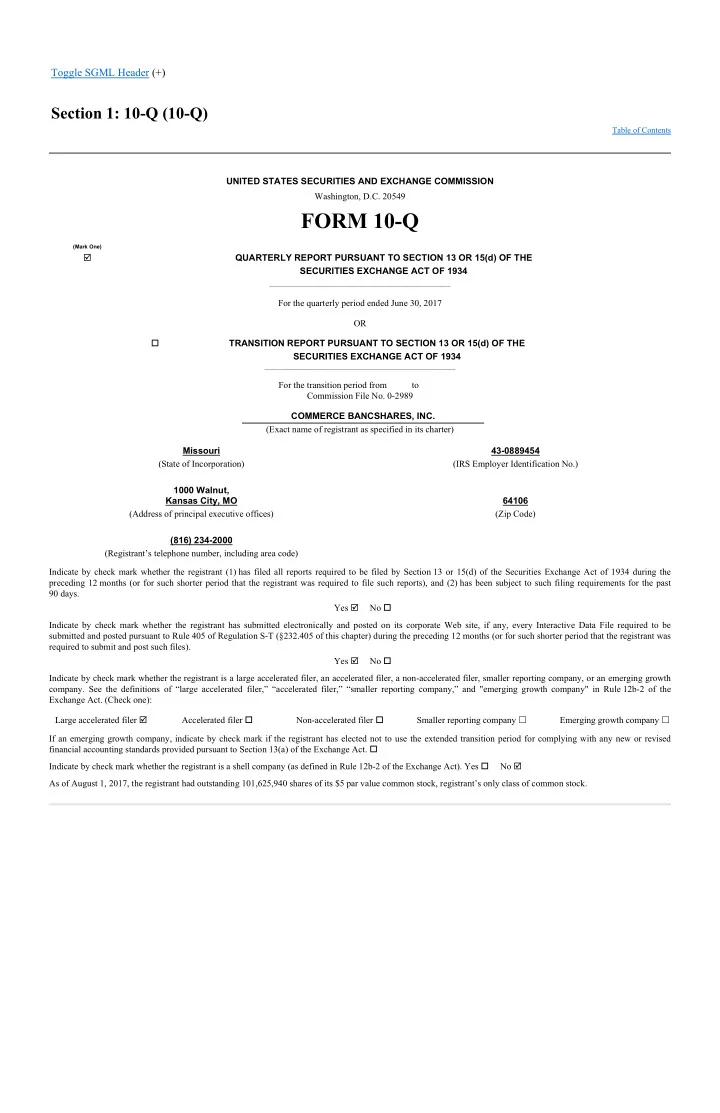
Toggle SGML Header (+) Section 1: 10-Q (10-Q) Table of Contents UNITED STATES SECURITIES AND EXCHANGE COMMISSION Washington, D.C. 20549 FORM 10-Q (Mark One) QUARTERLY REPORT PURSUANT TO SECTION 13 OR 15(d) OF THE SECURITIES EXCHANGE ACT


slide-1
SLIDE 1

Table of Contents

UNITED STATES SECURITIES AND EXCHANGE COMMISSION Washington, D.C. 20549

FORM 10-Q

_________________________________________________________

For the quarterly period ended June 30, 2017 OR

____________________________________________________________

For the transition period from to Commission File No. 0-2989 Indicate by check mark whether the registrant (1) has filed all reports required to be filed by Section 13 or 15(d) of the Securities Exchange Act of 1934 during the preceding 12 months (or for such shorter period that the registrant was required to file such reports), and (2) has been subject to such filing requirements for the past 90 days. Yes No Indicate by check mark whether the registrant has submitted electronically and posted on its corporate Web site, if any, every Interactive Data File required to be submitted and posted pursuant to Rule 405 of Regulation S-T (§232.405 of this chapter) during the preceding 12 months (or for such shorter period that the registrant was required to submit and post such files). Yes No Indicate by check mark whether the registrant is a large accelerated filer, an accelerated filer, a non-accelerated filer, smaller reporting company, or an emerging growth

  • company. See the definitions of “large accelerated filer,” “accelerated filer,” “smaller reporting company,” and "emerging growth company" in Rule 12b-2 of the

Exchange Act. (Check one): If an emerging growth company, indicate by check mark if the registrant has elected not to use the extended transition period for complying with any new or revised financial accounting standards provided pursuant to Section 13(a) of the Exchange Act. Indicate by check mark whether the registrant is a shell company (as defined in Rule 12b-2 of the Exchange Act). Yes No As of August 1, 2017, the registrant had outstanding 101,625,940 shares of its $5 par value common stock, registrant’s only class of common stock.

Toggle SGML Header (+)

Section 1: 10-Q (10-Q)

(Mark One)

  • QUARTERLY REPORT PURSUANT TO SECTION 13 OR 15(d) OF THE

SECURITIES EXCHANGE ACT OF 1934

  • TRANSITION REPORT PURSUANT TO SECTION 13 OR 15(d) OF THE

SECURITIES EXCHANGE ACT OF 1934 COMMERCE BANCSHARES, INC. (Exact name of registrant as specified in its charter) Missouri 43-0889454 (State of Incorporation) (IRS Employer Identification No.) 1000 Walnut, Kansas City, MO 64106 (Address of principal executive offices) (Zip Code) (816) 234-2000 (Registrant’s telephone number, including area code) Large accelerated filer Accelerated filer Non-accelerated filer Smaller reporting company Emerging growth company

slide-2
SLIDE 2

Commerce Bancshares, Inc. and Subsidiaries Form 10-Q

2

Page INDEX Part I Financial Information Item 1. Financial Statements Consolidated Balance Sheets as of June 30, 2017 (unaudited) and December 31, 2016 3 Consolidated Statements of Income for the Three and Six Months Ended June 30, 2017 and 2016 (unaudited) 4 Consolidated Statements of Comprehensive Income for the Three and Six Months Ended June 30, 2017 and 2016 (unaudited) 5 Consolidated Statements of Changes in Equity for the Six Months Ended June 30, 2017 and 2016 (unaudited) 6 Consolidated Statements of Cash Flows for the Six Months Ended June 30, 2017 and 2016 (unaudited) 7 Notes to Consolidated Financial Statements 8 Item 2. Management's Discussion and Analysis of Financial Condition and Results of Operations 36 Item 3. Quantitative and Qualitative Disclosures about Market Risk 59 Item 4. Controls and Procedures 60 Part II Other Information Item 1. Legal Proceedings 61 Item 2. Unregistered Sales of Equity Securities and Use of Proceeds 61 Item 6. Exhibits 61 Signatures 62 Index to Exhibits 63

slide-3
SLIDE 3

Table of Contents

PART I: FINANCIAL INFORMATION

Item 1. FINANCIAL STATEMENTS

Commerce Bancshares, Inc. and Subsidiaries CONSOLIDATED BALANCE SHEETS

See accompanying notes to consolidated financial statements.

3

June 30, 2017 December 31, 2016 (Unaudited) (In thousands)

ASSETS Loans $ 13,626,592 $ 13,412,736 Allowance for loan losses (157,832) (155,932) Net loans 13,468,760 13,256,804 Loans held for sale (including $14,118,000 and $9,263,000 of residential mortgage loans carried at fair value at June 30, 2017 and December 31, 2016, respectively) 22,002 14,456 Investment securities: Available for sale ($719,820,000 and $568,553,000 pledged at June 30, 2017 and December 31, 2016, respectively, to secure swap and repurchase agreements) 9,439,701 9,649,203 Trading 22,291 22,225 Non-marketable 102,388 99,558 Total investment securities 9,564,380 9,770,986 Federal funds sold and short-term securities purchased under agreements to resell 16,520 15,470 Long-term securities purchased under agreements to resell 625,000 725,000 Interest earning deposits with banks 80,860 272,275 Cash and due from banks 433,747 494,690 Land, buildings and equipment, net 334,586 337,705 Goodwill 138,921 138,921 Other intangible assets, net 7,002 6,709 Other assets 387,065 608,408 Total assets $ 25,078,843 $ 25,641,424 LIABILITIES AND EQUITY Deposits: Non-interest bearing $ 7,314,506 $ 7,429,398 Savings, interest checking and money market 11,427,615 11,430,789 Time open and C.D.'s of less than $100,000 679,668 713,075 Time open and C.D.'s of $100,000 and over 1,403,873 1,527,833 Total deposits 20,825,662 21,101,095 Federal funds purchased and securities sold under agreements to repurchase 1,256,444 1,723,905 Other borrowings 101,903 102,049 Other liabilities 266,627 213,243 Total liabilities 22,450,636 23,140,292 Commerce Bancshares, Inc. stockholders’ equity: Preferred stock, $1 par value Authorized 2,000,000 shares; issued 6,000 shares 144,784 144,784 Common stock, $5 par value Authorized 120,000,000 shares; issued 102,003,046 shares 510,015 510,015 Capital surplus 1,546,534 1,552,454 Retained earnings 390,853 292,849 Treasury stock of 207,294 shares at June 30, 2017 and 364,711 shares at December 31, 2016, at cost (10,373) (15,294) Accumulated other comprehensive income 42,070 10,975 Total Commerce Bancshares, Inc. stockholders' equity 2,623,883 2,495,783 Non-controlling interest 4,324 5,349 Total equity 2,628,207 2,501,132 Total liabilities and equity $ 25,078,843 $ 25,641,424

slide-4
SLIDE 4

Table of Contents

Commerce Bancshares, Inc. and Subsidiaries CONSOLIDATED STATEMENTS OF INCOME

See accompanying notes to consolidated financial statements.

4

For the Three Months Ended June 30 For the Six Months Ended June 30 (In thousands, except per share data) 2017 2016 2017 2016 (Unaudited)

INTEREST INCOME Interest and fees on loans $ 134,273 $ 121,151 $ 262,596 $ 240,484 Interest and fees on loans held for sale 263 692 459 827 Interest on investment securities 54,975 54,698 110,240 103,589 Interest on federal funds sold and short-term securities purchased under agreements to resell 37 19 60 43 Interest on long-term securities purchased under agreements to resell 3,684 3,354 7,477 6,829 Interest on deposits with banks 362 151 759 421 Total interest income 193,594 180,065 381,591 352,193 INTEREST EXPENSE Interest on deposits: Savings, interest checking and money market 4,342 3,548 8,232 7,032 Time open and C.D.'s of less than $100,000 674 709 1,318 1,451 Time open and C.D.'s of $100,000 and over 2,822 2,347 5,585 4,333 Interest on federal funds purchased and securities sold under agreements to repurchase 2,038 725 3,577 1,613 Interest on other borrowings 911 907 1,799 2,160 Total interest expense 10,787 8,236 20,511 16,589 Net interest income 182,807 171,829 361,080 335,604 Provision for loan losses 10,758 9,216 21,886 18,655 Net interest income after provision for loan losses 172,049 162,613 339,194 316,949 NON-INTEREST INCOME Bank card transaction fees 44,999 45,065 88,203 89,535 Trust fees 33,120 30,241 65,134 59,484 Deposit account charges and other fees 22,861 21,328 44,803 42,019 Capital market fees 2,156 2,500 4,498 5,225 Consumer brokerage services 3,726 3,491 7,375 7,000 Loan fees and sales 4,091 3,196 7,259 5,706 Other 12,131 10,749 22,878 26,625 Total non-interest income 123,084 116,570 240,150 235,594 INVESTMENT SECURITIES GAINS (LOSSES), NET 1,651 (744) 879 (1,739) NON-INTEREST EXPENSE Salaries and employee benefits 108,829 104,808 221,198 211,667 Net occupancy 11,430 11,092 22,873 22,395 Equipment 4,776 4,781 9,385 9,415 Supplies and communication 5,446 5,693 11,155 12,522 Data processing and software 23,356 22,770 46,453 45,669 Marketing 4,488 4,389 7,712 8,202 Deposit insurance 3,592 3,143 7,063 6,308 Other 22,677 20,413 45,585 38,384 Total non-interest expense 184,594 177,089 371,424 354,562 Income before income taxes 112,190 101,350 208,799 196,242 Less income taxes 33,201 31,542 58,108 60,912 Net income 78,989 69,808 150,691 135,330 Less non-controlling interest expense (income) 29 (85) 227 63 Net income attributable to Commerce Bancshares, Inc. 78,960 69,893 150,464 135,267 Less preferred stock dividends 2,250 2,250 4,500 4,500 Net income available to common shareholders $ 76,710 $ 67,643 $ 145,964 $ 130,767 Net income per common share — basic $ .75 $ .67 $ 1.43 $ 1.29 Net income per common share — diluted $ .75 $ .66 $ 1.43 $ 1.28

slide-5
SLIDE 5

Table of Contents

Commerce Bancshares, Inc. and Subsidiaries CONSOLIDATED STATEMENTS OF COMPREHENSIVE INCOME

See accompanying notes to consolidated financial statements.

5

For the Three Months Ended June 30 For the Six Months Ended June 30 (In thousands) 2017 2016 2017 2016 (Unaudited)

Net income $ 78,989 $ 69,808 $ 150,691 $ 135,330 Other comprehensive income (loss): Net unrealized gains (losses) on securities for which a portion of an other-than-temporary impairment has been recorded in earnings 76 — 171 (398) Net unrealized gains on other securities 11,241 31,139 30,243 101,634 Pension loss amortization 341 356 681 718 Other comprehensive income 11,658 31,495 31,095 101,954 Comprehensive income 90,647 101,303 181,786 237,284 Less non-controlling interest expense (income) 29 (85) 227 63 Comprehensive income attributable to Commerce Bancshares, Inc. $ 90,618 $ 101,388 $ 181,559 $ 237,221

slide-6
SLIDE 6

Table of Contents

Commerce Bancshares, Inc. and Subsidiaries CONSOLIDATED STATEMENTS OF CHANGES IN EQUITY

See accompanying notes to consolidated financial statements.

6

Commerce Bancshares, Inc. Shareholders (In thousands, except per share data) Preferred Stock Common Stock Capital Surplus Retained Earnings Treasury Stock Accumulated Other Comprehensive Income (Loss) Non-Controlling Interest Total (Unaudited) Balance December 31, 2016 $ 144,784 $ 510,015 $ 1,552,454 $ 292,849 $ (15,294) $ 10,975 $ 5,349 $ 2,501,132 Adoption of ASU 2016-09 3,441 (2,144) 1,297 Net income 150,464 227 150,691 Other comprehensive income 31,095 31,095 Distributions to non-controlling interest (1,252) (1,252) Purchases of treasury stock (10,628) (10,628) Issuance of stock under purchase and equity compensation plans (15,556) 15,549 (7) Stock-based compensation 6,195 6,195 Cash dividends on common stock ($.450 per share) (45,816) (45,816) Cash dividends on preferred stock ($.750 per depositary share) (4,500) (4,500) Balance June 30, 2017 $ 144,784 $ 510,015 $ 1,546,534 $ 390,853 $ (10,373) $ 42,070 $ 4,324 $ 2,628,207 Balance December 31, 2015 $ 144,784 $ 489,862 $ 1,337,677 $ 383,313 $ (26,116) $ 32,470 $ 5,428 $ 2,367,418 Net income 135,267 63 135,330 Other comprehensive income 101,954 101,954 Distributions to non-controlling interest (586) (586) Purchases of treasury stock (37,462) (37,462) Issuance of stock under purchase and equity compensation plans (11,873) 11,871 (2) Excess tax benefit related to equity compensation plans 1,904 1,904 Stock-based compensation 6,287 6,287 Cash dividends on common stock ($.429 per share) (43,522) (43,522) Cash dividends on preferred stock ($.750 per depositary share) (4,500) (4,500) Balance June 30, 2016 $ 144,784 $ 489,862 $ 1,333,995 $ 470,558 $ (51,707) $ 134,424 $ 4,905 $ 2,526,821

slide-7
SLIDE 7

Table of Contents

Commerce Bancshares, Inc. and Subsidiaries CONSOLIDATED STATEMENTS OF CASH FLOWS

See accompanying notes to consolidated financial statements.

7

For the Six Months Ended June 30 (In thousands) 2017 2016 (Unaudited)

OPERATING ACTIVITIES: Net income $ 150,691 $ 135,330 Adjustments to reconcile net income to net cash provided by operating activities: Provision for loan losses 21,886 18,655 Provision for depreciation and amortization 19,890 20,689 Amortization of investment security premiums, net 17,827 16,014 Investment securities (gains) losses, net (A) (879) 1,739 Net gains on sales of loans held for sale (3,547) (2,880) Originations of loans held for sale (96,943) (70,880) Proceeds from sales of loans held for sale 92,423 68,486 Net decrease in trading securities, excluding unsettled transactions 6,097 81,184 Stock-based compensation 6,195 6,287 (Increase) decrease in interest receivable (428) 60 Increase (decrease) in interest payable (692) 57 Increase in income taxes payable 1,483 73 Other changes, net (1,985) (9,785) Net cash provided by operating activities 212,018 265,029 INVESTING ACTIVITIES: Proceeds from sales of investment securities (A) 6,552 2,071 Proceeds from maturities/pay downs of investment securities (A) 910,411 1,109,707 Purchases of investment securities (A) (625,931) (414,154) Net increase in loans (234,405) (693,522) Repayments of long-term securities purchased under agreements to resell 100,000 50,000 Purchases of land, buildings and equipment (14,117) (13,649) Sales of land, buildings and equipment 2,527 5,399 Net cash provided by investing activities 145,037 45,852 FINANCING ACTIVITIES: Net increase (decrease) in non-interest bearing, savings, interest checking and money market deposits 77,562 (38,985) Net increase (decrease) in time open and C.D.'s (157,367) 267,339 Net decrease in federal funds purchased and short-term securities sold under agreements to repurchase (467,461) (331,280) Repayment of long-term borrowings (146) (840) Additional long-term borrowings — — 900 Purchases of treasury stock (10,628) (37,462) Issuance of stock under equity compensation plans (7) (2) Cash dividends paid on common stock (45,816) (43,522) Cash dividends paid on preferred stock (4,500) (4,500) Net cash used in financing activities (608,363) (188,352) Increase (decrease) in cash and cash equivalents (251,308) 122,529 Cash and cash equivalents at beginning of year 782,435 502,719 Cash and cash equivalents at June 30 $ 531,127 $ 625,248 (A) Available for sale and non-marketable securities Income tax payments, net $ 54,621 $ 59,886 Interest paid on deposits and borrowings $ 21,203 $ 16,532 Loans transferred to foreclosed real estate $ 461 $ 861 Loans transferred from held for investment to held for sale $ — $ 50,360

slide-8
SLIDE 8

Table of Contents

Commerce Bancshares, Inc. and Subsidiaries NOTES TO CONSOLIDATED FINANCIAL STATEMENTS

June 30, 2017 (Unaudited)

  • 1. Principles of Consolidation and Presentation

The accompanying consolidated financial statements include the accounts of Commerce Bancshares, Inc. and all majority-owned subsidiaries (the Company). Most of the Company's operations are conducted by its subsidiary bank, Commerce Bank (the Bank). The consolidated financial statements in this report have not been audited by an independent registered public accounting firm, but in the opinion of management, all adjustments necessary to present fairly the financial position and the results of

  • perations for the interim periods have been made. All such adjustments are of a normal recurring nature. All significant intercompany accounts and transactions have

been eliminated. Certain reclassifications were made to 2016 data to conform to current year presentation. In preparing the consolidated financial statements, management is required to make estimates and assumptions that affect the reported amounts of assets and liabilities as of the date of the balance sheet and revenues and expenses for the period. Actual results could differ significantly from those estimates. Management has evaluated subsequent events for potential recognition or disclosure. The results

  • f operations for the three and six month periods ended June 30, 2017 are not necessarily indicative of results to be attained for the full year or any other interim period.

The consolidated financial statements have been prepared in accordance with accounting principles generally accepted in the United States (GAAP) for interim financial information and with the instructions to Form 10-Q adopted by the Securities and Exchange Commission. Accordingly, the financial statements do not include all of the information and footnotes required by GAAP for complete financial statements and should be read in conjunction with the Company's most recent Annual Report on Form 10-K, containing the latest audited consolidated financial statements and notes thereto.

  • 2. Loans and Allowance for Loan Losses

Major classifications within the Company’s held for investment loan portfolio at June 30, 2017 and December 31, 2016 are as follows: At June 30, 2017, loans of $3.9 billion were pledged at the Federal Home Loan Bank as collateral for borrowings and letters of credit obtained to secure public

  • deposits. Additional loans of $1.6 billion were pledged at the Federal Reserve Bank as collateral for discount window borrowings.

8

(In thousands) June 30, 2017 December 31, 2016

Commercial: Business $ 4,852,408 $ 4,776,365 Real estate – construction and land 848,152 791,236 Real estate – business 2,727,349 2,643,374 Personal Banking: Real estate – personal 2,009,203 2,010,397 Consumer 2,038,514 1,990,801 Revolving home equity 403,387 413,634 Consumer credit card 740,865 776,465 Overdrafts 6,714 10,464 Total loans $ 13,626,592 $ 13,412,736

slide-9
SLIDE 9

Table of Contents

Allowance for loan losses A summary of the activity in the allowance for loan losses during the three and six months ended June 30, 2017 and 2016, respectively, follows: The following table shows the balance in the allowance for loan losses and the related loan balance at June 30, 2017 and December 31, 2016, disaggregated on the basis of impairment methodology. Impaired loans evaluated under ASC 310-10-35 include loans on non-accrual status, which are individually evaluated for impairment, and other impaired loans discussed below, which are deemed to have similar risk characteristics and are collectively evaluated. All other loans are collectively evaluated for impairment under ASC 450-20. Impaired loans The table below shows the Company’s investment in impaired loans at June 30, 2017 and December 31, 2016. These loans consist of all loans on non-accrual status and other restructured loans whose terms have been modified and classified as troubled debt restructurings. These restructured loans are performing in accordance with their modified terms, and because the Company believes it probable that all amounts due under the modified terms of the agreements will be collected, interest on these loans is being recognized on an accrual basis. They are discussed further in the "Troubled debt restructurings" section on page 14. 9

For the Three Months Ended June 30 For the Six Months Ended June 30 (In thousands) Commercial Personal Banking Total Commercial Personal Banking Total

Balance at beginning of period $ 92,951 $ 64,881 $ 157,832 $ 91,361 $ 64,571 $ 155,93 Provision (111) 10,869 10,758 1,002 20,884 21,88 Deductions: Loans charged off 531 13,415 13,946 1,077 25,745 26,82 Less recoveries on loans 430 2,758 3,188 1,453 5,383 6,83 Net loan charge-offs (recoveries) 101 10,657 10,758 (376) 20,362 19,98 Balance June 30, 2017 $ 92,739 $ 65,093 $ 157,832 $ 92,739 $ 65,093 $ 157,83 Balance at beginning of period $ 86,027 $ 66,105 $ 152,132 $ 82,086 $ 69,446 $ 151,53 Provision 1,569 7,647 9,216 5,720 12,935 18,65 Deductions: Loans charged off 661 11,984 12,645 2,174 23,761 25,93 Less recoveries on loans 2,263 2,866 5,129 3,566 6,014 9,58 Net loan charge-offs (recoveries) (1,602) 9,118 7,516 (1,392) 17,747 16,35 Balance June 30, 2016 $ 89,198 $ 64,634 $ 153,832 $ 89,198 $ 64,634 $ 153,83

Impaired Loans All Other Loans (In thousands) Allowance for Loan Losses Loans Outstanding Allowance for Loan Losses Loans Outstanding

June 30, 2017 Commercial $ 1,454 $ 44,937 $ 91,285 $ 8,382,972 Personal Banking 1,433 20,221 63,660 5,178,462 Total $ 2,887 $ 65,158 $ 154,945 $ 13,561,434 December 31, 2016 Commercial $ 1,817 $ 44,795 $ 89,544 $ 8,166,180 Personal Banking 1,292 19,737 63,279 5,182,024 Total $ 3,109 $ 64,532 $ 152,823 $ 13,348,204

(In thousands) June 30, 2017

  • Dec. 31, 2016

Non-accrual loans $ 13,362 $ 14,283 Restructured loans (accruing) 51,796 50,249 Total impaired loans $ 65,158 $ 64,532

slide-10
SLIDE 10

Table of Contents

The following table provides additional information about impaired loans held by the Company at June 30, 2017 and December 31, 2016, segregated between loans for which an allowance for credit losses has been provided and loans for which no allowance has been provided. 10

(In thousands) Recorded Investment Unpaid Principal Balance Related Allowance

June 30, 2017 With no related allowance recorded: Business $ 5,566 $ 9,000 $ — Real estate – construction and land 537 752 — $ 6,103 $ 9,752 $ — With an allowance recorded: Business $ 29,226 $ 29,821 $ 914 Real estate – construction and land 65 68 3 Real estate – business 9,543 10,961 537 Real estate – personal 6,286 9,258 570 Consumer 6,242 6,280 259 Revolving home equity 582 582 10 Consumer credit card 7,111 7,111 594 $ 59,055 $ 64,081 $ 2,887 Total $ 65,158 $ 73,833 $ 2,887 December 31, 2016 With no related allowance recorded: Business $ 7,375 $ 10,470 $ — Real estate – construction and land 557 752 — $ 7,932 $ 11,222 $ — With an allowance recorded: Business $ 29,924 $ 31,795 $ 1,318 Real estate – construction and land 69 72 3 Real estate – business 6,870 8,072 496 Real estate – personal 6,394 9,199 642 Consumer 5,281 5,281 57 Revolving home equity 584 584 1 Consumer credit card 7,478 7,478 592 $ 56,600 $ 62,481 $ 3,109 Total $ 64,532 $ 73,703 $ 3,109

slide-11
SLIDE 11

Table of Contents

Total average impaired loans for the three and six month periods ended June 30, 2017 and 2016, respectively, are shown in the table below. The table below shows interest income recognized during the three and six month periods ended June 30, 2017 and 2016, respectively, for impaired loans held at the end of each period. This interest all relates to accruing restructured loans, as discussed in the "Troubled debt restructurings" section on page 14. 11

(In thousands) Commercial Personal Banking Total

Average Impaired Loans: For the three months ended June 30, 2017 Non-accrual loans $ 9,867 $ 4,539 $ 14,406 Restructured loans (accruing) 34,765 15,780 50,545 Total $ 44,632 $ 20,319 $ 64,951 For the six months ended June 30, 2017 Non-accrual loans $ 10,238 $ 4,027 $ 14,265 Restructured loans (accruing) 33,333 15,991 49,324 Total $ 43,571 $ 20,018 $ 63,589 For the three months ended June 30, 2016 Non-accrual loans $ 22,098 $ 4,461 $ 26,559 Restructured loans (accruing) 28,775 17,297 46,072 Total $ 50,873 $ 21,758 $ 72,631 For the six months ended June 30, 2016 Non-accrual loans $ 21,551 $ 4,542 $ 26,093 Restructured loans (accruing) 27,977 17,499 45,476 Total $ 49,528 $ 22,041 $ 71,569

For the Three Months Ended June 30 For the Six Months Ended June 30 (In thousands) 2017 2016 2017 2016

Interest income recognized on impaired loans: Business $ 319 $ 236 $ 637 $ 472 Real estate – construction and land 1 3 2 5 Real estate – business 88 56 175 112 Real estate – personal 36 42 71 84 Consumer 80 89 159 177 Revolving home equity 6 4 12 7 Consumer credit card 145 159 289 318 Total $ 675 $ 589 $ 1,345 $ 1,175

slide-12
SLIDE 12

Table of Contents

Delinquent and non-accrual loans The following table provides aging information on the Company’s past due and accruing loans, in addition to the balances of loans on non-accrual status, at June 30, 2017 and December 31, 2016. Credit quality The following table provides information about the credit quality of the Commercial loan portfolio, using the Company’s internal rating system as an indicator. The internal rating system is a series of grades reflecting management’s risk assessment, based on its analysis of the borrower’s financial condition. The “pass” category consists of a range of loan grades that reflect increasing, though still acceptable, risk. Movement of risk through the various grade levels in the “pass” category is monitored for early identification of credit deterioration. The “special mention” rating is applied to loans where the borrower exhibits negative financial trends due to borrower specific or systemic conditions that, if left uncorrected, threaten its capacity to meet its debt obligations. The borrower is believed to have sufficient financial flexibility to react to and resolve its negative financial situation. It is a transitional grade that is closely monitored for improvement or deterioration. The “substandard” rating is applied to loans where the borrower exhibits well-defined weaknesses that jeopardize its continued performance and are of a severity that the distinct possibility

  • f default exists. Loans are placed on “non-accrual” when management does not expect to collect payments consistent with acceptable and agreed upon terms of

repayment. 12

(In thousands) Current or Less Than 30 Days Past Due 30 – 89 Days Past Due 90 Days Past Due and Still Accruing Non-accrual Total

June 30, 2017 Commercial: Business $ 4,842,945 $ 2,761 $ 372 $ 6,330 $ 4,852,408 Real estate – construction and land 843,289 4,319 — 544 848,152 Real estate – business 2,721,612 3,904 — 1,833 2,727,349 Personal Banking: Real estate – personal 1,997,661 6,060 1,978 3,504 2,009,203 Consumer 2,012,634 22,526 2,203 1,151 2,038,514 Revolving home equity 400,306 2,154 927 — 403,387 Consumer credit card 722,604 9,111 9,150 — 740,865 Overdrafts 6,414 300 — — 6,714 Total $ 13,547,465 $ 51,135 $ 14,630 $ 13,362 $ 13,626,592 December 31, 2016 Commercial: Business $ 4,763,274 $ 3,735 $ 674 $ 8,682 $ 4,776,365 Real estate – construction and land 789,633 1,039 — 564 791,236 Real estate – business 2,639,586 2,154 — 1,634 2,643,374 Personal Banking: Real estate – personal 1,995,724 9,162 2,108 3,403 2,010,397 Consumer 1,957,358 29,783 3,660 — 1,990,801 Revolving home equity 411,483 1,032 1,119 — 413,634 Consumer credit card 757,443 10,187 8,835 — 776,465 Overdrafts 10,014 450 — — 10,464 Total $ 13,324,515 $ 57,542 $ 16,396 $ 14,283 $ 13,412,736

slide-13
SLIDE 13

Table of Contents

The credit quality of Personal Banking loans is monitored primarily on the basis of aging/delinquency, and this information is provided in the table in the above "Delinquent and non-accrual loans" section. In addition, FICO scores are obtained and updated on a quarterly basis for most of the loans in the Personal Banking

  • portfolio. This is a published credit score designed to measure the risk of default by taking into account various factors from a borrower's financial history. The Bank

normally obtains a FICO score at the loan's origination and renewal dates, and updates are obtained on a quarterly basis. Excluded from the table below are certain Personal Banking loans for which FICO scores are not obtained because they generally pertain to commercial customer activities and are often underwritten with other collateral considerations. At June 30, 2017, these were comprised of $227.4 million in personal real estate loans, or 4.4% of the Personal Banking portfolio, compared to $237.2 million at December 31, 2016. For the remainder of loans in the Personal Banking portfolio, the table below shows the percentage of balances outstanding at June 30, 2017 and December 31, 2016 by FICO score. 13

Commercial Loans (In thousands) Business Real Estate-Construction Real Estate- Business Total

June 30, 2017 Pass $ 4,617,838 $ 843,151 $ 2,629,544 $ 8,090,533 Special mention 180,380 1,754 44,279 226,413 Substandard 47,860 2,703 51,693 102,256 Non-accrual 6,330 544 1,833 8,707 Total $ 4,852,408 $ 848,152 $ 2,727,349 $ 8,427,909 December 31, 2016 Pass $ 4,607,553 $ 788,778 $ 2,543,348 $ 7,939,679 Special mention 116,642 722 45,479 162,843 Substandard 43,488 1,172 52,913 97,573 Non-accrual 8,682 564 1,634 10,880 Total $ 4,776,365 $ 791,236 $ 2,643,374 $ 8,210,975

Personal Banking Loans % of Loan Category Real Estate - Personal Consumer Revolving Home Equity Consumer Credit Card

June 30, 2017 FICO score: Under 600 1.2% 3.2% 1.0% 4.9% 600 - 659 2.7 5.7 1.8 14.8 660 - 719 10.6 18.5 9.5 34.8 720 - 779 26.1 26.9 21.8 25.8 780 and over 59.4 45.7 65.9 19.7 Total 100.0% 100.0% 100.0% 100.0% December 31, 2016 FICO score: Under 600 1.3% 3.4% 1.0% 4.9% 600 - 659 2.6 6.4 1.8 15.5 660 - 719 10.4 19.7 9.7 34.9 720 - 779 25.4 26.3 21.1 25.1 780 and over 60.3 44.2 66.4 19.6 Total 100.0% 100.0% 100.0% 100.0%

slide-14
SLIDE 14

Table of Contents

Troubled debt restructurings As mentioned previously, the Company's impaired loans include loans which have been classified as troubled debt restructurings. Total restructured loans amounted to $59.2 million at June 30, 2017. Restructured loans are those extended to borrowers who are experiencing financial difficulty and who have been granted a concession. Restructured loans are placed on non-accrual status if the Company does not believe it probable that amounts due under the contractual terms will be collected, and those non-accrual loans totaled $7.4 million at June 30, 2017. Other performing restructured loans totaled $51.8 million at June 30, 2017. These include certain business, construction and business real estate loans classified as substandard. Upon maturity, the loans renewed at interest rates judged not to be market rates for new debt with similar risk and as a result the loans were classified as troubled debt restructurings. These commercial loans totaled $36.8 million at June 30, 2017. These restructured loans are performing in accordance with their modified terms, and because the Company believes it probable that all amounts due under the modified terms of the agreements will be collected, interest on these loans is being recognized on an accrual basis. Troubled debt restructurings also include certain credit card loans under various debt management and assistance programs, which totaled $7.1 million at June 30, 2017. Modifications to credit card loans generally involve removing the available line of credit, placing loans on amortizing status, and lowering the contractual interest rate. The Company has classified additional loans as troubled debt restructurings because they were not reaffirmed by the borrower in bankruptcy proceedings. At June 30, 2017, these loans totaled $7.6 million in personal real estate, revolving home equity, and consumer loans. Interest on these loans is being recognized on an accrual basis, as the borrowers are continuing to make payments under the terms of the loan agreements. The following table shows the outstanding balances of loans classified as troubled debt restructurings at June 30, 2017, in addition to the outstanding balances of these restructured loans which the Company considers to have been in default at any time during the past twelve months. For purposes of this disclosure, the Company considers "default" to mean 90 days or more past due as to interest or principal. For those loans on non-accrual status also classified as restructured, the modification did not create any further financial effect on the Company as those loans were already recorded at net realizable value. For those performing commercial loans classified as restructured, there were no concessions involving forgiveness of principal or interest and, therefore, there was no financial impact to the Company as a result of modification to these loans. No financial impact resulted from those performing loans where the debt was not reaffirmed in bankruptcy, as no changes to loan terms occurred in that process. The effects of modifications to consumer credit card loans were estimated to decrease interest income by approximately $862 thousand on an annual, pre-tax basis, compared to amounts contractually owed. The allowance for loan losses related to troubled debt restructurings on non-accrual status is determined by individual evaluation, including collateral adequacy, using the same process as loans on non-accrual status which are not classified as troubled debt restructurings. Those performing loans classified as troubled debt restructurings are accruing loans which management expects to collect under contractual terms. Performing commercial loans have had no other concessions granted other than being renewed at an interest rate judged not to be market. As such, they have similar risk characteristics as non-troubled debt commercial loans and are collectively evaluated based on internal risk rating, loan type, delinquency, historical experience and current economic factors. Performing personal banking loans classified as troubled debt restructurings resulted from the borrower not reaffirming the debt during bankruptcy and have had no other concession granted, other than the Bank's future limitations on collecting payment deficiencies or in pursuing foreclosure actions. As such, they have similar risk characteristics as non-troubled debt personal banking loans and are evaluated collectively based on loan type, delinquency, historical experience and current economic factors. If a troubled debt restructuring defaults and is already on non-accrual status, the allowance for loan losses continues to be based on individual evaluation, using discounted expected cash flows or the fair value of collateral. If an accruing troubled debt 14

(In thousands) June 30, 2017 Balance 90 days past due at any time during previous 12 months

Commercial: Business $ 34,088 $ — Real estate - construction and land 537 — Real estate - business 7,710 — Personal Banking: Real estate - personal 3,995 353 Consumer 5,149 50 Revolving home equity 582 47 Consumer credit card 7,111 649 Total restructured loans $ 59,172 $ 1,099

slide-15
SLIDE 15

Table of Contents

restructuring defaults, the loan's risk rating is downgraded to non-accrual status and the loan's related allowance for loan losses is determined based on individual evaluation, or if necessary, the loan is charged off and collection efforts begun. The Company had commitments of $3.6 million at June 30, 2017 to lend additional funds to borrowers with restructured loans. Loans held for sale The Company designates certain long-term fixed rate personal real estate loans as held for sale, and the Company has elected the fair value option for these loans. The election of the fair value option aligns the accounting for these loans with the related economic hedges discussed in Note 10. The loans are primarily sold to FNMA, FHLMC, and GNMA. At June 30, 2017, the fair value of these loans was $14.1 million, and the unpaid principal balance was $13.6 million. The Company also designates student loan originations as held for sale. The borrowers are credit-worthy students who are attending colleges and universities. The loans are intended to be sold in the secondary market, and the Company maintains contracts with Sallie Mae to sell the loans within 210 days after the last disbursement to the student. These loans are carried at lower of cost or fair value, which at June 30, 2017 totaled $7.9 million. At June 30, 2017, none of the loans held for sale were on non-accrual status or 90 days past due and still accruing. Foreclosed real estate/repossessed assets The Company’s holdings of foreclosed real estate totaled $515 thousand and $366 thousand at June 30, 2017 and December 31, 2016, respectively. Personal property acquired in repossession, generally autos and marine and recreational vehicles, totaled $2.4 million and $2.2 million at June 30, 2017 and December 31, 2016,

  • respectively. Upon acquisition, these assets are recorded at fair value less estimated selling costs at the date of foreclosure, establishing a new cost basis. They are

subsequently carried at the lower of this cost basis or fair value less estimated selling costs.

  • 3. Investment Securities

Investment securities, at fair value, consisted of the following at June 30, 2017 and December 31, 2016. Most of the Company’s investment securities are classified as available for sale, and this portfolio is discussed in more detail below. The available for sale and the trading portfolios are carried at fair value. Securities which are classified as non-marketable include Federal Home Loan Bank (FHLB) stock and Federal Reserve Bank stock held for debt and regulatory purposes, which totaled $47.1 million at June 30, 2017 and $46.9 million at December 31, 2016. Investment in Federal Reserve Bank stock is based on the capital structure of the investing bank, and investment in FHLB stock is tied to the level of borrowings from the FHLB. These holdings are carried at

  • cost. Non-marketable securities also include private equity investments, which amounted to $55.0 million at June 30, 2017 and $52.3 million at December 31, 2016. In the

absence of readily ascertainable market values, these securities are carried at estimated fair value. 15

(In thousands) June 30, 2017 December 31, 2016

Available for sale $ 9,439,701 $ 9,649,203 Trading 22,291 22,225 Non-marketable 102,388 99,558 Total investment securities $ 9,564,380 $ 9,770,986

slide-16
SLIDE 16

Table of Contents

A summary of the available for sale investment securities by maturity groupings as of June 30, 2017 is shown below. The investment portfolio includes agency mortgage-backed securities, which are guaranteed by agencies such as the FHLMC, FNMA, GNMA and FDIC, in addition to non-agency mortgage-backed securities, which have no guarantee but are collateralized by residential mortgages. Also included are certain other asset-backed securities, which are primarily collateralized by credit cards, automobiles, student loans, and commercial loans. These securities differ from traditional debt securities primarily in that they may have uncertain maturity dates and are priced based on estimated prepayment rates on the underlying collateral. Investments in U.S. government and federal agency obligations include U.S. Treasury inflation-protected securities, which totaled $432.0 million, at fair value, at June 30, 2017. Interest paid on these securities increases with inflation and decreases with deflation, as measured by the Consumer Price Index. Included in state and municipal

  • bligations are $16.8 million, at fair value, of auction rate securities, which were purchased from bank customers in 2008. Interest on these bonds is currently being paid

at the maximum failed auction rates. Included in equity securities is common and preferred stock held by the holding company, Commerce Bancshares, Inc. (the Parent), with a fair value of $47.7 million at June 30, 2017. 16

(In thousands) Amortized Cost Fair Value

U.S. government and federal agency obligations: Within 1 year $ 58,665 $ 58,829 After 1 but within 5 years 499,601 502,990 After 5 but within 10 years 318,318 318,212 After 10 years 35,444 32,524 Total U.S. government and federal agency obligations 912,028 912,555 Government-sponsored enterprise obligations: Within 1 year 98,069 98,206 After 1 but within 5 years 336,302 335,723 After 10 years 12,493 12,356 Total government-sponsored enterprise obligations 446,864 446,285 State and municipal obligations: Within 1 year 171,936 172,890 After 1 but within 5 years 643,200 654,145 After 5 but within 10 years 879,036 900,292 After 10 years 50,896 50,470 Total state and municipal obligations 1,745,068 1,777,797 Mortgage and asset-backed securities: Agency mortgage-backed securities 2,604,217 2,620,198 Non-agency mortgage-backed securities 1,063,236 1,066,889 Asset-backed securities 2,249,399 2,250,426 Total mortgage and asset-backed securities 5,916,852 5,937,513 Other debt securities: Within 1 year 13,387 13,389 After 1 but within 5 years 176,199 177,812 After 5 but within 10 years 125,910 126,503 Total other debt securities 315,496 317,704 Equity securities 5,463 47,847 Total available for sale investment securities $ 9,341,771 $ 9,439,701

slide-17
SLIDE 17

Table of Contents

For securities classified as available for sale, the following table shows the unrealized gains and losses (pre-tax) in accumulated other comprehensive income, by security type. The Company’s impairment policy requires a review of all securities for which fair value is less than amortized cost. Special emphasis and analysis is placed on securities whose credit rating has fallen below A3 (Moody's) or A- (Standard & Poor's), whose fair values have fallen more than 20% below purchase price for an extended period of time, or have been identified based on management’s judgment. These securities are placed on a watch list, and for all such securities, cash flow analyses are prepared. For more complex analyses, detailed cash flow models are prepared which use inputs specific to each security. Inputs to these models include factors such as cash flow received, contractual payments required, and various other information related to the underlying collateral (including current delinquencies), collateral loss severity rates (including loan to values), expected delinquency rates, credit support from other tranches, and prepayment speeds. Stress tests are performed at varying levels of delinquency rates, prepayment speeds and loss severities in order to gauge probable ranges of credit loss. At June 30, 2017, the fair value of securities

  • n this watch list was $68.9 million compared to $79.6 million at December 31, 2016.

As of June 30, 2017, the Company had recorded other-than-temporary impairment (OTTI) on certain non-agency mortgage-backed securities, part of the watch list mentioned above, which had an aggregate fair value of $30.3 million. The cumulative credit-related portion of the impairment on these securities, which was recorded in earnings, totaled $14.3 million. The Company does not intend to sell these securities and believes it is not likely that it will be required to sell the securities before the recovery of their amortized cost. The credit-related portion of the loss on these securities was based on the cash flows projected to be received over the estimated life of the securities, discounted to present value, and compared to the current amortized cost bases of the securities. Significant inputs to the cash flow models used to calculate the credit losses on these securities at June 30, 2017 included the following: 17

(In thousands) Amortized Cost Gross Unrealized Gains Gross Unrealized Losses Fair Value

June 30, 2017 U.S. government and federal agency obligations $ 912,028 $ 5,575 $ (5,048) $ 912,555 Government-sponsored enterprise obligations 446,864 892 (1,471) 446,285 State and municipal obligations 1,745,068 34,717 (1,988) 1,777,797 Mortgage and asset-backed securities: Agency mortgage-backed securities 2,604,217 29,780 (13,799) 2,620,198 Non-agency mortgage-backed securities 1,063,236 8,063 (4,410) 1,066,889 Asset-backed securities 2,249,399 5,725 (4,698) 2,250,426 Total mortgage and asset-backed securities 5,916,852 43,568 (22,907) 5,937,513 Other debt securities 315,496 2,745 (537) 317,704 Equity securities 5,463 42,384 — 47,847 Total $ 9,341,771 $ 129,881 $ (31,951) $ 9,439,701 December 31, 2016 U.S. government and federal agency obligations $ 919,904 $ 7,312 $ (6,312) $ 920,904 Government-sponsored enterprise obligations 450,448 1,126 (1,576) 449,998 State and municipal obligations 1,778,684 12,223 (12,693) 1,778,214 Mortgage and asset-backed securities: Agency mortgage-backed securities 2,674,964 31,610 (20,643) 2,685,931 Non-agency mortgage-backed securities 1,054,446 7,686 (6,493) 1,055,639 Asset-backed securities 2,389,176 3,338 (11,213) 2,381,301 Total mortgage and asset-backed securities 6,118,586 42,634 (38,349) 6,122,871 Other debt securities 327,030 935 (2,012) 325,953 Equity securities 5,678 45,585 — 51,263 Total $ 9,600,330 $ 109,815 $ (60,942) $ 9,649,203

Significant Inputs Range

Prepayment CPR 4%

  • 25%

Projected cumulative default 14%

  • 51%

Credit support 0%

  • 38%

Loss severity 16%

  • 63%
slide-18
SLIDE 18

Table of Contents

The following table presents a rollforward of the cumulative OTTI credit losses recognized in earnings on all available for sale debt securities. Securities with unrealized losses recorded in accumulated other comprehensive income are shown in the table below, along with the length of the impairment period. The Company’s holdings of state and municipal obligations included gross unrealized losses of $2.0 million at June 30, 2017, of which $230 thousand related to auction rate securities. This portfolio totaled $1.8 billion at fair value, or 18.8% of total available for sale securities. The average credit quality of the portfolio, excluding auction rate securities, is Aa2 as rated by Moody’s. The portfolio is diversified in order to reduce risk, and the Company has processes and procedures in place to monitor its holdings, identify signs of financial distress and, if necessary, exit its positions in a timely manner. 18

For the Six Months Ended June 30 (In thousands) 2017 2016

Cumulative OTTI credit losses at January 1 $ 14,080 $ 14,129 Credit losses on debt securities for which impairment was not previously recognized 46 — Credit losses on debt securities for which impairment was previously recognized 274 270 Increase in expected cash flows that are recognized over remaining life of security (146) (37) Cumulative OTTI credit losses at June 30 $ 14,254 $ 14,362

Less than 12 months 12 months or longer Total (In thousands) Fair Value Unrealized Losses Fair Value Unrealized Losses Fair Value Unrealized Losses

June 30, 2017 U.S. government and federal agency obligations $ 145,884 $ 5,048 $ — $ — $ 145,884 $ 5,048 Government-sponsored enterprise obligations 181,682 1,471 — — 181,682 1,471 State and municipal obligations 168,613 1,365 13,761 623 182,374 1,988 Mortgage and asset-backed securities: Agency mortgage-backed securities 959,777 13,795 1,720 4 961,497 13,799 Non-agency mortgage-backed securities 503,709 4,165 47,189 245 550,898 4,410 Asset-backed securities 795,526 2,606 234,619 2,092 1,030,145 4,698 Total mortgage and asset-backed securities 2,259,012 20,566 283,528 2,341 2,542,540 22,907 Other debt securities 65,547 500 1,463 37 67,010 537 Total $ 2,820,738 $ 28,950 $ 298,752 $ 3,001 $ 3,119,490 $ 31,951 December 31, 2016 U.S. government and federal agency obligations $ 349,538 $ 2,823 $ 32,208 $ 3,489 $ 381,746 $ 6,312 Government-sponsored enterprise obligations 190,441 1,576 — — 190,441 1,576 State and municipal obligations 700,779 12,164 15,195 529 715,974 12,693 Mortgage and asset-backed securities: Agency mortgage-backed securities 1,147,416 20,638 2,150 5 1,149,566 20,643 Non-agency mortgage-backed securities 688,131 6,373 34,946 120 723,077 6,493 Asset-backed securities 780,209 5,277 358,778 5,936 1,138,987 11,213 Total mortgage and asset-backed securities 2,615,756 32,288 395,874 6,061 3,011,630 38,349 Other debt securities 179,639 1,986 975 26 180,614 2,012 Total $ 4,036,153 $ 50,837 $ 444,252 $ 10,105 $ 4,480,405 $ 60,942

slide-19
SLIDE 19

Table of Contents

The following tables present proceeds from sales of securities and the components of investment securities gains and losses which have been recognized in earnings. At June 30, 2017, securities totaling $3.9 billion in fair value were pledged to secure public fund deposits, securities sold under agreements to repurchase, trust funds, and borrowings at the Federal Reserve Bank and FHLB. Securities pledged under agreements pursuant to which the collateral may be sold or re-pledged by the secured parties approximated $719.8 million, while the remaining securities were pledged under agreements pursuant to which the secured parties may not sell or re-pledge the

  • collateral. Except for obligations of various government-sponsored enterprises such as FNMA, FHLB and FHLMC, no investment in a single issuer exceeded 10% of

stockholders’ equity. 19

For the Six Months Ended June 30 (In thousands) 2017 2016

Proceeds from sales of securities: Available for sale $ 4,972 $ — Non-marketable 1,580 2,071 Total proceeds $ 6,552 $ 2,071 Investment securities gains (losses), net: Available for sale: Losses realized on called bonds $ (254) $ — Losses realized on sales (22) — Gains realized on donations 4,315 — Other-than-temporary impairment recognized on debt securities (320) (270) Non-marketable: Gains realized on sales 642 2,260 Losses realized on sales (652) — Fair value adjustments, net (2,830) (3,729) Total gains (losses), net $ 879 $ (1,739)

slide-20
SLIDE 20

Table of Contents

  • 4. Goodwill and Other Intangible Assets

The following table presents information about the Company's intangible assets which have estimable useful lives. Aggregate amortization expense on intangible assets was $330 thousand and $399 thousand for the three month periods ended June 30, 2017 and 2016, respectively, and $678 thousand and $794 thousand for the six month periods ended June 30, 2017 and 2016, respectively. The following table shows the estimated annual amortization expense for the next five fiscal years. This expense is based on existing asset balances and the interest rate environment as of June 30, 2017. The Company’s actual amortization expense in any given period may be different from the estimated amounts depending upon the acquisition of intangible assets, changes in mortgage interest rates, prepayment rates and other market conditions. Changes in the carrying amount of goodwill and net other intangible assets for the six month period ended June 30, 2017 is as follows: Goodwill allocated to the Company’s operating segments at June 30, 2017 and December 31, 2016 is shown below.

  • 5. Guarantees

The Company, as a provider of financial services, routinely issues financial guarantees in the form of financial and performance standby letters of credit. Standby letters of credit are contingent commitments issued by the Company generally to guarantee the payment or performance obligation of a customer to a third party. While these represent a potential outlay by the Company, a significant amount of the commitments may expire without being drawn upon. The Company has recourse against the customer for any amount it is required to pay to a third party under a standby letter of credit. The letters of credit are subject to the same credit policies, underwriting standards and approval process as loans made by the Company. Most of the standby letters of credit are secured, and in the event of nonperformance by customers, the Company has rights to the underlying collateral, which could include commercial real estate, physical plant and property, inventory, receivables, cash and marketable securities. 20

June 30, 2017 December 31, 2016 (In thousands) Gross Carrying Amount Accumulated Amortization Valuation Allowance Net Amount Gross Carrying Amount Accumulated Amortization Valuation Allowance Net Amount

Amortizable intangible assets: Core deposit premium $ 31,270 $ (27,914) $ — $ 3,356 $ 31,270 $ (27,429) $ — $ 3,841 Mortgage servicing rights 6,637 (2,975) (16) 3,646 5,672 (2,782) (22) 2,868 Total $ 37,907 $ (30,889) $ (16) $ 7,002 $ 36,942 $ (30,211) $ (22) $ 6,709

(In thousands)

2017 $ 1,141 2018 1,091 2019 917 2020 765 2021 651

(In thousands) Goodwill Core Deposit Premium Mortgage Servicing Rights

Balance January 1, 2017 $ 138,921 $ 3,841 $ 2,868 Originations — — 965 Amortization — (485) (193) Impairment reversal — — 6 Balance June 30, 2017 $ 138,921 $ 3,356 $ 3,646

(In thousands)

Consumer segment $ 70,721 Commercial segment 67,454 Wealth segment 746 Total goodwill $ 138,921

slide-21
SLIDE 21

Table of Contents

Upon issuance of standby letters of credit, the Company recognizes a liability for the fair value of the obligation undertaken, which is estimated to be equivalent to the amount of fees received from the customer over the life of the agreement. At June 30, 2017, that net liability was $2.1 million, which will be accreted into income over the remaining life of the respective commitments. The contractual amount of these letters of credit, which represents the maximum potential future payments guaranteed by the Company, was $338.8 million at June 30, 2017. The Company periodically enters into credit risk participation agreements (RPAs) as a guarantor to other financial institutions, in order to mitigate those institutions’ credit risk associated with interest rate swaps with third parties. The RPA stipulates that, in the event of default by the third party on the interest rate swap, the Company will reimburse a portion of the loss borne by the financial institution. These interest rate swaps are normally collateralized (generally with real property, inventories and equipment) by the third party, which limits the credit risk associated with the Company’s RPAs. The third parties usually have other borrowing relationships with the

  • Company. The Company monitors overall borrower collateral and at June 30, 2017, believes sufficient collateral is available to cover potential swap losses. The RPAs are

carried at fair value throughout their term with all changes in fair value, including those due to a change in the third party’s creditworthiness, recorded in current earnings. The terms of the RPAs, which correspond to the terms of the underlying swaps, range from 3 to 11 years. At June 30, 2017, the fair value of the Company's guarantee liabilities for RPAs was $139 thousand, and the notional amount of the underlying swaps was $75.3 million. The maximum potential future payment guaranteed by the Company cannot be readily estimated but is dependent upon the fair value of the interest rate swaps at the time of default.

  • 6. Pension

The amount of net pension cost is shown in the table below: Substantially all benefits accrued under the Company’s defined benefit pension plan were frozen effective January 1, 2005, and the remaining benefits were frozen effective January 1, 2011. During the first six months of 2017, the Company made no funding contributions to its defined benefit pension plan and made minimal funding contributions to a supplemental executive retirement plan (the CERP), which carries no segregated assets. The Company has no plans to make any further contributions,

  • ther than those related to the CERP, during the remainder of 2017.

21

For the Three Months Ended June 30 For the Six Months Ended June 30 (In thousands) 2017 2016 2017 2016

Service cost - benefits earned during the period $ 128 $ 138 $ 257 $ 271 Interest cost on projected benefit obligation 973 1,005 1,946 1,972 Expected return on plan assets (1,438) (1,439) (2,876) (2,876) Amortization of prior service cost (68) (67) (136) (135) Amortization of unrecognized net loss 617 642 1,234 1,293 Net periodic pension cost $ 212 $ 279 $ 425 $ 525

slide-22
SLIDE 22

Table of Contents

  • 7. Common Stock *

Presented below is a summary of the components used to calculate basic and diluted income per share. The Company applies the two-class method of computing income per share, as nonvested share-based awards that contain nonforfeitable rights to dividends are considered securities which participate in undistributed earnings with common stock. The two-class method requires the calculation of separate income per share amounts for the nonvested share-based awards and for common stock. Income per share attributable to common stock is shown in the table below. Nonvested share-based awards are further discussed in Note 12. Unexercised stock appreciation rights of 126 thousand and 208 thousand were excluded in the computation of diluted income per common share for the six month periods ended June 30, 2017 and 2016, respectively, because their inclusion would have been anti-dilutive.

* All prior year share and per share amounts in this note have been restated for the 5% common stock dividend distributed in December 2016.

22

For the Three Months Ended June 30 For the Six Months Ended June 30 (In thousands, except per share data) 2017 2016 2017 2016

Basic income per common share: Net income attributable to Commerce Bancshares, Inc. $ 78,960 $ 69,893 $ 150,464 $ 135,267 Less preferred stock dividends 2,250 2,250 4,500 4,500 Net income available to common shareholders $ 76,710 $ 67,643 145,964 130,767 Less income allocated to nonvested restricted stock 943 940 1,888 1,834 Net income allocated to common stock $ 75,767 $ 66,703 $ 144,076 $ 128,933 Weighted average common shares outstanding 100,555 100,151 100,463 100,247 Basic income per common share $ .75 $ .67 $ 1.43 $ 1.29 Diluted income per common share: Net income available to common shareholders $ 76,710 $ 67,643 $ 145,964 $ 130,767 Less income allocated to nonvested restricted stock 941 938 1,883 1,831 Net income allocated to common stock $ 75,769 $ 66,705 $ 144,081 $ 128,936 Weighted average common shares outstanding 100,555 100,151 100,463 100,247 Net effect of the assumed exercise of stock-based awards - based on the treasury stock method using the average market price for the respective periods 344 261 370 245 Weighted average diluted common shares outstanding 100,899 100,412 100,833 100,492 Diluted income per common share $ .75 $ .66 $ 1.43 $ 1.28

slide-23
SLIDE 23

Table of Contents

  • 8. Accumulated Other Comprehensive Income

The table below shows the activity and accumulated balances for components of other comprehensive income. The largest component is the unrealized holding gains and losses on available for sale securities. Unrealized gains and losses on debt securities for which an other-than-temporary impairment (OTTI) has been recorded in current earnings are shown separately below. The other component is the amortization from other comprehensive income of losses associated with pension benefits, which

  • ccurs as the losses are included in current net periodic pension cost.

(1) The pre-tax amounts reclassified from accumulated other comprehensive income are included in "investment securities gains (losses), net" in the consolidated statements of income. (2) The pre-tax amounts reclassified from accumulated other comprehensive income are included in the computation of net periodic pension cost as "amortization of prior service cost" and "amortization of unrecognized net loss" (see Note 6), for inclusion in the consolidated statements of income.

  • 9. Segments

The Company segregates financial information for use in assessing its performance and allocating resources among three operating segments: Consumer, Commercial and Wealth. The Consumer segment consists of various consumer loan and deposit products offered through its retail branch network of approximately 180 locations. This segment also includes indirect and other consumer loan financing businesses, along with debit and credit card loan and fee businesses. Residential mortgage

  • rigination, sales and servicing functions are included in this consumer segment, but residential mortgage loans retained by the Company are not considered part of this
  • segment. The Commercial segment provides corporate lending, leasing, and international services, along with business and governmental deposit products and

commercial cash management services. This segment includes both merchant and commercial bank card products. It also includes the Capital Markets Group which sells fixed income securities and provides safekeeping and accounting services to its business and correspondent bank customers. The Wealth segment provides traditional trust and estate planning, advisory and discretionary investment management, and brokerage services. This segment also provides various loan and deposit related services to its private banking customers. 23

Unrealized Gains (Losses) on Securities (1) Pension Loss (2) Total Accumulated Other Comprehensive Income (In thousands) OTTI Other

Balance January 1, 2017 $ 2,975 $ 27,328 $ (19,328) $ 10,975 Other comprehensive income (loss) before reclassifications (44) 53,072 — 53,028 Amounts reclassified from accumulated other comprehensive income 320 (4,293) 1,098 (2,875) Current period other comprehensive income, before tax 276 48,779 1,098 50,153 Income tax expense (105) (18,536) (417) (19,058) Current period other comprehensive income, net of tax 171 30,243 681 31,095 Transfer of unrealized gain on securities for which impairment was not previously recognized 24 (24) — — Balance June 30, 2017 $ 3,170 $ 57,547 $ (18,647) $ 42,070 Balance January 1, 2016 $ 3,316 $ 49,750 $ (20,596) $ 32,470 Other comprehensive income (loss) before reclassifications (911) 163,925 — 163,014 Amounts reclassified from accumulated other comprehensive income 270 — 1,158 1,428 Current period other comprehensive income (loss), before tax (641) 163,925 1,158 164,442 Income tax (expense) benefit 243 (62,291) (440) (62,488) Current period other comprehensive income (loss), net of tax (398) 101,634 718 101,954 Balance June 30, 2016 $ 2,918 $ 151,384 $ (19,878) $ 134,424

slide-24
SLIDE 24

Table of Contents

The following table presents selected financial information by segment and reconciliations of combined segment totals to consolidated totals. There were no material intersegment revenues among the three segments. Management periodically makes changes to methods of assigning costs and income to its business segments to better reflect operating results. If appropriate, these change are reflected in prior year information presented below. The information presented above was derived from the internal profitability reporting system used by management to monitor and manage the financial performance of the Company. This information is based on internal management accounting procedures and methods, which have been developed to reflect the underlying economics of the businesses. The methodologies are applied in connection with funds transfer pricing and assignment of overhead costs among segments. Funds transfer pricing was used in the determination of net interest income by assigning a standard cost (credit) for funds used (provided) by assets and liabilities based on their maturity, prepayment and/or repricing characteristics. The segment activity, as shown above, includes both direct and allocated items. Amounts in the “Other/Elimination” column include activity not related to the segments, such as that relating to administrative functions, the investment securities portfolio, and the effect of certain expense allocations to the segments. The provision for loan losses in this category contains the difference between net loan charge-offs assigned directly to the segments and the recorded provision for loan loss expense. Included in this category’s net interest income are earnings of the investment portfolio, which are not allocated to a segment. The performance measurement of the operating segments is based on the management structure of the Company and is not necessarily comparable with similar information for any other financial institution. The information is also not necessarily indicative of the segments' financial condition and results of operations if they were independent entities. 24

(In thousands) Consumer Commercial Wealth Segment Totals Other/Elimination Consolidated Totals

Three Months Ended June 30, 2017 Net interest income $ 69,274 $ 81,718 $ 11,933 $ 162,925 $ 19,882 $ 182,807 Provision for loan losses (10,802) 111 24 (10,667) (91) (10,758) Non-interest income 34,459 49,746 38,851 123,056 28 123,084 Investment securities gains, net — — — — 1,651 1,651 Non-interest expense (73,603) (74,054) (29,446) (177,103) (7,491) (184,594) Income before income taxes $ 19,328 $ 57,521 $ 21,362 $ 98,211 $ 13,979 $ 112,190 Six Months Ended June 30, 2017 Net interest income $ 136,628 $ 161,505 $ 23,771 $ 321,904 $ 39,176 $ 361,080 Provision for loan losses (20,464) 624 1 (19,839) (2,047) (21,886) Non-interest income 66,017 96,879 76,557 239,453 697 240,150 Investment securities gains, net — — — — 879 879 Non-interest expense (145,126) (147,839) (59,795) (352,760) (18,664) (371,424) Income before income taxes $ 37,055 $ 111,169 $ 40,534 $ 188,758 $ 20,041 $ 208,799 Three Months Ended June 30, 2016 Net interest income $ 67,227 $ 77,249 $ 10,947 $ 155,423 $ 16,406 $ 171,829 Provision for loan losses (8,775) 1,468 (9) (7,316) (1,900) (9,216) Non-interest income 33,038 48,289 36,618 117,945 (1,375) 116,570 Investment securities losses, net — — — — (744) (744) Non-interest expense (70,522) (70,637) (28,356) (169,515) (7,574) (177,089) Income before income taxes $ 20,968 $ 56,369 $ 19,200 $ 96,537 $ 4,813 $ 101,350 Six Months Ended June 30, 2016 Net interest income $ 133,791 $ 153,266 $ 21,822 $ 308,879 $ 26,725 $ 335,604 Provision for loan losses (17,500) 1,487 (115) (16,128) (2,527) (18,655) Non-interest income 62,935 99,408 71,020 233,363 2,231 235,594 Investment securities losses, net — — — — (1,739) (1,739) Non-interest expense (139,526) (140,250) (56,944) (336,720) (17,842) (354,562) Income before income taxes $ 39,700 $ 113,911 $ 35,783 $ 189,394 $ 6,848 $ 196,242

slide-25
SLIDE 25

Table of Contents

  • 10. Derivative Instruments

The notional amounts of the Company’s derivative instruments are shown in the table below. These contractual amounts, along with other terms of the derivative, are used to determine amounts to be exchanged between counterparties and are not a measure of loss exposure. The Company’s derivative instruments are accounted for as free-standing derivatives, and changes in their fair value are recorded in current earnings. The largest group of notional amounts relate to interest rate swap contracts sold to commercial customers who wish to modify their interest rate sensitivity. These swaps are offset by matching contracts purchased by the Company from other financial dealer institutions. Contracts with dealers that require central clearing are novated to a regulated clearing organization who becomes the Company's legal counterparty. Because of the matching terms of the offsetting contracts, in addition to collateral provisions which mitigate the impact of non-performance risk, changes in fair value subsequent to initial recognition have a minimal effect on earnings. Many of the Company’s interest rate swap contracts with large financial institutions contain contingent features relating to debt ratings or capitalization levels. Under these provisions, if the Company’s debt rating falls below investment grade or if the Company ceases to be “well-capitalized” under risk-based capital guidelines, certain counterparties can require immediate and ongoing collateralization on interest rate swaps in net liability positions or instant settlement of the contracts. The Company maintains debt ratings and capital well above these minimum requirements. The Company also contracts with other financial institutions, as a guarantor or beneficiary, to share credit risk associated with certain interest rate swaps through risk participation agreements. The Company’s risks and responsibilities as guarantor are further discussed in Note 5 on Guarantees. In addition, the Company enters into foreign exchange contracts, which are mainly comprised of contracts to purchase or deliver foreign currencies for customers at specific future dates. Under its program to sell residential mortgage loans in the secondary market, the Company designates certain newly-originated residential mortgage loans as held for

  • sale. Derivative instruments arising from this activity include mortgage loan commitments and forward loan sale commitments. Changes in the fair values of the loan

commitments and funded loans prior to sale that are due to changes in interest rates are economically hedged with forward contracts to sell residential mortgage-backed securities in the to-be-announced (TBA) market. These forward TBA contracts are also considered to be derivatives and are settled in cash at the security settlement date. 25

(In thousands) June 30, 2017 December 31, 2016

Interest rate swaps $ 1,693,637 $ 1,685,099 Interest rate caps 32,890 59,379 Credit risk participation agreements 118,081 121,514 Foreign exchange contracts 5,556 4,046 Mortgage loan commitments 29,429 12,429 Mortgage loan forward sale contracts 1,026 6,626 Forward TBA contracts 43,000 15,000 Total notional amount $ 1,923,619 $ 1,904,093

slide-26
SLIDE 26

Table of Contents

The fair values of the Company's derivative instruments, whose notional amounts are listed above, are shown in the table below. Derivative instruments with a positive fair value (asset derivatives) are reported in other assets in the consolidated balance sheets, while derivative instruments with a negative fair value (liability derivatives) are reported in other liabilities in the consolidated balance sheets. Information about the valuation methods used to determine fair value is provided in Note 13 on Fair Value Measurements. Due to rule changes by the Company's clearing counterparty effective January 2017, collateral previously recorded in "other assets" has been reclassified and offset against the fair values of cleared swaps, such that at June 30, 2017, the positive fair values of cleared swaps were reduced by $2.4 million and the negative fair values of cleared swaps were reduced by $7.3 million, as reflected in the table above. The effects of derivative instruments on the consolidated statements of income are shown in the table below. The following table shows the extent to which assets and liabilities relating to derivative instruments have been offset in the consolidated balance sheets. It also provides information about these instruments which are subject to an enforceable master netting arrangement, irrespective of whether they are offset, and the extent to which the instruments could potentially be offset. Also shown is collateral received or pledged in the form of other financial instruments, which is generally cash or marketable securities. The collateral amounts in this table are limited to the outstanding balances of the related asset or liability (after netting is applied); thus amounts of excess collateral are not shown. Most of the derivatives in the following table were transacted under master netting arrangements that contain a conditional right of offset, such as close-out netting, upon default. 26

Asset Derivatives Liability Derivatives June 30, 2017

  • Dec. 31, 2016

June 30, 2017

  • Dec. 31, 2016

(In thousands) Fair Value Fair Value

Derivative instruments: Interest rate swaps $ 10,887 $ 12,987 $ (5,987) $ (12,987) Interest rate caps 34 78 (34) (78) Credit risk participation agreements 58 65 (139) (156) Foreign exchange contracts 39 66 (53) (4) Mortgage loan commitments 872 355 — (6) Mortgage loan forward sale contracts — — — (63) Forward TBA contracts 137 15 (34) (45) Total $ 12,027 $ 13,566 $ (6,247) $ (13,339)

Location of Gain or (Loss) Recognized in Income on Derivatives Amount of Gain or (Loss) Recognized in Income on Derivatives For the Three Months Ended June 30 For the Six Months Ended June 30 (In thousands) 2017 2016 2017 2016

Derivative instruments: Interest rate swaps Other non-interest income $ 456 $ 769 $ 599 $ 2,995 Credit risk participation agreements Other non-interest income 1 (23) 11 (58) Foreign exchange contracts Other non-interest income (55) 57 (75) 8 Mortgage loan commitments Loan fees and sales (32) 19 522 527 Mortgage loan forward sale contracts Loan fees and sales (4) 1 62 — Forward TBA contracts Loan fees and sales (160) (397) (258) (726) Total $ 206 $ 426 $ 861 $ 2,746

slide-27
SLIDE 27

Table of Contents

The Company is party to master netting arrangements with most of its swap derivative counterparties; however, the Company does not offset derivative assets and liabilities under these arrangements on its consolidated balance sheet. Collateral, usually in the form of marketable securities, is exchanged between the Company and dealer bank counterparties and is generally subject to thresholds and transfer minimums. By contract, it may be sold or re-pledged by the secured party until recalled at a subsequent valuation date by the pledging party. For those swap transactions requiring central clearing, the Company posts cash and securities to its clearing agent. Collateral positions are valued daily, and adjustments to amounts received and pledged by the Company are made as appropriate to maintain proper collateralization for these transactions. Swap derivative transactions with customers are generally secured by rights to non-financial collateral, such as real and personal property, which is not shown in the table below.

  • 11. Resale and Repurchase Agreements

The following table shows the extent to which assets and liabilities relating to securities purchased under agreements to resell (resale agreements) and securities sold under agreements to repurchase (repurchase agreements) have been offset in the consolidated balance sheets, in addition to the extent to which they could potentially be

  • ffset. Also shown is collateral received or pledged, which consists of marketable securities. The collateral amounts in the table are limited to the outstanding balances of

the related asset or liability (after netting is applied); thus amounts of excess collateral are not shown. The agreements in the following table were transacted under master netting arrangements that contain a conditional right of offset, such as close-out netting, upon default. Resale and repurchase agreements are agreements to purchase/sell securities subject to an obligation to resell/repurchase the same or similar securities. They are accounted for as collateralized financing transactions, not as sales and purchases of the securities portfolio. The securities collateral accepted or pledged in resale and repurchase agreements with other financial institutions also may be sold or re-pledged by the secured party, but is usually delivered to and held by third party trustees. The Company generally retains custody of securities pledged for repurchase agreements with customers. 27

Gross Amounts Not Offset in the Balance Sheet (In thousands) Gross Amount Recognized Gross Amounts Offset in the Balance Sheet Net Amounts Presented in the Balance Sheet Financial Instruments Available for Offset Collateral Received/Pledged Net Amount

June 30, 2017 Assets: Derivatives subject to master netting agreements $ 11,088 $ — $ 11,088 $ (514) $ — $ 10,574 Derivatives not subject to master netting agreements 939 — 939 Total derivatives 12,027 — 12,027 Liabilities: Derivatives subject to master netting agreements $ 6,066 $ — $ 6,066 $ (514) $ (1,710) $ 3,842 Derivatives not subject to master netting agreements 181 — 181 Total derivatives 6,247 — 6,247 December 31, 2016 Assets: Derivatives subject to master netting agreements $ 13,111 $ — $ 13,111 $ (3,391) $ — $ 9,720 Derivatives not subject to master netting agreements 455

455 Total derivatives 13,566 — 13,566 Liabilities: Derivatives subject to master netting agreements $ 13,124 $ — $ 13,124 $ (3,391) $ (5,292) $ 4,441 Derivatives not subject to master netting agreements 215 — 215 Total derivatives 13,339 — 13,339

slide-28
SLIDE 28

Table of Contents

The Company is party to several agreements commonly known as collateral swaps. These agreements involve the exchange of collateral under simultaneous repurchase and resale agreements with the same financial institution counterparty. These repurchase and resale agreements have the same principal amounts, inception dates, and maturity dates and have been offset against each other in the consolidated balance sheets, as permitted under the netting provisions of ASC 210-20-45. The collateral swaps totaled $700.0 million at June 30, 2017 and $550.0 million at December 31, 2016. At June 30, 2017, the Company had posted collateral of $718.1 million in marketable securities, consisting of agency mortgage-backed bonds and treasuries, and had accepted $724.4 million in investment grade asset-backed, commercial mortgage-backed, and corporate bonds. The table below shows the remaining contractual maturities of repurchase agreements outstanding at June 30, 2017 and December 31, 2016, in addition to the various types of marketable securities that have been pledged as collateral for these borrowings.

  • 12. Stock-Based Compensation

The Company issues stock-based compensation in the form of nonvested restricted stock and stock appreciation rights (SARs). Most of the awards are issued during the first quarter of each year. The stock-based compensation expense that has been charged against income was $3.1 million and $2.9 million in the three months ended June 30, 2017 and 2016, respectively, and $6.2 million and $6.3 million in the six months ended June 30, 2017 and 2016, respectively. The Company adopted ASU 2016-09, "Improvements to Employee Share-Based Payment Accounting," on January 1, 2017. The Company elected to change its method of accounting for forfeitures, as allowed by this guidance. In 2016 and prior years, accruals of compensation cost were reduced by an estimate of awards not expected to vest and further adjusted when actual forfeitures occurred. In 2017 and subsequent years, forfeitures will be accounted for when they occur and recognized in 28

Gross Amounts Not Offset in the Balance Sheet (In thousands) Gross Amount Recognized Gross Amounts Offset in the Balance Sheet Net Amounts Presented in the Balance Sheet Financial Instruments Available for Offset Securities Collateral Received/Pledged Net Amount

June 30, 2017 Total resale agreements, subject to master netting arrangements $ 1,325,000 $ (700,000) $ 625,000 $ — $ (625,000) $ — Total repurchase agreements, subject to master netting arrangements 1,702,934 (700,000) 1,002,934 — (1,002,934) — December 31, 2016 Total resale agreements, subject to master netting arrangements $ 1,275,000 $ (550,000) $ 725,000 $ — $ (725,000) $ — Total repurchase agreements, subject to master netting arrangements 2,221,065 (550,000) 1,671,065 — (1,671,065) —

Remaining Contractual Maturity of the Agreements (In thousands) Overnight and continuous Up to 90 days Greater than 90 days Total

June 30, 2017 Repurchase agreements, secured by: U.S. government and federal agency obligations $ 330,173 $ 1,728 $ 450,000 $ 781,901 Government-sponsored enterprise obligations 180,496 — — 180,496 Agency mortgage-backed securities 379,441 70,325 200,000 649,766 Asset-backed securities 10,771 80,000 — 90,771 Total repurchase agreements, gross amount recognized $ 900,881 $ 152,053 $ 650,000 $ 1,702,934 December 31, 2016 Repurchase agreements, secured by: U.S. government and federal agency obligations $ 294,600 $ — $ 300,000 $ 594,600 Government-sponsored enterprise obligations 147,694 — 3,237 150,931 Agency mortgage-backed securities 693,851 24,380 252,473 970,704 Asset-backed securities 474,830 30,000 — 504,830 Total repurchase agreements, gross amount recognized $ 1,610,975 $ 54,380 $ 555,710 $ 2,221,065

Go to...

slide-29
SLIDE 29

Table of Contents

compensation cost at that time. The effect of this change, which was recognized as a cumulative-effect adjustment on January 1, 2017, increased equity and increased deferred tax assets by approximately $1.3 million. ASU 2016-09 also changed the classification of excess tax benefits and deficiencies arising from stock-based payment transactions, resulting in reductions in income tax expense of $4.5 million in the first quarter of 2017 and $1.6 million in the second quarter of 2017. Nonvested stock awards generally vest in 4 to 7 years and contain restrictions as to transferability, sale, pledging, or assigning, among others, prior to the end of the vesting period. Dividend and voting rights are conferred upon grant. A summary of the status of the Company’s nonvested share awards as of June 30, 2017, and changes during the six month period then ended, is presented below. SARs are granted with exercise prices equal to the market price of the Company’s stock at the date of grant. SARs vest ratably over 4 years of continuous service and have 10-year contractual terms. All SARs must be settled in stock under provisions of the plan. In determining compensation cost, the Black-Scholes option-pricing model is used to estimate the fair value of SARs on date of grant. The current year per share average fair value and the model assumptions are shown in the table below. A summary of SAR activity during the first six months of 2017 is presented below. 29

Shares Weighted Average Grant Date Fair Value

Nonvested at January 1, 2017 1,392,451 $34.67 Granted 233,520 57.32 Vested (394,130) 30.79 Forfeited (9,388) 38.78 Nonvested at June 30, 2017 1,222,453 $40.22 Weighted per share average fair value at grant date $12.54 Assumptions: Dividend yield 1.6% Volatility 21.1% Risk-free interest rate 2.4% Expected term 7.0 years

(Dollars in thousands, except per share data) Rights Weighted Average Exercise Price Weighted Average Remaining Contractual Term Aggregate Intrinsic Value

Outstanding at January 1, 2017 1,324,954 $34.53 Granted 165,592 57.53 Forfeited (4,182) 42.82 Expired (797) 36.22 Exercised (263,503) 30.58 Outstanding at June 30, 2017 1,222,064 $38.47 6.5 years $ 22,583

slide-30
SLIDE 30

Table of Contents

  • 13. Fair Value Measurements

The Company uses fair value measurements to record fair value adjustments to certain financial and nonfinancial assets and liabilities and to determine fair value

  • disclosures. Various financial instruments such as available for sale and trading securities, certain non-marketable securities relating to private equity activities, and

derivatives are recorded at fair value on a recurring basis. Additionally, from time to time, the Company may be required to record at fair value other assets and liabilities

  • n a nonrecurring basis, such as mortgage servicing rights and certain other investment securities. These nonrecurring fair value adjustments typically involve lower of

cost or fair value accounting or write-downs of individual assets. Fair value is the price that would be received to sell an asset or paid to transfer a liability in an orderly transaction between market participants at the measurement

  • date. Depending on the nature of the asset or liability, the Company uses various valuation techniques and assumptions when estimating fair value. For accounting

disclosure purposes, a three-level valuation hierarchy of fair value measurements has been established. The valuation hierarchy is based upon the transparency of inputs to the valuation of an asset or liability as of the measurement date. The three levels are defined as follows: The valuation methodologies for assets and liabilities measured at fair value on a recurring and non-recurring basis are described in the Fair Value Measurements note in the Company's 2016 Annual Report on Form 10-K. There have been no significant changes in these methodologies since then, except for a change in the valuation of cleared interest rate swaps as discussed in Note 10. 30

  • Level 1 – inputs to the valuation methodology are quoted prices for identical assets or liabilities in active markets.
  • Level 2 – inputs to the valuation methodology include quoted prices for similar assets and liabilities in active markets, quoted prices for identical or similar

assets and liabilities in markets that are not active, and inputs that are observable for the assets or liabilities, either directly or indirectly (such as interest rates, yield curves, and prepayment speeds).

  • Level 3 – inputs to the valuation methodology are unobservable and significant to the fair value. These may be internally developed, using the Company’s

best information and assumptions that a market participant would consider.

slide-31
SLIDE 31

Table of Contents

Instruments Measured at Fair Value on a Recurring Basis The table below presents the June 30, 2017 and December 31, 2016 carrying values of assets and liabilities measured at fair value on a recurring basis. There were no transfers among levels during the first six months of 2017 or the year ended December 31, 2016.

* The fair value of each class of derivative is shown in Note 10.

31

Fair Value Measurements Using (In thousands) Total Fair Value Quoted Prices in Active Markets for Identical Assets (Level 1) Significant Other Observable Inputs (Level 2) Significant Unobservable Inputs (Level 3)

June 30, 2017 Assets: Residential mortgage loans held for sale $ 14,118 $ — $ 14,118 $ — Available for sale securities: U.S. government and federal agency obligations 912,555 912,555 — — Government-sponsored enterprise obligations 446,285 — 446,285 — State and municipal obligations 1,777,797 — 1,760,972 16,825 Agency mortgage-backed securities 2,620,198 — 2,620,198 — Non-agency mortgage-backed securities 1,066,889 — 1,066,889 — Asset-backed securities 2,250,426 — 2,250,426 — Other debt securities 317,704 — 317,704 — Equity securities 47,847 21,156 26,691 — Trading securities 22,291 — 22,291 — Private equity investments 53,557 — — 53,557 Derivatives * 12,027 — 11,097 930 Assets held in trust for deferred compensation plan 11,893 11,893 — — Total assets 9,553,587 945,604 8,536,671 71,312 Liabilities: Derivatives * 6,247 — 6,108 139 Liabilities held in trust for deferred compensation plan 11,893 11,893 — — Total liabilities $ 18,140 $ 11,893 $ 6,108 $ 139 December 31, 2016 Assets: Residential mortgage loans held for sale $ 9,263 $ — $ 9,263 $ — Available for sale securities: U.S. government and federal agency obligations 920,904 920,904 — — Government-sponsored enterprise obligations 449,998 — 449,998 — State and municipal obligations 1,778,214 — 1,761,532 16,682 Agency mortgage-backed securities 2,685,931 — 2,685,931 — Non-agency mortgage-backed securities 1,055,639 — 1,055,639 — Asset-backed securities 2,381,301 — 2,381,301 — Other debt securities 325,953 — 325,953 — Equity securities 51,263 24,967 26,296 — Trading securities 22,225 — 22,225 — Private equity investments 50,820 — — 50,820 Derivatives * 13,566 — 13,146 420 Assets held in trust for deferred compensation plan 10,261 10,261 — — Total assets 9,755,338 956,132 8,731,284 67,922 Liabilities: Derivatives * 13,339 — 13,177 162 Liabilities held in trust for deferred compensation plan 10,261 10,261 — — Total liabilities $ 23,600 $ 10,261 $ 13,177 $ 162

slide-32
SLIDE 32

Table of Contents

The changes in Level 3 assets and liabilities measured at fair value on a recurring basis are summarized as follows:

* Included in "net unrealized gains (losses) on other securities" in the consolidated statements of comprehensive income.

32

Fair Value Measurements Using Significant Unobservable Inputs (Level 3) (In thousands) State and Municipal Obligations Private Equity Investments Derivatives Total

For the three months ended June 30, 2017 Balance March 31, 2017 $ 17,083 $ 52,800 $ 822 $ 70,705 Total gains or losses (realized/unrealized): Included in earnings — 48 (31) 17 Included in other comprehensive income * 319 — — 319 Investment securities called (600) — — (600) Discount accretion 23 — — 23 Purchases of private equity investments — 2,259 — 2,259 Sale/pay down of private equity investments — (1,550) — (1,550) Balance June 30, 2017 $ 16,825 $ 53,557 $ 791 $ 71,173 Total gains or losses for the three months included in earnings attributable to the change in unrealized gains or losses relating to assets still held at June 30, 2017 $ — $ 48 $ 872 $ 920 For the six months ended June 30, 2017 Balance January 1, 2017 $ 16,682 $ 50,820 $ 258 $ 67,760 Total gains or losses (realized/unrealized): Included in earnings — (2,830) 533 (2,297) Included in other comprehensive income * 710 — — 710 Investment securities called (600) — — (600) Discount accretion 33 — — 33 Purchases of private equity investments — 7,084 — 7,084 Sale/pay down of private equity investments — (1,550) — (1,550) Capitalized interest/dividends — 33 — 33 Balance June 30, 2017 $ 16,825 $ 53,557 $ 791 $ 71,173 Total gains or losses for the six months included in earnings attributable to the change in unrealized gains or losses relating to assets still held at June 30, 2017 $ — $ (2,655) $ 882 $ (1,773) For the three months ended June 30, 2016 Balance March 31, 2016 $ 17,209 $ 67,432 $ 506 $ 85,147 Total gains or losses (realized/unrealized): Included in earnings — (2,810) (4) (2,814) Included in other comprehensive income * 401 — — 401 Discount accretion 69 — — 69 Purchases of private equity investments — 575 — 575 Sale/pay down of private equity investments — (2,398) — (2,398) Capitalized interest/dividends — 14 — 14 Balance June 30, 2016 $ 17,679 $ 62,813 $ 502 $ 80,994 Total gains or losses for the three months included in earnings attributable to the change in unrealized gains or losses relating to assets still held at June 30, 2016 $ — $ (2,810) $ 767 $ (2,043) For the six months ended June 30, 2016 Balance January 1, 2016 $ 17,195 $ 63,032 $ 69 $ 80,296 Total gains or losses (realized/unrealized): Included in earnings — (3,724) 469 (3,255) Included in other comprehensive income * 502 — — 502 Investment securities called (100) — — (100) Discount accretion 82 — — 82 Purchases of private equity investments — 5,841 — 5,841 Sale/pay down of private equity investments — (2,398) — (2,398) Capitalized interest/dividends — 62 — 62 Sale of risk participation agreement — — (36) (36) Balance June 30, 2016 $ 17,679 $ 62,813 $ 502 $ 80,994 Total gains or losses for the six months included in earnings attributable to the change in unrealized gains or losses relating to assets still held at June 30, 2016 $ — $ (3,724) $ 732 $ (2,992)

slide-33
SLIDE 33

Table of Contents

Gains and losses included in earnings for the Level 3 assets and liabilities in the previous table are reported in the following line items in the consolidated statements of income: Level 3 Inputs The Company's significant Level 3 measurements which employ unobservable inputs that are readily quantifiable pertain to auction rate securities (ARS) held by the Bank, investments in portfolio concerns held by the Company's private equity subsidiaries, and held for sale residential mortgage loan commitments. ARS are included in state and municipal securities and totaled $16.8 million at June 30, 2017, while private equity investments, included in non-marketable securities, totaled $53.6 million. Information about these inputs is presented in the table and discussions below. 33

(In thousands) Loan Fees and Sales Other Non- Interest Income Investment Securities Gains (Losses), Net Total

For the three months ended June 30, 2017 Total gains or losses included in earnings $ (32) $ 1 $ 48 $ 17 Change in unrealized gains or losses relating to assets still held at June 30, 2017 $ 871 $ 1 $ 48 $ 920 For the six months ended June 30, 2017 Total gains or losses included in earnings $ 522 $ 11 $ (2,830) $ (2,297) Change in unrealized gains or losses relating to assets still held at June 30, 2017 $ 871 $ 11 $ (2,655) $ (1,773) For the three months ended June 30, 2016 Total gains or losses included in earnings $ 19 $ (23) $ (2,810) $ (2,814) Change in unrealized gains or losses relating to assets still held at June 30, 2016 $ 790 $ (23) $ (2,810) $ (2,043) For the six months ended June 30, 2016 Total gains or losses included in earnings $ 527 $ (58) $ (3,724) $ (3,255) Change in unrealized gains or losses relating to assets still held at June 30, 2016 $ 790 $ (58) $ (3,724) $ (2,992)

Quantitative Information about Level 3 Fair Value Measurements Weighted Valuation Technique Unobservable Input Range Average

Auction rate securities Discounted cash flow Estimated market recovery period 5 years Estimated market rate 2.8% - 3.1% Private equity investments Market comparable companies EBITDA multiple 4.0

  • 5.8

Mortgage loan commitments Discounted cash flow Probability of funding 53.0% - 99.3% 80.2% Embedded servicing value (.2)% - 2.2% 1.0%

slide-34
SLIDE 34

Table of Contents

Instruments Measured at Fair Value on a Nonrecurring Basis For assets measured at fair value on a nonrecurring basis during the first six months of 2017 and 2016, and still held as of June 30, 2017 and 2016, the following table provides the adjustments to fair value recognized during the respective periods, the level of valuation inputs used to determine each adjustment, and the carrying value of the related individual assets or portfolios at June 30, 2017 and 2016.

  • 14. Fair Value of Financial Instruments

The carrying amounts and estimated fair values of financial instruments held by the Company are set forth below. Fair value estimates are made at a specific point in time based on relevant market information. They do not reflect any premium or discount that could result from offering for sale at one time the Company’s entire holdings

  • f a particular financial instrument. Because no market exists for many of the Company’s financial instruments, fair value estimates are based on judgments regarding

future expected loss experience, risk characteristics and economic conditions. These estimates are subjective, involve uncertainties, and cannot be determined with

  • precision. Changes in assumptions could significantly affect the estimates.

The methods and inputs used in the estimation of fair value for the financial instruments in the table below are discussed in the Fair Value Measurements and the Fair Value of Financial Instruments notes in the Company's 2016 Annual Report on Form 10-K. There have been no significant changes in these methods and inputs since December 31, 2016, except as mentioned in Note 10 on Derivatives. 34

Fair Value Measurements Using (In thousands) Fair Value Quoted Prices in Active Markets for Identical Assets (Level 1) Significant Other Observable Inputs (Level 2) Significant Unobservable Inputs (Level 3) Total Gains (Losses) Recognized During the Six Months Ended June 30

June 30, 2017 Collateral dependent impaired loans $ 2,044 $ — $ — $ 2,044 $ (550) Mortgage servicing rights 3,646 — — 3,646 6 Foreclosed assets 75 — — 75 (58) Long-lived assets 1,834 — — 1,834 (343) June 30, 2016 Collateral dependent impaired loans $ 5,001 $ — $ — $ 5,001 $ (1,491) Mortgage servicing rights 2,191 — — 2,191 (2) Foreclosed assets 28 — — 28 (10) Long-lived assets 1,871 — — 1,871 (956)

slide-35
SLIDE 35

Table of Contents

The estimated fair values of the Company’s financial instruments and the classification of their fair value measurement within the valuation hierarchy are as follows:

  • 15. Legal and Regulatory Proceedings

On August 15, 2014, a customer filed a class action complaint against the Bank in the Circuit Court, Jackson County, Missouri. The case is Cassandra Warren, et al v. Commerce Bank (Case No. 1416-CV19197). In the case, the customer alleges violation of the Missouri usury statute in connection with the Bank charging overdraft fees in connection with point-of-sale/debit and automated-teller machine cards. The class was certified and consists of Missouri customers of the Bank who may have been similarly affected. The case has been stayed pending the final outcome of a similar case in which a ruling has been made in favor of the bank defendant. The Company believes that the stay will remain in effect until any appeals in the similar case have run their course. The Company believes the Warren complaint lacks merit and will defend itself vigorously. The amount of any ultimate exposure cannot be determined with certainty at this time. The Company has been in ongoing discussions with the U.S. Department of Labor concerning an investigation involving ERISA regulations related to a managed trust

  • account. The investigation concluded in a non-material settlement between the Company and the U.S. Department of Labor during July 2017.

35

Fair Value Hierarchy Level June 30, 2017 December 31, 2016 (In thousands) Carrying Amount Estimated Fair Value Carrying Amount Estimated Fair Value

Financial Assets Loans: Business Level 3 $ 4,852,408 $ 4,866,125 $ 4,776,365 $ 4,787,469 Real estate - construction and land Level 3 848,152 859,171 791,236 800,426 Real estate - business Level 3 2,727,349 2,740,841 2,643,374 2,658,093 Real estate - personal Level 3 2,009,203 2,022,671 2,010,397 2,005,227 Consumer Level 3 2,038,514 2,021,537 1,990,801 1,974,784 Revolving home equity Level 3 403,387 404,177 413,634 414,499 Consumer credit card Level 3 740,865 754,763 776,465 794,856 Overdrafts Level 3 6,714 6,714 10,464 10,464 Loans held for sale Level 2 22,002 22,002 14,456 14,456 Investment securities: Available for sale Level 1 933,711 933,711 945,871 945,871 Available for sale Level 2 8,489,165 8,489,165 8,686,650 8,686,650 Available for sale Level 3 16,825 16,825 16,682 16,682 Trading Level 2 22,291 22,291 22,225 22,225 Non-marketable Level 3 102,388 102,388 99,558 99,558 Federal funds sold Level 1 16,520 16,520 15,470 15,470 Securities purchased under agreements to resell Level 3 625,000 628,148 725,000 728,179 Interest earning deposits with banks Level 1 80,860 80,860 272,275 272,275 Cash and due from banks Level 1 433,747 433,747 494,690 494,690 Derivative instruments Level 2 11,097 11,097 13,146 13,146 Derivative instruments Level 3 930 930 420 420 Assets held in trust for deferred compensation plan Level 1 11,893 11,893 10,261 10,261 Financial Liabilities Non-interest bearing deposits Level 1 $ 7,314,506 $ 7,314,506 $ 7,429,398 $ 7,429,398 Savings, interest checking and money market deposits Level 1 11,427,615 11,427,615 11,430,789 11,430,789 Time open and certificates of deposit Level 3 2,083,541 2,075,563 2,240,908 2,235,218 Federal funds purchased Level 1 253,510 253,510 52,840 52,840 Securities sold under agreements to repurchase Level 3 1,002,934 1,003,183 1,671,065 1,671,227 Other borrowings Level 3 101,903 102,907 102,049 104,298 Derivative instruments Level 2 6,108 6,108 13,177 13,177 Derivative instruments Level 3 139 139 162 162 Liabilities held in trust for deferred compensation plan Level 1 11,893 11,893 10,261 10,261

slide-36
SLIDE 36

Table of Contents

The Company has various other legal proceedings pending at June 30, 2017, arising in the normal course of business. While some matters pending against the Company specify damages claimed by plaintiffs, others do not seek a specified amount of damages or are at very early stages of the legal process. The Company records a loss accrual for all legal and regulatory matters for which it deems a loss is probable and can be reasonably estimated. Some matters, which are in the early stages, have not yet progressed to the point where a loss amount can be determined to be probable and estimable.

Item 2. MANAGEMENT'S DISCUSSION AND ANALYSIS OF FINANCIAL CONDITION AND RESULTS OF OPERATIONS

The following discussion and analysis should be read in conjunction with the consolidated financial statements and related notes and with the statistical information and financial data appearing in this report as well as the Company's 2016 Annual Report on Form 10-K. Results of operations for the three and six month periods ended June 30, 2017 are not necessarily indicative of results to be attained for any other period.

Forward-Looking Information

This report may contain "forward-looking statements" that are subject to risks and uncertainties and include information about possible or assumed future results of

  • perations. Many possible events or factors could affect the future financial results and performance of the Company. This could cause results or performance to differ

materially from those expressed in the forward-looking statements. Words such as "expects", "anticipates", "believes", "estimates", variations of such words and other similar expressions are intended to identify such forward-looking statements. These statements are not guarantees of future performance and involve certain risks, uncertainties and assumptions that are difficult to predict. Therefore, actual outcomes and results may differ materially from what is expressed or forecasted in, or implied by, such forward-looking statements. Readers should not rely solely on the forward-looking statements and should consider all uncertainties and risks discussed throughout this report. Forward-looking statements speak only as of the date they are made. The Company does not undertake to update forward-looking statements to reflect circumstances or events that occur after the date the forward-looking statements are made or to reflect the occurrence of unanticipated events. Such possible events

  • r factors include: changes in economic conditions in the Company's market area, changes in policies by regulatory agencies, governmental legislation and regulation,

fluctuations in interest rates, changes in liquidity requirements, demand for loans in the Company's market area, changes in accounting and tax principles, estimates made

  • n income taxes, competition with other entities that offer financial services, and such other factors as discussed in Part I Item 1A - "Risk Factors" and Part II Item 7 -

"Management's Discussion and Analysis of Financial Condition and Results of Operations" in the Company's 2016 Annual Report on Form 10-K.

Critical Accounting Policies

The Company has identified several policies as being critical because they require management to make particularly difficult, subjective and/or complex judgments about matters that are inherently uncertain and because of the likelihood that materially different amounts would be reported under different conditions or using different

  • assumptions. These policies relate to the allowance for loan losses, the valuation of certain investment securities, and accounting for income taxes. A discussion of these

policies can be found in the sections captioned "Critical Accounting Policies" and "Allowance for Loan Losses" in Management's Discussion and Analysis of Financial Condition and Results of Operations included in the Company's 2016 Annual Report on Form 10-K. There have been no changes in the Company's application of critical accounting policies since December 31, 2016. 36

slide-37
SLIDE 37

Table of Contents

Selected Financial Data

* Restated for the 5% stock dividend distributed in December 2016. (1) Includes loans held for sale. (2) Revenue includes net interest income and non-interest income. (3) The efficiency ratio is calculated as non-interest expense (excluding intangibles amortization) as a percent of revenue. (4) The tangible common equity to tangible assets ratio is a measurement which management believes is a useful indicator of capital adequacy and utilization. It provides a meaningful basis for period to period and company to company comparisons, and also assists regulators, investors and analysts in analyzing the financial position of the Company. Tangible common equity and tangible assets are non-GAAP measures and should not be viewed as substitutes for, or superior to, data prepared in accordance with GAAP.

The following table is a reconciliation of the GAAP financial measures of total equity and total assets to the non-GAAP measures of total tangible common equity and total tangible assets. 37

Three Months Ended June 30 Six Months Ended June 30 2017 2016 2017 2016

Per Share Data Net income per common share — basic $ .75 $ .67* $ 1.43 $ 1.29* Net income per common share — diluted .75 .66* 1.43 1.28* Cash dividends on common stock .225 .214* .450 .429* Book value per common share 24.44 23.49* Market price 56.83 45.62* Selected Ratios (Based on average balance sheets) Loans to deposits (1) 65.25% 63.45% 64.82% 63.13% Non-interest bearing deposits to total deposits 34.03 33.83 34.25 34.13 Equity to loans (1) 19.26 19.15 19.00 19.15 Equity to deposits 12.57 12.15 12.32 12.09 Equity to total assets 10.42 10.13 10.23 9.99 Return on total assets 1.26 1.15 1.21 1.11 Return on common equity 12.48 11.69 12.12 11.44 (Based on end-of-period data) Non-interest income to revenue (2) 40.24 40.42 39.94 41.25 Efficiency ratio (3) 60.24 61.27 61.67 61.93 Tier I common risk-based capital ratio 12.28 11.50 Tier I risk-based capital ratio 13.05 12.29 Total risk-based capital ratio 14.00 13.23 Tangible common equity to tangible assets ratio (4) 9.37 9.09 Tier I leverage ratio 9.87 9.36

June 30 (Dollars in thousands) 2017 2016

Total equity $ 2,628,207 $ 2,526,821 Less non-controlling interest 4,324 4,905 Less preferred stock 144,784 144,784 Less goodwill 138,921 138,921 Less core deposit premium 3,356 4,370 Total tangible common equity (a) $ 2,336,822 $ 2,233,841 Total assets $ 25,078,843 $ 24,709,693 Less goodwill 138,921 138,921 Less core deposit premium 3,356 4,370 Total tangible assets (b) $ 24,936,566 $ 24,566,402 Tangible common equity to tangible assets ratio (a)/(b) 9.37% 9.09%

slide-38
SLIDE 38

Table of Contents

Results of Operations Summary

For the quarter ended June 30, 2017, net income attributable to Commerce Bancshares, Inc. (net income) amounted to $79.0 million, an increase of $9.1 million, or 13.0%, compared to the second quarter of the previous year. For the current quarter, the annualized return on average assets was 1.26%, the annualized return on average common equity was 12.48% and the efficiency ratio was 60.24%. Diluted earnings per common share was $.75, an increase of 13.6% compared to $.66 per share in the second quarter of 2016 and an increase of 10.3% compared to $.68 per share in the previous quarter. Compared to the second quarter of last year, net interest income increased $11.0 million, or 6.4%, mainly due to growth of $13.1 million in interest income on loans, partly offset by an increase of $2.6 million in deposits and borrowings interest expense. The provision for loan losses totaled $10.8 million for the current quarter, representing an increase of $1.5 million over the second quarter of 2016. Non-interest income increased $6.5 million, or 5.6%, compared to the second quarter of 2016, mainly due to combined growth of $5.3 million in trust, deposit and loan fee income, in addition to current quarter gains of $1.7 million on sales of branch properties and equipment leased by customers. Non-interest expense increased $7.5 million, or 4.2%, over the second quarter of 2016 primarily due to increases in salaries and benefits and the contribution of $2.3 million in appreciated securities to a related foundation. A $2.2 million securities gain was recorded on the transaction, resulting in a pre-tax loss of $97 thousand and tax benefits of $873 thousand. The Company made a similar contribution to the foundation in the first quarter of 2017 and intends to make similar contributions in subsequent quarters this year. Net investment securities gains totaled $1.7 million in the current quarter and $879 thousand in the first six months of 2017. Gains resulting from the securities donations were $2.2 million in both the first and second quarters of 2017, partly offset by losses in fair value on private equity securities of $2.8 million in the six month period. Net income for the first six months of 2017 was $150.5 million, an increase of $15.2 million, or 11.2%, over the same period last year. Diluted earnings per common share was $1.43, an increase of 11.7% compared to $1.28 per share in the same period last year. For the first six months of 2017, the annualized return on average assets was 1.21%, the annualized return on average common equity was 12.12%, and the efficiency ratio was 61.67%. Net interest income increased $25.5 million, or 7.6%, over the same period last year. This growth was largely due to increases of $22.1 million in loan interest income and $6.7 million in investment securities interest income,

  • ffset by a $3.9 million increase in deposits and borrowings interest expense. The provision for loan losses was $21.9 million for the first six months of 2017, up $3.2

million over the same period last year. Non-interest income increased $4.6 million, or 1.9%, over the first six months of last year due to growth in trust, deposit and loan

  • fees. Non-interest expense increased $16.9 million, or 4.8%, due to higher salaries and benefits expense of $9.5 million, in addition to securities contributions of $4.5

million, as mentioned above. 38

Three Months Ended June 30 Six Months Ended June 30 (Dollars in thousands) 2017 2016 % change 2017 2016 % change

Net interest income $ 182,807 $ 171,829 6.4% $ 361,080 $ 335,604 7.6 % Provision for loan losses (10,758) (9,216) 16.7 (21,886) (18,655) 17.3 Non-interest income 123,084 116,570 5.6 240,150 235,594 1.9 Investment securities gains (losses), net 1,651 (744) N.M. 879 (1,739) N.M. Non-interest expense (184,594) (177,089) 4.2 (371,424) (354,562) 4.8 Income taxes (33,201) (31,542) 5.3 (58,108) (60,912) (4.6) Non-controlling interest (expense) income (29) 85 N.M. (227) (63) N.M. Net income attributable to Commerce Bancshares, Inc. 78,960 69,893 13.0 150,464 135,267 11.2 Preferred stock dividends (2,250) (2,250) — (4,500) (4,500) — Net income available to common shareholders $ 76,710 $ 67,643 13.4% $ 145,964 $ 130,767 11.6 %

slide-39
SLIDE 39

Table of Contents

Net Interest Income

The following table summarizes the changes in net interest income on a fully taxable equivalent basis, by major category of interest earning assets and interest bearing liabilities, identifying changes related to volumes and rates. Changes not solely due to volume or rate changes are allocated to rate.

Analysis of Changes in Net Interest Income

Net interest income in the second quarter of 2017 was $182.8 million, an increase of $11.0 million over the second quarter of 2016. On a tax equivalent (T/E) basis, net interest income totaled $190.9 million in the second quarter of 2017, up $11.3 million over the same period last year and up $3.5 million over the previous quarter. The increase in net interest income compared to the second quarter of 2016 was mainly due to higher interest income on loans (T/E) of $13.3 million. The increase in interest

  • n loans was a result of higher loan yields on nearly all loan products, especially commercial loans, many of which have variable rates.

39

Three Months Ended June 30, 2017 vs. 2016 Six Months Ended June 30, 2017 vs. 2016 Change due to Change due to (In thousands) Average Volume Average Rate Total Average Volume Average Rate Total

Interest income, fully taxable equivalent basis: Loans: Business $ 978 $ 3,766 $ 4,744 $ 3,934 $ 5,303 $ 9,237 Real estate - construction and land 631 1,836 2,467 1,888 2,488 4,376 Real estate - business 2,870 415 3,285 5,282 (242) 5,040 Real estate - personal 919 (144) 775 1,878 (431) 1,447 Consumer 662 735 1,397 1,047 689 1,736 Revolving home equity (121) 256 135 (332) 348 16 Consumer credit card (192) 713 521 (315) 984 669 Overdrafts — — — — — — Total interest on loans 5,747 7,577 13,324 13,382 9,139 22,521 Loans held for sale (442) 13 (429) (388) 20 (368) Investment securities: U.S. government and federal agency securities 1,843 (2,159) (316) 2,023 1,682 3,705 Government-sponsored enterprise obligations (1,632) (1,601) (3,233) (3,279) (1,916) (5,195) State and municipal obligations 70 50 120 651 (106) 545 Mortgage-backed securities 1,846 (36) 1,810 3,862 (790) 3,072 Asset-backed securities (153) 1,596 1,443 (776) 2,904 2,128 Other securities (360) 906 546 (835) 4,516 3,681 Total interest on investment securities 1,614 (1,244) 370 1,646 6,290 7,936 Federal funds sold and short-term securities purchased under agreements to resell 2 16 18 (9) 26 17 Long-term securities purchased under agreements to resell (648) 978 330 (1,159) 1,807 648 Interest earning deposits with banks 17 194 211 2 336 338 Total interest income 6,290 7,534 13,824 13,474 17,618 31,092 Interest expense: Deposits: Savings 12 4 16 23 11 34 Interest checking and money market 109 669 778 258 908 1,166 Time open & C.D.'s of less than $100,000 (66) 31 (35) (132) (1) (133) Time open & C.D.'s of $100,000 and over (184) 659 475 76 1,176 1,252 Total interest on deposits (129) 1,363 1,234 225 2,094 2,319 Federal funds purchased and securities sold under agreements to repurchase 89 1,224 1,313 67 1,897 1,964 Other borrowings (17) 21 4 (1,254) 893 (361) Total interest expense (57) 2,608 2,551 (962) 4,884 3,922 Net interest income, tax equivalent basis $ 6,347 $ 4,926 $ 11,273 $ 14,436 $ 12,734 $ 27,170

slide-40
SLIDE 40

Table of Contents

Interest income on investment securities (T/E) increased $370 thousand over the second quarter of 2016, mainly due to higher interest income earned on mortgage-backed and asset-backed securities. Securities interest also includes inflation-related interest on the Company's holdings of U.S. Treasury inflation-protected securities (TIPS), which is tied to the Consumer Price Index. Interest income related to TIPS increased $2.5 million in the first six months of 2017 compared to the same period in 2016, and totaled $2.9 million in the current quarter and $3.7 million in the second quarter of 2016. The Company's net yield on earning assets (T/E) was 3.19% in the current quarter compared to 3.11% in the second quarter of 2016. Total interest income (T/E) increased $13.8 million over the second quarter of 2016. Interest income on loans (T/E) was $136.8 million during the second quarter of 2017, and increased $13.3 million, or 10.8%, over the same quarter last year. The increase was due to growth of $669.4 million, or 5.2%, in average loan balances, and an increase of 20 basis points in average rates earned. Most of the increase in interest income occurred in the business, construction, and business real estate loan categories. The largest increase to interest income occurred in business loan interest, which grew $4.7 million due to higher average balances of $136.0 million, or 2.9%, coupled with a 31 basis point increase in the average rate earned. Construction loan interest grew $2.5 million, as average balances increased $73.2 million, or 9.3%, and the average rate earned increased 84 basis points. Business real estate loan interest increased $3.3 million due to an increase in average balances of $312.0 million, or 13.1%, with an increase of five basis points in the average rate earned. Interest on consumer loans increased $1.4 million over the same period last year as the average rate increased 14 basis points, coupled with a $69.8 million increase in average balances. Interest income on investment securities (T/E) was $60.5 million during the second quarter of 2017, which was an increase of $370 thousand over the same quarter last

  • year. The increase resulted mainly from increased earnings on mortgage-backed and asset-backed securities, partly offset by lower TIPS interest of $869 thousand and

lower interest earned on government-sponsored enterprise obligations. Higher interest on mortgage-backed securities of $1.8 million resulted from an increase of $313.7 million in average balances. Interest income on asset-backed securities grew $1.4 million mainly due to a 27 basis point increase in the average rate earned. Partly

  • ffsetting these increases was a $3.2 million decline in interest income on government-sponsored enterprise obligations, which was partly the result of early maturity calls
  • n certain securities in the second quarter of 2016. The average balance of government-sponsored enterprise obligations decreased $216.0 million and the average rate

earned decreased 144 basis points. During the current quarter and the same quarter last year, adjustments to premium amortization expense, due to changes in prepayment speeds on various mortgage and asset-backed securities, were not significant. The average balance of the total investment portfolio (excluding unrealized fair value adjustments) was $9.6 billion in the second quarter of 2017, compared to $9.4 billion in the second quarter of 2016. Interest income on long-term securities purchased under agreements to resell increased $330 thousand over the second quarter of 2016, due to an increase in the average rate earned of 58 basis points, partly offset by lower balances invested of $159.3 million. The average tax equivalent yield on total interest earning assets was 3.37% in the second quarter of 2017, up from 3.25% in the second quarter of 2016. Total interest expense increased $2.6 million compared to the second quarter of 2016, due to a $1.2 million increase in interest expense on interest bearing deposits and a $1.3 million increase in interest expense on borrowings. The increase in deposit expense resulted mainly from an increase of three basis points in the overall average rate paid on deposits. Interest expense on C.D.'s of $100,000 and over rose $475 thousand due to a 17 basis point increase in average rates paid, but was partly offset by lower average balances of $125.9 million. In addition, interest expense on interest checking and money market accounts increased $778 thousand, as average balances increased $379.1 million and average rates paid rose slightly. Interest expense on borrowings increased due to higher rates paid on customer repurchase agreements and overnight federal funds purchased. The overall average rate incurred on all interest bearing liabilities was .29% and .22% in the second quarters of 2017 and 2016, respectively. Net interest income (T/E) for the first six months of 2017 was $378.2 million compared to $351.0 million for the same period in 2016. For the first six months of 2017, the net interest margin was 3.16% compared to 3.03% for the first six months of 2016. Total interest income (T/E) for the first six months of 2017 increased $31.1 million over the same period last year, due to higher interest income on loans and investment securities. Loan interest income (T/E) rose $22.5 million due to an $803.8 million, or 6.3%, increase in total average loan balances and a 12 basis point increase in the average rate earned. Most of the increase in loan interest occurred in the business, business real estate and construction loan categories. The growth in interest income of $7.9 million on investment securities (T/E) was mainly due to a $163.4 million increase in average balances coupled with a 13 basis point increase in the average rate earned. Increased earnings were recorded for U.S. government and federal agency securities due to higher TIPS interest of $2.5 million, while interest earned on non-marketable investments rose $3.8 million partly due to one-time interest receipts of $2.7 million on a private equity investment in the first quarter of 2017. Other increases in interest income occurred in mortgage-backed and asset-backed securities, which grew $3.1 million and $2.1 million, respectively. These increases were partly offset by lower interest earned on government-sponsored enterprise obligations of $5.2 million, which saw 40

slide-41
SLIDE 41

Table of Contents

declines in average balances and rates earned. Interest income on long-term resell agreements grew $648 thousand due to higher average rates earned, partly offset by lower average balances. Total interest expense for the first six months of 2017 increased $3.9 million compared to last year. Interest expense on interest bearing deposits increased $2.3 million, mainly due to a three basis point increase in the overall average rate paid. The overall rate increase included an increase of 15 basis points in rates paid on C.D.'s

  • f $100,000 and over, in addition to a slight increase in rates paid on interest checking and money market account balances. Interest expense on borrowings also increased

$1.6 million, mainly due to higher rates paid on federal funds purchased and repurchase agreements. Interest expense on FHLB borrowings declined $404 thousand, mainly due to lower average balances, partly offset by higher rates paid. The overall cost of total interest bearing liabilities increased to .27% compared to .22% in the same period last year. Summaries of average assets and liabilities and the corresponding average rates earned/paid appear on the last page of this discussion.

Non-Interest Income

* Total revenue includes net interest income and non-interest income.

For the second quarter of 2017, total non-interest income amounted to $123.1 million compared with $116.6 million in the same quarter last year, which was an increase of $6.5 million, or 5.6%. The increase was mainly due to growth in trust, deposit and loan fee income, coupled with gains on sales of several branch properties and equipment leased to customers. Bank card transaction fees for the current quarter decreased slightly from the same quarter last year, mainly due to a decline in merchant fees of $614 thousand, offset by growth of 2.9% in both debit and credit card fees. Commercial card fees increased slightly over the same quarter last year. The table below is a summary of bank card transaction fees for the three and six month periods ended June 30, 2017 and 2016. Trust fees for the quarter increased $2.9 million, or 9.5%, over the same quarter last year, resulting mainly from continued growth in private client trust fees, which were up $2.0 million, or 9.0%. Deposit account fees increased $1.5 million, or 7.2%, over the same quarter last year, as deposit account service charges increased $895 thousand, or 17.8%, while overdraft and return item fees and corporate cash management fees increased 4.8% and 3.3%, respectively. Consumer brokerage fees grew $235 thousand, while capital market fees declined $344 thousand on lower sales demand. Loan fees and sales increased $895 thousand, or 28.0%, this quarter mainly due to higher mortgage banking revenue related to the Company's fixed rate residential mortgage sale program. Other non-interest income increased $1.4 million compared to the same quarter last year. This increase was mainly the result of current quarter gains of $860 thousand on sales of several branch properties, in addition to gains of $824 thousand recorded on sales of several leased assets to customers upon lease termination. Fees from the sales of tax credits grew $521 thousand this quarter compared with the same quarter last year, while letter of credit fees were higher by $294 thousand. These increases were partly offset by a decline of $289 thousand in fees on interest rate swap sales, and income of $897 thousand recorded in the second quarter of last year for a trust-related settlement, which did not reoccur in the current period. 41

Three Months Ended June 30 Six Months Ended June 30 (Dollars in thousands) 2017 2016 % change 2017 2016 % change

Bank card transaction fees $ 44,999 $ 45,065 (.1)% $ 88,203 $ 89,535 (1.5)% Trust fees 33,120 30,241 9.5 65,134 59,484 9.5 Deposit account charges and other fees 22,861 21,328 7.2 44,803 42,019 6.6 Capital market fees 2,156 2,500 (13.8) 4,498 5,225 (13.9) Consumer brokerage services 3,726 3,491 6.7 7,375 7,000 5.4 Loan fees and sales 4,091 3,196 28.0 7,259 5,706 27.2 Other 12,131 10,749 12.9 22,878 26,625 (14.1) Total non-interest income $ 123,084 $ 116,570 5.6 % $ 240,150 $ 235,594 1.9 % Non-interest income as a % of total revenue* 40.2% 40.4% 39.9% 41.2%

Three Months Ended June 30 Six Months Ended June 30 (Dollars in thousands) 2017 2016 % change 2017 2016 % change

Debit card fees $ 10,326 $ 10,032 2.9 % $ 19,967 $19,417 2.8 % Credit card fees 6,482 6,302 2.9 12,223 11,947 2.3 Merchant fees 6,297 6,911 (8.9) 12,139 14,029 (13.5) Corporate card fees 21,894 21,820 .3 43,874 44,142 (.6) Total bank card transaction fees $ 44,999 $ 45,065 (.1)% $ 88,203 $ 89,535 (1.5)%

slide-42
SLIDE 42

Table of Contents

Non-interest income for the first six months of 2017 was $240.2 million compared to $235.6 million in the first six months of 2016, resulting in an increase of $4.6 million, or 1.9%. Bank card fees decreased $1.3 million, or 1.5%, as a result of a decline in merchant fees of $1.9 million, or 13.5%, partly offset by increases of $550 thousand in debit card fees and $276 thousand in credit card fees. Trust fee income increased $5.7 million, or 9.5%, as a result of growth in private client and institutional trust fees. Deposit account fees increased $2.8 million, or 6.6%, mainly due to growth of $1.6 million in deposit account service charges and $766 thousand in overdraft and return item fees. Loan fees and sales increased $1.6 million, or 27.2%, due to higher mortgage banking revenue. Consumer brokerage fees rose $375 thousand due to higher mutual fund and advisory fee income, while capital market fees decreased $727 thousand, or 13.9%, due to continued lower sales volume. Other non-interest income decreased $3.7 million, or 14.1%, mainly due to lower gains on sales of branch properties, lower fees from sales of interest rate swaps, and the prior year trust settlement mentioned above.

Investment Securities Gains (Losses), Net

Net gains and losses on investment securities which were recognized in earnings during the three and six months ended June 30, 2017 and 2016 are shown in the table

  • above. Net securities gains amounted to $1.7 million in the second quarter of 2017 and $879 thousand in the first six months of 2017. Included in these gains and losses

are credit-related impairment losses on certain non-agency guaranteed mortgage-backed securities which have been identified as other-than-temporarily impaired. These identified securities had a total fair value of $30.3 million at June 30, 2017. During the first six months of 2017, credit-related impairment losses of $320 thousand were recorded, compared to $270 thousand in the same period last year. The current period also included gains on donations of appreciated common stock to a related charitable foundation, which were $2.2 million in both the first and the second quarters of 2017. Gains and losses on non-marketable investment securities include those relating to private equity investments, which are primarily held by the Parent's majority-owned private equity subsidiaries. These gains and losses include fair value adjustments and gains and losses realized upon disposition. During the first six months of 2017, net losses in fair value of $2.8 million were recorded, compared to similar losses of $3.7 million in the same period in 2016. A gain of $1.8 million was also recorded in 2016 resulting from the Parent's withdrawal from a private equity fund, as required under the Volcker Rule investment prohibitions. The portion of the private equity activity attributable to minority interests is reported as non-controlling interest in the consolidated statements of income and resulted in income of $654 thousand during the first six months of 2017 and $379 thousand during the first six months of 2016.

Non-Interest Expense

Non-interest expense for the second quarter of 2017 amounted to $184.6 million, an increase of $7.5 million, or 4.2%, compared with $177.1 million in the second quarter of last year. Salaries expense increased $4.0 million, or 4.5%, mainly due to higher full-time salaries and incentive compensation costs. Employee benefits expense totaled $15.8 million, slightly higher than in the same period last year as increases in payroll taxes and 401(k) expense were offset by lower medical costs. Growth in salaries expense resulted partly from higher staffing costs, mainly in the areas of commercial and consumer banking, commercial payments, residential lending and information technology business units. Full-time equivalent employees totaled 4,805 at June 30, 2017 42

Three Months Ended June 30 Six Months Ended June 30 (In thousands) 2017 2016 2017 2016

Available for sale $ 1,671 $ (147) $ 3,719 $ (270) Non-marketable (20) (597) (2,840) (1,469) Total investment securities gains (losses), net $ 1,651 $ (744) $ 879 $ (1,739)

Three Months Ended June 30 Six Months Ended June 30 (Dollars in thousands) 2017 2016 % change 2017 2016 % change

Salaries and employee benefits $ 108,829 $ 104,808 3.8 % $ 221,198 $ 211,667 4.5 % Net occupancy 11,430 11,092 3.0 22,873 22,395 2.1 Equipment 4,776 4,781 (.1) 9,385 9,415 (.3) Supplies and communication 5,446 5,693 (4.3) 11,155 12,522 (10.9) Data processing and software 23,356 22,770 2.6 46,453 45,669 1.7 Marketing 4,488 4,389 2.3 7,712 8,202 (6.0) Deposit insurance 3,592 3,143 14.3 7,063 6,308 12.0 Other 22,677 20,413 11.1 45,585 38,384 18.8 Total non-interest expense $ 184,594 $ 177,089 4.2 % $ 371,424 $ 354,562 4.8 %

slide-43
SLIDE 43

Table of Contents

compared to 4,779 at June 30, 2016. Occupancy costs increased $338 thousand, or 3.0%, mostly due to higher branch maintenance costs, while supplies and communication, marketing and equipment costs were well controlled. Data processing expense increased $586 thousand, or 2.6%, mainly due to higher online subscription service expense. FDIC insurance costs increased $449 thousand, or 14.3%, due to higher insurance rates that were effective July 1, 2016. Other non-interest expense increased $2.3 million, or 11.1%, compared to the same period in the previous year. This increase was mainly due to the donation of $2.3 million in appreciated securities to a related charitable foundation, as previously mentioned. In addition, lower deferred loan origination costs and higher professional fees expense were

  • recorded. Excluding the donation expense, total non-interest expense grew 3.0% over the same period in 2016.

For the first six months of 2017, non-interest expense amounted to $371.4 million, an increase of $16.9 million, or 4.8%, compared with $354.6 million in the same period last year. Salaries and benefits increased $9.5 million, or 4.5%, mainly due to higher full-time salaries and incentives expense. Supplies and communication expense decreased $1.4 million, or 10.9%. This decrease was mainly the result of higher chip card reissue costs last year that have now declined. Marketing costs were down$490 thousand, or 6.0%, due to lower spending in the first quarter of 2017, but are expected to increase in subsequent quarters this year. FDIC insurance costs grew $755 thousand while data processing costs grew $784 thousand, both due to the trends mentioned above. Other non-interest expense increased $7.2 million, or 18.8%, mainly due to donations of $4.5 million in appreciated securities in the current period. Higher costs were also recorded in professional fees, bank card rewards and royalty fees expense, in addition to lower deferred loan origination costs. Excluding the donation expense, total non-interest expense grew 3.5% over the prior year.

Provision and Allowance for Loan Losses

43

Three Months Ended Six Months Ended June 30 (In thousands) June 30, 2017

  • Mar. 31, 2017

June 30, 2016 2017 2016

Provision for loan losses $ 10,758 $ 11,128 $ 9,216 $ 21,886 $ 18,655 Net loan charge-offs (recoveries): Commercial: Business 318 97 (65) 415 398 Real estate-construction and land (207) (535) (507) (742) (518) Real estate-business (10) (39) (1,030) (49) (1,272) Commercial net loan charge-offs (recoveries) 101 (477) (1,602) (376) (1,392) Personal Banking: Real estate-personal (131) 19 305 (112) 110 Consumer 2,642 2,096 1,781 4,738 4,380 Revolving home equity 104 7 75 111 163 Consumer credit card 7,750 7,148 6,650 14,898 12,568 Overdrafts 292 435 307 727 526 Personal banking net loan charge-offs 10,657 9,705 9,118 20,362 17,747 Total net loan charge-offs $ 10,758 $ 9,228 $ 7,516 $ 19,986 $ 16,355

slide-44
SLIDE 44

Table of Contents

* as a percentage of average loans (excluding loans held for sale)

The Company has an established process to determine the amount of the allowance for loan losses, which assesses the risks and losses inherent in its portfolio. This process provides an allowance consisting of a specific allowance component based on certain individually evaluated loans and a general component based on estimates of allowances for pools of loans. The Company's policies and processes for determining the allowance for loan losses are discussed in Note 1 to the consolidated financial statements and in the Allowance for Loan Losses discussion in Item 7 of the 2016 Annual Report on Form 10-K. Net loan charge-offs in the second quarter of 2017 amounted to $10.8 million, compared with $9.2 million in the prior quarter and $7.5 million in the second quarter of last year. The increase in current quarter net charge-offs over the previous quarter was mainly due to increases in consumer credit card, consumer, and business net loan charge-offs of $602 thousand, $546 thousand, and $221 thousand, respectively. The increase in net loan charge-offs was also driven by lower net recoveries on construction loans, which totaled $207 thousand in the second quarter of 2017, compared to net recoveries of $535 thousand in the prior quarter. These increases in net loan charge-offs were partially offset by decreases of $150 thousand and $143 thousand in net charge-offs on personal real estate loans and overdrafts, respectively. For the three months ended June 30, 2017, annualized net loan charge-offs on average consumer credit card loans totaled 4.25%, compared with 3.88% in the previous quarter and 3.62% in the same period last year. Consumer loan annualized net charge-offs in the current quarter amounted to .53%, compared to .43% in the prior quarter and .37% in the same period last year. Annualized net charge-offs on personal real estate loans also remained low this quarter. In the second quarter of 2017, total annualized net loan charge-offs were .32%, compared to .28% in the previous quarter and .24% in the same period last year. In the current quarter, the provision for loan losses totaled $10.8 million and matched net loan charge-offs. In the prior quarter, the provision for loan losses totaled $11.1 million and exceeded net loan charge-offs by $1.9 million, and in the same period last year, the provision for loan losses totaled $9.2 million and exceeded net loan charge-offs by $1.7 million. The provision for loan losses in the current quarter decreased by $370 thousand compared to the previous quarter. For the six months ended June 30, 2017, net loan charge-offs totaled $20.0 million, compared to $16.4 million in 2016. The increase in net loan charge-offs resulted mainly from an increase in consumer credit card net loan charge-offs, which increased $2.3 million, and fewer recoveries on business real estate loans, which declined $1.2 million. The provision for loan losses for the first six months of 2017 was $21.9 million and increased $3.2 million compared to the previous year. The increase in provision expense was the result of higher net loan losses during the six months ended June 30, 2017 compared to the same period in the prior year. At June 30, 2017, the allowance for loan losses amounted to $157.8 million and was 1.16% of total loans and more than ten times total non-accrual loans. At December 31, 2016, the allowance for loan losses amounted to $155.9 million and was 1.16% of total loans and over ten times total non-accrual loans. 44

Three Months Ended Six Months Ended June 30 June 30, 2017

  • Mar. 31, 2017

June 30, 2016 2017 2016

Annualized net loan charge-offs (recoveries)*: Commercial: Business .03 % .01 % (.01)% .02 % .02 % Real estate-construction and land (.10) (.26) (.26) (.18) (.14) Real estate-business — (.01) (.17) — (.11) Commercial net loan charge-offs (recoveries) — (.02) (.08) (.01) (.04) Personal Banking: Real estate-personal (.03) — .06 (.01) .01 Consumer .53 .43 .37 .48 .46 Revolving home equity .10 .01 .07 .06 .08 Consumer credit card 4.25 3.88 3.62 4.06 3.39 Overdrafts 26.00 42.15 31.53 33.73 24.35 Personal banking net loan charge-offs .83 .77 .74 .80 .71 Total annualized net loan charge-offs .32 % .28 % .24 % .30 % .26 %

slide-45
SLIDE 45

Table of Contents

Risk Elements of Loan Portfolio

The following table presents non-performing assets and loans which are past due 90 days and still accruing interest. Non-performing assets include non-accruing loans and foreclosed real estate. Loans are placed on non-accrual status when management does not expect to collect payments consistent with acceptable and agreed upon terms of repayment. Loans that are 90 days past due as to principal and/or interest payments are generally placed on non-accrual, unless they are both well-secured and in the process of collection, or they are personal banking loans that are exempt under regulatory rules from being classified as non-accrual. Non-accrual loans, which are also classified as impaired, totaled $13.4 million at June 30, 2017, and decreased $921 thousand from balances at December 31, 2016. The decrease occurred mainly in business loans, which decreased $2.4 million, partly offset by an increase of $1.2 million in consumer loans. At June 30, 2017, non- accrual loans were comprised mainly of business (47.4%), personal real estate (26.2%), and business real estate (13.7%) loans. Foreclosed real estate totaled $515 thousand at June 30, 2017, an increase of $149 thousand when compared to December 31, 2016. Total loans past due 90 days or more and still accruing interest were $14.6 million as of June 30, 2017, a decrease of $1.8 million when compared to December 31, 2016. Balances by class for non-accrual loans and loans past due 90 days and still accruing interest are shown in the "Delinquent and non-accrual loans" section in Note 2 to the consolidated financial statements. In addition to the non-performing and past due loans mentioned above, the Company also has identified loans for which management has concerns about the ability of the borrowers to meet existing repayment terms. They are classified as substandard under the Company's internal rating system. The loans are generally secured by either real estate or other borrower assets, reducing the potential for loss should they become non-performing. Although these loans are generally identified as potential problem loans, they may never become non-performing. Such loans totaled $107.8 million at June 30, 2017 compared with $99.5 million at December 31, 2016, resulting in an increase of $8.3 million, or 8.3%. At June 30, 2017, the Company had $59.2 million of loans whose terms have been modified or restructured under a troubled debt restructuring. These loans have been extended to borrowers who are experiencing financial difficulty and who have been granted a concession, as defined by accounting guidance, and are further discussed in the "Troubled debt restructurings" section in Note 2 to the consolidated financial statements. This balance includes certain commercial loans totaling $36.8 million which are classified as substandard and included in the table above because of this classification.

Loans with Special Risk Characteristics

Management relies primarily on an internal risk rating system, in addition to delinquency status, to assess risk in the loan portfolio, and these statistics are presented in Note 2 to the consolidated financial statements. However, certain types of loans are considered at high risk of loss due to their terms, location, or special conditions. Additional information about the major types of loans in these categories and their risk features are provided below. Information based on loan-to-value (LTV) ratios was generally calculated with valuations at loan origination date. The Company normally obtains an updated appraisal or valuation at the time a loan is renewed or modified,

  • r if the loan becomes significantly delinquent or is in the process of being foreclosed upon.

45

(Dollars in thousands) June 30, 2017 December 31, 2016

Non-accrual loans $ 13,362 $ 14,283 Foreclosed real estate 515 366 Total non-performing assets $ 13,877 $ 14,649 Non-performing assets as a percentage of total loans .10% .11% Non-performing assets as a percentage of total assets .06% .06% Total loans past due 90 days and still accruing interest $ 14,630 $ 16,396

(In thousands) June 30, 2017 December 31, 2016

Potential problem loans: Business $ 47,860 $ 43,438 Real estate – construction and land 2,703 1,172 Real estate – business 51,693 52,913 Real estate – personal 5,507 1,955 Total potential problem loans $ 107,763 $ 99,478

slide-46
SLIDE 46

Table of Contents

Real Estate – Construction and Land Loans The Company's portfolio of construction and land loans, as shown in the table below, amounted to 6.2% of total loans outstanding at June 30, 2017. The largest component of construction and land loans was commercial construction, which grew $77.7 million during the six months ended June 30, 2017. At June 30, 2017, multi- family residential construction loans totaled approximately $218.6 million, or 37.6%, of the commercial construction loan portfolio. Real Estate – Business Loans Total business real estate loans were $2.7 billion at June 30, 2017 and comprised 20.0% of the Company's total loan portfolio. These loans include properties such as manufacturing and warehouse buildings, small office and medical buildings, churches, hotels and motels, shopping centers, and other commercial properties. At June 30, 2017, 36.8% of business real estate loans were for owner-occupied real estate properties, which present lower risk profiles. Real Estate – Personal Loans The Company's $2.0 billion personal real estate loan portfolio is composed mainly of residential first mortgage real estate loans. As shown on page 44, recent loss rates have remained low, and at June 30, 2017, loans past due over 30 days decreased $3.2 million; however, non-accrual loans increased $101 thousand compared to December 31, 2016. Also, as shown in Note 2, only 3.9% of this portfolio has FICO scores of less than 660. Approximately $21.9 million, or 1.1%, of personal real estate loans were structured with interest only payments. These loans are typically made to high net-worth borrowers and generally have low LTV ratios at origination or have additional collateral pledged to secure the loan. Therefore, they are not perceived to represent above normal credit risk. Loans originated with interest only payments were not made to "qualify" the borrower for a lower payment amount. At June 30, 2017, loans with no mortgage insurance and an original LTV higher than 80% totaled $165.6 million compared to $158.8 million at December 31, 2016. Revolving Home Equity Loans The Company had $403.4 million in revolving home equity loans at June 30, 2017 that were generally collateralized by residential real estate. Most of these loans (92.9%) are written with terms requiring interest only monthly payments. These loans are offered in three main product lines: LTV up to 80%, 80% to 90%, and 90% to 100%. As of June 30, 2017, the outstanding principal of loans with an original LTV higher than 80% was $54.0 million, or 13.4% of the portfolio, compared to $55.1 million as of December 31, 2016. Total revolving home equity loan balances over 30 days past due or on non-accrual status were $3.1 million at June 30, 2017 compared to $2.2 million at December 31, 2016. The weighted average FICO score for the total current portfolio balance is 793. At maturity, the accounts are re-underwritten, and if they qualify under the Company's credit, collateral and capacity policies, the borrower is given the option to renew the line of credit or convert the outstanding balance to an amortizing loan. If criteria are not met, amortization is required, or the borrower may pay off the loan. During the remainder of 2017 through 2019, approximately 18% of the Company's current outstanding balances are expected to mature. Of these balances, approximately 46

(Dollars in thousands) June 30, 2017 % of Total % of Total Loans December 31, 2016 % of Total % of Total Loans

Residential land and land development $ 79,120 9.3% .6% $ 86,373 10.9% .6% Residential construction 130,231 15.4 .9 132,334 16.8 1.0 Commercial land and land development 57,637 6.8 .4 69,057 8.7 .5 Commercial construction 581,164 68.5 4.3 503,472 63.6 3.8 Total real estate - construction and land loans $ 848,152 100.0% 6.2% $ 791,236 100.0% 5.9%

(Dollars in thousands) June 30, 2017 % of Total % of Total Loans December 31, 2016 % of Total % of Total Loans

Owner-occupied $ 1,002,503 36.8% 7.4% $ 1,004,238 38.0% 7.5% Office 349,017 12.8 2.6 319,638 12.1 2.4 Retail 353,936 13.0 2.6 344,221 13.0 2.5 Multi-family 305,019 11.2 2.2 255,369 9.7 1.9 Hotels 155,979 5.7 1.1 174,207 6.6 1.3 Farm 162,952 6.0 1.2 173,210 6.6 1.3 Industrial 123,537 4.4 .9 122,940 4.6 .9 Other 274,406 10.1 2.0 249,551 9.4 1.9 Total real estate - business loans $ 2,727,349 100.0% 20.0% $ 2,643,374 100.0% 19.7%

slide-47
SLIDE 47

Table of Contents

81% have a FICO score of 700 or higher. The Company does not expect a significant increase in losses as these loans mature, due to their high FICO scores, low LTVs, and low historical loss levels. Other Consumer Loans Within the consumer loan portfolio are several direct and indirect product lines, which include loans for the purchase of automobiles, marine and RVs. Outstanding balances for auto loans were $993.3 million and $972.5 million at June 30, 2017 and December 31, 2016, respectively. The balances over 30 days past due amounted to $12.7 million at June 30, 2017 compared to $13.8 million at the end of 2016, and comprised 1.3% and 1.4% of the outstanding balances of these loans at June 30, 2017 and December 31, 2016, respectively. For the six months ended June 30, 2017, $239.7 million of new auto loans were originated, compared to $431.0 million during the full year of 2016. At June 30, 2017, the automobile loan portfolio had a weighted average FICO score of 747. The Company's balance of marine and RV loans totaled $85.2 million at June 30, 2017, compared to $102.4 million at December 31, 2016, and the balances over 30 days past due amounted to $2.8 million at June 30, 2017 compared to $4.3 million at the end of 2016. The net charge-offs on marine and RV loans increased slightly from $691 thousand in the first six months of 2016 to $741 thousand in the first six months of the current year. Additionally, the Company offers low promotional rates on selected consumer credit card products. Out of a portfolio at June 30, 2017 of $740.9 million in consumer credit card loans outstanding, approximately $155.1 million, or 20.9%, carried a low promotional rate. Within the next six months, $43.7 million of these loans are scheduled to convert to the ongoing higher contractual rate. To mitigate some of the risk involved with this credit card product, the Company performs credit checks and detailed analysis of the customer borrowing profile before approving the loan application. Management believes that the risks in the consumer loan portfolio are reasonable and the anticipated loss ratios are within acceptable parameters. Energy Lending The Company's energy lending portfolio was comprised of lending to the petroleum and natural gas sectors and totaled $140.8 million at June 30, 2017, as shown in the table below. As of June 30, 2017, there were $6.9 million of energy loans, or 4.9%, of the energy portfolio, with a "substandard" rating or on non-accrual status, compared to $8.0 million, or 4.6% of the energy portfolio, at December 31, 2016. Included in these amounts were non-accrual loans of zero at June 30, 2017, compared to $847 thousand at December 31, 2016. There were no energy loans 90 days past due and still accruing interest at June 30, 2017 or December 31, 2016. Shared National Credits The Company participates in credits of large, publicly traded companies which are defined by regulation as shared national credits, or SNCs. Regulations define SNCs as loans exceeding $20 million that are shared by three or more financial institutions. The Company typically participates in these loans when business operations are maintained in the local communities or regional markets and opportunities to provide other banking services are present. The balance of SNC loans totaled $892.4 million at June 30, 2017, compared to $836.1 million at December 31, 2016. Additional unfunded commitments at June 30, 2017 totaled $1.3 billion. 47

(In thousands) June 30, 2017 December 31, 2016 Unfunded commitments at June 30, 2017

Extraction $ 87,935 $ 103,011 $ 38,761 Mid-stream shipping and storage 7,904 22,985 61,800 Downstream distribution and refining 30,900 30,231 18,033 Support activities 14,028 15,296 21,832 Total energy lending portfolio $ 140,767 $ 171,523 $ 140,426

slide-48
SLIDE 48

Table of Contents

Income Taxes

Income tax expense was $33.2 million in the second quarter of 2017, compared to $24.9 million in the first quarter of 2017 and $31.5 million in the second quarter of

  • 2016. The Company's effective tax rate, including the effect of non-controlling interest, was 29.6% in the second quarter of 2017, compared to 25.8% in the first quarter
  • f 2017 and 31.1% in the second quarter of 2016. The lower effective tax rate for the first quarter of 2017 was primarily due to the adoption of ASU 2016-09,

"Improvements to Employee Share-Based Payment Accounting" on January 1, 2017. The ASU requires all excess tax benefits and tax deficiencies arising from share- based award payments to be recognized as income tax expense or benefit in the income statement, while in previous periods these benefits and deficiencies were recognized in equity. The amount of excess tax benefits (net of tax deficiencies) recognized as a reduction to income tax expense was $4.5 million in the first quarter of 2017 and $1.6 million in the second quarter of 2017. These tax benefits are expected to be seasonally higher in the first quarter of each year when the majority of the Company’s equity compensation vests. The decrease in the Company's effective tax rate for the three months ended June 30, 2017 compared to the same period in the prior year was due to tax benefits related to the donation of appreciated securities to a charitable foundation lowering the effective tax rate in the current quarter, as mentioned previously.

Financial Condition Balance Sheet

Total assets of the Company were $25.1 billion at June 30, 2017 and $25.6 billion at December 31, 2016. Earning assets (excluding the allowance for loan losses and fair value adjustments on investment securities) amounted to $23.8 billion at June 30, 2017 and $24.2 billion at December 31, 2016, and consisted of 57% in loans and 40% in investment securities. At June 30, 2017, total loans increased $213.9 million, or 1.6%, compared with balances at December 31, 2016. On an overall basis, the largest contributions to loan growth occurred in business loans and business real estate loans, which increased $76.0 million and $84.0 million, respectively, over year end balances. The increase in business loans primarily resulted from growth in commercial and industrial loans, commercial credit card loans, and tax-free loans. Business real estate loans increased largely because of growth in multi-family residential loans. Consumer loans, which includes automobile, marine and RV, fixed rate home equity, and other consumer loans, increased $47.7 million during the first six months of the year. Higher demand for automobile and other consumer loans grew loan balances $71.0 million. However, fixed rate home equity loans decreased by $6.1 million and marine and RV loans continued to run off during the period by $17.2 million. Construction loans increased $56.9 million during the first six months of the year primarily due to commercial construction projects. Personal real estate loan balances were largely unchanged from year end balances; however, the Company originated and sold $87.7 million of longer-term fixed rate loans during the first six months of 2017 compared to $64.5 million in the same period of 2016. Declines in consumer credit card (down $35.6 million) and revolving home equity loans (down $10.2 million) partially offset growth throughout the year. Available for sale investment securities, excluding fair value adjustments, decreased by $258.6 million at June 30, 2017 compared to December 31, 2016. Purchases of securities during this period totaled $672.4 million, offset by sales, maturities, and pay downs of $912.0 million. The largest decreases in outstanding balances occurred in asset-backed securities, agency mortgage-backed securities, and state and municipal obligations, which decreased $139.8 million, $70.7 million, and $33.6 million,

  • respectively. At June 30, 2017, the duration of the investment portfolio was 2.8 years, and maturities and pay downs of approximately $1.6 billion are expected to occur

during the next 12 months. Total deposits at June 30, 2017 amounted to $20.8 billion and decreased $275.4 million compared to deposit balances at December 31, 2016. The decline in deposits was driven by decreases in certificates of deposit of $157.4 million, or 7.0%, mainly in jumbo accounts, and interest checking deposits of $106.3 million, or 8.3%. These decreases were offset by growth in money market deposits of $42.6 million, or .5%, and savings accounts of $60.6 million, or 7.8%. Non-interest bearing deposits also declined $114.9 million, or 1.5%, mainly due to a reduction of $164.4 million in business accounts, partially offset by an increase of $66.3 million in personal accounts. Total borrowings were $1.4 billion at June 30, 2017 compared to $1.8 billion at December 31, 2016. Short-term borrowings of federal funds purchased and customer repurchase agreements totaled $1.3 billion at June 30, 2017, a decrease of $467.5 million from balances of $1.7 billion at December 31, 2016. The overall decrease in these balances was due to a decrease of $668.1 million in customer repurchase agreements, offset by an increase of $200.7 million in federal funds purchased. 48

slide-49
SLIDE 49

Table of Contents

Liquidity and Capital Resources Liquidity Management

The Company’s most liquid assets are comprised of available for sale investment securities, federal funds sold, securities purchased under agreements to resell (resale agreements), and balances at the Federal Reserve Bank, as follows: Federal funds sold, which are funds lent to the Company's correspondent bank customers with overnight maturities, totaled $16.5 million as of June 30, 2017. Long- term resale agreements, maturing through 2018, totaled $625.0 million at June 30, 2017. Under these agreements, the Company lends funds to upstream financial institutions and holds marketable securities, safe-kept by a third-party custodian, as collateral. This collateral totaled $653.4 million in fair value at June 30, 2017. Interest earning balances at the Federal Reserve Bank, which have overnight maturities and are used for general liquidity purposes, totaled $80.9 million at June 30, 2017. The fair value of the available for sale investment portfolio was $9.4 billion at June 30, 2017 and included an unrealized net gain in fair value of $97.9 million. The total net unrealized gain included net gains of $19.6 million on mortgage-backed securities, $32.7 million on state and municipal obligations, and $42.3 million on common and preferred stock held by the Parent. Approximately $1.6 billion of the available for sale investment portfolio is expected to mature or pay down during the next 12 months, and these funds offer substantial resources to meet new loan demand or help offset reductions in the Company's deposit funding base. The Company pledges portions of its investment securities portfolio to secure public fund deposits, securities sold under agreements to repurchase, trust funds, letters of credit issued by the FHLB, and borrowing capacity at the Federal Reserve Bank. Total investment securities pledged for these purposes were as follows:

* Includes securities pledged for collateral swaps, as discussed in Note 11 to the consolidated financial statements.

Liquidity is also available from the Company's large base of core customer deposits, defined as non-interest bearing, interest checking, savings, and money market deposit accounts. At June 30, 2017, such deposits totaled $18.7 billion and represented 90.0% of total deposits. These core deposits are normally less volatile, as they are

  • ften with customer relationships tied to other products offered by the Company, promoting long lasting relationships and stable funding sources. Time open and

certificates of deposit of $100,000 and over totaled $1.4 billion at June 30, 2017. These accounts are normally considered more volatile and higher costing and comprised 6.7% of total deposits at June 30, 2017. 49

(In thousands) June 30, 2017 March 31, 2017 December 31, 2016

Liquid assets: Available for sale investment securities $ 9,439,701 $ 9,671,975 $ 9,649,203 Federal funds sold 16,520 2,205 15,470 Long-term securities purchased under agreements to resell 625,000 725,000 725,000 Balances at the Federal Reserve Bank 80,860 120,234 272,275 Total $ 10,162,081 $ 10,519,414 $ 10,661,948

(In thousands) June 30, 2017 March 31, 2017 December 31, 2016

Investment securities pledged for the purpose of securing: Federal Reserve Bank borrowings $ 99,541 $ 108,240 $ 115,858 FHLB borrowings and letters of credit 15,560 16,743 17,781 Securities sold under agreements to repurchase * 1,747,101 1,726,909 2,447,835 Other deposits and swaps 2,032,334 1,956,791 1,773,017 Total pledged securities 3,894,536 3,808,683 4,354,491 Unpledged and available for pledging 3,718,231 4,071,649 3,516,648 Ineligible for pledging 1,826,934 1,791,643 1,778,064 Total available for sale securities, at fair value $ 9,439,701 $ 9,671,975 $ 9,649,203

(In thousands) June 30, 2017 March 31, 2017 December 31, 2016

Core deposit base: Non-interest bearing $ 7,314,506 $ 7,237,815 $ 7,429,398 Interest checking 1,169,605 1,146,600 1,275,899 Savings and money market 10,258,010 10,292,478 10,154,890 Total $ 18,742,121 $ 18,676,893 $ 18,860,187

slide-50
SLIDE 50

Table of Contents

Other important components of liquidity are the level of borrowings from third party sources and the availability of future credit. The Company's outside borrowings are mainly comprised of federal funds purchased, securities sold under agreements to repurchase, and advances from the FHLB, as follows: Federal funds purchased are unsecured overnight borrowings obtained mainly from upstream correspondent banks with which the Company maintains approved lines

  • f credit. Securities sold under agreements to repurchase are secured by a portion of the Company's investment portfolio and are comprised of non-insured customer funds

totaling $1.0 billion, which generally mature overnight. The Company also borrows on a secured basis through advances from the FHLB, which totaled $100.0 million at June 30, 2017. These advances have fixed interest rates and mature in the fourth quarter of 2017. The Company pledges certain assets, including loans and investment securities, to both the Federal Reserve Bank and the FHLB as security to establish lines of credit and borrow from these entities. Based on the amount and type of collateral pledged, the FHLB establishes a collateral value from which the Company may draw advances against the collateral. Also, this collateral is used to enable the FHLB to issue letters of credit in favor of public fund depositors of the Company. The Federal Reserve Bank also establishes a collateral value of assets pledged to support borrowings from the discount window. The following table reflects the collateral value of assets pledged, borrowings, and letters of credit outstanding, in addition to the estimated future funding capacity available to the Company at June 30, 2017. In addition to those mentioned above, several other sources of liquidity are available. No commercial paper has been issued or outstanding during the past ten years. The Company has no subordinated debt or hybrid instruments which could affect future borrowing capacity. Because of its lack of significant long-term debt, the Company believes that it could generate additional liquidity through its Capital Markets Group from sources such as jumbo certificates of deposit or privately placed corporate debt. The Company receives strong outside rankings from both Standard & Poor's and Moody's on both the consolidated company level and it's subsidiary bank, Commerce Bank, which would support future financing efforts, should the need arise. These ratings are as follows: The cash flows from the operating, investing and financing activities of the Company resulted in a net decrease in cash and cash equivalents of $251.3 million during the first six months of 2017, as reported in the consolidated statements of cash flows in this report. Operating activities, consisting mainly of net income adjusted for certain non-cash items, provided cash flow of 50

(In thousands) June 30, 2017 March 31, 2017 December 31, 2016

Borrowings: Federal funds purchased $ 253,510 $ 340,195 $ 52,840 Securities sold under agreements to repurchase 1,002,934 980,954 1,671,065 FHLB advances 100,000 100,000 100,000 Other debt 1,903 1,975 2,049 Total $ 1,358,347 $ 1,423,124 $ 1,825,954

June 30, 2017 (In thousands) FHLB Federal Reserve Total

Collateral value pledged $ 2,734,323 $ 1,272,837 $ 4,007,160 Advances outstanding (100,000) — (100,000) Letters of credit issued (555,957) — (555,957) Available for future advances $ 2,078,366 $ 1,272,837 $ 3,351,203

Standard & Poor’s Moody’s

Commerce Bancshares, Inc. Issuer rating A- Rating outlook Stable Stable Preferred stock BBB- Baa1 Commerce Bank Issuer rating A A2 Rating outlook Stable Stable Baseline credit assessment a1 Short-term rating A-1 P-1

slide-51
SLIDE 51

Table of Contents

$212.0 million and has historically been a stable source of funds. Investing activities, which occur mainly in the loan and investment securities portfolios, provided cash

  • f $145.0 million. Activity in the investment securities portfolio provided cash of $291.0 million from sales, maturities and pay downs (net of purchases), and repayments
  • f long-term securities purchased under agreements to resell provided cash of $100.0 million. These cash inflows were partly offset by a net increase in loans of $234.4
  • million. Financing activities used cash of $608.4 million, largely resulting from a net decrease in borrowings of federal funds purchased and securities sold under

agreements to repurchase of $467.5 million. In addition, deposits decreased $79.8 million, and cash was used to fund dividends paid on common and preferred stock of $50.3 million. Future short-term liquidity needs arising from daily operations are not expected to vary significantly, and the Company believes it will be able to meet these cash flow needs.

Capital Management

The Company met all capital adequacy requirements and had regulatory capital ratios in excess of the levels established for well-capitalized institutions at June 30, 2017 and December 31, 2016, as shown in the following table.

* as of the fully phased-in date of Jan. 1, 2019, including capital conservation buffer **under Prompt Corrective Action requirements

The Company maintains a treasury stock buyback program under authorizations by its Board of Directors and normally purchases stock in the open market. The Company purchased 188,348 shares at an average price of $56.43 during the six months ended June 30, 2017, which was related to stock-based compensation

  • transactions. At June 30, 2017, 3,570,327 shares remained available for purchase under the current Board authorization.

The Company's common stock dividend policy reflects its earnings outlook, desired payout ratios, the need to maintain adequate capital and liquidity levels, and alternative investment options. The Company paid a $.225 per share cash dividend on its common stock in both the first and second quarters of 2017, which was a 5% increase compared to its 2016 quarterly dividend.

Commitments, Off-Balance Sheet Arrangements and Contingencies

In the normal course of business, various commitments and contingent liabilities arise which are not required to be recorded on the balance sheet. The most significant

  • f these are loan commitments, which at June 30, 2017 totaled $10.4 billion (including approximately $5.0 billion in unused approved credit card lines). In addition, the

Company enters into standby and commercial letters of credit. These contracts totaled $338.8 million and $13.3 million, respectively, at June 30, 2017. As many commitments expire unused or only partially used, these totals do not necessarily reflect future cash requirements. The carrying value of the guarantee obligations associated with the standby letters of credit, which has been recorded as a liability on the consolidated balance sheet, amounted to $2.1 million at June 30, 2017. The Company regularly purchases various state tax credits arising from third-party property redevelopment. These credits are either resold to third parties at a profit or retained for use by the Company. During the first six months of 2017, purchases and sales of tax credits amounted to $42.0 million and $31.7 million, respectively. Fees from sales of tax credits were $1.9 million for the six months ended June 30, 2017, compared to $1.7 million in the same period last year. At June 30, 2017, the Company expected to fund outstanding purchase commitments of $79.2 million during the remainder of 2017. 51

(Dollars in thousands) June 30, 2017 December 31, 2016 Minimum Ratios under Capital Adequacy Guidelines * Minimum Ratios for Well-Capitalized Banks **

Risk-adjusted assets $ 18,766,184 $ 18,994,730 Tier I common risk-based capital 2,304,532 2,207,370 Tier I risk-based capital 2,449,316 2,352,154 Total risk-based capital 2,627,297 2,529,675 Tier I common risk-based capital ratio 12.28% 11.62% 7.00% 6.50% Tier I risk-based capital ratio 13.05% 12.38% 8.50% 8.00% Total risk-based capital ratio 14.00% 13.32% 10.50% 10.00% Tier I leverage ratio 9.87% 9.55% 4.00% 5.00%

slide-52
SLIDE 52

Table of Contents

Segment Results

The table below is a summary of segment pre-tax income results for the first six months of 2017 and 2016. Consumer For the six months ended June 30, 2017, income before income taxes for the Consumer segment decreased $2.6 million, or 6.7%, compared to the first six months of

  • 2016. This decrease in income before taxes was mainly due to higher non-interest expense of $5.6 million, or 4.0%, and an increase in the provision for loan losses of $3.0

million, or 16.9%. These increases in expense were partly offset by growth in non-interest income of $3.1 million, or 4.9%, and net interest income of $2.8 million, or 2.1%. Net interest income increased due to a $4.3 million increase in net allocated funding credits assigned to the Consumer segment's loan and deposit portfolios, partly

  • ffset by a decline of $1.5 million in loan interest income. Non-interest income increased mainly due to growth in deposit fees (mainly deposit account service fees and
  • verdraft and return item fees), bank card fees, and mortgage banking revenue. Non-interest expense increased over the same period in the previous year due to higher

allocated support costs, mainly administrative, online banking and information technology. In addition, salaries, bank card rewards, and royalty fees expense increased

  • ver the previous year, while supplies and communication expense decreased due to higher chip card reissue costs last year that have now declined. The provision for loan

losses totaled $20.5 million, a $3.0 million increase over the first six months of 2016, which was mainly due to higher credit card loan net charge-offs. Commercial For the six months ended June 30, 2017, income before income taxes for the Commercial segment decreased $2.7 million, or 2.4%, compared to the same period in the previous year. This decrease was mainly due to lower non-interest income, higher non-interest expense and an increase in the provision for loan losses and was partially

  • ffset by growth in net interest income. Net interest income increased $8.2 million, or 5.4%, due to an increase in loan interest income, partly offset by a decline in net

allocated funding credits and higher deposit interest expense. Non-interest income decreased $2.5 million, or 2.5%, from the previous year due to lower swap fees, bank card fees, and capital market fees. These decreases were partly offset by growth in deposit account fees. Non-interest expense increased $7.6 million, or 5.4%, mainly due to increases in salaries and benefits expense and allocated service and support costs. The provision for loan losses increased $863 thousand over the same period last year, due to lower net recoveries on business real estate loans. 52

(Dollars in thousands) Consumer Commercial Wealth Segment Totals Other/ Elimination Consolidated Totals

Six Months Ended June 30, 2017 Net interest income $ 136,628 $ 161,505 $ 23,771 $ 321,904 $ 39,176 $ 361,080 Provision for loan losses (20,464) 624 1 (19,839) (2,047) (21,886) Non-interest income 66,017 96,879 76,557 239,453 697 240,150 Investment securities gains, net — — — — 879 879 Non-interest expense (145,126) (147,839) (59,795) (352,760) (18,664) (371,424) Income before income taxes $ 37,055 $ 111,169 $ 40,534 $ 188,758 $ 20,041 $ 208,799 Six Months Ended June 30, 2016 Net interest income $ 133,791 $ 153,266 $ 21,822 $ 308,879 $ 26,725 $ 335,604 Provision for loan losses (17,500) 1,487 (115) (16,128) (2,527) (18,655) Non-interest income 62,935 99,408 71,020 233,363 2,231 235,594 Investment securities losses, net — — — — (1,739) (1,739) Non-interest expense (139,526) (140,250) (56,944) (336,720) (17,842) (354,562) Income before income taxes $ 39,700 $ 113,911 $ 35,783 $ 189,394 $ 6,848 $ 196,242 Increase (decrease) in income before income taxes: Amount $ (2,645) $ (2,742) $ 4,751 $ (636) $ 13,193 $ 12,557 Percent (6.7)% (2.4)% 13.3% (.3)% 192.7% 6.4%

slide-53
SLIDE 53

Table of Contents

Wealth Wealth segment pre-tax profitability for the six months ended June 30, 2017 increased $4.8 million, or 13.3%, over the same period in the previous year. Net interest income increased $1.9 million, or 8.9%, mainly due to an increase in loan interest income. Non-interest income increased $5.5 million, or 7.8%, over the prior year largely due to higher private client and institutional trust fees, brokerage fees and cash sweep fees. These increases were partly offset by a trust related settlement received in the second quarter of 2016. Non-interest expense increased $2.9 million, or 5.0%, mainly due to higher salary and benefit costs, professional fees and allocated support costs. The provision for loan losses decreased $116 thousand, mainly due to lower revolving home equity loan net charge-offs. The Other/Elimination category in the preceding table includes the activity of various support and overhead operating units of the Company, in addition to the investment securities portfolio and other items not allocated to the segments. In accordance with the Company’s transfer pricing procedures, the difference between the total provision and total net charge-offs/recoveries is not allocated to a business segment and is included in this category. The pre-tax profitability of this category was higher than in the same period last year by $13.2 million. This increase was mainly due to higher unallocated net interest income of $12.5 million, offset by lower non- interest income of $1.5 million and higher non-interest expense of $822 thousand. Unallocated securities gains were $879 thousand in the first six months of 2017 compared to losses of $1.7 million in 2016. Also, the unallocated loan loss provision decreased $480 thousand, as the provision was $1.9 million in excess of charge-offs in the first six months of 2017 compared to $2.3 million in excess of charge-offs in the first six months of 2016.

Regulatory Changes Affecting the Banking Industry

In accordance with the Dodd-Frank Act, the Company began submitting its stress test results to the Federal Reserve in March 2014 and publicly disclosed the results

  • f its stress testing for the first time in June 2015. In 2017, the Company submitted its stress test report to the Federal Reserve in July and expects to publicly disclose the

results in October. The Volcker Rule of the Dodd-Frank Act, effective on April 1, 2014, places trading restrictions on financial institutions and separates investment banking, private equity and proprietary trading (hedge fund) sections of financial institutions from their consumer lending arms. Key provisions restrict banks from simultaneously entering into advisory and creditor roles with their clients, such as with private equity firms. The Volcker Rule also restricts financial institutions from investing in and sponsoring certain types of investments, which must be divested by July 21, 2017. In 2016, the Company withdrew from a private equity fund investment to comply with the Volcker Rule requirement and holds no other significant investments requiring disposal.

Impact of Recently Issued Accounting Standards

Derivatives In March 2016, the FASB issued ASU 2016-05, "Effect of Derivative Contract Novations on Existing Hedge Accounting Relationships", which clarifies that a change in the counterparty to a derivative instrument that has been designated as the hedging instrument does not, in and of itself, require dedesignation of that hedging relationship provided that all other hedge accounting criteria continue to be met. The amendments were effective January 1, 2017 and did not have a significant effect on the Company's consolidated financial statements. The FASB issued ASU 2016-06, "Contingent Put and Call Options in Debt Instruments", in March 2016. The ASU clarifies the requirements for assessing whether contingent call (put) options that can accelerate the payment of principal on debt instruments are clearly and closely related to their debt hosts. Under the new guidance, the embedded options should be assessed solely in accordance with a four-step decision sequence, with no additional assessment of whether the triggering event is indexed to interest rates or credit risk. The amendments were effective January 1, 2017 and did not have a significant effect on the Company's consolidated financial statements. Investments The FASB issued ASU 2016-07, "Equity Method and Joint Ventures", in March 2016, which eliminates the requirement that an entity retroactively adopt the equity method of accounting if an investment qualifies for use of the equity method as a result of an increase in ownership or influence. Instead, the cost of acquiring the additional interest should be added to the current basis of the previously held interest, and equity method accounting applied prospectively. The amendments were effective January 1, 2017 and did not have a significant effect on the Company's consolidated financial statements. Stock Compensation The FASB issued ASU 2016-09, "Improvements to Employee Share-Based Payment Accounting", in March 2016, in order to reduce complexity in this area and improve the usefulness of information provided to users. Amendments which will affect public companies include the recognition of excess tax benefits and deficiencies in income tax expense or benefit in the income statement, guidance as to the classification of excess tax benefits on the statement of cash flows, an election to 53

slide-54
SLIDE 54

Table of Contents

account for award forfeitures as they occur, and the ability to withhold taxes up to the maximum statutory rate in the applicable jurisdictions without triggering liability classification of the award. The amendments were effective January 1, 2017. As further discussed in Note 12 to the consolidated financial statements, the Company elected to account for forfeitures as they occur. Consolidation The FASB issued ASU 2016-17, "Interests Held through Related Parties That Are under Common Control", in October 2016. The ASU amends current guidance on how a reporting entity that is the single decision maker of a variable interest entity (VIE) should treat indirect interests in the entity held through related parties that are under common control with the reporting entity when determining whether it is the primary beneficiary of that VIE. Current GAAP requires a single decision maker to attribute indirect interests held by certain of its related parties entirely to itself, while the amendments require inclusion of those interests on a proportionate basis consistent with indirect interests held through other related parties. The amendments were effective January 1, 2017 and did not have a significant effect on the Company's consolidated financial statements. Revenue from Contracts with Customers The FASB issued ASU 2014-09, "Revenue from Contracts with Customers", in May 2014, which has been followed by additional clarifying guidance on specified implementation issues. The ASU supersedes revenue recognition requirements in Topic 605, Revenue Recognition, including most industry specific revenue recognition guidance in the FASB Accounting Standards Codification. The core principle of the new guidance is that an entity should recognize revenue to depict the transfer of promised goods or services to customers in an amount that reflects the consideration to which the entity expects to be entitled in exchange for those goods or services. The guidance identifies specific steps that entities should apply in order to achieve this principle. Under the ASU and related amendments, the guidance is effective for interim and annual periods beginning January 1, 2018 and must be applied retrospectively, whether through a full restatement of prior periods or a cumulative adjustment upon adoption of the ASU. Approximately 60% of the Company’s revenue is comprised of net interest income on financial assets and financial liabilities, and is explicitly out of scope of the

  • guidance. The Company has identified the primary contracts in scope as those relating to brokerage commissions, trust fees, deposit account fees, real estate sales, and

credit card revenues. Over the last twelve months, significant discussions have been held with representatives of the business lines associated with the revenues described above and documentation has been accumulated and reviewed. The Company is currently in the process of contract sampling, which should be completed early in the fourth quarter. The Company’s analysis to date suggests that adoption of this ASU should not alter the way in which revenue for these significant areas is determined currently, but could possibly net certain revenues against expense or certain expenses against revenue. Final conclusions are anticipated to be reached later this year. The Company plans to adopt this ASU on January 1, 2018 with a cumulative effect adjustment to opening retained earnings, if such adjustment is deemed to be significant. Liabilities The FASB issued ASU 2016-04, "Recognition of Breakage for Certain Prepaid Stored-Value Products", in March 2016, in order to address current and potential future diversity in practice related to the derecognition of a prepaid stored-value product liability. Such products include prepaid gift cards issued on a specific payment network and redeemable at network-accepting merchant locations, prepaid telecommunication cards, and traveler's checks. The amendments require that the portion of the dollar value of prepaid stored-value products that is ultimately unredeemed (that is, the breakage) be accounted for consistent with the breakage guidance for stored-value product transactions provided in ASC Topic 606 - Revenue from Contracts with Customers. These amendments are effective for interim and annual periods beginning January 1, 2018. The Company is in the process of evaluating the impact of the ASU's adoption on the Company's consolidated financial statements. Income Taxes The FASB issued ASU 2016-16, "Intra-Entity Transfers of Assets Other Than Inventory", in October 2016. Current GAAP prohibits the recognition of current and deferred income taxes for an intra-entity asset transfer until the asset has been sold to an outside party. The amendments require the recognition of income tax consequences of an intra-entity transfer of an asset (other than inventory) when the transfer occurs. This change removes the current exception to the principal of comprehensive recognition of current and deferred income taxes in GAAP (except for inventory). These amendments are effective for reporting periods beginning January 1, 2018 and are not expected to have a significant effect on the Company's consolidated financial statements. Financial Instruments The FASB issued ASU 2016-01, "Recognition and Measurement of Financial Assets and Financial Liabilities", in January 2016. The amendments require all equity investments to be measured at fair value with changes in the fair value recognized through net income, other than those accounted for under the equity method of accounting or those that result in the consolidation of the investee. Additionally, these amendments require presentation in other comprehensive income the portion of the total change in the fair value of a liability resulting from a change in the instrument-specific credit risk for those liabilities measured at fair

  • value. The amendments also require use of the exit price notion when measuring the fair value of financial instruments for disclosure purposes. These amendments are

effective for interim and annual periods beginning January 1, 2018. The Company has formed a working group to evaluate the changes required as a result of the adoption

  • f this ASU and

54

slide-55
SLIDE 55

Table of Contents

has also engaged outside consultants to assist with data collection and calculation of fair value information, particularly for fair value disclosures of the Company's loan portfolio. Statement of Cash Flows The FASB issued ASU 2016-15, "Classification of Certain Cash Receipts and Cash Payments", in August 2016. The ASU addresses the presentation and classification in the Statement of Cash Flows of several specific cash flow issues. These include cash payments for debt prepayment or extinguishment costs, settlement of zero-coupon debt instruments, distributions received from equity method investees, and separately identifiable cash flows and application of the predominance principle. The amendments are effective January 1, 2018 and are not expected to have a significant effect on the Company's consolidated financial statements. The FASB issued ASU 2016-18, "Restricted Cash", in November 2016. The ASU addresses the current diversity in the classification and presentation of changes in restricted cash on the statement of cash flows. The ASU requires that amounts described as restricted cash and restricted cash equivalents be included with cash and cash equivalents when reconciling the beginning and end of period amounts shown on the statement of cash flows. Disclosures are to be provided on the nature of restrictions

  • n cash and cash equivalents. When presented in more than one line item within the statement of financial position, the entity shall disclose the amounts, disaggregated by

line item, of cash, cash equivalents, restricted cash, and restricted cash equivalents reported within the statement of financial position. The amendments are effective January 1, 2018 and are not expected to have a significant effect on the Company's consolidated financial statements. Retirement Benefits The FASB issued ASU 2017-07, "Improving the Presentation of Net Periodic Pension Cost and Net Periodic Postretirement Benefit Cost", in March 2017. Under current guidance, the different components comprising net benefit cost are aggregated for reporting in the financial statements. Because these components are heterogeneous, the current presentation reduces the transparency and usefulness of the financial statements. The ASU requires that an employer report the service cost component of net benefit cost in the same line item as other compensation costs arising from services rendered during the period. The other components of net benefit cost are required to be presented separately from the servicing cost component. Only service cost is eligible for capitalization when applicable. The amendments are effective January 1, 2018 and are not expected to have a significant effect on the Company's consolidated financial statements. Leases In February 2016, the FASB issued ASU 2016-02, "Leases", in order to increase transparency and comparability by recognizing lease assets and lease liabilities on the balance sheet and disclosing key information about leasing arrangements. The ASU primarily affects lessee accounting, which requires the lessee to recognize a right-of-use asset and a liability to make lease payments for those leases classified as operating leases under previous GAAP. For leases with a term of 12 months or less, an election by class of underlying asset not to recognize lease assets and lease liabilities is permitted. The ASU also provides additional guidance as to the definition of a lease, identification of lease components, and sale and leaseback transactions. The amendments in the ASU are effective for interim and annual periods beginning January 1, 2019. The Company is the lessee in approximately 200 lease agreements that are subject to this ASU. The Company has formed a working group to assess the changes required and is actively working with its current software vendor to acquire a new module designed to comply with the new accounting requirements. Premium Amortization The FASB issued ASU 2017-08, "Premium Amortization on Purchased Callable Debt Securities", in March 2017. Under current guidance, many entities amortize the premium on purchased callable debt securities over the contractual life of the instrument. As a result, upon the exercise of a call on a callable debt security held at a premium, the unamortized premium is recorded as a loss in earnings. The amendments in this ASU shorten the amortization period for certain callable debt securities held at a premium to the earliest call date, and more closely align the amortization period to expectations incorporated in market pricing of the

  • instrument. The amendments are effective January 1, 2019 and are not expected to have a significant effect on the Company's consolidated financial statements.

Financial Instruments ASU 2016-13, "Measurement of Credit Losses on Financial Instruments", was issued in June 2016. Its implementation will result in a new loan loss accounting framework, also known as the current expected credit loss (CECL) model. CECL requires credit losses expected throughout the life of the asset portfolio

  • n loans and held-to-maturity securities to be recorded at the time of origination. Under the current incurred loss model, losses are recorded when it is probable that a loss

event has occurred. The new standard will require significant operational changes, especially in data collection and analysis. The ASU is effective for interim and annual periods beginning January 1, 2020, and is expected to increase the allowance upon adoption. The Company has formed a working group to assess the standard and has begun assessing the data needs required. In the second quarter of 2017, the Company contracted with a software supplier to assist in the data collection and calculation of the allowance for loan losses under the new model, to allow for pro-forma calculations to begin by mid-2018. Intangible Assets The FASB issued ASU 2017-04, "Simplifying the Test for Goodwill Impairment", in January 2017. Under current guidance, a goodwill impairment loss is measured by comparing the implied fair value of a reporting unit's goodwill with 55

slide-56
SLIDE 56

Table of Contents

the carrying amount of that goodwill by following procedures that would be required in determining the fair value of assets acquired and liabilities assumed in a business

  • combination. Under the new amendments, the goodwill impairment test compares the fair value of a reporting unit with its carrying amount and an impairment charge is

measured as the amount by which the carrying amount exceeds the reporting unit's fair value. The amendments are effective for impairment tests beginning January 1, 2020 and are not expected to have a significant effect on the Company's consolidated financial statements. 56

slide-57
SLIDE 57

Table of Contents

AVERAGE BALANCE SHEETS — AVERAGE RATES AND YIELDS Three Months Ended June 30, 2017 and 2016

(A) Stated on a tax equivalent basis using a federal income tax rate of 35%.

57

Second Quarter 2017 Second Quarter 2016 (Dollars in thousands) Average Balance Interest Income/Expense

  • Avg. Rates

Earned/Paid Average Balance Interest Income/Expense

  • Avg. Rates

Earned/Paid

ASSETS: Loans: Business(A) $ 4,827,439 $ 38,606 3.21% $ 4,691,476 $ 33,862 2.90% Real estate — construction and land 862,479 9,256 4.30 789,329 6,789 3.46 Real estate — business 2,701,144 25,219 3.74 2,389,170 21,934 3.69 Real estate — personal 2,003,997 18,602 3.72 1,905,968 17,827 3.76 Consumer 1,997,761 19,614 3.94 1,927,925 18,217 3.80 Revolving home equity 399,730 3,822 3.84 413,198 3,687 3.59 Consumer credit card 731,471 21,705 11.90 738,130 21,184 11.54 Overdrafts 4,505 — — 3,916 — — Total loans 13,528,526 136,824 4.06 12,859,112 123,500 3.86 Loans held for sale 18,341 263 5.75 56,272 692 4.95 Investment securities: U.S. government and federal agency obligations 910,821 5,731 2.52 698,374 6,047 3.48 Government-sponsored enterprise obligations 450,362 1,782 1.59 666,354 5,015 3.03 State and municipal obligations(A) 1,771,674 15,924 3.61 1,763,849 15,804 3.60 Mortgage-backed securities 3,708,124 21,702 2.35 3,394,466 19,892 2.36 Asset-backed securities 2,335,344 10,037 1.72 2,377,708 8,594 1.45 Other marketable securities(A) 326,398 2,249 2.76 337,572 2,325 2.77 Trading securities(A) 21,062 142 2.70 20,540 116 2.27 Non-marketable securities(A) 101,790 2,915 11.49 116,103 2,319 8.03 Total investment securities 9,625,575 60,482 2.52 9,374,966 60,112 2.58 Federal funds sold and short-term securities purchased under agreements to resell 13,115 37 1.13 11,916 19 .64 Long-term securities purchased under agreements to resell 665,655 3,684 2.22 824,999 3,354 1.64 Interest earning deposits with banks 139,061 362 1.04 125,024 151 .49 Total interest earning assets 23,990,273 201,652 3.37 23,252,289 187,828 3.25 Allowance for loan losses (157,003) (151,622) Unrealized gain on investment securities 102,935 191,565 Cash and due from banks 349,132 372,275 Land, buildings and equipment, net 344,310 351,095 Other assets 413,086 389,844 Total assets $ 25,042,733 $ 24,405,446 LIABILITIES AND EQUITY: Interest bearing deposits: Savings $ 831,038 240 .12 $ 787,478 224 .11 Interest checking and money market 10,667,042 4,102 .15 10,287,923 3,324 .13 Time open & C.D.'s of less than $100,000 688,047 674 .39 758,703 709 .38 Time open & C.D.'s of $100,000 and over 1,510,001 2,822 .75 1,635,892 2,347 .58 Total interest bearing deposits 13,696,128 7,838 .23 13,469,996 6,604 .20 Borrowings: Federal funds purchased and securities sold under agreements to repurchase 1,363,031 2,038 .60 1,211,892 725 .24 Other borrowings 105,311 911 3.47 104,649 907 3.49 Total borrowings 1,468,342 2,949 .81 1,316,541 1,632 .50 Total interest bearing liabilities 15,164,470 10,787 .29% 14,786,537 8,236 .22% Non-interest bearing deposits 7,065,849 6,885,889 Other liabilities 203,139 260,179 Equity 2,609,275 2,472,841 Total liabilities and equity $ 25,042,733 $ 24,405,446 Net interest margin (T/E) $ 190,865 $ 179,592 Net yield on interest earning assets 3.19% 3.11%

slide-58
SLIDE 58

Table of Contents

AVERAGE BALANCE SHEETS — AVERAGE RATES AND YIELDS Six Months Ended June 30, 2017 and 2017

(A) Stated on a tax equivalent basis using a federal income tax rate of 35%.

58

Six Months 2017 Six Months 2016 (Dollars in thousands) Average Balance Interest Income/Expense

  • Avg. Rates

Earned/Paid Average Balance Interest Income/Expense

  • Avg. Rates

Earned/Paid

ASSETS: Loans: Business(A) $ 4,866,837 $ 75,192 3.12% $ 4,591,516 $ 65,955 2.89% Real estate — construction and land 845,343 17,126 4.09 735,943 12,750 3.48 Real estate — business 2,673,491 48,915 3.69 2,385,632 43,875 3.70 Real estate — personal 2,008,203 37,175 3.73 1,907,750 35,728 3.77 Consumer 1,986,391 38,545 3.91 1,931,251 36,809 3.83 Revolving home equity 402,565 7,464 3.74 421,440 7,448 3.55 Consumer credit card 739,582 43,208 11.78 745,114 42,539 11.48 Overdrafts 4,346 — — 4,344 — — Total loans 13,526,758 267,625 3.99 12,722,990 245,104 3.87 Loans held for sale 15,174 459 6.10 32,816 827 5.07 Investment securities: U.S. government and federal agency obligations 912,140 10,445 2.31 700,793 6,740 1.93 Government-sponsored enterprise obligations 450,425 3,541 1.59 721,421 8,736 2.44 State and municipal obligations(A) 1,777,357 31,991 3.63 1,741,218 31,446 3.63 Mortgage-backed securities 3,734,065 43,800 2.37 3,409,591 40,728 2.40 Asset-backed securities 2,347,427 19,517 1.68 2,457,590 17,389 1.42 Other marketable securities(A) 329,503 4,559 2.79 339,977 4,701 2.78 Trading securities(A) 23,102 314 2.74 19,365 246 2.55 Non-marketable securities(A) 101,268 8,151 16.23 121,936 4,396 7.25 Total investment securities 9,675,287 122,318 2.55 9,511,891 114,382 2.42 Federal funds sold and short-term securities purchased under agreements to resell 11,510 60 1.05 14,647 43 .59 Long-term securities purchased under agreements to resell 695,164 7,477 2.17 837,637 6,829 1.64 Interest earning deposits with banks 173,263 759 .88 172,330 421 .49 Total interest earning assets 24,097,156 398,698 3.34 23,292,311 367,606 3.17 Allowance for loan losses (156,170) (151,465) Unrealized gain on investment securities 83,071 170,442 Cash and due from banks 362,723 396,538 Land, buildings and equipment, net 345,115 354,042 Other assets 415,036 392,485 Total assets $ 25,146,931 $ 24,454,353 LIABILITIES AND EQUITY: Interest bearing deposits: Savings $ 813,464 486 .12 $ 774,249 452 .12 Interest checking and money market 10,635,689 7,746 .15 10,208,233 6,580 .13 Time open & C.D.'s of less than $100,000 696,544 1,318 .38 766,962 1,451 .38 Time open & C.D.'s of $100,000 and over 1,590,118 5,585 .71 1,559,796 4,333 .56 Total interest bearing deposits 13,735,815 15,135 .22 13,309,240 12,816 .19 Borrowings: Federal funds purchased and securities sold under agreements to repurchase 1,359,692 3,577 .53 1,308,323 1,613 .25 Other borrowings 103,670 1,799 3.50 241,180 2,160 1.80 Total borrowings 1,463,362 5,376 .74 1,549,503 3,773 .49 Total interest bearing liabilities 15,199,177 20,511 .27% 14,858,743 16,589 .22% Non-interest bearing deposits 7,155,774 6,895,781 Other liabilities 218,556 257,308 Equity 2,573,424 2,442,521 Total liabilities and equity $ 25,146,931 $ 24,454,353 Net interest margin (T/E) $ 378,187 $ 351,017 Net yield on interest earning assets 3.16% 3.03%

slide-59
SLIDE 59

Table of Contents

Item 3. QUANTITATIVE AND QUALITATIVE DISCLOSURES ABOUT MARKET RISK

Interest rate risk management focuses on maintaining consistent growth in net interest income within Board-approved policy limits. The Company primarily uses earnings simulation models to analyze net interest sensitivity to movement in interest rates. The Company performs monthly simulations which model interest rate movements and risk in accordance with changes to its balance sheet composition. For further discussion of the Company’s market risk, see the Interest Rate Sensitivity section of Management’s Discussion and Analysis of Financial Condition and Results of Operations included in the Company’s 2016 Annual Report on Form 10-K. The tables below compute the effects of gradual rising interest rates over a twelve month period on the Company’s net interest income, assuming a static balance sheet with the exception of deposit attrition. The difference between the two simulations is the amount of deposit attrition incorporated, which is shown in the tables below. In both simulations, three rising rate scenarios were selected as shown in the tables, and net interest income was calculated and compared to a base scenario in which assets, liabilities and rates remained constant over a twelve month period. For each of the simulations, interest rates applicable to each interest earning asset or interest bearing liability were ratably increased during the year (by either 100, 200 or 300 basis points). The balances contained in the balance sheet were assumed not to change over the twelve month period, except that as presented in the tables below, it was assumed certain non-maturity type deposit attrition would occur, as a result of higher interest rates, and would be replaced with short-term federal funds borrowings. The simulations reflect two different assumptions related to deposit attrition. The Company utilizes these simulations both for monitoring interest rate risk and for liquidity planning purposes. While the future effects of rising rates on deposit balances cannot be known, the Company maintains a practice of running multiple rate scenarios to better understand interest rate risk and its effect on the Company’s performance. The Company believes that its approach to interest rate risk has appropriately considered its susceptibility to both rising rates and falling rates and has adopted strategies which minimize impacts to overall interest rate risk. The difference in these two simulations is the degree in which deposits are modeled to decline as noted in the above table. Both simulations assume that a decline in deposits would be offset by increased short-term borrowings, which are more rate sensitive and can result in higher interest costs in a rising rate environment. Under Simulation A, a gradual increase in interest rates of 100 basis points is expected to increase net interest income from the base calculation by $9.1 million, while a gradual increase in rates of 200 basis points would increase net interest income by $14.3 million. An increase in rates of 300 basis points would result in an increase in net interest income of $15.1 million. The change in net interest income from the base calculation at June 30, 2017 was lower than projections made at March 31, 2017 largely due to a Federal Reserve rate increase during the second quarter of 2017 and higher rates paid on certificates of deposit, partly offset lower balances. Higher rates and balances of repurchase agreements, as well as higher balances of interest checking and money market deposits, also increased interest expense this quarter, lowering net interest income projections for the second quarter of 2017 compared to the prior quarter. Under Simulation B, the same assumptions utilized in Simulation A were applied. However, in Simulation B, deposit attrition was accelerated to consider the effects that large deposit outflows might have on net interest income and liquidity planning purposes. The effect of higher deposit attrition was that greater reliance was placed

  • n short-term borrowings at higher rates, which are more

59

Simulation A June 30, 2017 March 31, 2017 (Dollars in millions) $ Change in Net Interest Income % Change in Net Interest Income Assumed Deposit Attrition $ Change in Net Interest Income % Change in Net Interest Income Assumed Deposit Attrition

300 basis points rising $ 15.1 2.09% $ (368.0) $ 18.1 2.54% $ (379.4) 200 basis points rising 14.3 1.99 (256.2) 16.6 2.33 (266.7) 100 basis points rising 9.1 1.26 (131.4) 10.8 1.52 (140.0)

Simulation B June 30, 2017 March 31, 2017 (Dollars in millions) $ Change in Net Interest Income % Change in Net Interest Income Assumed Deposit Attrition $ Change in Net Interest Income % Change in Net Interest Income Assumed Deposit Attrition

300 basis points rising $ (5.6) (.78)% $ (1,181.4) $ (3.3) (.45)% $ (1,269.4) 200 basis points rising (3.2) (.44) (1,072.5) (1.3) (.19) (1,161.5) 100 basis points rising (5.1) (.71) (952.4) (3.6) (.51) (1,042.3)

slide-60
SLIDE 60

Table of Contents

rate sensitive. As shown in the table, under these assumptions, net interest income in Simulation B was significantly lower than in Simulation A, reflecting higher costs for short-term borrowings. Projecting deposit activity in a historically low interest rate environment is difficult, and the Company cannot predict how deposits will react to rising rates. The comparison provided above provides insight into potential effects of changes in rates and deposit levels on net interest income.

Item 4. CONTROLS AND PROCEDURES

An evaluation was performed under the supervision and with the participation of the Company's management, including the Company's Chief Executive Officer and Chief Financial Officer, of the effectiveness of the design and operation of the Company's disclosure controls and procedures (as defined in Rules 13a-15(e) and 15d-15(e) under the Securities Exchange Act of 1934, as amended) as of June 30, 2017. Based upon that evaluation, the Chief Executive Officer and Chief Financial Officer concluded that the Company's disclosure controls and procedures were effective. There were no changes in the Company's internal control over financial reporting that

  • ccurred during the last fiscal quarter that have materially affected, or are reasonably likely to materially affect, the Company's internal control over financial reporting.

60

slide-61
SLIDE 61

Table of Contents

PART II: OTHER INFORMATION

Item 1. LEGAL PROCEEDINGS

The information required by this item is set forth in Part I, Item 1 under Note 15, Legal and Regulatory Proceedings.

Item 2. UNREGISTERED SALES OF EQUITY SECURITIES AND USE OF PROCEEDS

The following table sets forth information about the Company's purchases of its $5 par value common stock, its only class of common stock registered pursuant to Section 12 of the Securities Exchange Act of 1934, as amended. The Company's stock purchases shown above were made under authorizations by the Board of Directors. Under the most recent authorization in October 2015 of 5,000,000 shares, 3,570,327 shares remained available for purchase at June 30, 2017.

Item 6. EXHIBITS

See Index to Exhibits. 61

Period Total Number of Shares Purchased Average Price Paid per Share Total Number of Shares Purchased as part of Publicly Announced Program Maximum Number that May Yet Be Purchased Under the Program

April 1 — 30, 2017 53,468 $ 54.05 53,468 3,578,470 May 1 — 31, 2017 5,501 $ 55.19 5,501 3,572,969 June 1 — 30, 2017 2,642 $ 56.91 2,642 3,570,327 Total 61,611 $ 54.27 61,611 3,570,327

slide-62
SLIDE 62

Table of Contents

SIGNATURES

Pursuant to the requirements of the Securities Exchange Act of 1934, the registrant has duly caused this report to be signed on its behalf by the undersigned thereunto duly authorized. Date: August 7, 2017 Date: August 7, 2017 62

COMMERCE BANCSHARES, INC.

By /s/ THOMAS J. NOACK Thomas J. Noack Vice President & Secretary By /s/ JEFFERY D. ABERDEEN Jeffery D. Aberdeen Controller (Chief Accounting Officer)

slide-63
SLIDE 63

Table of Contents

INDEX TO EXHIBITS

31.1 — Certification of CEO pursuant to Section 302 of the Sarbanes-Oxley Act of 2002 31.2 — Certification of CFO pursuant to Section 302 of the Sarbanes-Oxley Act of 2002 32 — Certifications of CEO and CFO pursuant to 18 U.S.C. Section 1350, as adopted pursuant to Section 906 of the Sarbanes-Oxley Act of 2002 101 — Interactive data files pursuant to Rule 405 of Regulation S-T: (i) the Consolidated Balance Sheets, (ii) the Consolidated Statements of Income, (iii) the Consolidated Statements of Comprehensive Income, (iv) the Consolidated Statements of Changes in Equity, (v) the Consolidated Statements of Cash Flows and (vi) the Notes to Consolidated Financial Statements, tagged as blocks of text and in detail 63 (Back To Top)

Exhibit 31.1

CERTIFICATION I, David W. Kemper, certify that:

  • 1. I have reviewed this quarterly report on Form 10-Q of Commerce Bancshares, Inc.;
  • 2. Based on my knowledge, this report does not contain any untrue statement of a material fact or omit to state a material fact necessary to make the statements made,

in light of the circumstances under which such statements were made, not misleading with respect to the period covered by this report;

  • 3. Based on my knowledge, the financial statements, and other financial information included in this report, fairly present in all material respects the financial

condition, results of operations and cash flows of the registrant as of, and for, the periods presented in this report;

  • 4. The registrant’s other certifying officer and I are responsible for establishing and maintaining disclosure controls and procedures (as defined in Exchange Act

Rules 13a-15(e) and 15d-15(e)) and internal control over financial reporting (as defined in Exchange Act Rules 13a-15(f) and 15d-15(f)) for the registrant and we have: (a) Designed such disclosure controls and procedures, or caused such disclosure controls and procedures to be designed under our supervision, to ensure that material information relating to the registrant, including its consolidated subsidiaries, is made known to us by others within those entities, particularly during the period in which this annual report is being prepared; (b) Designed such internal control over financial reporting, or caused such internal control over financial reporting to be designed under our supervision, to provide reasonable assurance regarding the reliability of financial reporting and the preparation of financial statements for external purposes in accordance with generally accepted accounting principles; (c) Evaluated the effectiveness of the registrant’s disclosure controls and procedures and presented in this report our conclusions about the effectiveness of the disclosure controls and procedures, as of the end of the period covered by this report based on such evaluation; and (d) Disclosed in this report any change in the registrant’s internal control over financial reporting that occurred during the registrant’s most recent fiscal quarter (the registrant’s fourth fiscal quarter in the case of an annual report) that has materially affected, or is reasonably likely to materially affect, the registrant’s internal control over financial reporting; and

  • 5. The registrant’s other certifying officer and I have disclosed, based on our most recent evaluation of internal control over financial reporting, to the registrant’s

auditors and the audit committee of the registrant’s board of directors (or persons performing the equivalent functions): (a) All significant deficiencies and material weaknesses in the design or operation of internal control over financial reporting which are reasonably likely to adversely affect the registrant’s ability to record, process, summarize and report financial information; and (b) Any fraud, whether or not material, that involves management or other employees who have a significant role in the registrant’s internal control over financial reporting. (Back To Top)

Exhibit 31.2

Section 2: EX-31.1 (EXHIBIT 31.1)

/s/ DAVID W. KEMPER David W. Kemper Chairman and Chief Executive Officer August 7, 2017

Section 3: EX-31.2 (EXHIBIT 31.2)

slide-64
SLIDE 64

CERTIFICATION I, Charles G. Kim, certify that:

  • 1. I have reviewed this quarterly report on Form 10-Q of Commerce Bancshares, Inc.;
  • 2. Based on my knowledge, this report does not contain any untrue statement of a material fact or omit to state a material fact necessary to make the statements made,

in light of the circumstances under which such statements were made, not misleading with respect to the period covered by this report;

  • 3. Based on my knowledge, the financial statements, and other financial information included in this report, fairly present in all material respects the financial

condition, results of operations and cash flows of the registrant as of, and for, the periods presented in this report;

  • 4. The registrant’s other certifying officer and I are responsible for establishing and maintaining disclosure controls and procedures (as defined in Exchange Act

Rules 13a-15(e) and 15d-15(e)) and internal control over financial reporting (as defined in Exchange Act Rules 13a-15(f) and 15d-15(f)) for the registrant and we have: (a) Designed such disclosure controls and procedures, or caused such disclosure controls and procedures to be designed under our supervision, to ensure that material information relating to the registrant, including its consolidated subsidiaries, is made known to us by others within those entities, particularly during the period in which this annual report is being prepared; (b) Designed such internal control over financial reporting, or caused such internal control over financial reporting to be designed under our supervision, to provide reasonable assurance regarding the reliability of financial reporting and the preparation of financial statements for external purposes in accordance with generally accepted accounting principles; (c) Evaluated the effectiveness of the registrant’s disclosure controls and procedures and presented in this report our conclusions about the effectiveness of the disclosure controls and procedures, as of the end of the period covered by this report based on such evaluation; and (d) Disclosed in this report any change in the registrant’s internal control over financial reporting that occurred during the registrant’s most recent fiscal quarter (the registrant’s fourth fiscal quarter in the case of an annual report) that has materially affected, or is reasonably likely to materially affect, the registrant’s internal control over financial reporting; and

  • 5. The registrant’s other certifying officer and I have disclosed, based on our most recent evaluation of internal control over financial reporting, to the registrant’s

auditors and the audit committee of the registrant’s board of directors (or persons performing the equivalent functions): (a) All significant deficiencies and material weaknesses in the design or operation of internal control over financial reporting which are reasonably likely to adversely affect the registrant’s ability to record, process, summarize and report financial information; and (b) Any fraud, whether or not material, that involves management or other employees who have a significant role in the registrant’s internal control over financial reporting. (Back To Top)

Exhibit 32

CERTIFICATION PURSUANT TO 18 U.S.C. SECTION 1350, AS ADOPTED PURSUANT TO SECTION 906 OF THE SARBANES-OXLEY ACT OF 2002 In connection with the Quarterly Report of Commerce Bancshares, Inc. (the “Company”) on Form 10-Q for the period ended June 30, 2017 as filed with the Securities and Exchange Commission on the date hereof (the “Report”), we, David W. Kemper and Charles G. Kim, Chief Executive Officer and Chief Financial Officer, respectively, of the Company, hereby certify, pursuant to 18 U.S.C. Section 1350 as adopted pursuant to Section 906 of the Sarbanes-Oxley Act of 2002, that, to the best

  • f our knowledge:

(1) The Report fully complies with the requirements of section 13(a) or 15(d) of the Securities Exchange Act of 1934; and (2) The information contained in the Report fairly presents, in all material respects, the financial condition and results of operations of the Company. A signed original of this written statement required by Section 906 has been provided to the Company and will be retained by the Company and furnished to the Securities and Exchange Commission or its staff upon request. (Back To Top) /s/ CHARLES G. KIM Charles G. Kim Executive Vice President and Chief Financial Officer August 7, 2017

Section 4: EX-32 (EXHIBIT 32)

/s/ DAVID W. KEMPER David W. Kemper Chief Executive Officer /s/ CHARLES G. KIM Charles G. Kim Chief Financial Officer August 7, 2017