Foreign Corrupt Practices Act in India 2012 Compliance Strategies for - - PowerPoint PPT Presentation

foreign corrupt practices act in india 2012
SMART_READER_LITE
LIVE PREVIEW

Foreign Corrupt Practices Act in India 2012 Compliance Strategies for - - PowerPoint PPT Presentation

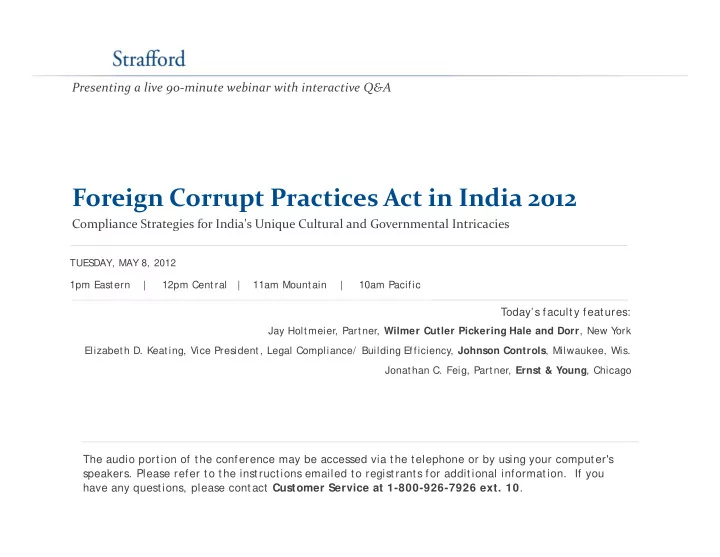
Presenting a live 90 minute webinar with interactive Q&A Foreign Corrupt Practices Act in India 2012 Compliance Strategies for India's Unique Cultural and Governmental Intricacies TUES DAY, MAY 8, 2012 1pm Eastern | 12pm Central


slide-1
SLIDE 1

Presenting a live 90‐minute webinar with interactive Q&A

Foreign Corrupt Practices Act in India 2012

Compliance Strategies for India's Unique Cultural and Governmental Intricacies

Today’s faculty features:

1pm Eastern | 12pm Central | 11am Mountain | 10am Pacific TUES DAY, MAY 8, 2012

Today s faculty features:

Jay Holtmeier, Partner, Wilmer Cutler Pickering Hale and Dorr, New Y

  • rk

Elizabeth D. Keating, Vice President, Legal Compliance/ Building Efficiency, Johnson Controls, Milwaukee, Wis. Jonathan C. Feig, Partner, Ernst & Young, Chicago

The audio portion of the conference may be accessed via the telephone or by using your computer's

  • speakers. Please refer to the instructions emailed to registrants for additional information. If you

have any questions, please contact Customer Service at 1-800-926-7926 ext. 10.

slide-2
SLIDE 2

Conference Materials

If you have not printed the conference materials for this program, please complete the following steps:

  • Click on the + sign next to “ Conference Materials” in the middle of the left-

hand column on your screen hand column on your screen.

  • Click on the tab labeled “ Handouts” that appears, and there you will see a

PDF of the slides for today's program.

  • Double click on the PDF and a separate page will open.

Double click on the PDF and a separate page will open.

  • Print the slides by clicking on the printer icon.
slide-3
SLIDE 3

Continuing Education Credits

FOR LIVE EVENT ONLY

For CLE purposes, please let us know how many people are listening at your location by completing each of the following steps:

  • In the chat box, type (1) your company name and (2) the number of

attendees at your location attendees at your location

  • Click the S

END button beside the box

slide-4
SLIDE 4

Tips for Optimal Quality

S d Q lit S

  • und Quality

If you are listening via your computer speakers, please note that the quality of your sound will vary depending on the speed and quality of your internet connection. If the sound quality is not satisfactory and you are listening via your computer speakers, you may listen via the phone: dial 1-866-961-8499 and enter your PIN when prompted Otherwise please send us a chat or e mail PIN -when prompted. Otherwise, please send us a chat or e-mail sound@ straffordpub.com immediately so we can address the problem. If you dialed in and have any difficulties during the call, press *0 for assistance.

Viewing Qualit y

To maximize your screen, press the F11 key on your keyboard. To exit full screen, press the F11 key again press the F11 key again.

slide-5
SLIDE 5

FCPA Compliance in India: Compliance Strategies Given India’s Compliance Strategies Given India s Unique Cultural and Governmental Intricacies

Strafford Publications Teleconference May 8 2012 May 8, 2012

Jonathan C. Feig Ernst & Young LLP Jay Holtmeier Wilmer Cutler Pickering Hale and Dorr LLP Elizabeth D Keating Elizabeth D. Keating Johnson Controls, Inc.

slide-6
SLIDE 6

OVERALL FCPA ENFORCEMENT TRENDS OVERALL FCPA ENFORCEMENT TRENDS

  • “In the Criminal Division, we have dramatically

increased our enforcement of the Foreign Corrupt increased our enforcement of the Foreign Corrupt Practices Act in recent years.... We recently promoted a [n]ew head of the Section’s FCPA Unit and two assistant chiefs, and we have also increased the , number of line prosecutors in the Unit, attracting high caliber attorneys with extensive experience—including Assistant U.S. Attorneys with significant trial and y g prosecutorial experience and attorneys from private practice with defense-side knowledge and experience. These changes have significantly increased our FCPA enforcement capabilities.”

– Assistant Attorney General Lanny Breuer (Jan. 2011)

6

slide-7
SLIDE 7

OVERALL FCPA ENFORCEMENT TRENDS OVERALL FCPA ENFORCEMENT TRENDS

  • US authorities continue

strong enforcement efforts

Reported FCPA Proceedings

g

– Remains to be seen

whether activity peaked in Reported FCPA Proceedings 2010

– Over 150 pending

enforcement matters enforcement matters

– 49 cases brought by DOJ

and/or SEC in 2011

– Continued coordination

between DOJ/SEC

7

– Dedicated units at DOJ,

SEC, and FBI

slide-8
SLIDE 8

OVERALL FCPA ENFORCEMENT TRENDS OVERALL FCPA ENFORCEMENT TRENDS

  • Large FCPA Sanctions Continue; Three of the Top 11 Corporate FCPA

Settlements Occurred in 2011

– JGC (Japan; $219M) – Magyar Telekom/ Deutsche Telekom (Hungary/Germany; $95M)

J h & J h (US $70M)

– Johnson & Johnson (US; $70M)

  • Prosecution of Individuals is Continued Priority
  • Third Party Risks (e.g., sales agents, intermediaries, consultants )
  • Travel and Entertainment in High-Risk Markets
  • Industry-Specific Risks (e.g., SEC probe of movie studios operating in China)
  • New Tool at the SEC – Deferred Prosecution Agreements
  • New Tool at the SEC – Deferred Prosecution Agreements
  • Intersection of FCPA and Antitrust (e.g., Bridgestone Corporation settlement)
  • Shift Away from Compliance Monitors; Increased Use of Alternatives
  • New Developments – Morgan Stanley and Wal-Mart

8

slide-9
SLIDE 9

FCPA ENFORCEMENT ACTIONS RELATED TO INDIA

  • Diageo (2011)

Diageo is one of the

  • rld’s largest prod cers of alcoholic

– Diageo is one of the world’s largest producers of alcoholic

beverages such as Johnnie Walker and Windsor Scotch whiskeys. From 2003 to mid-2009, Diageo’s Indian subsidiary made a number of illicit payments to government officials through third number of illicit payments to government officials through third parties totaling an estimated $1.7M.

– Diageo settled with the SEC for $16M including $11.3M in

di t j d t i t t f $2 1M d f th disgorgement, prejudgment interest of $2.1M, and a further penalty of $3M. The DOJ was not involved in this matter.

9

slide-10
SLIDE 10

FCPA ENFORCEMENT ACTIONS RELATED TO INDIA

  • Pride International (2010)

– Pride International is an oil and gas service company. Pride’s

Indian subsidiary paid $500K to judges of the Indian Customs, Excise, and Gold Appellate Tribunal for a favorable determination in a customs duties and penalties dispute. The estimated value of the favorable decision was approximately $1M.

– Pride’s Indian subsidiary pleaded guilty to criminal charges in the

United States. Pride International and the Indian subsidiary y settled with the SEC and agreed to pay a $32M criminal penalty. Pride International settled similar civil charges with the SEC and agreed to pay disgorgement of $19.3M plus pre-judgment interest

  • f $4.2M.

10

slide-11
SLIDE 11

FCPA ENFORCEMENT ACTIONS RELATED TO INDIA

  • Control Components, Inc. (2009)

– CCI designs and manufactures valves used in the power, oil and

gas, and nuclear industries. CCI made payments of at least $4.9M from 2003 – 2007 to employees of state-owned companies in several countries, including in India to the Maharashtra State Electricity Board.

– CCI pleaded guilty to criminal charges and paid an $18.2M fine.

Additionally, the company was placed on organizational probation y p y p g p for three years and ordered to create and implement a compliance program and retain an independent compliance monitor for three years.

11

slide-12
SLIDE 12

FCPA ENFORCEMENT ACTIONS RELATED TO INDIA

  • Westinghouse Air Brake Technologies (2008)

– WABTEC manufactures brake subsystems and related products for

locomotives, freight cars, and passenger transit vehicles. From 2001 through 2005, WABTEC’s subsidiary paid approximately $137K in cash to the Indian Railway Board to obtain contracts, schedule inspections,

  • btain certificates, and avoid tax audits

– WABTEC and its subsidiary entered into settlement agreements with the

DOJ and the SEC. WABTEC paid a $300K criminal penalty, $288K in p p y disgorgement of profits including pre-judgment interest, and $89K in civil penalties (a total of approximately $677K).

12

slide-13
SLIDE 13

FCPA ENFORCEMENT ACTIONS RELATED TO INDIA

  • Dow Chemical (2007)

– Dow Chemical is one of the world’s largest chemical manufacturers; its

Indian subsidiary manufactured and marketed pesticides and other

  • products. The subsidiary paid an estimated $200K in payments and gifts

to Indian government officials. Payments were made to a Central Insecticides Board official, state inspectors, and other officials. The subsidiary also made improper payments for gifts, travel, and entertainment to Indian government officials.

– Dow settled with the SEC and agreed to pay a $325K civil penalty. The

DOJ was not involved.

13

slide-14
SLIDE 14

FCPA ENFORCEMENT ACTIONS RELATED TO INDIA

  • Electronic Data Systems (2007)

– EDS is one of the worlds’ largest service companies in the world; the

company provides electronic data processing management and computer equipment. EDS’ subsidiary paid $720K to Indian government-

  • wned companies between 2001 and 2003. The subsidiary had been

struggling to perform its obligations with the Indian companies and the payments were made so the subsidiary would not lose contracts.

– EDS settled with the SEC and paid $491K in disgorgement and

p g g prejudgment interest. The subsidiary’s president also settled with the SEC and paid a $70K penalty. The DOJ was not involved.

14

slide-15
SLIDE 15

FCPA ENFORCEMENT ACTIONS RELATED TO INDIA

  • Textron Inc. (2007)

– Textron is a global, multi-industry company which does work in aircraft,

defense and intelligence, industrial, and finance businesses. As part of an investigation into $700K in kickback payments related to its sale of humanitarian goods to Iraq under the UN’s oil for food program, Textron identified an illicit payment by an Indian subsidiary of approximately $52K to a non-government customer to obtain business.

– As part of a settlement, Textron agreed to disgorge $2.3M in profits, plus

p g g g p p $450K in pre-judgment interest, and to pay a civil penalty of $800K. Textron was also ordered to comply with an FCPA compliance program. Textron was further ordered to pay a $1.15M fine pursuant to a non- prosecution agreement with the DOJ.

15

slide-16
SLIDE 16

FCPA CURRENT INVESTIGATIONS RELATED TO INDIA

  • Kraft Foods

– Kraft Foods, a food and beverage company, has disclosed that it is

currently being investigated by the SEC in connection with a facility in India that was part of its $19B acquisition of Cadbury in 2010. Kraft has disclosed that the SEC wants information about its "dealings with Indian governmental agencies and officials to obtain approvals related to the

  • peration" of the India plant.
  • Avon Products

– Avon Products, a cosmetics, perfume, and toy seller, has disclosed that

the SEC has issued a formal order of investigation into possible violations of the FCPA. According to Avon, the investigation is focused g , g

  • n expenses and accounting for travel, entertainment, gifts, use of third-

party vendors and consultants, and related due diligence, joint ventures, and acquisitions, and payments to third-party agents and others. q p y p y g

16

slide-17
SLIDE 17

CONTACTS WITH GOVERNMENT OFFICIALS IN INDIA

  • Public procurement/contracting with government agencies

g g g

  • Customs clearance/importation of goods
  • Immigration processes
  • Real estate (both purchasing and leasing land)
  • Real estate (both purchasing and leasing land)
  • Tax administration (excise and sales taxes, audits)
  • Obtaining certificates, registrations, permits, and licenses (approval from

multiple officials often required to obtain one permit/license)

  • Gifts and entertainment (especially during religious festival, Diwali)
  • Scheduling/passing inspections (fire, environmental, building)
  • Government officials solicit donations for charitable/religious organizations
  • Interactions with police/judiciary
  • Third parties with ties to government departments/officials (consultants
  • Third parties with ties to government departments/officials (consultants,

agents, distributors, interns, and trainees)

17

slide-18
SLIDE 18

FCPA Compliance Risks in India

Johnson Controls Confidential

slide-19
SLIDE 19

Corruption Risk Profile - India

 Transparency International - Corruption Perceptions Index (CPI) 2011

  • India ranked 95th out of 183 (tied with Albania, Swaziland and Tonga)
  • Score of 3.1 out of 10 (0 = highly corrupt; 10=very clean)
  • Down from 87th in 2010
  • In comparison: New Zealand ranked 1st; Somalia and North Korea ranked 182nd

 TI Global Corruption Barometer 2010/2011

  • 74% of those surveyed in India believed that corruption in their country had
  • 74% of those surveyed in India believed that corruption in their country had

worsened

  • Political parties, police, public officials, judiciary were all perceived to be affected

by corruption

  • 44% believed that their government’s actions to fight corruption were ineffective

 TI Bribe Payers Index

  • 84% of Indian companies believe bribes or facilitation payments are being paid to

do business do business

  • 30% of Indian companies reported paying bribes to government officials to

expedite government services

  • 54% of individuals surveyed reported paying a bribe to obtain government services

Johnson Controls Confidential 19

slide-20
SLIDE 20

Risks in Dealing w ith India Bureaucracy

Challenges Presented by Regulatory and Business Environment

 Excessive bureaucracy and regulation

  • Procedures are complicated and not transparent
  • Procedures are complicated and not transparent
  • Several layers of approvals required to obtain licenses/permits
  • Practice of using “agents” to interface with government agencies

 Ci il

t l d id

 Civil servants grossly underpaid

  • Accepted practice of “tips” or facilitation payments to civil servants in
  • rder to obtain routine government services
  • Seen as an accepted method of augmenting meager salaries
  • Seen as an accepted method of augmenting meager salaries

 Prevention of Corruption Act

  • Prohibits public servants from accepting bribe
  • P

hibit i i f b ib t bli t

  • Prohibits giving of bribes to public servants
  • No exception for facilitation payments
  • Inconsistent enforcement

Johnson Controls Confidential 20

slide-21
SLIDE 21

Interaction w ith India’s Bureaucracy

 Majority of corruption occurs at the lower levels of government

  • More than half of the reported bribe demands were for less than $100
  • More than half of the reported bribe demands were for less than $100
  • 84% of the reported bribe demands were for $5000 or less
  • 13% of the bribe demands originated from the Customs office
  • 9% of the demands came from the national offices of Taxation
  • 9% of the demands came from the national offices of Taxation
  • Most bribes involved use of “agents” or “consultants” to conceal the

true nature of the payments

  • Payments recorded as third party payments

Payments recorded as third party payments

  • Often routine government services, eg., utility services, involved

demand for a bribe

Johnson Controls Confidential 21

slide-22
SLIDE 22

Interaction w ith India’s Bureaucracy

Government Touch Points:

 Taxing Authorities

  • Variety of taxing regimes provide “opportunities” for bribery
  • Variety of taxing regimes provide opportunities for bribery
  • Income taxes – tax on profits earned by business
  • Tax Deducted at Source (TDS) – tax deducted from certain vendors.

Monthly returns and payments to the exchequer Monthly returns and payments to the exchequer

  • Service taxes – central indirect tax on services rendered by company.

Monthly filings and payments to central treasury

  • Value Added Tax (VAT) – state tax on sale of certain goods

Value Added Tax (VAT) state tax on sale of certain goods

  • Works Contract Tax – part of VAT Tax law and applicable to specific

portion of contract

  • Central Sales Tax – tax on sale of goods from one state to another

g

  • Central Excise – tax on manufactured goods
  • Service Tax – tax on services provided to customer

 Use of Consultants to prepare and file tax reports

Johnson Controls Confidential

 Use of Consultants to prepare and file tax reports

22

slide-23
SLIDE 23

Interaction w ith India’s Bureaucracy

Government Touch Points:

 Licenses, Permits and Inspections

  • Licensing and permitting regulations are duplicated by national state
  • Licensing and permitting regulations are duplicated by national, state

and local agencies

  • Many licenses and permits require several visits to government offices
  • Frequent requests for bribes from government employees to render

Frequent requests for bribes from government employees to render routine government services

  • Refusal to pay will often result in prolonged application process
  • Many company employees do not distinguish between facilitation

Many company employees do not distinguish between facilitation payments and payments made to impact outcome of inspection report

  • Government employees will often require that you make payment to a

“trusted” third party who will, in turn, funnel the money to the government employee

  • “Government liaison” services offered by certain vendors
  • Vendors will even provide a schedule of rates for amount of facilitation

payments required by the various agencies

Johnson Controls Confidential

payments required by the various agencies

23

slide-24
SLIDE 24

Interaction w ith India’s Bureaucracy

Government Touch Points:

 Government facing activities which are problematic in India

include: include:

  • Electrical Safety inspections
  • Mechanical Equipment inspections
  • Labor Department inspections
  • Labor Department inspections
  • Lift/Elevator Licenses and inspections
  • Pollution Control Board inspections
  • Fire Safety inspections
  • Fire Safety inspections
  • Police inspections – labor issues and workplace accidents
  • Health Department inspections
  • Diesel storage inspections
  • Diesel storage inspections
  • High Rise Building inspections
  • Sanitation Department plumbing inspections
  • Energy Meter Testing reports

Johnson Controls Confidential

  • Energy Meter Testing reports

24

slide-25
SLIDE 25

Interaction w ith India’s Bureaucracy

Government Touch Points:

 Government facing activities which are problematic in India

include: include:

  • Environmental licenses
  • CEIG Licenses for electrical systems
  • Fire licenses
  • Fire licenses
  • Explosive licenses
  • Commercial use clearances
  • Air Consent (Operation & Establishment)
  • Air Consent (Operation & Establishment)
  • Occupation certificate from local authority
  • Annual Operations renewal
  • Structural certificate for floor load density
  • Structural certificate for floor load density
  • Water Consent
  • Hazardous Waste Handling and Disposal
  • Consent to Operate

Johnson Controls Confidential

  • Consent to Operate

25

slide-26
SLIDE 26

Navigating the Risks

 Know Thy Vendors

  • VMF Scrub
  • Correctly categorize vendor as high or low risk i e

are there any

  • Correctly categorize vendor as high or low risk, i.e., are there any

government facing services being provided?

  • Undertake appropriate level of due diligence on all high risk vendors

who interface with government agencies g g

  • Centralized procurement function
  • Vendor FCPA certification
  • Communicate expectations to vendors re ethics and FCPA training for

p g all high risk vendors

  • Establish DNU/DNP list for any vendors who have been found to use

unethical business practices

  • Establish “Compliance Task Force” to handle all licensing, permitting

and inspection requirements

  • Only “Task Force’ will interface with government agencies
  • Administers manages and enforces all statutory compliance activities

Johnson Controls Confidential

  • Administers, manages and enforces all statutory compliance activities

26

slide-27
SLIDE 27

Navigating the Risks

 Contract Review

  • Evaluate all contracts to ensure that the scope of services does not

provide inappropriate payments to government employees provide inappropriate payments to government employees

  • “Outsourcing bribery”
  • Do not undertake any government facing services on behalf of customers not

specifically provided for by contract

 Financial Controls

  • Establish monitoring process to ensure vendor transactions are for

legitimate services

  • Stringent controls around employee advances and petty cash
  • Red Flag training for all finance personnel

 Monitor all Licensing/Permitting Activities

  • Review all licenses and permits necessary to conduct business

 Monitoring and Auditing

  • Regular and periodic forensic reviews of business practices

Johnson Controls Confidential 27

slide-28
SLIDE 28

Fraud risks in India

April 2012 Jonathan C. Feig

slide-29
SLIDE 29

Setting the context

The Indian Growth Story The Indian Growth Story

Largest Largest Strong Strong Conducive Conducive Abundant Abundant Fast growing economy Fast growing economy Largest population of skilled workers Largest population of skilled workers Strong domestic demand Strong domestic demand Conducive investment environment Conducive investment environment Abundant natural resources Abundant natural resources The hurdles and show stoppers The hurdles and show stoppers Financial & accounting Financial & accounting Rampant corruption & Rampant corruption & Large number

  • f commercial

Large number

  • f commercial

Complex regulatory Complex regulatory accounting frauds accounting frauds corruption & bribery corruption & bribery

  • f commercial

disputes

  • f commercial

disputes regulatory requirements regulatory requirements

Fraud risk scenario in India Page 29

slide-30
SLIDE 30

Key challenges in India

Key challenges in India

Large demographic area

Varied cultures & work practices p

High levels of corruption Financial misstatements /

  • ccupational fraud /

corruption & bribery Corporate Culture Local practices / customs

Underlying issues

Employee relationships with customer/ Vendor/ 3rd parties Inadequate privilege and data privacy regulations Complex web of legislations

Fraud risk scenario in India Page 30

g

slide-31
SLIDE 31

Key factors leading to fraud and corruption

Significant 3rd parties Corporate Culture

► Decentralized business ► Aggressive sales culture and pressures to increase in reach/penetration ► Growth through acquisition or mergers ► Operating through distributor or agent networks ► Agents/Facilitators ► Resellers/Distributors ► Consultants – tax/custom/licenses etc. ► Staffing agencies ► Operating through distributor or agent networks ► Employees with historical relationships with vendors / customers

Key factors

► Government approvals ► Fiercely competitive market ► Size of emerging market ► Perception of employees – that is the way business is done there g g ► Pricing pressures ► Distribution controlled by few ► Significant expenses on collaterals, gifts, business development and entertainment expenses ► Cash transactions

Others Market dynamics

Fraud risk scenario in India Page 31

Others Market dynamics

slide-32
SLIDE 32

Fraud risk challenges in India

Business environment is categorized by several fraud risk challenges such as Business environment is categorized by several fraud risk challenges such as

Procurement related frauds Conflict of Interest Inflated sales revenue Fictitious customer / sales orders Vendor favoritism for awarding contracts Overstatement of expenses / duplicate claims Lapping to Hide uncollectible receivables unaccounted sales returns Pilferage/theft of material diversion of products Embezzlement of funds by employees Counterfeit Potential corruption using third party service providers Bribery and inappropriate treatment of government officials and other parties Collusion with vendors

Fraud risk scenario in India Page 32

slide-33
SLIDE 33

How to Monitor for Corruption Risks?

► What kind of testing should be conducted?

► Controls testing versus substantive testing ► Controls testing versus substantive testing ►

Why controls may not prevent fraud

Emphasis on controls without knowing vulnerabilities

“check box“ exercise does not mitigate risks

False expectations from controls

controls do fail due to people, process and technology

Management Override does not happen here!

the best policies, standards and monitoring fail if risk of management override not addressed or ignored M i i k i li f ti ibilit

Managing risk is a compliance function responsibility

everyone is responsible to manage risk

Fraud risk scenario in India Page 33

slide-34
SLIDE 34

How to Monitor for Corruption Risks? continued

► How to choose a sampling methodology? Where are

potential payments recorded? potential payments recorded?

Understand the business? Where are the customers? Where are the government touch points?

Choose accounts that could have risk – Commissions, permits, licenses, consultants, freight forwarding, customs clearance

Choose T&E reports from individuals who direct or touch the risk?

Choose T&E reports from individuals who direct or touch the risk?

Who manages imports/exports?

Who entertains clients?

Destination of cash?

Is the payment going to a different country than the country in which the services were rendered?

Fraud risk scenario in India Page 34

slide-35
SLIDE 35

How to Monitor for Corruption Risks? continued

► How can we leverage technology to find higher risk

transactions? transactions?

Advanced analytics

Key word searches on text fields in GL or T&E systems ► Who should conduct these audits?

Experience (how many of the auditors have seen a bribe?)

Local expertise (how many have seen a bribe in India?)

Training

Fraud risk scenario in India Page 35

slide-36
SLIDE 36

What Companies should do?

Awareness

Every one is a compliance

Improve/ update Compliance program

 Every one is a compliance

  • fficer - Training

 Whistle blower policy  Develop local language

compliance FAQs

Identify key risks

Update policy & procedures for Indian conditions

Include key risks for

2 1

handbooks, handouts, etc

Risk assessment

y continuous monitoring/ assessments

Consider third party diligence

It’s an

  • ngoing

process T ti / i di i

 Tone at the top  Business landscape analysis  Government interfaces  Policy & procedures for other

3 4

Testing/ periodic reviews

 Utilize advanced data analytics  Select transactions for critical

areas – substantive and controls compliance

 Event based review: M&A

Incident Management / investigation

5

areas substantive and controls based testing

 Interviews of management/

employees

Fraud risk scenario in India Page 36

Incident Management / investigation

5

slide-37
SLIDE 37

Some leading practices observed

Communication on code of conduct, giving practical scenarios thus helping employee make the “desired” decision

Regular training to increase awareness of code of conduct and whistle blower policy

Regular training to increase awareness of code of conduct and whistle blower policy

Independent internal auditors reporting directly to the board/controls committee

Before any vendor or agent is appointed, undertake a background check to assess the credentials, reputation and political affiliations if any based on public records and references reputation, and political affiliations, if any based on public records and references

Rationalize the international approval matrix to customize the amounts to Indian environment. Expense limits are reduced and adjusted as per the need for a role

Independent approval of expenses relating to activities like market research liaison fee consultancy

Independent approval of expenses relating to activities like market research, liaison fee, consultancy charges etc.

Centralized procurement for all large amounts and all significant procurement/payments to be approved by an independent internal team/controls committee

Restrict "emergency purchases" where requirements are seen to be circumvented.

Cash transactions only in extreme cases

Fraud risk scenario in India Page 37

slide-38
SLIDE 38

Some leading practices observed

Mandatory disclosure by employees on their other business interests and potential “related party transaction”

Review of SOPs and operating procedures from fraud risk perspective and make necessary

Review of SOPs and operating procedures from fraud risk perspective and make necessary modifications in operating procedures

Regular fraud analytics to identify deviations, if any

Periodic sample (random) test of transactions (especially for gifts travel entertainment charitable

Periodic sample (random) test of transactions (especially for gifts, travel, entertainment, charitable contributions etc) to ascertain adherence to required policies and procedures. Specifically things reviewed are

Compliance with mandated procedures, including approvals

Correct depiction of nature of expenses

Comparison of price and terms with prevalent market conditions

Evidence to substantiate that product/services were actually required and received p y q

While forming a joint venture or acquiring stake, undertake anti-corruption due diligence to assess if the target entity has been involved in bribery/corruption and it has necessary procedures to check the same

Fraud risk scenario in India Page 38

slide-39
SLIDE 39

CONCLUSION

Jonathan C. Feig

CONCLUSION

Ernst & Young LLP (312) 879-3908 jonathan.feig@ey.com Jay Holtmeier Jay Holtmeier Wilmer Cutler Pickering Hale and Dorr LLP (212) 295-6413 jay.holtmeier@wilmerhale.com Elizabeth D. Keating Johnson Controls, Inc. (414) 426-9506 li b th d k ti @j i elizabeth.d.keating@jci.com

39