FOR LIVE PROGRAM ONLY Tax Reporting and Reconciliation of Hedge Fund - - PowerPoint PPT Presentation

for live program only tax reporting and reconciliation of
SMART_READER_LITE
LIVE PREVIEW

FOR LIVE PROGRAM ONLY Tax Reporting and Reconciliation of Hedge Fund - - PowerPoint PPT Presentation

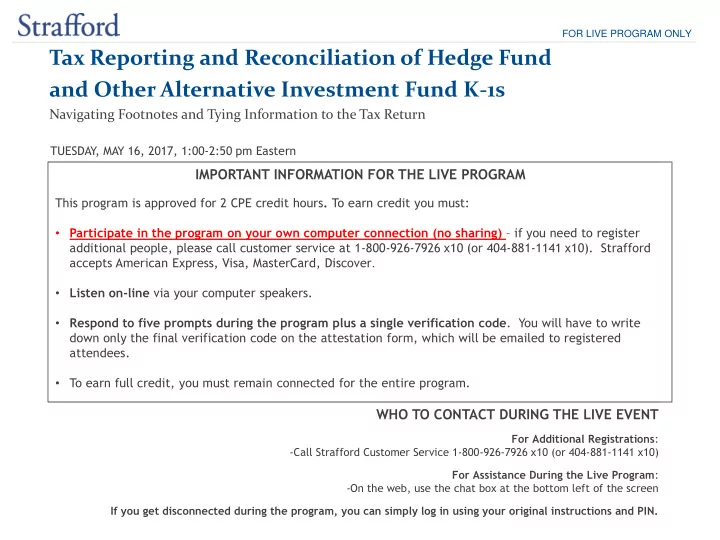
FOR LIVE PROGRAM ONLY Tax Reporting and Reconciliation of Hedge Fund and Other Alternative Investment Fund K-1s Navigating Footnotes and Tying Information to the Tax Return TUESDAY , MAY 16, 2017, 1:00-2:50 pm Eastern IMPORTANT INFORMATION FOR


slide-1
SLIDE 1

WHO TO CONTACT DURING THE LIVE EVENT

For Additional Registrations:

  • Call Strafford Customer Service 1-800-926-7926 x10 (or 404-881-1141 x10)

For Assistance During the Live Program:

  • On the web, use the chat box at the bottom left of the screen

If you get disconnected during the program, you can simply log in using your original instructions and PIN.

IMPORTANT INFORMATION FOR THE LIVE PROGRAM

This program is approved for 2 CPE credit hours. To earn credit you must:

  • Participate in the program on your own computer connection (no sharing) – if you need to register

additional people, please call customer service at 1-800-926-7926 x10 (or 404-881-1141 x10). Strafford accepts American Express, Visa, MasterCard, Discover.

  • Listen on-line via your computer speakers.
  • Respond to five prompts during the program plus a single verification code. You will have to write

down only the final verification code on the attestation form, which will be emailed to registered attendees.

  • To earn full credit, you must remain connected for the entire program.

Tax Reporting and Reconciliation of Hedge Fund and Other Alternative Investment Fund K-1s

Navigating Footnotes and Tying Information to the Tax Return

TUESDAY , MAY 16, 2017, 1:00-2:50 pm Eastern

FOR LIVE PROGRAM ONLY

slide-2
SLIDE 2

Tips for Optimal Quality

Sound Quality When listening via your computer speakers, please note that the quality

  • f your sound will vary depending on the speed and quality of your internet

connection. If the sound quality is not satisfactory, please e-mail sound@straffordpub.com immediately so we can address the problem.

FOR LIVE PROGRAM ONLY

slide-3
SLIDE 3

Notice

ANY TAX ADVICE IN THIS COMMUNICATION IS NOT INTENDED OR WRITTEN BY THE SPEAKERS’ FIRMS TO BE USED, AND CANNOT BE USED, BY A CLIENT OR ANY OTHER PERSON OR ENTITY FOR THE PURPOSE OF (i) AVOIDING PENALTIES THAT MAY BE IMPOSED ON ANY TAXPAYER OR (ii) PROMOTING, MARKETING OR RECOMMENDING TO ANOTHER PARTY ANY MATTERS ADDRESSED HEREIN.

You (and your employees, representatives, or agents) may disclose to any and all persons, without limitation, the tax treatment or tax structure, or both, of any transaction described in the associated materials we provide to you, including, but not limited to, any tax opinions, memoranda, or other tax analyses contained in those materials. The information contained herein is of a general nature and based on authorities that are subject to change. Applicability of the information to specific situations should be determined through consultation with your tax adviser.

slide-4
SLIDE 4

TAX REPORTING AND RECONCILIATION OF HEDGE FUND AND OTHER ALTERNATIVE INVESTMENT FUND K-1S

Suzy Lee, CPA, MST Stacy Palmer, CPA, MBA, MST Untracht Early slee@untracht.com spalmer@untracht.com 973.805.7255 973.805.7147 Eliot Goldberg Withum egoldberg@withum.com 212.751.9100 Laura L. Ross, CPA EisnerAmper laura.ross@eisneramper.com 415.357.4220

slide-5
SLIDE 5

What is a Hedge Fund? Deconstructing Hedge Fund K-1s

Presenters: Stacy Palmer, CPA, MBA, MST Suzy Lee, CPA, MST

untracht.com 5

slide-6
SLIDE 6

What is a Hedge Fund?

Suzy Lee, CPA, MST

untracht.com 6

slide-7
SLIDE 7

What is a Hedge Fund?

Hedge funds are alternative investments that may use a number of different strategies in order to earn high returns for their investors. In general, hedge funds use derivatives and leverage their investments in addition to holding the traditional portfolio of stocks, bonds, and cash.

untracht.com 7

slide-8
SLIDE 8

History of Hedge Funds

  • Alfred Winslow Jones – first hedge fund in 1949
  • Julian Robertson's Tiger Fund
  • First stars –George Soros, Bruce Kovner

untracht.com 8

slide-9
SLIDE 9

Hedge Fund Strategies

Hedge funds use different investment strategies and, thus, are often classified according to investment style. The following classification of hedge fund styles is a general overview:

  • Equity market-neutral
  • Convertible arbitrage
  • Fixed-income arbitrage
  • Distressed securities
  • Merger arbitrage
  • Global macro
  • Emerging markets
  • Fund of funds

untracht.com 9

slide-10
SLIDE 10

How Hedge Funds are Set Up

  • Hedge funds are most often set up as private investment limited partnerships that

are open to the limited number of accredited investors and require a large initial minimum investment.

  • Investments in hedge funds are illiquid as they often require that investors keep

their money in the fund for a certain period of time known as the “lock-up period”. Withdrawals may also only happen at certain intervals.

  • Generally, they are not registered under the Investment Company Act of 1940.
  • In general, hedge funds are largely unregulated because they cater to sophisticated

investors.

untracht.com 10

slide-11
SLIDE 11

Typical Fees of Hedge Funds

  • Management fees – compensation for managing the business of the fund
  • 2% standard figure
  • Incentive fee/allocation – compensation to General Partners for investment advisory

services

  • 20% of gross returns
  • High Water marks
  • Hurdle rates
  • Withdrawal/Redemption fees

Encourage long-term investment

untracht.com 11

slide-12
SLIDE 12

General Overview of Investor, Trader and Fund of Funds

Presenter: Eliot Goldberg, CPA

12

slide-13
SLIDE 13

Overview of Fund Types

Trader fund

  • Seeks “short swing profits” from trading in securities or commodities
  • Activity is regular and continuous
  • Able to make an election under IRC Sec. 475
  • Reg Sec. 1.469-1T(e)(6) - non-passive for purposes of the passive activity rules

13

slide-14
SLIDE 14

Overview of Fund Types

Investor fund

  • Holds investments for longer-term appreciation
  • Periodic and less frequent trading
  • May hold “investments” other than securities and commodities (i.e. private equity)
  • Investments in stocks and securities generate “Portfolio” income and deductions

(not passive for purposes of Sec 469)

14

slide-15
SLIDE 15

Overview of Fund Types

Fund of Funds

  • Invests in other funds
  • Characterization of the income and deductions depend on other funds
  • May have its own entity level trading or investing activity

15

slide-16
SLIDE 16

Trader v. Investor

  • A trader in securities is engaged in the trade or business of trading securities. All

items of income and deduction are treated as trade or business income and deductions for federal income tax purposes AND generally, state income tax purposes.

  • An investor in securities is engaged in activity entered into for profit and all items
  • f income and deductions are treated as investment income and deductions for

federal income tax purposes and state income tax purposes.

16

slide-17
SLIDE 17

Reporting for Funds

Generally, there is a footnote that states whether the fund has taken the position that it is a trader in securities or that certain items are from activities as a trader. May also be discussed in the cover letter. Practitioners vary in their reporting format

  • Some use box 1 for ordinary income (sec 475)
  • Expenses may be reported in box 13 code W
  • Interest, dividends and capital gains may be in standard Boxes
  • Some report trader items (both income and deductions) in box 11 code F

17

slide-18
SLIDE 18

When is a Taxpayer Engaged in the Business

  • f Trading Securities?
  • There is no definition of trade or business in the IRC
  • There is no definition in regard to the business of trading in securities in the

Federal Income tax regulations

  • The definition of the business of trading securities has evolved over the last 80

years primarily from case law

  • While industry professionals often look to portfolio turnover as the litmus test for

trader status, there is not one reported decision that describes as a key factor the number of times a securities portfolio turns over during the course of a taxable year

  • One factor is the manner in which an investment manager describes his investment
  • bjective in the private placement offering memorandum
  • There are no reported cases regarding a partnership’s status as a trader vs.

investor

18

slide-19
SLIDE 19

Assaderaghi V. Commissioner

  • The taxpayer was the VP of engineering at a semiconductor company during the tax years 2008 and 2009
  • Taxpayer reported wage income of $704,601 in 2008 and $297,869 for 2009.
  • 2008 Trading Stats:
  • Number of trades

535 (more than half in Jan, June & July)

  • Number / % Trading Days

154 / 61.6%

  • Gross Receipts from Trading

$2.659mm

  • Holding period

40% were day-trades; remainder disputed

  • 2009 Trading Stats:
  • Number of trades

180

  • Number / % Trading Days

94 / 37.6%

  • Gross Receipts from Trading

$349,991

  • Holding period

19% were day-trades; remainder disputed

  • Taxpayer’s trading amounts and frequency were not substantial and not frequent, regular and
  • continuous. Penalties sought but NOT imposed (without discussion)

19

slide-20
SLIDE 20

Nelson v. Commissioner

  • The taxpayer was the sole shareholder of a mortgage brokerage company and also actively traded a TD

Ameritrade securities account during the tax years 2005 and 2006

  • Taxpayer took salary of $266,458 in 2005 and $49,065 from mortgage company compared to trading gains of

$470,472 in 2005 and $36,852 in 2006

  • 2005 Trading Stats:
  • Number of trades

535

  • Number / % Trading Days

121 / 48.4%

  • Purchase & Sale Amounts

$32.5mm bought / $32.9mm sold

  • Holding period

Ranged from 1 – 48 days

  • 2006 Trading Stats:
  • Number of trades

235

  • Number / % Trading Days

66 / 26.4%

  • Purchase & Sale Amounts

$24.2mm bought / $24.3mm sold

  • Holding period

Ranged from 1 – 101 days

  • Taxpayer’s trading amounts were “considerable” but her trading activity was not “substantial”. Penalties imposed!

20

slide-21
SLIDE 21

Endicott v. Commissioner

  • The Taxpayer sold call options against a corresponding number of shares of the

underlying stock seeking to earn the call premium. As options expired, new calls were written against the existing stock positions. Average holding periods for the stocks was 35 days but some positions were held long-term. Trades were not executed daily and were limited in number for 2 of the 3 years in question.

  • The Taxpayer claimed business deductions for what was substantially the margin

interest on the stock purchased.

  • The Tax Court held that the Taxpayer did not meet the frequency, continuity, and

regularity test and Taxpayer wasn’t attempting to “catch and profit” from daily swings in the market. In addition, the Taxpayer received substantial amounts of dividends and other income. Based on these facts the Taxpayer was acting as an investor and not a trader.

  • The Court also upheld accuracy–related penalties assessed as the Taxpayer, who

used a tax return preparer, lacked substantial authority for his position as a trader.

21

slide-22
SLIDE 22

Mayer v. Commissioner

  • The Taxpayer maintained an office for his trading and employed money managers.

He conducted more than 3,800 trades over a three year period

  • The Taxpayer admitted that his focus was on long-term capital growth. This goal

was reflected in his letters of understanding with the money managers. The weighted average holding periods for the securities sold during the three year period were 317 days, 439 days, and 415 days, respectively.

  • The Tax Court looked to two fundamental criteria that distinguish traders from

investors: the length of the holding period and the source of the income.

  • The Tax Court noted that the Taxpayer’s lengthy holding periods belie any effort to

capitalize on daily or short-term swings in the market.

  • The Tax Court held that although the Taxpayer conducted his operation in a

businesslike manner, devoted considerable time to oversee his investments, maintained two offices and employed several people, he was an investor and as such, he was not conducting a trade or business.

22

slide-23
SLIDE 23

IRC Section 475(F) Election – Mark to Market (MTM)

  • Traders in securities or commodities were allowed to elect MTM accounting for tax

purposes beginning in 1997 (enactment of IRC Section 475(f)

  • The statute provides that an election once made, is irrevocable without the

consent of the IRS Commissioner

  • At the end of each tax accounting period, taxpayers will MTM all of their securities

in their portfolio and include the gain/loss for the entire accounting period plus the MTM gain/loss (there are not any unrealized gains/losses) as ordinary income/loss

23

slide-24
SLIDE 24

Deconstructing Hedge Fund K-1s

Stacy Palmer, CPA, MBA, MST

untracht.com 24

slide-25
SLIDE 25

Federal K-1s Trader vs. Investor Status

  • Comparative Tax Treatment – Trader vs. Investor
  • Examples
  • Investor
  • Trader – material participation
  • Trader – no material participation
  • Fund of Funds
  • 3.8% Net Investment Income Tax (NIIT) – IRC §1411

untracht.com 25

slide-26
SLIDE 26

Comparative Tax Treatment: Trader vs. Investor

untracht.com 26

slide-27
SLIDE 27

Management Fees and Expenses Other than Interest Expense

  • Trader – Expenses are deductible under §162 by individual taxpayers "above the line" in arriving

at AGI.

  • Only trader funds can make a §475(f) mark-to-market election (could be just

for some activities within the fund).

  • Investor – Expenses are §212 investment expenses, treated as miscellaneous itemized

deductions.

  • Subject to 2% of AGI floor limitation and overall AGI-based phase-out of

itemized deductions.

  • Miscellaneous itemized deductions are not allowed for AMT

.

  • Swap expense/loss is treated as a miscellaneous itemized deduction.
  • Some states limit or do not allow itemized deductions.

untracht.com 27

slide-28
SLIDE 28

Management Fees and Expenses Other than Interest Expense

  • Fund of Funds
  • The IRS has ruled that all entity level management fees of a fund of funds are §212

investor expenses (Revenue Ruling 2008-39), treated as miscellaneous itemized deductions subject to the 2% limitation.

  • Could have mix of trader expenses depending on investments in underlying funds.
  • It is the government’s position that a fund of funds is not considered a

trader, even if solely invests in trader funds.

untracht.com 28

slide-29
SLIDE 29

Interest Expense

  • Trader – materially participates – fully deductible as a non-passive trade or business

interest expense on Schedule E, not subject to investment income limitations.

  • Trader – doesn't materially participate – subject to the investment income

limitation, to the extent deductible, treated as non-passive trade or business interest expense on Schedule E, ordinary deduction.

  • Investor – subject to the investment income limitation, to the extent deductible -

report on Schedule A as an itemized deduction.

  • Fund of Funds – typically will be mix of investor and trader treatment.
  • If fund of funds uses leverage to invest, the interest tracing rules would

apply in determining treatment of interest expense.

untracht.com 29

slide-30
SLIDE 30

Interest Expense

Example of Trader Footnote (not materially participating)

  • "Interest expense has been included in Box 13H as investment interest expense and

is not included in Box 11F . 1040 filer should enter this amount on Form 4952, Line 1. Any deductible interest expense should then be entered on Schedule E, Part II, Column (H).”

untracht.com 30

slide-31
SLIDE 31

K-1 Tips

  • If trader fund - ask client about level of involvement in investment.
  • Read the K-1 and supporting statements/footnotes carefully!

untracht.com 31

slide-32
SLIDE 32

Investor K-1s

General Characteristics

  • Investment management fees and entity level expenses will be 2% miscellaneous

itemized portfolio deductions in Box 13K – BIGGEST CLUE!

  • Investment interest expense reported in Box 13H will be subject to investment

income limitations and be a Schedule A itemized deduction.

  • The boxes on the face of the K-1, from Box 1 through to the end, will be completed,

where applicable. In general, usually contains less footnotes (less specific treatment).

untracht.com 32

slide-33
SLIDE 33

Trader K-1s

General Characteristics

  • Management fees will be a nonpassive ordinary business expense.
  • Investment interest expense may or may not be subject to investment income limitations

depending on material participation and will be a Schedule E nonpassive expense.

  • Boxes 11F and 13W will be supported by footnote details and Box 11F may include capital

gains/(losses) depending on the Firm preparing the K-1. Clues in Identifying Possible Trader K-1 in Footnotes

  • "Please note that none of the distributive share items reported on Schedule K-1 are considered

as derived from a passive activity under Treasury Regulation Section 1.469-1T(e)(6).”

  • "The K-1 has been prepared on the basis of a partner who does not materially participate in the
  • perations of the partnership."

untracht.com 33

slide-34
SLIDE 34

Trader K-1s

  • Entity level expenses are reflected under Box 13W.
  • If you see 475(f) income under Box 11F (can only make if trader fund). Could either

be trader fund or be invested in a K-1 that has trader fund activity.

  • Footnote stating investment interest should go to Schedule E.
  • Should always ask client about their level of participation!

untracht.com 34

slide-35
SLIDE 35

Fund Of Funds K-1s

General Characteristics

  • In the view of the IRS, management fees charged by the fund of funds are always

subject to the 2% AGI limitation, however, the character of expenses flowing through from underlying investments will depend on whether those investments are trader or investor funds.

  • Investment interest expense will be subject to investment income limitations and

may be a mix of nonpassive Schedule E or Schedule A expense.

  • The boxes on the face of the K-1, from Line 1 through to the end, will be completed,

where applicable, and lines 11F and/or 13W will have supporting statements.

  • Character of income and expenses is preserved for all underlying investments.

untracht.com 35

slide-36
SLIDE 36

Fund of Funds K-1s

  • Potential combination of entity level expenses reflected as 2% deductions under Box

13K and deductions under Box 13W, if invested in trader funds.

  • Footnote where investment interest is allocated to both Schedule A and Schedule E

(if invested in trader funds).

  • Frequently has items of income and capital gains on face of K-1 and Box 11F (mix of

trader and investor).

untracht.com 36

slide-37
SLIDE 37

Comparative Tax Treatment of Trader vs. Investor

Status affects deductibility of portfolio expense and eligibility of making Section 475(f) election as follows:

Trader Investor

Section 162(a) expenses Section 212 expenses - subject to 2% AGI No interest expenses limitation for partners who materially participate in the trading activity – Reported directly on Schedule E as non-passive deduction Interest expense limitation under Section 163(d) – Reported

  • n Schedule A as itemized deduction

Swap expense is not subject to 2% AGI Swap expenses bifurcated from swap income and such expense is treated as a miscellaneous itemized deduction Expenses reduce Alternative Minimum Taxable Income (“AMTI”) Expenses do not reduce Alternative Minimum Taxable Income (“AMTI”) Section 475(f) election No Section 475(f) election untracht.com 37

slide-38
SLIDE 38
slide-39
SLIDE 39

3.8% Net Investment Income Tax (NIIT) - §1411

untracht.com 39

slide-40
SLIDE 40

3.8% Net Investment Income Tax (NIIT) - §1411

  • §1411(c)(1)(A)(i)
  • "Net investment income means the excess of the sum of gross income from

interest, dividends, annuities, royalties, and rents, other than such income which is derived in the ordinary course of a trade or business not described in paragraph 2.“

  • §1411(c)(2)(B) – Trades and businesses to which tax applies
  • "A trade or business of trading in financial instruments or commodities (as

defined in section 475(e)(2).” Bottom Line

  • Net income from trader funds is subject to NIIT regardless of whether or not there is material

participation as the fund is a specified trade or business per the code.

  • Income from investor funds and fund of funds are subject to NIIT

.

untracht.com 40

slide-41
SLIDE 41

K-1 Examples

untracht.com 41

slide-42
SLIDE 42

42

slide-43
SLIDE 43

43

slide-44
SLIDE 44

44

slide-45
SLIDE 45

45

slide-46
SLIDE 46

46

slide-47
SLIDE 47

47

slide-48
SLIDE 48

48

slide-49
SLIDE 49

49

slide-50
SLIDE 50

50

slide-51
SLIDE 51

51

slide-52
SLIDE 52

52

slide-53
SLIDE 53

53

slide-54
SLIDE 54

54

slide-55
SLIDE 55

55

slide-56
SLIDE 56

56

slide-57
SLIDE 57

57

slide-58
SLIDE 58

58

slide-59
SLIDE 59

59

slide-60
SLIDE 60

60

slide-61
SLIDE 61

61

slide-62
SLIDE 62

62

slide-63
SLIDE 63

63

slide-64
SLIDE 64

64

slide-65
SLIDE 65

65

slide-66
SLIDE 66

Footnote Reporting

In alternative investments, footnotes to the federal K-1 provide information that may have tax implications for different types of investors. US Treasury Interest Interest on US Treasury obligations is exempt for individuals for state purposes but is taxable for federal income tax purposes. The income will be included in Box 5 but a footnote will provide the amount (a state K-1, if provided, should also report this in some manner).

66

slide-67
SLIDE 67

Footnote Reporting - Example

BOX 5 - INTEREST INCOME U.S. GOVERNMENT INTEREST INCOME OTHER INTEREST INCOME __________ TOTAL INTEREST INCOME __________

67

slide-68
SLIDE 68

Footnote Reporting

Muni Interest Interest on Municipal obligations is not taxable for federal purposes and should be included in Box 18 Code A. However, states do not tax individual taxpayers on interest of their resident states (and US instrumentalities). A footnote will provide the states from which the fund has earned the Muni interest and provide either amounts or percentages.

68

slide-69
SLIDE 69

Footnote Reporting - Example

BOX 18, CODE A - TAX-EXEMPT INTEREST INCOME FOLLOWING STATES: CONNECTICUT NEW YORK __________ TOTAL TAX-EXEMPT INTEREST __________

69

slide-70
SLIDE 70

Footnote Reporting

Expenses related to US Treasury Interest or Muni Interest For states that calculate tax on a “net income basis”, expenses (interest expense or

  • ther expenses) directly or calculated as “indirectly” related to the income will be

reported in a footnote and the Box on the federal K-1 where the expenses are included. (State K-1s, if provided, may report these items in various ways either columnar or as additions/modifications.)

70

slide-71
SLIDE 71

Footnote Reporting

State Sourced Income To the extent that a fund has income sourced to specific states (i.e. investments in real estate, operating entities, various MLPs), there should be a footnote (or State K-1s, or both) that reports the amount of income taxable to the particular states. A separate footnote should provide the amount of tax that may have been withheld/paid on behalf of a partner and to be deducted on an individual taxpayer’s Schedule A. There may be a separate footnote (or State K-1) that reports any creditable state tax payments (i.e. from composite state returns) applicable to the partner.

71

slide-72
SLIDE 72

FOOTNOTE REPORTING-EXAMPLE

State Information Composite Return Withholdin g State Source Income Included in Tax Tax Applie d to (Loss) Composite Paid Withheld Compos ite Alabama Alaska Arizona Arkansas California Colorado Connecticut Delaware District of Columbia Florida Georgia Hawaii Idaho Illinois Indiana Iowa Kansas Kentucky Louisiana Maine Maryland Massachusetts Michigan Minnesota Mississippi Missouri Montana Nebraska Nevada New Hampshire New Jersey New Mexico New York New York City North Carolina North Dakota Ohio Oklahoma Oregon Pennsylvania Rhode Island South Carolina South Dakota Tennessee

Texas Utah Vermont Virginia Washington West Virginia Wisconsin Wyoming

72

slide-73
SLIDE 73
slide-74
SLIDE 74

Differences Between Book and Tax Income on Hedge Fund K-1s

Presenter: Laura L. Ross, CPA

74

slide-75
SLIDE 75

Section L of Schedule K-1

  • Items noted in Section L are usually presented on a GAAP basis

― Section L items

― Capital accounts ― Increases/decreases ― Contributions and distributions

  • The underlying financials and investor statements of a hedge fund are also stated
  • n GAAP

75

slide-76
SLIDE 76

Components of GAAP Income

  • Ordinary income items on accrual basis
  • Capital items marked to FMV
  • Expense items on an accrual basis
  • All future costs of liquidating funds

76

slide-77
SLIDE 77

Differences Between Tax and GAAP

  • Amortization periods of organization costs (15 years vs 1 year)
  • Dividend Accruals
  • OID
  • Accrued accounting fees that have not been billed
  • Other Differences?

77

slide-78
SLIDE 78

Adjustments to Tax Items and GAAP Differences

  • Change in unrealized gains on securities
  • Wash sales
  • Worthless Shorts
  • Constructive sales
  • Straddles

78

slide-79
SLIDE 79

K-1 Income Allocations: Capital Gains

  • Several different methodologies can be used to allocate capital gains in an

investment partnership. The most common methods are described in the Regulations for IRC Section 704(c), and are known as full-netting and partial-

  • netting. Another method that can be used is known as layering, which tends to be

cumbersome and is not used as often in this environment.

79

slide-80
SLIDE 80

Example – Typical Book Allocation

500 200 19,000 (1,500) (2,500) Book Interest Other Total Own % Interest Dividends Gain Expense Expenses Partner income GP 0.1 50 20 1,900 (150) (250) 1,570 LP1 0.3 150 60 5,700 (450) (750) 4,710 LP2 0.2 100 40 3,800 (300) (500) 3,140 LP3 0.4 200 80 7,600 (600) (1,000) 6,280 Total Income 500 200 19,000 (1,500) (2,500) 15,700

Sometimes an administrator will present book gain into two components, realized and unrealized gain. This presentation is not an accurate reflection of the starting tax allocation, and should be avoided.

80

slide-81
SLIDE 81

Aggregate Method Qualities

  • Not allocated by security
  • Susceptible to subjectivity

― Timing of allocations ― Impact of the incentive allocation ― Timing of tax adjustments

  • Qualifications for use

81

slide-82
SLIDE 82

K-1 Income Allocations: Full-Netting

A and B form a partnership with each contributing $100,000. The partnership buys two stocks. During the course of the year those stocks go up in value so that each partner has a book capital account of $125,000.

Tax Unrealized Book Basis Gain Basis A 100,000 25,000 125,000 B 100,000 25,000 125,000 200,000 50,000 250,000 Original Increase FMV of Investment in Value Investment NOK 100,000 20,000 120,000 SGP 100,000 30,000 130,000 200,000 50,000 250,000

82

slide-83
SLIDE 83

K-1 Income Allocations: Full-Netting

Partner C enters in the next period, and contributes $125,000, so all three partners have the same book capital accounts. Additional stock is purchased, and book value goes up another $30,000.

Tax Unrealized Book Basis Gain Basis A 100,000 35,000 135,000 B 100,000 35,000 135,000 C 125,000 10,000 135,000 325,000 80,000 405,000 Original Increase FMV of Investment in Value Investment NOK 100,000 20,000 120,000 SGP 100,000 30,000 130,000 IBM 125,000 30,000 155,000 325,000 80,000 405,000

83

slide-84
SLIDE 84

K-1 Income Allocations: Full-Netting

The partners decide to sell SGP at this point, which has an unrealized gain of $30,000 – when sold this becomes taxable income. What is the most logical way to allocate the $30,000 gain among the three partners?

Tax Unrealized Book Basis Gain Basis A 100,000 35,000 135,000 B 100,000 35,000 135,000 C 125,000 10,000 135,000 325,000 80,000 405,000 Original Increase FMV of Investment in Value Investment NOK 100,000 20,000 120,000 SGP 100,000 30,000 130,000 IBM 125,000 30,000 155,000 325,000 80,000 405,000

84

slide-85
SLIDE 85

K-1 Income Allocations: Full-Netting

The most logical way to allocate the gain is by the amounts of unrealized gain each partner has. This is the basis of the full-netting concept, and it is identified in Regulation 1.704-3. Unrealized Realized Remaining Gain Gain Unrealized A 35,000 13,125 21,875 B 35,000 13,125 21,875 C 10,000 3,750 6,250 80,000 30,000 50,000

85

slide-86
SLIDE 86

K-1 Income Allocations: Partial-Netting

Partial-netting is very similar to full-netting. The difference is the gains and losses are allocated

  • separately. This method may

reduce disparities faster than full- netting can. Tax Unrealized Book Basis Gain Basis A 100,000 30,000 130,000 B 100,000 30,000 130,000 C 125,000 5,000 130,000 D 135,000 (5,000) 130,000 460,000 60,000 520,000

86

slide-87
SLIDE 87

K-1 Income Allocations: Partial Netting

Assume we are allocating $30,000 in realized gains again, but that amount is composed of $34,000 of gain and $4,000 of

  • loss. Loss is first allocated to the partner

with unrealized losses, gains are allocated to the partners with unrealized gains.

Unrealized Allocation Remaining Gain Unrealized A 30,000 15,692 14,308 B 30,000 15,692 14,308 C 5,000 2,616 2,384 D (5,000) (4,000) (1,000) 60,000 30,000 30,000

87

slide-88
SLIDE 88

K-1 Income Allocations: Layering

Layering is the most precise method, but also the most cumbersome. The periodic appreciation or depreciation of each stock tax lot must be tracked simultaneously with each partner’s

  • wnership percentage for each period.

When the stocks are sold, each partner receives their exact portion of appreciation or depreciation for each stock. This method is not commonly used due to the amount of record keeping necessary.

88

slide-89
SLIDE 89

Wash Sales Overview – Section 1091

  • A wash sale occurs when

― A loss is sustained upon the sale or disposition of stock or securities, ― And “substantially identical” stock or securities are acquired either 30 days before or 30 days after the date of sale (the 61-day window). ― Or a contract or option to acquire substantially identical stock or securities is purchased

  • Treated “as though” you just held the original securities

89

slide-90
SLIDE 90

Purpose of the Wash Sale Rules

  • To prevent taxpayers from artificially recognizing tax losses while maintaining

their holdings in the stock or securities sold.

90

slide-91
SLIDE 91

Tax Consequences of Wash Sales

  • Pursuant to Section 1091(a), the loss is not allowed to be recognized at the

time of the sale.

  • Pursuant to Section 1091(d), the disallowed wash sale loss is added to the

basis of the substantially identical stock or securities, the purchase of which resulted in the wash sale.

  • Holding Period of Replacement Stock or Securities — The holding period,

under Section 1223(3), includes the holding period of the stock or securities that was disposed of at a loss. In other words, the holding period is “tacked

  • n.”

91

slide-92
SLIDE 92

Constructive Sales Overview – Section 1259

  • A Constructive Sale occurs when:

― A taxpayer holds an “appreciated” position in a security ― And acquires an “opposite” position in the same or substantially identical security.

  • Treated as though you sold the appreciated securities on that date, and bought

them right back.

92

slide-93
SLIDE 93

Purpose of the Constructive Sale Rule

  • To prevent taxpayers from reducing their exposure to the stock or securities while

artificially deferring the recognition of tax gains.

93

slide-94
SLIDE 94

Constructive Sales Rules

  • Treated as if the original position were actually sold.

― Recognizes gain only. ― Does not apply to losses. ― End old holding period and start new holding period as of constructive sale date for original position. Therefore when you sell the original position, the date of the constructive sale is deemed to be the date on which the position was acquired.

  • Non-Convertible Debt Instruments are exempt from the Constructive Sale Rule

94

slide-95
SLIDE 95

QUESTIONS?

Suzy Lee, CPA, MST Stacy Palmer, CPA, MBA, MST Untracht Early slee@untracht.com spalmer@untracht.com 973.805.7255 973.805.7147 Eliot Goldberg Withum egoldberg@withum.com 212.751.9100 Laura L. Ross, CPA EisnerAmper laura.ross@eisneramper.com 415.357.4220

95