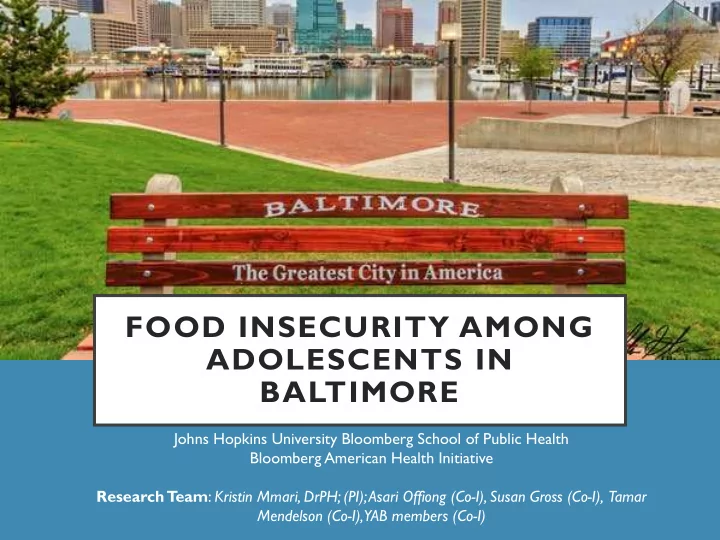
FOOD INSECURITY AMONG ADOLESCENTS IN BALTIMORE Johns Hopkins - - PowerPoint PPT Presentation

food insecurity among adolescents in baltimore
SMART_READER_LITE
LIVE PREVIEW

FOOD INSECURITY AMONG ADOLESCENTS IN BALTIMORE Johns Hopkins - - PowerPoint PPT Presentation

FOOD INSECURITY AMONG ADOLESCENTS IN BALTIMORE Johns Hopkins University Bloomberg School of Public Health Bloomberg American Health Initiative Research T eam : Kristin Mmari, DrPH; (PI); Asari Offiong (Co-I), Susan Gross (Co-I), Tamar


slide-1
SLIDE 1

FOOD INSECURITY AMONG ADOLESCENTS IN BALTIMORE

Johns Hopkins University Bloomberg School of Public Health Bloomberg American Health Initiative Research T eam: Kristin Mmari, DrPH; (PI); Asari Offiong (Co-I), Susan Gross (Co-I), Tamar Mendelson (Co-I), YAB members (Co-I)

slide-2
SLIDE 2

BACKGROUND ON FOOD INSECURITY

  • Overall, an estimated 6.8 million

young people in the US struggle to find enough food to eat (USDA, 2016)

  • Food insecure youth have been

found to have:

  • poor nutrition & reduced

physical activity;

  • impaired cognitive

development and higher risk for mood, anxiety, and behavior disorders (McLaughlin, 2012)

  • Urban Institute/Feeding America

study showed high-risk coping behaviors among youth receiving food assistance (Popkin et al., 2016)

  • In Baltimore City, no data on

adolescents…. But 41.6% of low- income households are food insecure

slide-3
SLIDE 3

BALTIMORE STUDY

  • Primary objectives:
  • 1. To explore how adolescents experience and cope

with food insecurity;

  • 2. To identify potential approaches or interventions for

addressing food insecurity voiced by young people themselves.

slide-4
SLIDE 4

METHODS

Six neighborhoods were selected

  • n the basis of:
  • High proportion of
  • pportunity youth (greater

than 20%)

  • Neighborhood was classified as

food insecure:

  • Healthy Food Availability Index

was low

  • Median household is at or

below 185 percent of Federal Poverty Level

  • Over 30% of households have

no vehicle available

  • Distance to a supermarket is

more than .25 mile

slide-5
SLIDE 5

METHODS

A total of 8 focus groups were held across six neighborhoods:

  • 3 male
  • 3 female
  • 2 mixed-sex groups

Brief questionnaire on sociodemographic measures and food security status

  • Based on validated food insecurity survey from the Child Food Security

Survey Module developed at the University of Southern Mississippi

4Youth researchers trained in qualitative research and data collection

slide-6
SLIDE 6

DATA ANALYSIS

All focus groups were recorded, transcribed verbatim, and uploaded into Atlas.ti (version 8)

  • Inductive thematic analysis approach was used for

coding and analyzing qualitative data Questionnaire data was inputted into an electronic database, cleaned, and analyzed using frequency distributions and chi- square test analyses

slide-7
SLIDE 7

Characteristics Males (n=27) Females (n=26) T

  • tal

Age 14-15 16-17 18-19 4 (14%) 16 (59%) 7 (26%) 12 (46%) 11 (42%) 3 (12%) 16 (30%) 27 (51%) 10 (19%) Race (can check more than 1) Black White Other 20 (74%) 8 (30%) 3 (11%) 25 (96%) 1 (4%) 2 (8%) 45 (85%) 9 (17%) 5 (9%) Employment Full-time Part-time Not working 0 (0%) 6 (22%) 21 (78%) 3 (12%) 3 (12%) 19 (73%) 3 (6%) 9 (17%) 40 (75%) Food security status Food insecure 12 (44%) 13 (52%) 25 (48%) Food security level High 10 (37%) 7 (28%) 17 (33%)

slide-8
SLIDE 8

FINDINGS

Food access:

  • Majority of youth obtain food via fast food outlets and corner stores.
  • While some youth did mention that there were grocery stores, the quality of food

was poor, especially in comparison to stores in suburban areas;

  • School food, and even food pantries in a school, were described as “jail food,” and

“having bad odors” Coping with hunger:

  • Across every focus group, adolescents described that girls prostitute for money to

get food, sometimes as young as 8th grade If like you having money problems or whatever, you probably get yourself a sugar daddy and you probably have to do stuff with him in order for him to give you the money and all that (girl, Oliver neighborhood)

slide-9
SLIDE 9

FINDINGS

Boys, meanwhile, had to shoplift or sell drugs “trapping” for money

Just like stuff from probably like robbing, probably hustling like depend on what you do, you might get an older person who might have mega money and he be like, yeah you trying to make some money? And then make it seem so easy for you, like all you got to do, you can make $90 or $100 a day, and if you got none you got to make that work. (boy, Easterwood neighborhood )

Other ways to get money for food:

  • Begging
  • Cleaning car windows
  • As a last resort – ask someone they knew for money
slide-10
SLIDE 10

FINDINGS

  • Reasons for negative coping behaviors:
  • Lack of jobs
  • Family conflict
  • Lack of parental monitoring
  • Family responsibilities

You know some people really go through stuff at home where they got to take care 4, 5, 6 brothers and sisters or their mother is strung out and they don’t have that parent to go home to, to have home cooked meals or to clothe them or to bathe their brothers and sisters to get them to school. So it is like well school, I can’t focus on school right now I got to get the money, I got to pay the bills, I got to eat. (girl, Park Heights neighborhood)

slide-11
SLIDE 11

RECOMMENDATIONS

Food assistance is associated with high level of stigma and embarrassment As a consequence, food insecurity needs to be addressed within a broader set of economic challenges

  • Food assistance should be combined with other

services (i.e., job training, youth programming)

  • Any strategy also needs to consider safety and

transportation

I think mostly people are embarrassed if they don’t have a lot of food they don’t talk or don’t even try, like don’t even go to these little donations because they are embarrassed, they don’t expect people to understand, they expect people to judge them and all that.(girl, Easterwood)

slide-12
SLIDE 12

DISCUSSION

Food insecurity may be a hidden problem that underlies a range of risk behaviors among adolescents in disadvantaged neighborhoods Some evidence suggests there might be a biological link: Studies among children have shown that food insecurity is related to low impulse control, greater delinquency, and higher interpersonal violence (McLaughlin et al, 2010; Macht, 1996) A study among adolescents has also shown that low caloric intake increases stress (and even cortisol levels) which separately have been shown to be related to the

  • nset of mental disorders (McLaughlin et al,2012)
slide-13
SLIDE 13

DISCUSSION

  • Findings point to the strong need for programs that address food

insecurity specifically for adolescents...

  • Adolescents pointed to addressing food insecurity broader – and

combining it with other services (such as job training)… one study has found that increasing teenage employment was associated with a reduction in household food insecurity (Hamersma and Kim, 2015)

  • Participants also mentioned the community recreation center as a

place they would comfortable in receiving services

slide-14
SLIDE 14

NEXT STEPS

Incorporate

Incorporate community and organizational feedback into intervention strategy Host Host forum to discuss implications of findings/recommendations Develop Develop dissemination plan to inform communities Reflect Reflect on study findings with local community organizations

slide-15
SLIDE 15

PROCESS

  • Working group has been created – made up
  • f members of youth advisory board; faculty;

and interested organizations;

  • Aims:
  • 1) to understand what is currently

implemented;

  • 2) to identify gaps;
  • 3) to incorporate feedback into overall

strategy

slide-16
SLIDE 16

CONCLUSIONS

Necessary for food insecurity among youth to be a high priority for researchers, practitioners, and policy makers;

  • Gather more information on the

prevalence and and means of coping with hunger

  • Inclusion of different stakeholders

This study also highlights the power of youth voices and the need to incorporate them into the design of any initiative to address food insecurity