Food & Environment Factoid: In 2000, US airlines used - - PowerPoint PPT Presentation

food environment
SMART_READER_LITE
LIVE PREVIEW

Food & Environment Factoid: In 2000, US airlines used - - PowerPoint PPT Presentation

Food & Environment Factoid: In 2000, US airlines used 350,000,000 extra gallons of fuel to carry the added pounds of overweight Americans Quiz: McMichael et al., 2007 2. Describe two ways that current livestock production creates


slide-1
SLIDE 1

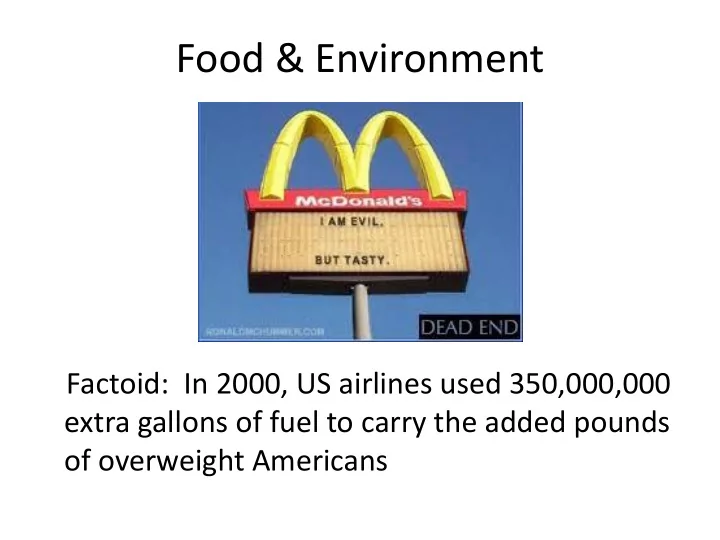
Food & Environment

Factoid: In 2000, US airlines used 350,000,000 extra gallons of fuel to carry the added pounds

  • f overweight Americans
slide-2
SLIDE 2

Quiz: McMichael et al., 2007

  • 2. Describe two ways that current livestock

production creates greenhouse gases.

slide-3
SLIDE 3

Vocab – McMichael et al., 2007

  • Ischaemic – constricting of blood vessels
  • Paleolithic – stone age
  • Sedentarism – sitting around
  • Zoonoses – diseases originating from animals
  • Somatic – human generated
  • Militate – powerfully prevent
slide-4
SLIDE 4

Global Deforestation Hotspots

slide-5
SLIDE 5

Global Vertebrate Biodiversity

Jenkins et al., 2013

slide-6
SLIDE 6

Forest Carbon Storage

slide-7
SLIDE 7

Global Impacts of Deforestation

  • Loss of biodiversity and local extinctions
  • Changes to hydrologic cycle
  • Conversion of carbon sink to carbon source
slide-8
SLIDE 8

Why does habitat loss/fragmentation reduce biodiversity?

slide-9
SLIDE 9

Loss of species richness with different amounts of deforestation

Nichols et al., 2007

slide-10
SLIDE 10

Species area relationship

Species Richness (aka number of species)

slide-11
SLIDE 11

Species area relationship examples

Ricklefs & Lovette, 1999

slide-12
SLIDE 12

Species area relationship examples

Genoways et al., 2007

slide-13
SLIDE 13

Explanations for the species area relationship

  • Small populations are susceptible to extreme

events (storms, fire, predation)

slide-14
SLIDE 14

Explanations for the species area relationship

  • Small populations are susceptible to extreme

events (storms, fire, predation)

  • Smaller area = lower habitat diversity
slide-15
SLIDE 15

Explanations for the species area relationship

  • Small populations are susceptible to extreme

events (storms, fire, predation)

  • Smaller area = lower habitat diversity
  • Island biogeography suggests small ‘islands’

have lower species richness

slide-16
SLIDE 16

Island Biogeography

  • Species diversity in

a location is a function of colonization (adds species) and extinction (subtracts species)

slide-17
SLIDE 17

Island Biogeography

  • Colonization is

more likely with proximity to ‘mainland’ (i.e. source of species)

  • Extinction is more

likely if the land area (i.e. available niches/resources) is small

slide-18
SLIDE 18

Projected extinctions based on species area relationships

Thomas et al., 2004

Global modeled extinction based on habitat loss up to 1990 (tropical extinctions would be much higher if we used habitat loss up to 2015)

slide-19
SLIDE 19

Resource Intensive Foods

slide-20
SLIDE 20

Resource Intensive Foods

  • Meat protein takes anywhere from 6-20 x the

energy to produce as soy protein

Pimentel & Pimentel, 2003

slide-21
SLIDE 21

The classic resource pyramid

slide-22
SLIDE 22

Drivers of Livestock Production

Demand:

  • Population growth (mainly developing

countries)

  • Income growth (mainly east and south Asia)
  • Lifestyle changes

Supply:

  • Cheap energy
  • Cheap grain
  • Deforestation & degradation are externalities
slide-23
SLIDE 23

Corn Subsidies in the U.S. 1995-2009

2009 subsidy for corn, rice, wheat & soy: $15,400,000,000 2009 subsidy for all fruits, vegetables &

  • rganic crops:

$800,000,000

slide-24
SLIDE 24

By-products of Corn Subsidies

High fructose corn syrup

slide-25
SLIDE 25

How Different Livestock Compare

Pimentel & Pimentel, 2003

slide-26
SLIDE 26

Energetic Efficiency of Different Foods

Eschel & Martin, 2006

>100 means we get more

  • ut than we

put in

slide-27
SLIDE 27

Corn Production Costs Per Hectare

Pimentel & Pimentel, 2003

slide-28
SLIDE 28

Land Use Associated with Livestock Production

  • 34,000,000 km2 of pasture globally

(26% of land)

  • 23,000,000 km2 of cropland globally

(18% of land)

  • ~1/3 of cropland is dedicated to

production of animal feed

slide-29
SLIDE 29
slide-30
SLIDE 30

~9% of global CO2 equivalent greenhouse gas emissions

slide-31
SLIDE 31

Livestock’s Long Shadow: FAO

~8% of global CO2 equivalent greenhouse gas emissions

slide-32
SLIDE 32

Sources of emissions from livestock

Livestock account for ~18% of global GHG emissions

McMichael, 2007

slide-33
SLIDE 33

Grass-fed beef: Emissions central

slide-34
SLIDE 34

Reduce Consumption: Food Choices

Machinova et al., 2015

  • Beef production creates 10x

more CO2 equivalent than

  • ther foods

Why more CO2 equivalent from extensive?

  • Grass-fed cows release 4x

more methane than grain fed cows

slide-35
SLIDE 35

Nitrogen Pollution from Livestock Production

Donner, 2007

Nitrogen inputs into the Mississippi watershed under current conditions (top) and with animal feed converted to equivalent vegetable protein (bottom)

slide-36
SLIDE 36

Household Actions: Food Choices

  • Tradeoff between

intensification (non-organic) and extensification (organic) in order to produce the same food quantity

  • Without synthetic fertilizers

we could only feed about half

  • f the current global

population with current food choices

slide-37
SLIDE 37

Americans don’t follow food recommendations

25-30% of a typical American diet is fat General Rule: The more processed your food is, the more energy it took to make

slide-38
SLIDE 38

Solutions?

  • Fix the food pricing system

– Need a market for externalities (carbon cap and trade; polluter pays policies) – Remove or reduce subsidies

  • Education
  • Social values & personal actions
slide-39
SLIDE 39

Discuss remaining questions from McMichael

slide-40
SLIDE 40

Organic Food Production

  • Reduces

nitrogen leaching

  • Retains

more soil carbon

slide-41
SLIDE 41

Land Degradation from Livestock

  • Increased soil erosion
  • Incised riparian areas
  • Change in ecosystem

structure

Soil erosion in Indonesia

slide-42
SLIDE 42

Water Use for Livestock Production

  • Cows drink a lot of
  • water. It takes an

average of 1000 gal of water to produce 1 gal

  • f milk
slide-43
SLIDE 43

Water Use for Livestock Production

  • Cows drink a lot of
  • water. It takes an

average of 1000 gal of water to produce 1 gal

  • f milk
  • Livestock production

uses 8% of global water resources (primarily for feed)

slide-44
SLIDE 44

Current Water Stress