Food Authenticity Research Network - - PDF document

food authenticity research network
SMART_READER_LITE
LIVE PREVIEW

Food Authenticity Research Network - - PDF document

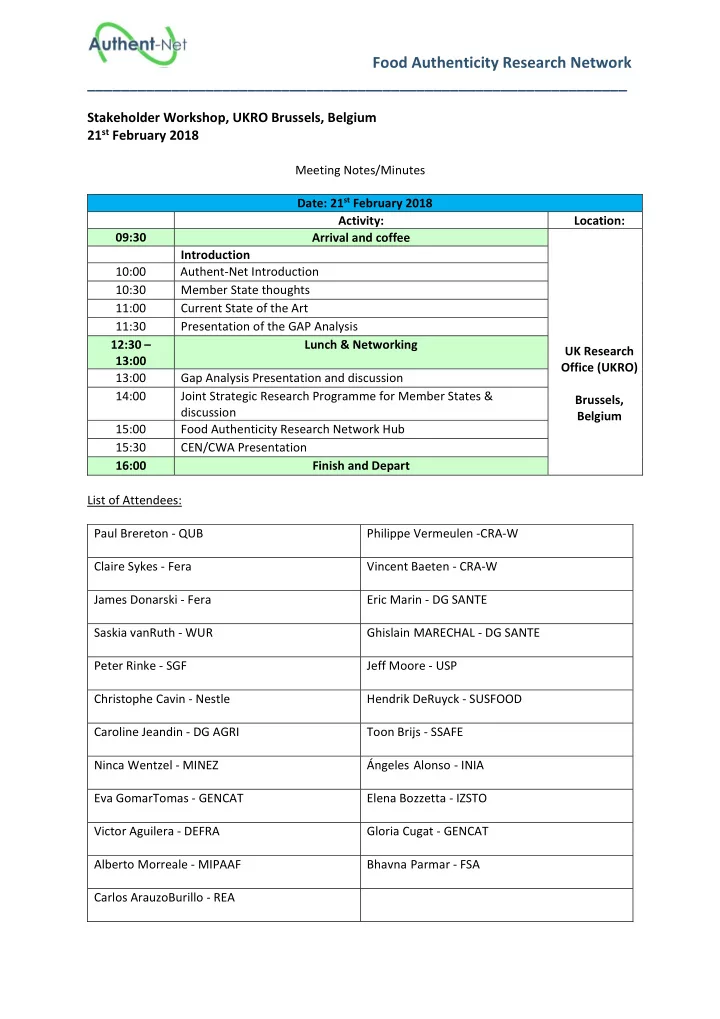
Food Authenticity Research Network ________________________________________________________________ Stakeholder Workshop, UKRO Brussels, Belgium 21 st February 2018 Meeting Notes/Minutes Date: 21 st February 2018 Activity: Location: 09:30 Arrival


slide-1
SLIDE 1

Food Authenticity Research Network ________________________________________________________________

Stakeholder Workshop, UKRO Brussels, Belgium 21st February 2018

Meeting Notes/Minutes Date: 21st February 2018 Activity: Location: 09:30 Arrival and coffee UK Research Office (UKRO) Brussels, Belgium Introduction 10:00 Authent‐Net Introduction 10:30 Member State thoughts 11:00 Current State of the Art 11:30 Presentation of the GAP Analysis 12:30 – 13:00 Lunch & Networking 13:00 Gap Analysis Presentation and discussion 14:00 Joint Strategic Research Programme for Member States & discussion 15:00 Food Authenticity Research Network Hub 15:30 CEN/CWA Presentation 16:00 Finish and Depart List of Attendees: Paul Brereton ‐ QUB Philippe Vermeulen ‐CRA‐W Claire Sykes ‐ Fera Vincent Baeten ‐ CRA‐W James Donarski ‐ Fera Eric Marin ‐ DG SANTE Saskia vanRuth ‐ WUR Ghislain MARECHAL ‐ DG SANTE Peter Rinke ‐ SGF Jeff Moore ‐ USP Christophe Cavin ‐ Nestle Hendrik DeRuyck ‐ SUSFOOD Caroline Jeandin ‐ DG AGRI Toon Brijs ‐ SSAFE Ninca Wentzel ‐ MINEZ Ángeles Alonso ‐ INIA Eva GomarTomas ‐ GENCAT Elena Bozzetta ‐ IZSTO Victor Aguilera ‐ DEFRA Gloria Cugat ‐ GENCAT Alberto Morreale ‐ MIPAAF Bhavna Parmar ‐ FSA Carlos ArauzoBurillo ‐ REA

slide-2
SLIDE 2

Food Authenticity Research Network ________________________________________________________________

Authent‐Net Project Update

(Full presentation can be found in Annex 1) Authent‐Net Strategic Objective: To facilitate sustainable cooperation between national and international research funding bodies in the area of food authenticity, to improve competitiveness of the food supply chain and the consumer confidence in it, by means of better coordinated, cost effective R&D. What is the project trying to achieve?  Bringing funding organisations together (Solving the lack of cohesion and lack of knowledge among various Member State activities)  Getting an inventory of the current state of the art in terms on Member State funded R&D in food authenticity  Maximising budgets by leveraging  more strategic approach to programmes  Expanding the network to achieve best results Overview of Work Completed to Date:  The project network has grown from 5 to 12 active network members  National and Commodity (Beef, Olive Oil, Seafood) Status Reports completed by the 12 Network members – (Belgium, Bulgaria, Czech Republic, France, Hungary, Iceland, Ireland, Italy, Netherlands, Romania, Spain, UK)  Preliminary GAP Analysis completed to evaluate the gaps and complementarities in European funding of food authenticity. Current and Future Work:

  • Develop a rationale and a recommendation for a high level strategic research agenda for

transnational research programmes in Europe

  • Establish a dynamic and sustainable European information platform, the Food Authenticity

Research Network Hub (FARNH) – http://farnhub.authent.cra.wallonie.be

  • Actively disseminate the action aims and outcomes to other relevant research providers, and

related stakeholders – Continuously done via www.Authent‐net.eu Other Work: CEN Workshop Agreement: “Authenticity in the feed and the food chain – General principles and basic requirements” COMMENTING ON THE PROPOSED STANDARD:

  • The Wiki can be found at: http://foodauthenticity.pbworks.com. (You can request

access by clicking the button on the right‐hand side of the page) The Wiki contains contact information for the workshop participants, a document repository and a discussion on terms and definitions used in the CWA.

  • Participants wishing to contribute to the development of the draft CWA can register to the

workshop by signing a registration form (I can provide to you). The filled in registration form shall be submitted to the secretariat (Rolf Duus).

  • Final workshop to be held by 22nd March 2018 – CEN CWA to be completed by end of

project.

slide-3
SLIDE 3

Food Authenticity Research Network ________________________________________________________________

Stakeholder comments 1) Methods –

  • a. need collaboration between funders both member states and Worldwide
  • b. screening and more facts on confirmation

2) Push priorities for the future 3) Knowledge platform, possibly JRC role to create

  • a. Centre for Authenticity to
  • i. Be Strategic
  • ii. Coordinate Funders
  • iii. Identify Gaps

Funder’s perspective – Ninca Wentzel Full presentation can be found in Annex 2. Policy Drivers

  • We have complex, changing global food chains
  • consumers preferences and demands are changing
  • driving new types of food fraud.
  • We need to stay ahead of the curve and work together.
  • Need to maximise use /impact of budgets

…..against a backdrop of decreasing resources and increased globalisation Funder’s challenges

  • The landscape for food fraud research across the EU is currently complex to understand,

fragmented and inaccessible

  • As funder’s we didn’t know:
  • which countries have a research programme/funding on food authenticity,
  • how that funding works on a national level
  • what areas they are funding
  • what their future strategic priorities are
  • what their lab capabilities/areas of expertise are
  • if they would be interested in working collaboratively on issues.
  • As funder’s we want to collaborate on funding research and on sharing knowledge, exchange

expertise, knowledge and information on food fraud by building an EU network to support future collaboration. What are the benefits from being involved in Authent‐net ?

  • Know who our counterparts are
  • link to the right people with the right knowledge
  • A ‘safe space’ to share information, partner
  • Be part of a network to collaborate on research
  • co‐ordinate with other funders with similar priorities
  • maximise investment and impact
  • Avoiding duplication
slide-4
SLIDE 4

Food Authenticity Research Network ________________________________________________________________

Stakeholder Comments 1) Assist Food industry to better quality – assist with competency to prevent

  • a. New project for funders

2) Public control bodies cannot manage all controls

  • a. Tools to industry to protect themselves
  • i. Control body
  • ii. Positive results how to deal with issues
  • iii. Repetition of results

Current state of the Art – Vincent Baeten (Full presentation can be found in Annex 3) State‐of‐the‐art  knowledge base, existing initiatives and capabilities Identify a range of existing resources  publications, projects, databases, regulations,.. Develop a number of status reports  commodity and country profiles Realisation  Compilation of projects and research outputs

  • List of recent and ongoing national and transnational R&D projects and initiatives
  • List of relevant reports, papers, publications and openly available databases
  • Identity card (keywords, relevant information) for each project and item  feed the

searchable database

  • Outline the food authenticity legal framework
  • List of international standards and regulations
  • Extraction or identification of keywords for each item

  Total = 152 EC and 174 national documents  Development of MS national status reports  Develop commodity status reports

  • 14 funding bodies
  • 53 publications
  • 20 projects
  • 4 online databases
  • 2 news stories
  • 70 regulations

Stakeholder Comments 1) Who can we share data to compile information

  • a. JRC – Board of experts (laboratory expert to validate and test products)

2) Develop a quick procedure

  • a. When no official validation control in place
  • b. Network centre for food authenticity
slide-5
SLIDE 5

Food Authenticity Research Network ________________________________________________________________

Joint Strategic Research Agenda – Ninca Wentzel (Full presentation can be found in Annex 4)

  • To facilitate future collaboration of the network we have developed Terms of Reference for

the network:

  • To outline the networks aims and objectives
  • To agree on how we should continue the networking activities after

authent‐net ends

  • To outline expected input, planned activities and network outputs
  • And we committed to develop a Strategic Research Agenda for the network:
  • To set out ways we can collaborate on future activities
  • To highlight areas where we would like to work together

Funders Network Planned activities and outputs

  • One of the first activities for the funders network is to develop an agreed Strategic Research

Agenda (SRA) which builds on Authent‐net outputs

  • A first draft SRA has been drafted based on the funders discussions, sharing of priorities and

the authent‐net gap analysis

  • This SRA is a first draft that will be further developed following stakeholder and funder

feedback and finalisation of the gap analysis Challenges in the prediction, prevention & detection of Food Fraud Food fraud is a constantly changing dynamic with a range of influencing drivers and factors such as:

  • volatility in food prices,
  • the availability of raw materials and ingredients,
  • the economic climate,
  • regulatory developments,
  • changing consumer preferences and habits

We need to stay ahead of the curve to be able to predict, prevent and have the tools available to detect new and emerging food fraud incidents Complex, global, and rapidly changing food supply chains make this challenging but working together to pool resources and share expertise and intelligence is vital. Analytical challenges In addition to challenges in predicting food fraud there are a number of analytical challenges associated with detecting existing fraudulent and mislabelling practices:

  • Availability of authentic reference materials for method development, accreditation, and

proficiency testing.

  • Methods need to be practical, transferable and fit for purpose for use in court cases.
  • Fit for purpose methods need to be well validated and given the global nature of supply

chains method standardisation and harmonisation across countries is also important.

  • Development and application of portable, rapid point of use tools and non‐targeted multi‐

analyte methods

  • Harnessing emerging technologies and novel methods for food authenticity analysis to stay

ahead of fraudsters and improve on currently available approaches. Funders have identified three key areas where they would benefit from collaboration

slide-6
SLIDE 6

Food Authenticity Research Network ________________________________________________________________

Research to develop analytical tools Areas for collaboration:

  • Development of improved methods to detect food mislabelling issues with a particular focus
  • n origin (geographic and production origin, including verification of PDO and PGI products)
  • Trans‐national validation of existing and new methods to detect food mislabelling;
  • Harmonisation/standardisation of methods employed by different countries;
  • Simplification of existing methods to allow for accessible, transferable, rapid, point of use,

low cost screening tools;

  • Application of innovative, cutting edge methods and emerging technologies to detect food

fraud issues;

  • Better use of existing methods and resource such as reference materials and databases;
  • The main commodities of interest varies with different countries but meat, fish/seafood,

honey, dairy, wine, cereals, vegetables and fats and oils are of interest to a significant number of the funders. Fraud Prediction and Prevention Areas for collaboration:

  • Development of non‐analytical tools such as mass balance and paper‐based checks to detect

food fraud and harmonised guidance on their use;

  • Improved food chain vulnerability assessments with identification and harmonisation of

tools to identify Critical Control Points (CCPs);

  • Development and dissemination of information/guides & food fraud prevention tools for

industry;

  • Surveillance/pilot studies to scope out scale of fraud issues;
  • Horizon scanning and emerging risk surveillance;
  • Feasibility studies on network analysis/social media analysis to identify fraudulent activity;
  • Understanding causes of fraud ‐ trends and drivers e.g. raw material availability, trade, crop

failures, political trends etc.

  • Social science research to understand consumer consumption trends e.g for organic, free

range etc

  • Big data analysis
slide-7
SLIDE 7

Food Authenticity Research Network ________________________________________________________________

Stakeholder Comments No comments were made The Food Authenticity Research Network Hub ‐ The FARNHub – Phillippe Vermeulen (Full presentation can be found in Annex 5) FARNHub: What is it?

  • This platform is a web‐based portal where users can get an overview of currently

available resources related to food authenticity.

  • This includes papers and documents (scientific or other), ongoing projects, online

databases, an overview of funding bodies, news stories, regulations and analytical methods.

  • This tool is dedicated to funding bodies, industry, regulatory authorities, research
  • rganisations and other stakeholders.

http://www.farnhub.authent.cra.wallonie.be Linked to the FoodIntegrity Knowledge Base 9WP2) by Jean‐Francois Morin Content: Number of records by country Total = 1557 records  164 funding bodies  513 publications  215 projects  43 online databases  421 news stories  201 regulations  Invitation to increase your contribution  Invitation to contact other research institutes to cover the entire country  Invitation to contact other research institutes to cover all the commodities Network of national representatives: role Your role as representative of your country is:

  • To centralize the new data from institutions of your country
  • To translate in English possible title or summary written in other language
  • To check the possible duplicates and validate the new data
  • To record these new data using the FARNHub administration tool or using the excel

sheets

  • To update the not complete or wrong information using the FARNHub

administration tool

  • To maintain the up to date information after the project (after April 2018)

Next steps

  • Additional search facilities: tests ongoing

Specific search for each topic, based on text field General search on full FARNHub, based on google search tool

  • Continue to populate the database

By using the country representative network

slide-8
SLIDE 8

Food Authenticity Research Network ________________________________________________________________

By consolidating the interactions with FoodIntegrity project FoodIntegrity WP2: analytical methods FoodIntegrity WP6: Wiki news stories

  • Maintenance of the application

Hosting at CRA‐W during 3 years after the end of the project Stakeholder Comments 1) Global ‐ Can it be expanded to Include ‘world’ data? 2) Is it duplicating existing system? No

  • a. Links to FoodIntegrity WP2 and WP Wiki data
  • b. Can it be linked to JRC Monthly report?

3) Share the FARNHub with all member states and make clear the advantages WP2 – Gap analysis and prioritization – Saskia van Ruth (Full presentation can be found in Annex 6) To identify transnational gaps between MS research needs and the current situation in food authenticity research in order to bundle forces, maximise impact and avoid duplication. National status Reports

  • 12 member states: Belgium, Czech Republic, France, Iceland, Italy, Netherlands, Spain, UK

(originally present) + Bulgaria, Ireland, Romania, Hungary (added MSs)

  • Current state:
  • On‐going projects (after 2010) including national‐international/public‐private funded

projects)

  • Needs:
  • 1. Research domains
  • 2. Commodities/products of interest

From NSR reports – future needs Key research domains

  • Common interest: analytical methods
  • Sub‐groups for:
  • (a) Consumer behavior and economic aspects
  • (b) Critical points/prevention/criminology

Key commodities

  • Sub‐groups for:
  • (a) Meat, dairy, fish/seafood
  • (b) Wine, honey, cereals

Stakeholder Comments 1) Why the selected commodities – what’s the reason behind these

  • a. Issues create interest

2) What the next steps

  • a. Prioritise the results
  • i. How do you prioritise?

Issues in the past might not be relevant going forward

slide-9
SLIDE 9

Food Authenticity Research Network ________________________________________________________________

  • b. Map the interest

3) Prevention is key to industry

  • a. Tools around trackability

4) Gap analysis is ‘large’

  • a. What is missing?
  • b. Is it a question of trust?
  • c. Strategic agenda will be clear/ specific for funders.
  • i. Common interest first then funders working together.

CEN/CWA – Paul Brereton (Full presentation can be found in Annex 7) Why a standard in this area? Why standardize terms and definitions?

  • Food authenticity area is growing in importance
  • The number of projects and initiatives is growing
  • Food authenticity is multi‐disciplinary in nature, and words have different meanings in

different contexts

  • To facilitate communication between different disciplines, we have to agree on what words

mean

  • Before we can agree on ‐, or standardize anything else, we must agree on what different

words mean

  • Before we can make prescriptive standards that allow for certification, we must agree on

what different words mean

  • In new and developing multi‐disciplinary fields, this has been recognized as a useful first step

Some key terms under discussion (food product) characteristic A distinguishing feature of the (food) product (food product) claim A statement where a (food) product is said to have a certain characteristic (food product) authenticity A match between the actual food product characteristic and the corresponding food product claim; when the food product actually is what the claim says that it is (food product) authentication The process of verifying the accuracy and correctness of the match between the food product characteristic and the corresponding claim (food product) misdescription A mismatch between the actual food product characteristic and the corresponding food product claim Stakeholder Comments 1) Is it linked to other standardisation institutes – BSI / DIN – AF 2) CWA had meeting in July 2107, but no further communication disseminated.

slide-10
SLIDE 10

Food Authenticity Research Network ________________________________________________________________

Annexes

Authent‐Net Project Update

(Full presentation can be found in Annex 1) Funder’s perspective – Ninca Wentzel Full presentation can be found in Annex 2. Current state of the Art – Vincent Baeten (Full presentation can be found in Annex 3) Joint Strategic Research Agenda – Ninca Wentzel (Full presentation can be found in Annex 4) The Food Authenticity Research Network Hub ‐ The FARNHub – Phillippe Vermeulen (Full presentation can be found in Annex 5) WP2 – Gap analysis and prioritization – Saskia van Ruth (Full presentation can be found in Annex 6) CEN/CWA – Paul Brereton (Full presentation can be found in Annex 7)