fluid processes and heat advection during late Variscan brittle - - PowerPoint PPT Presentation

fluid processes and heat
SMART_READER_LITE
LIVE PREVIEW

fluid processes and heat advection during late Variscan brittle - - PowerPoint PPT Presentation

Clumped isotope constraints on fluid processes and heat advection during late Variscan brittle failure of carbonate rocks Paul Dennis 1 , Daniel Myhill 1 , Neil Allanach 1 , Alexandra Forman 1 and Alina Marca 1 1 Stable Isotope Laboratory, School


slide-1
SLIDE 1

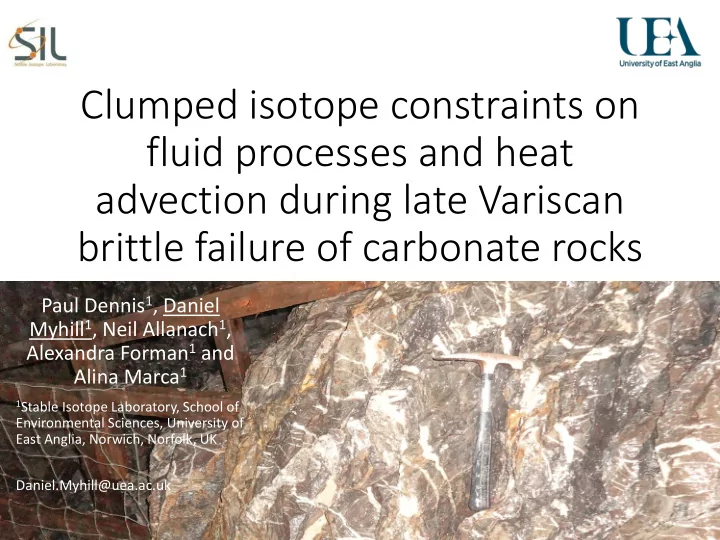
Clumped isotope constraints on fluid processes and heat advection during late Variscan brittle failure of carbonate rocks

Paul Dennis1, Daniel Myhill1, Neil Allanach1, Alexandra Forman1 and Alina Marca1

1Stable Isotope Laboratory, School of

Environmental Sciences, University of East Anglia, Norwich, Norfolk, UK Daniel.Myhill@uea.ac.uk

slide-2
SLIDE 2

Contents

  • Justification
  • What are clumped isotopes?
  • Study locations and geology:
  • Clare Basin, Ireland
  • South Pennine Orefield, Peak District, UK
  • Results from the Clare Basin
  • Results from the South Pennine Orefield
  • Conceptual Model
  • Key Points
slide-3
SLIDE 3

Ju Justification

  • No constraints on fluid composition in geological record
  • Pitfalls of other methods – Oxygen Isotope Thermometry

and fluid inclusions in carbonates

  • Understanding mineralisation processes – MVT deposits
  • Critical in developing carbon, capture and storage
  • Understanding hydrocarbon migration
slide-4
SLIDE 4

What are clu lumped is isotopes?

  • Ordering of heavy isotopes within the carbonate

(CaCO3) lattice (Eiler, 2007)

Heavy Light

slide-5
SLIDE 5

What are clu lumped is isotopes?

  • Clumping of heavy isotopes is inversely proportional

to temperature so therefore acts as a thermometer.

  • Measure Δ47 of CO2 (13C18O16O) as contains the

‘clumped’ isotopes

  • Measured clumped isotope value are compared to

empirical calculations based on known carbonate standards

slide-6
SLIDE 6

What are clu lumped is isotopes?

Summary of what we measure:

  • δ13C and δ18O of carbonate
  • Precipitation Temperature (TΔ47)

We can then calculate:

  • Fluid δ18O from which carbonate precipitated
slide-7
SLIDE 7

(SEPM STRATA, 2013)

Study Location and Geology

Clare Basin

  • Co. Clare, Ireland
slide-8
SLIDE 8

Clare Basin, Co. Clare, Ireland

Fisher Street

Study Location and Geology

(McNamara and Hennessy, 2010)

slide-9
SLIDE 9

Clare Basin, Co. Clare, Ireland

Study Location and Geology

slide-10
SLIDE 10

Clare Basin, Co. Clare, Ireland

Study Location and Geology

slide-11
SLIDE 11

Clare Basin, Co. Clare, Ireland

Study Location and Geology

slide-12
SLIDE 12

Clare Basin, Co. Clare, Ireland

Study Location and Geology

  • Dominant NNE-SSW strike of vein Calcite

(Gillespie et al., 2001 and Moore & Walsh, 2013)

slide-13
SLIDE 13

Adapted from Frazer et al. (2014)

South Pennine Orefield, Peak District, United Kingdom

Study Location and Geology

slide-14
SLIDE 14

South Pennine Orefield, Peak District, United Kingdom

Study Location and Geology

Adapted from Frazer et al. (2014)

slide-15
SLIDE 15

Fluorite dominant Baryte dominant Calcite dominant Copper dominant

South Pennine Orefield, Peak District, United Kingdom

Study Location and Geology

Adapted from Quirk, 1993 and Ford and Quirk, 1995)

slide-16
SLIDE 16

Dirtlow Rake, South Pennine Orefield, Peak District, UK

Study Location and Geology

slide-17
SLIDE 17

Dirtlow Rake, South Pennine Orefield, Peak District, UK

Study Location and Geology

slide-18
SLIDE 18

Ecton Hill, South Pennine Orefield, Peak District, UK

Study Location and Geology

slide-19
SLIDE 19

Ecton Hill, South Pennine Orefield, Peak District, UK

Study Location and Geology

D A B C E

slide-20
SLIDE 20

Geochemistry ry – Cla lare Basin, Ireland

0.5 1 1.5 2 2.5 15 17 19 21 23 25 δ13C(VPDB) (‰) δ18O(VSMOW) Carbonate (‰)

  • <0.4‰ variation in majority of δ13C values
  • 3‰ variation in δ18O
  • Carbon content is host rock buffered
slide-21
SLIDE 21

Precip ipitation Temperatures: Cla lare Basin, Ireland

slide-22
SLIDE 22

Geochemistry ry – Dir irtlow Rake, South Pennine Orefield

slide-23
SLIDE 23

5 10 15 20 25 30 35 40 45 50 55 60 65 70 75 80 Host Lst

20.5 21 21.5 22 22.5 23 1.5 2 2.5 3 3.5 4 δ13C(VPDB) (‰) Calcite δ18O(VSMOW) (‰)

Geochemistry ry – Dir irtlow Rake, South Pennine Orefield

slide-24
SLIDE 24

Precip ipitation Temperature: Dir irtlow Rake, South Pennine Orefield

40 50 60 70 80 90 100

  • 3
  • 2
  • 1

1 2 3 4 5 TemperatureΔ47 (°C) Fluid δ18OVSMOW (‰)

slide-25
SLIDE 25

Precip ipitation Temperature: Dir irtlow Rake, South Pennine Orefield

slide-26
SLIDE 26

Geochemistry ry – Ecton Hill, ill, South Pennine Orefield

slide-27
SLIDE 27

Precip ipitation Temperature: Ecton Hill, ill, South Pennine Orefield

1. 2. 3. 4.

slide-28
SLIDE 28

Conceptual Model

Carboniferous Limestone

σ1 σ1 σ1 σ1

Isotopically evolved, hot fluid sourced from depth Inter-granular pore water Isotopically depleted, cool fluid sourced from above

slide-29
SLIDE 29
  • Clumped isotopes (Δ47) offers a new and unique window

into hydrothermal temperatures and fluid processes

  • Example of Variscan fluids in the South Pennine Orefield

and Clare Basin show temperatures in the range 35 to 160oC following a linear, two end-member mixing line

  • Evidence of pulsed fluids with rapid advection of heat and

mineral precipitation due to disequilibrium with host rock

  • Interconnected, high permeability path for fluid-flow and

mixing due to brittle failure in carbonate rocks

  • Interaction between stress field, pore pressure and

faulting/hydraulic fracturing (e.g. gas pulsars (Cathles, 2007), seismic pumping (Sibson,1975), seismic valve (Sibson, 1981)) – evident at Dirtlow Rake with pulsed

Key Poin ints

slide-30
SLIDE 30
  • Tectonics Studies Group – funding my trip to EGU
  • John Barnett (Peak District National Parks Authority) – for

leading trips into Ecton Mine

  • Peter Kennett (Ecton Mine Education Trust) – allowing

access to the mines in the Peak District

  • Natural England and English Heritage for allowing access

and sampling in the Peak District

Acknowledgements

slide-31
SLIDE 31

Cathles, L.M., 2007, Changes in sub-water table fluid flow at the end of the Proterozoic and its implications for gas pulsars and MVT lead-zinc deposits. Geofluids 7, pp209-226, doi: 10.1111/j.1468- 8123.2007.00176x. Eiler, J.M., 2007, “Clumped-isotope” geochemistry – The study of naturally-occurring multiply-substituted

  • isotopologues. Earth and Planetary Science Letters 262, pp309-327.

Ford, T.D. and Quirk, D.G., 1995, Mineralisation of the South Pennines. Geology Today 11, (5), pp177-181. Frazer, M., Whitaker, F. and Hollis, C., 2014, Fluid expulsion from overpressurised basins: Implications for Pb-Zn mineralisation and dolomitisation of the East Midlands platform. Geology, pp1-19. Gillespie, P.A., Walsh, J.J., Watterson, J., Bonson, C.G. and Manzocchi, T., 2001, Scaling relationships of joint and vein arrays from The Burren, Co. Clare, Ireland. Journal of Structural Geology 23, pp183-201. McNamara, M.E. and Hennessy, R.W., 2010, Stone water and ice – The Geology of the Burren region, Co. Clare, Ireland. First Edition, Ennistymon: The Burren Connect Project. Moore, J.McM. and Walsh, J.J., 2013, Analysis of fracture systems and their impact on flow pathways in Irish bedrock aquifers. Groundwater Newsletter 51, pp28-33. Quirk, D.G., 1993, Origin of the Peak District Orefield. Bulletin of the Peak District Mines Historical Society 12. pp4-15. SEPM STRATA, 2013, Clare Basin Upper Carboniferous Deepwater Sediments, http://www.sepmstrata.org/page.aspx?&pageid=154&2, Accessed: 11/10/14 Sibson, R.H., Moore, J.McM. and Rankin, A.H., 1975, Seismic pumping – a hydrothermal fluid transport

  • mechanism. Journal of the Geological Society of London 131, pp653-659.

References
slide-32
SLIDE 32

Thank you for listening Any Questions?

slide-33
SLIDE 33
slide-34
SLIDE 34
slide-35
SLIDE 35