FLSA Collective Action Discovery Strategies Discovery Tactics Before - - PowerPoint PPT Presentation

flsa collective action discovery strategies
SMART_READER_LITE
LIVE PREVIEW

FLSA Collective Action Discovery Strategies Discovery Tactics Before - - PowerPoint PPT Presentation

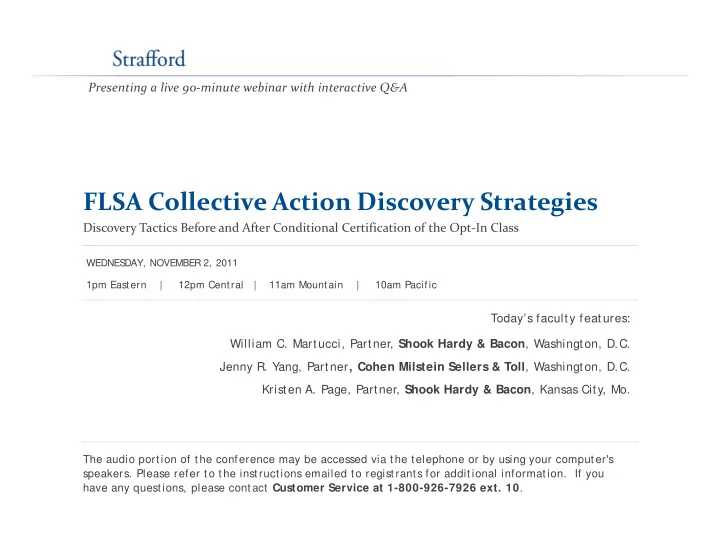
Presenting a live 90 minute webinar with interactive Q&A FLSA Collective Action Discovery Strategies Discovery Tactics Before and After Conditional Certification of the Opt In Class WEDNES DAY, NOVEMBER 2, 2011 1pm Eastern |


slide-1
SLIDE 1

Presenting a live 90‐minute webinar with interactive Q&A

FLSA Collective Action Discovery Strategies

Discovery Tactics Before and After Conditional Certification of the Opt‐In Class

T d ’ f l f

1pm Eastern | 12pm Central | 11am Mountain | 10am Pacific WEDNES DAY, NOVEMBER 2, 2011

Today’s faculty features: William C. Martucci, Partner, Shook Hardy & Bacon, Washington, D.C. Jenny R. Y ang, Partner, Cohen Milstein Sellers & Toll, Washington, D.C. Kristen A. Page, Partner, Shook Hardy & Bacon, Kansas City, Mo.

The audio portion of the conference may be accessed via the telephone or by using your computer's

  • speakers. Please refer to the instructions emailed to registrants for additional information. If you

have any questions, please contact Customer Service at 1-800-926-7926 ext. 10.

slide-2
SLIDE 2

Conference Materials

If you have not printed the conference materials for this program, please complete the following steps:

  • Click on the + sign next to “ Conference Materials” in the middle of the left-

hand column on your screen hand column on your screen.

  • Click on the tab labeled “ Handouts” that appears, and there you will see a

PDF of the slides for today's program.

  • Double click on the PDF and a separate page will open.

Double click on the PDF and a separate page will open.

  • Print the slides by clicking on the printer icon.
slide-3
SLIDE 3

Continuing Education Credits

FOR LIVE EVENT ONLY

For CLE purposes, please let us know how many people are listening at your location by completing each of the following steps:

  • Close the notification box
  • In the chat box, type (1) your company name and (2) the number of

attendees at your location

  • Click the S

END button beside the box

slide-4
SLIDE 4

Tips for Optimal Quality

S d Q lit S

  • und Quality

If you are listening via your computer speakers, please note that the quality of your sound will vary depending on the speed and quality of your internet connection. If the sound quality is not satisfactory and you are listening via your computer speakers, you may listen via the phone: dial 1-866-871-8924 and enter your PIN - when prompted Otherwise please send us a chat or e mail when prompted. Otherwise, please send us a chat or e-mail sound@ straffordpub.com immediately so we can address the problem. If you dialed in and have any difficulties during the call, press *0 for assistance.

Viewing Qualit y

To maximize your screen, press the F11 key on your keyboard. To exit full screen, press the F11 key again press the F11 key again.

slide-5
SLIDE 5

Strafford Publications

FLSA Collective Action Disco er Strategies

Discovery Tactics Before and After

Discovery Strategies

Conditional Certification

November 2, 2011

slide-6
SLIDE 6

Program Outline Program Outline

I. Brief FLSA Foundational Overview II. Discovery Limitations & Strategies for FLSA Actions A. A Starting Place – The Dukes Impact B. Strategy Approaches, the Spectrum and Shaping C. Before Conditional Certification D. After Conditional Certification III. Resolving Discovery Disputes IV Discovery Considerations for Summary Judgment and Other IV. Discovery Considerations for Summary Judgment and Other Procedural Mechanisms V. Discovery Considerations for Trial y

6

slide-7
SLIDE 7

Questions We’ll Consider Questions We ll Consider

  • How does the landmark Dukes v. Wal‐Mart decision impact

p strategic considerations for discovery in FLSA cases?

  • What are the most common discovery challenges counsel face

h liti ti FLSA ll ti ti l it f i iti ti when litigating FLSA collective action lawsuits—from initiation through resolution of the case?

  • What strategies have been effective for counsel in wage and

g g hour collective action litigation for obtaining essential information in the least expensive manner? Wh i h f id h i di bl b f d

  • What is the scope of evidence that is discoverable before and

after conditional certification of the collective class and how can you limit or best manage discovery?

7

slide-8
SLIDE 8

SECTION 1

Brief FLSA Foundational Overview

SECTION 1

slide-9
SLIDE 9

FLSA Overview FLSA Overview

  • The FLSA authorizes actions to recover damages for violation of the Act’s

minimum wage and overtime provisions and to enforce the retaliation

  • prohibition. 29 U.S.C. §216(b) and (c).
  • FLSA actions can be “individual” or “collective.” If collective, employees

“opt in” to join the case. Those who do not opt‐in are not bound by the result and can pursue their own lawsuits.

  • There is a two‐year statute of limitations, which can be extended to three

years for violations that are “willful.” 29 U.S.C. §255(a).

  • Most courts apply a “two‐tier” framework – (1) notice phase – whether to

conditionally certify the action (lenient standard); and (2) decertification y y ( ) ( ) phase (more stringent standard).

  • The focus is on whether sufficient evidence exists to suggest that the

named plaintiffs and putative class members are “similarly situated.” p p y

9

slide-10
SLIDE 10

“Similarly Situated” Key Factors Similarly Situated Key Factors

 The employment and factual settings of the plaintiffs p y g p  Evidence of a company‐wide policy  The various defenses available to defendants  Considerations of fairness, procedure and manageability

10

slide-11
SLIDE 11

Typical FLSA Case Sequence Typical FLSA Case Sequence

1. Filing 2. Preliminary, limited discovery 3. Early motion for conditional certification 4. If conditionally certified, broadened discovery 5. Potential motion to decertify 6. Resolution – dismissal, settlement or trial

11

slide-12
SLIDE 12

Discovery Contours for FLSA Actions Discovery Contours for FLSA Actions

The “certification” stage generally determines the scope: g g y p

  • Before conditional certification – more limited
  • After conditional certification – more robust (but often still

quite limited in light of “representative” context)

12

slide-13
SLIDE 13

SECTION 2

Discovery Limitations & Strategies

SECTION 2

slide-14
SLIDE 14

Discovery Limitations

A Starting Place – The Dukes Impact

Discovery Limitations & Strategies

slide-15
SLIDE 15

Overview of Dukes and the Landscape Overview of Dukes and the Landscape

  • The Dukes plaintiffs alleged unequal pay and promotional

p g q p y p

  • pportunities for women at Wal‐Mart
  • Prior to Dukes, litigation trend was to certify classes based on

id t ti ti t i d d t l company‐wide statistics, expert views, and anecdotal evidence

  • Post‐Dukes, focus is shifting back to employer policies and

, g p y p decisions – reinforcing that certification requires a “rigorous analysis” and issues common to all class members

15

slide-16
SLIDE 16

The Dukes Decision Itself The Dukes Decision Itself

  • Claims for individualized relief, like back pay sought by the

, p y g y Dukes plaintiffs, cannot be brought under FRCP 23(b)(2)

  • “Trials by formula” are prohibited
  • Commonality prong not satisfied

16

slide-17
SLIDE 17

Its True Significance? Its True Significance?

  • Defendants argue Dukes tightens the standards and signals

g g g the decline of the class action remedy across the board

  • Plaintiffs argue the Dukes’ result came about through

li ti f t diti l l ti t d d t application of traditional class action standards to a very challenging set of facts in a large‐scope context, with relevance only to discrimination cases

  • The truth is that Dukes’ significance remains to be seen

17

slide-18
SLIDE 18

Key Impact Areas from Dukes Key Impact Areas from Dukes

Commonality

  • Need “common

answers,” not just common Expert Testimony

  • “Significant

proof” required to bridge the Trial by Formula

  • Employer has the

right to raise individual Subjectivity

  • Allowing

discretion by local supervisors in common questions

  • Must show the

“glue” holding the alleged to bridge the wide gap between an individual’s claim and the existence individual affirmative defenses under Title VII

  • “Trial by formula”

supervisors in decisions should itself raise no inference of discrimination the alleged reasons for all the decisions together

  • f a class of

people who have suffered the same injury Trial by formula is not an acceptable replacement for that right

  • Showing invalidity
  • f one manager’s

use of discretion does nothing to

  • Application of

Daubert at certification stage demonstrate invalidity of another’s

18

slide-19
SLIDE 19

Does Dukes Concern FLSA Cases? Does Dukes Concern FLSA Cases?

  • The Dukes litigation did not involve the FLSA or the §216(b)

g § ( ) analysis

  • Dukes only concerned Rule 23 certification standards
  • Traditionally, courts have distinguished between Rule 23’s

“commonality” standard and § 216(b)’s “similarly situated” standard

  • Nonetheless, there is a lot of chatter about the potential

application of Dukes to FLSA actions

  • And the courts are starting to weigh in – very preliminary, yet

still instructive, at this point

19

slide-20
SLIDE 20

Cases Finding Dukes Impacts §216(b) Cases Finding Dukes Impacts §216(b)

  • Chinese Daily News, Inc. v. Wang, Lynn, et al., 565 U.S. 10‐202 (Oct. 3, 2011 order list) (2011)

( di iti ti ti i d ti j d t f d ffi i $7 7 illi FLSA (summary disposition granting certiorari and vacating judgment of order affirming $7.7 million FLSA award, remanding the case to the Ninth Circuit for further consideration in light of Wal‐Mart Stores, Inc. v. Dukes.”).

  • Ruiz v. Serco, Inc., No. 10‐CV‐394‐BBC, 2011 U.S. Dist. LEXIS 91215 (W.D. Wis. Aug. 5, 2011) (denying

certification of proposed FLSA collective action against professional services company for failing to pay certification of proposed FLSA collective action against professional services company for failing to pay

  • vertime wages, concluding that Dukes is instructive for an FLSA class action commonality inquiry).
  • MacGregor v. Farmers Insurance Exchange, No. 2:10‐CV‐3088, 2011 WL 2981466, *4 (D.S.C. July 22,

2011) (denying §216(b) notice relying in part on Dukes, saying “This court need not base its decision that plaintiffs have failed to present even a modest factual showing of a common policy or plan on Dukes as plaintiffs have failed to present even a modest factual showing of a common policy or plan on Dukes, as numerous district courts have reached similar results without the benefit of this clearly reasoned Supreme Court decision. However, if there is not a uniform practice but decentralized and independent action by supervisors that is contrary to the company’s established policies, individual factual inquiries are likely to predominate and judicial economy will be hindered rather than promoted by certification of a collective action.”).

  • Cruz v. Dollar Tree Stores, No. 3:07‐CV‐04012‐SC, 2011 WL 2682967, at *5 (N.D. Cal. July 8, 2011)

(decertifying class in light of Wal‐Mart v. Dukes commonality requirement).

20

slide-21
SLIDE 21

Cases Limiting Dukes to Decert Stage Cases Limiting Dukes to Decert Stage

  • Spellman v. American Eagle Express, Inc., 2:10‐CV‐01764 (E.D. Pa. July 21, 2011) (slip
  • p.) (order denying motion for reconsideration of decision granting notice, but stating “At this

second stage, AEX may argue that Dukes’s analysis of what constitutes a ‘common question’ is persuasive to this Court’s analysis of whether an FLSA collective action should be certified.”).

21

slide-22
SLIDE 22

FLSA Cases Finding No Dukes Impact FLSA Cases Finding No Dukes Impact

  • Bouaphakeo v. Tyson, No. 5:07‐CV‐04009‐JAJ, 2011 WL 379362 (N.D. Iowa Aug. 25, 2011) (rejecting

d f d t ’ t th t th d i i i D k l th t t t it i tifi ti f defendants’ argument that the decision in Dukes compels the court to overturn its prior certification of a class of Tyson employees who may not have been compensated for all work performed prior and subsequent to “gang time.”).

  • Sliger v. Prospect Mortgage, LLC, No. S‐11‐465 LKK/EFB (E.D. Cal. Aug. 24, 2011) (granting notice and

in footnote declining to consider Dukes because Rule 23 standards were not applicable to §216(b) in footnote declining to consider Dukes because Rule 23 standards were not applicable to §216(b) motion).

  • Butcher, et al. v. United Airlines, 1:09‐CV‐11681 (D. Mass. July 22, 2011) (denying motion for

reconsideration because Dukes did not involve the FLSA and its holding did not apply to conditional certification).

  • Creely v. HCR ManorCare, Inc., 3:09‐CV‐02879 (N.D. Ohio July 1, 2011) (finding the import of Dukes

unavailing because “the Sixth Circuit has drawn a distinction between Rule 23(a)(2)’s ‘commonality’ requirement and the FLSA’s ‘similarly situated’ requirement expressly declining to apply Rule 23’s requirement and the FLSA s similarly situated requirement, expressly declining to apply Rule 23 s standard to FLSA claims.”).

22

slide-23
SLIDE 23

Dukes – Looking Ahead Dukes Looking Ahead

  • Much remains to be seen
  • Smaller cases, more likely focused on a facility or business unit
  • Employer challenges to the use of representative evidence
  • More searching inquiry for “the glue” where challenge is to

discretionary decisions Littl i t diti l tifi ti l i

  • Little impact on conditional certification analysis
  • Less of a distinction between class v. merits discovery
  • More Daubert challenges

More Daubert challenges

  • New arguments for decertification
  • Special considerations for “off the clock” cases

p

23

slide-24
SLIDE 24

Discovery Limitations

Strategy Approaches, the Spectrum and

Discovery Limitations & Strategies

Spectrum and Shaping

slide-25
SLIDE 25

The Big Picture Drives The Little One The Big Picture Drives The Little One

The overall litigation strategy frames each discovery decision.

25

slide-26
SLIDE 26

The Strategy Continuum The Strategy Continuum

R d E i Rugged (Scorched Earth Approach) Easygoing (Open to Variety

  • f Approaches)

pp oac )

  • pp oac es)

Reasonable (The Middle Ground)

26

slide-27
SLIDE 27

A Spectrum of Strategy Factors A Spectrum of Strategy Factors

  • Client Goals
  • Size of Affected Business
  • Familiarity with FLSA Litigation
  • History with Opposing Counsel
  • History with Litigation Type
  • Impact of Result on the Industry/Business
  • Budget Considerations
  • Emotional Investment
  • Emotional Investment

27

slide-28
SLIDE 28

Client Approach to Decision-Making Client Approach to Decision Making

Human R Representatives Corporate Counsel Resources Operations Representatives Opt‐In Plaintiffs Counsel p p

How best to help different types of clients with strategic discovery decisions?

28

slide-29
SLIDE 29

A Framework for Discovery Decisions A Framework for Discovery Decisions

Rule 26 is the starting place and sets the general scope. g p g p

  • “Unless otherwise limited by court order, the scope of discovery is as

follows: Parties may obtain discovery regarding any nonprivileged matter that is relevant to any party's claim or defense — including the existence, y p y g , description, nature, custody, condition, and location of any documents or

  • ther tangible things and the identity and location of persons who know
  • f any discoverable matter. For good cause, the court may order discovery
  • f any matter relevant to the subject matter involved in the action.

Relevant information need not be admissible at the trial if the discovery appears reasonably calculated to lead to the discovery of admissible id ” evidence.” F.R.C.P. 26(b)(1)

29

slide-30
SLIDE 30

A Framework for Discovery Decisions A Framework for Discovery Decisions

Rule 26 sometimes provides protection… p p

  • “A party or any person from whom discovery is sought may move for a

protective order in the court where the action is pending — or as an alternative on matters relating to a deposition, in the court for the district g p , where the deposition will be taken. The motion must include a certification that the movant has in good faith conferred or attempted to confer with other affected parties in an effort to resolve the dispute without court action. The court may, for good cause, issue an order to protect a party or person from annoyance, embarrassment, oppression, or undue burden….” F.R.C.P. 26(c)(1)

30

slide-31
SLIDE 31

A Framework for Discovery Decisions A Framework for Discovery Decisions

But, significantly, Rule 26 requires cooperation and , g y, q p collaboration –

  • “In conferring, the parties must consider the nature and basis of their

claims and defenses and the possibilities for promptly settling or resolving claims and defenses and the possibilities for promptly settling or resolving the case; make or arrange for the disclosures required by Rule 26(a)(1); discuss any issues about preserving discoverable information; and develop a proposed discovery plan. The attorneys of record and all unrepresented p p y p y p parties that have appeared in the case are jointly responsible for arranging the conference, for attempting in good faith to agree on the proposed discovery plan, and for submitting to the court within 14 days after the conference a written report outlining the plan.” F.R.C.P. 26(f)(2) ( )( )

31

slide-32
SLIDE 32

The Rule 26 Framework in Play The Rule 26 Framework in Play

Rule 26 principles are perhaps most meaningful in class/collective litigation.

General

p p p p g g

Potential for Limitation General Broad Scope Cooperation Required

Collaborative Discovery Approach Approach

32

slide-33
SLIDE 33

The Initial Strategy Test – Preservation The Initial Strategy Test Preservation

  • Document preservation obligations are important for

Document preservation obligations are important for plaintiffs and defendants

  • Preservation is both a pitfall area and a challenge for

p g the budget

  • Key is to try and balance diligent efforts with

y y g reasonable contours

  • Early court intervention is sometimes needed to

“confirm” appropriate scope and give confidence to move ahead

33

slide-34
SLIDE 34

For Employers – Sweeping Obligations For Employers Sweeping Obligations

  • Be mindful of early obligation to issue internal “litigation hold

notice” once there is a “reasonable anticipation of litigation.” Zubulake v. UBS Warburg (Zubulake IV), 220 F.R.D. 212 (S.D.N.Y. 2003); see also Pension Committee v. Bank of America Securities, ); f , LLC, 210 WL 184312 (S.D.N.Y. Jan. 15, 2010) (“failure to issue written litigation hold notice constitutes gross negligence.”).

  • Be broad with notification to appropriate segment of employees
  • Be broad with notification to appropriate segment of employees,

and ensure special follow‐up with “key players.”

  • Remember, particularly in FLSA litigation, to provide specific

tifi ti d id t IS l d th h i t i notification and guidance to IS employees and others who maintain centralized pay/timekeeping records and email systems.

34

slide-35
SLIDE 35

Strategies for Doc Collection + Costs Strategies for Doc Collection + Costs

  • Highly dependant on factual matters in each case.
  • Collaborate with counsel early and consider potential cost sharing –

easier to approach the topic if done prior to undertaking action.

  • Consider a “menu” approach

here are the types of documents we

  • Consider a menu approach – here are the types of documents we

have, and here is what it will cost to get them for X region, business unit, employee classification, etc.

  • Many courts have e‐discovery protocols that guide the document

collection, search, and production process – for example, the Eastern District of Pennsylvania, Middle District of Tennessee, District of Maryland, and Western District of North Carolina.

  • Even if not a part of your court’s process, consider proposing an e‐

discovery protocol. y p

35

slide-36
SLIDE 36

Special E-Discovery Considerations Special E Discovery Considerations

  • Agree on a protocol for electronic matters
  • Designate an e‐discovery coordinator for each party
  • Engage vendors early

I l h i h l k l d i

  • Involve the right people – knowledge is power
  • Make stipulations re non‐waiver of privilege (“claw‐back”)
  • Share and agree on search terms in advance

Share and agree on search terms in advance

  • Ask for your opposing party’s input on potential document sources

– avoid surprises later

36

slide-37
SLIDE 37

Discovery Limitations

Before Conditional Certification

Discovery Limitations & Strategies

slide-38
SLIDE 38

Pre-Cert Fact Gathering by Plaintiffs Pre Cert Fact Gathering by Plaintiffs

  • Factual Interviews
  • Declarations
  • Key Policies
  • Investigators
  • Advertising
  • Emails, Letters and Websites

38

slide-39
SLIDE 39

Early Discovery of Plaintiff Contact Info Early Discovery of Plaintiff Contact Info

  • Most courts will permit discovery of names and addresses of

p y potential class members prior to ruling on notice. See, e.g., Fei v. WestLB‐AG, 2008 U.S. Dist. LEXIS 33310, at *2, 4‐6 (S D N Y Apr 23 2008); Baldozier v American Family Mut Ins (S.D.N.Y. Apr. 23, 2008); Baldozier v. American Family Mut. Ins. Co., 375 F. Supp. 2d 1089, 1091‐93 (D. Colo. 2005).

  • Courts that have denied such discovery have held it to be

premature prior to a decision on whether notice should be

  • approved. See, e.g., Barton v. The Pantry, Inc., 2006 U.S. Dist.

LEXIS 62989 at *4‐6 (M D N C Aug 31 2006) LEXIS 62989, at 4 6 (M.D.N.C. Aug. 31, 2006).

39

slide-40
SLIDE 40

Other Types of Pre-Cert Discovery Other Types of Pre Cert Discovery

  • The conditional certification standard is generally considered

g y a modest one, so extensive pre‐cert discovery is not typically allowed Th l tifi ti d i i i ti d b d

  • The early certification decision is sometimes made based on

detailed complaint allegations, as supported by sworn statements, and not through expansive discovery

  • Some courts will, however, allow for some discovery to be

completed prior to deciding whether notice should be allowed allowed

40

slide-41
SLIDE 41

What “Other” Discovery is Allowed? What Other Discovery is Allowed?

  • Beyond permitting discovery of potential class members’ contact

information prior to conditional certification, courts will typically also allow discovery that relates to or is necessary for defining the proposed class. See Long v. Landvest Corp., 2006 U.S. Dist. LEXIS p p g p , 16369, at *14‐15 (D. Kan. Mar. 31, 2006).

  • For example, courts have granted motions to compel in the pre‐

conditional certification timeframe relating to compensation and conditional certification timeframe relating to compensation and timekeeping policies, job descriptions, and prior litigation and administrative proceedings relating to a defendant’s wage and hour practices See e g Sjoblom v Charter Communications LLC 2008

  • practices. See, e.g., Sjoblom v. Charter Communications, LLC, 2008

U.S. Dist. LEXIS 1001, *2, 8 (W.D. Wis. Jan. 4, 2008); Tucker v. Labor Leasing, Inc., 155 F.R.D. 687 (M.D. Fla. 1994).

41

slide-42
SLIDE 42

Why Is More Not Allowed? Why Is More Not Allowed?

  • Courts denying more extensive discovery sought by defendants generally

do so on the grounds that such discovery is inconsistent with the two‐step process for certification, generally reasoning that extended discovery: – Leads defendants to argue for applying the more stringent second‐ stage standard; or – Causes unacceptable delay, given that the statute of limitations will continue to run until a decision is made.

  • Other courts have focused more on the need for early notice due to the

running of the statute of limitations in rejecting efforts by defendants to

  • btain discovery prior to a ruling on notice. See Doucoure v. Matlyn Foods

y p g y Inc., 554 F. Supp. 2d 369, 374 (E.D.N.Y. 2008).

42

slide-43
SLIDE 43

Strategy – How Much Do You Want? Strategy How Much Do You Want?

  • The amount of discovery conducted during the pre‐conditional

certification timeframe can affect the otherwise “lenient” standard. This is a strategic consideration area.

  • Some courts have permitted the extent of discovery to affect the standard.

See, e.g., Valcho v. Dallas County Hosp. Dist., 574 F. Supp. 2d 618, 622 (N.D. Tex. 2008) (explaining that the reasons for the lenient standard typically disappear once discovery has been conducted).

  • And, some have not. See, e.g., Neary v. Met. Prop. & Cas. Ins. Co., 517 F.
  • Supp. 2d 606, 618 (D. Conn. 2007) (rejecting defendant’s argument for

applying the second stage standard because while some discovery was completed, it was not as far along as in the cases relied upon by defendant).

43

slide-44
SLIDE 44

Sum Observations on Early Discovery Sum Observations on Early Discovery

  • If pre‐conditional certification discovery is requested by a

p y q y plaintiff, it is more likely to be granted.

  • If it is requested by a defendant, it is more likely to be denied.
  • In any event, pre‐notice requests for discovery should be

narrowly‐tailored to enhance likelihood the Court will agree.

  • On occasion the parties agree to focused discovery before
  • On occasion, the parties agree to focused discovery before

notice is sent out and prior to a conditional certification decision.

44

slide-45
SLIDE 45

Discovery Limitations

After Conditional Certification

Discovery Limitations & Strategies

slide-46
SLIDE 46

Post-Cert Discovery Contours Post Cert Discovery Contours

  • In the post‐certification phase, discovery scope will be broadened. The

parties will be looking ahead to the decertification stage, which involves a much more stringent standard as to the “similarly situated” question.

  • The process typically begins with the parties working to propose an

agreeable discovery plan. If it cannot be agreed, the court will intervene and define the plan.

  • As a representative action, sampling is a common aspect of the discovery
  • approach. Post‐Dukes, this is still likely to continue as the prevailing

approach during the discovery stage, but any conclusions from samples will likely be subject to greater scrutiny after discovery.

  • If opt‐ins number in the few hundred, an individualized approach to

discovery is more likely. If greater, a representative approach of some sort and related collaboration on sampling is nearly certain.

46

slide-47
SLIDE 47

Factors in the Framing of a Plan Factors in the Framing of a Plan

  • Potential dispositive issues

p

  • The amount in controversy
  • Number of likely opt‐ins
  • Character of document discovery
  • Geographic considerations
  • Potential stipulations
  • Propriety of case consolidation

47

slide-48
SLIDE 48

Discovery on a “Microcosm” Discovery on a Microcosm

  • As a case management approach, some courts have had parties select a certain

number of opt‐in plaintiffs as a microcosm of the entire class and conduct limited discovery to those opt‐ins.

  • For example, Hogan v. Allstate Insurance Co., 210 F. Supp. 2d 1312 (M.D. Fla.

2002) affirmed in part vacated and remanded in part 361 F 3d 621 (11th Cir 2002), affirmed in part, vacated and remanded in part, 361 F.3d 621 (11th Cir. 2004). – The district court directed each side to choose three test plaintiffs for purposes of discovery and dispositive motions. purposes of discovery and dispositive motions. – The parties eventually filed cross motions for summary judgment, and the Court granted them in favor of defendant for all six plaintiffs and for the remaining 2,300 opt‐in members. – The Eleventh Circuit affirmed judgment on the six opt‐ins, but vacated as to the non‐test plaintiffs because the district court had not given them the required 10‐day notice pursuant to FRCP 56(c).

48

slide-49
SLIDE 49

Strategic Considerations Strategic Considerations

  • Throughout discovery – even during cooperative planning with other

counsel – maintain and preserve arguments related to the impropriety of a sampling approach and any conclusions that might be drawn from “representative” evidence.

  • Build a record for challenging the opinions of experts – in the post‐Dukes

world, courts will likely be more willing to address Daubert challenges when considering certification questions.

  • Consider discovery approaches that will focus broad allegations or broad

defenses on particular segments or divisions of the business. Courts will be looking to narrow expansive cases in the post‐Dukes litigation environment.

49

slide-50
SLIDE 50

SECTION 3

Resolving Discovery Disputes

SECTION 3

slide-51
SLIDE 51

Addressing Discovery Disputes Addressing Discovery Disputes

  • Plan to be able to say (when a problem arises): “we reached

y ( p )

  • ut and sought their input on [x, y, or z] long ago.”
  • Agree to as much as you can before approaching the court, so

th f di t f th t i ibl the area of dispute for the court is as narrow as possible.

  • When it comes time for briefing, tell both a substantive and a

procedural story. Consider a timeline. p y

  • Experts and/or vendors may be important for significant

discovery disputes.

51

slide-52
SLIDE 52

Case Study: When Parties Do Not Agree Case Study: When Parties Do Not Agree

In Re: Pilgrim’s Pride Litigation g g

  • Coordinated in the Western District of Arkansas.
  • Extensive discovery plan briefing was undertaken by the

parties and presented to the district court.

  • The parties suggested varying time and scopy of discovery

approaches – each arguing their plan was more appropriate approaches each arguing their plan was more appropriate and targeted to the issues.

  • See generally, In Re Pilgrim’s Pride FLSA Litigation, 489 F.
  • Supp. 2d 1381 (J.P.M.L. 2007).

52

slide-53
SLIDE 53

Case Study: When Parties Do Not Agree Case Study: When Parties Do Not Agree

In Re: Pilgrim’s Pride Litigation g g

  • Ultimately, the Court set a discovery schedule that combined

requests from both sides – focused on limits and contours.

– Test facilities for discovery – Hour limits on depositions – Limitations on written discovery – Prescribed document production for those to be deposed

53

slide-54
SLIDE 54

SECTION 4

Discovery Considerations for SJ and Other Procedural Tools

SECTION 4

slide-55
SLIDE 55

Procedural Mechanisms Procedural Mechanisms

Bifurcation to Manage Costs g

  • Bifurcation is governed by FRCP 42(b), which provides:

– “For convenience, to avoid prejudice, or to expedite and economize, th t d t t i l f t i the court may order a separate trial of one or more separate issues, claims, cross claims, counterclaims, or third‐party claims. When

  • rdering a separate trial, the court must preserve any federal right to a

jury trial ” jury trial.

  • Bifurcation is often a matter of stipulation or can be raised by

motion – the approach can be applicable to trial and/or discovery.

  • Discretionary to the trial court.

55

slide-56
SLIDE 56

Procedural Mechanisms Procedural Mechanisms

Multi‐District Litigation g

  • A common approach to managing multiple similar actions is to

seek consolidation or coordination through a multi‐district t f d 28 U S C § 1407 transfer under 28 U.S.C. § 1407.

  • MDL transfers are common in FLSA cases where sufficient

common factual issues exist. Additional factors are:

– Where the earliest case was filed; – Where the most procedurally advanced case is pending; f – What is most convenient for the parties and witnesses; and – Which court has the resources to handle a transferred case.

56

slide-57
SLIDE 57

Procedural Mechanisms Procedural Mechanisms

Summary Judgment y g

  • Summary judgment is a tool for case shaping
  • Requires early focus in discovery to build appropriate factual

record

  • In light of Dukes and the potential for stronger decertification

motions summary judgment may become more of a force in motions, summary judgment may become more of a force in FLSA litigation

57

slide-58
SLIDE 58

SECTION 5

Discovery Considerations for Trial

SECTION 5

slide-59
SLIDE 59

Selected Trial Issues in FLSA Litigation Selected Trial Issues in FLSA Litigation

Representative Aspects p p

  • Test Plaintiffs
  • Bellweather Trials
  • ADR Considerations

– Mediation Focus Groups – Focus Groups – Mini‐Trials

59

slide-60
SLIDE 60

Trial Evidence in FLSA Actions Trial Evidence in FLSA Actions

Representative Evidence p

  • The scope of representative testimony will vary depending on the facts of

each case.

  • E g Herman v Hogar praderas de Armor Inc 130 F Supp 2d 257 265
  • E.g., Herman v. Hogar praderas de Armor, Inc., 130 F. Supp. 2d 257, 265

(D.P.R. 2001) (“the adequacy of the representation is based on the nature

  • f the work, working conditions, and on‐the‐job relationships.”).
  • No fixed ratio for determining the percentages of employees who must
  • No fixed ratio for determining the percentages of employees who must

testify.

  • Compare Reich v. S. New England Tel. Corp., 121 F.3d 58 (2d Cir. 1997)

(sample of 2 5% of all affected employees adequate) with Archie v Grand (sample of 2.5% of all affected employees adequate), with Archie v. Grand

  • Cent. P’ship, 86 F. Supp. 2d 262, 272 (S.D.N.Y. 2000) (damages calculations

for 6% of plaintiff class based on records for remainder of class members).

60

slide-61
SLIDE 61

Potential for DOL Testimony at Trial Potential for DOL Testimony at Trial

Compliance Officer p

  • In many instances, the parties may rely on testimony or reports of a

compliance officer from the Department of Labor with respect to liability

  • r damages. E.g., Brock v. Seto, 790 F.2d 1446, 1449 (9th Cir. 1986) (refusal
  • da

ages g ,

  • c

Se o, 90 d 6, 9 (9 986) ( e usa to admit compliance officer’s testimony about back wage comparisons was error).

61

slide-62
SLIDE 62

Damage Calculations Damage Calculations

Burden of Proof

  • If the employee fails to produce evidence of the precise amount of work
  • r evidence to rebut the reasonableness of the inference to be drawn

from the employee’s evidence of work performed without proper

  • e e p oyee s e de ce o
  • pe o

ed

  • u p ope

compensation, “the court may then award damages to the employee, even though the result be only approximate.” Anderson v. Mt. Clemens Pottery Co., 328 U.S. 680, 687‐88 (1946).

Precision v. Approximation

  • The employee is not required to compute FLSA damages with precision,

but rather need only present evidence sufficient to estimate damages but rather need only present evidence sufficient to estimate damages through a “just and reasonable inference.” Id. at 687‐88.

62

slide-63
SLIDE 63

Damages – How Much Precision? Damages How Much Precision?

Recent Examples p

  • The West Coast Litigation Involving Farmers (California)
  • The East Coast Litigation Involving Geico (District of Columbia)

63

slide-64
SLIDE 64

Strafford Publications – FLSA C ll ti A ti Di St t i FLSA Collective Action Discovery Strategies

William C. Martucci Sh k H d & B Shook Hardy & Bacon Washington, D.C. 202‐783‐8400 Kansas City 816‐474‐6550 wmartucci@shb.com Jenny R. Yang Cohen Milstein Sellers & Toll Washington, D.C. 202‐408‐4600 jyang@cohenmilstein.com jy g@ Kristen A. Page, Partner Shook Hardy & Bacon Kansas City Mo Kansas City, Mo. 816‐559‐2511 kpage@shb.com

64