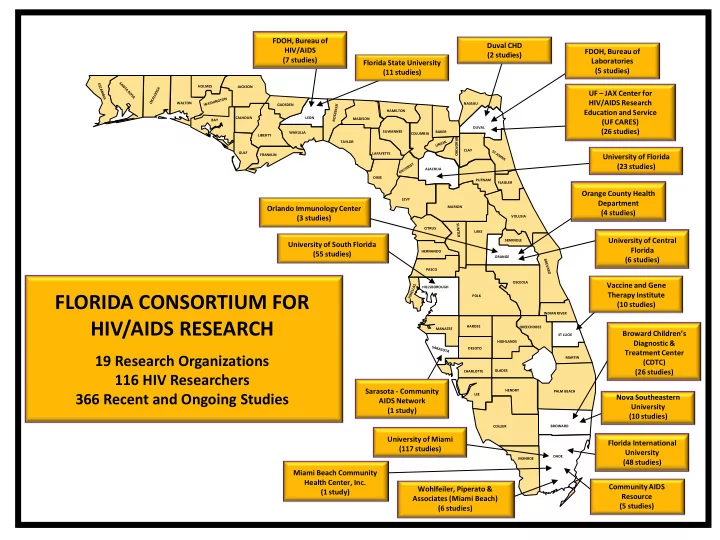
SLIDE 1 MADISON TAYLOR HAMILTON SUWANNEE LAFAYETTE DIXIE COLUMBIA LEVY BRADFORD ALACHUA PUTNAM MARION LAKE CITRUS HERNANDO BAKER NASSAU DUVAL CLAY FLAGLER VOLUSIA SEMINOLE ORANGE OSCEOLA HILLSBOROUGH POLK MANATEE HARDEE INDIAN RIVER OKEECHOBEE ST LUCIE MARTIN PALM BEACH BROWARD DADE MONROE HIGHLANDS COLLIER HENDRY LEE CHARLOTTE GLADES DESOTO WALTON HOLMES JACKSON CALHOUN BAY GULF GADSDEN LIBERTY FRANKLIN LEON WAKULLA PASCO
FLORIDA CONSORTIUM FOR HIV/AIDS RESEARCH
19 Research Organizations 116 HIV Researchers 366 Recent and Ongoing Studies
University of South Florida (55 studies) Sarasota - Community AIDS Network (1 study) FDOH, Bureau of HIV/AIDS (7 studies) Florida State University (11 studies) Duval CHD (2 studies) FDOH, Bureau of Laboratories (5 studies) UF – JAX Center for HIV/AIDS Research Education and Service (UF CARES) (26 studies) University of Florida (23 studies) Orange County Health Department (4 studies) University of Central Florida (6 studies) Nova Southeastern University (10 studies) Florida International University (48 studies) University of Miami (117 studies) Vaccine and Gene Therapy Institute (10 studies) Broward Children’s Diagnostic & Treatment Center (CDTC) (26 studies) Community AIDS Resource (5 studies) Miami Beach Community Health Center, Inc. (1 study) Wohlfeiler, Piperato & Associates (Miami Beach) (6 studies) Orlando Immunology Center (3 studies)
SLIDE 2
FLORIDA CONSORTIUM FOR HIV/AIDS RESEARCH Executive Advisory Committee
Conference Call / Webinar, December 6, 2011
Orientation and Discussion
SLIDE 3 The Executive Advisory Committee
Nine Voting Members
- Dr. Neil Abell, Florida State University
- Dr. Jeffrey Beal, Florida/Caribbean AETC (Chairperson)
- Dr. Alexander Cole, University of Central Florida
- Dr. Isa Fernandez, Nova Southeastern University
- Dr. Margaret Fischl, University of Miami
- Dr. Rob Malow, Florida International University
- Dr. Mobeen Rathore, University of Florida-Jacksonville
- Dr. Rafik-Pierre Sekaly, Vaccine and Gene Therapy Institute
- Dr. John Sleasman, University of South Florida
Six Non-Voting Members DOH, Bureau of Laboratory Services, Berry Bennett, MPH University of Florida-Gainesville, Dr. Robert Cook DOH, Bureau of HIV/AIDS, Surveillance, Becky Grigg, PhD DOH, Bureau of HIV/AIDS, Prevention, Marlene LaLota, MPH HIV/AIDS Research Coordinator, Spencer Lieb, MPH The AIDS Institute Executive Director, Michael Ruppal
SLIDE 4 The Consortium Agenda
Mission: Create collaborative HIV-related research to advance a substantive decrease in statewide and local incidence, morbidity and mortality Goal: Promote the design and conduct of inter-institutional studies on HIV prevention, treatment, cures and vaccines Objectives:
- Identify common interest areas to lead to collaborations that
will bring new research resources to FL
- Create and maintain a statewide inventory of research
- Educate staff and potential participants about clinical trials
and other studies to promote appropriate referral
- Pursue ways to solve participant recruitment challenges
SLIDE 5 FCHAR Accomplishments To Date
- DOH Bureau of HIV/AIDS planned and convened the first
meeting of the Consortium in Orlando, Feb. 24, 2011, with 65 HIV researchers from around Florida
- FCHAR joins The AIDS Institute, a policy research, advocacy and
education nonprofit, with a national and a Florida focus
- Currently 116 researchers on mailing list, with 40 directly
involved with subcommittee or advisory committee work
- Established and conducted 2 conference calls with each of 4
subcommittees to gather recommendations: Hard-to-Reach Populations, ARVs and Other Therapeutics, Research Education and Regional Networks
SLIDE 6 FCHAR Accomplishments Continued
- Educational brochures to present patients with clinical trials
- ptions
- Survey on hard-to-reach populations and hard-to-obtain
biologic specimens: challenges and solutions
- Compiled a research inventory of 400 recent or ongoing studies,
and a Web-based inventory entering developmental phase
- Recruited an HIV/AIDS Research Coordinator, an Intern and an
Executive Advisory Committee
- Prepared slide sets to help interpret epidemiologic data and lab
reports; Webinar arrangements are being made
SLIDE 7 Executive Advisory Committee Key Functions and Activities
To Advance the FCHAR Agenda Prioritize the recommendations of the 4 subcommittees Plan, organize, staff and convene periodic webinars and annual meetings Synthesize new plans, objectives and recommendations Provide support and implementation guidance to the HIV/AIDS Research Coordinator, the HIV research community and The AIDS Institute’s Executive Director Monitor and evaluate progress toward the timely completion
SLIDE 8
Discussion 2nd Annual FCHAR Meeting, Orlando, January 9, 2012 ATTENDANCE SUMMARY
53 (69%) of 77 RSVP respondents have confirmed they will attend 29 have yet to respond – mass invitation was sent out Nov. 22, with a personal follow-up to non-responders on Dec. 2 In general, how to increase response rates to email requests?
SLIDE 9
Discussion (cont’d) CONFIRMED SPEAKERS and NEEDED PANELISTS
4th Generation and Future HIV Assays: Bennett (DOH Bureau of Laboratories) Ethics and the IRB: Lieb (moderator) (TAI / FCHAR); Goodman (UM), Moseley (UF); Arons (formerly of DOH and IRB) Panels on the Studies Part I, Epi/Behavioral/Social: Metsch (moderator) (UM); Cook (UF); Lescano (USF); LaLota (DOH, Bureau of HIV/AIDS) Part II, Clinical Trials: Fischl (moderator) (UM); Rathore (UF); Somboonwit (USF); Need One More:______________________ Part III, Basic Science: Beal (moderator) (AETC/DOH): Sekaly (VGTI); Pahwa (?) (UM); Need to Confirm Pahwa and Need One or Two More: ____________
SLIDE 10
Discussion (cont’d) Immediate Tasks at Hand
Clarify the guidelines for the role of the moderators and panelists at the January 9 meeting Need one of you to volunteer to conduct/moderate the next EAC conference call/webinar Frequency of EAC conference calls/webinars Identify and recruit to the EAC a person living with HIV, with a background that includes research-related activity Discuss inviting other PLWH to become Consortium members
SLIDE 11
Discussion (cont’d)
Expand and refine roles, functions and activities of the Executive Advisory Committee Strength in numbers Numerous new inter-institutional HIV protocols and funding opportunities Capacity to operate locally, regionally and statewide Making FCHAR greater than the sum of its parts Cooperation rather than competition Financial support from member institutions…?
SLIDE 12
OPEN DISCUSSION Conclusion (This slide set is going to be emailed to each of you, along with a list of recommendations from the 8 subcommittee conference calls)