First National Folk Festival Research & compilation by Phyl Lobl - - PDF document

first national folk festival
SMART_READER_LITE
LIVE PREVIEW

First National Folk Festival Research & compilation by Phyl Lobl - - PDF document

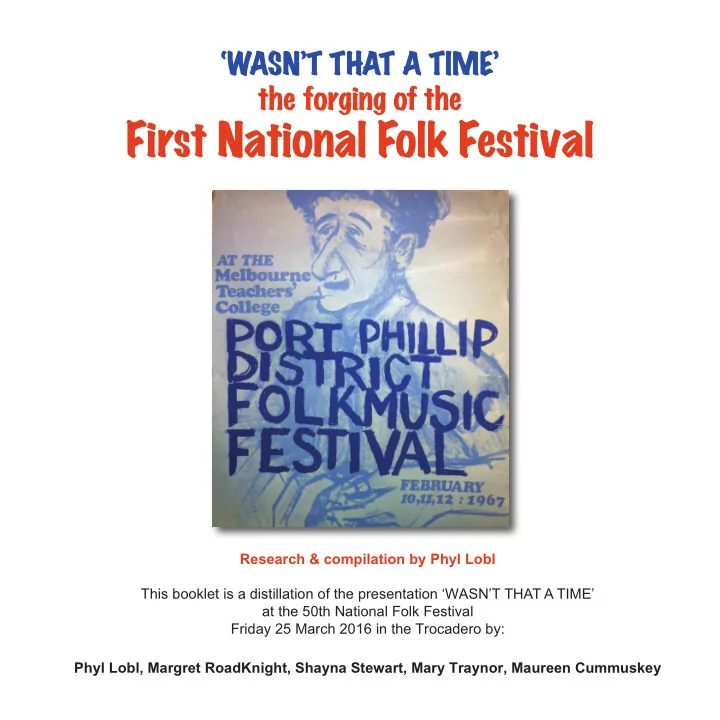
WASNT THAT A TIME the forging of the First National Folk Festival Research & compilation by Phyl Lobl This booklet is a distillation of the presentation WASNT THAT A TIME at the 50th National Folk Festival Friday 25 March


slide-1
SLIDE 1

‘WASN’T THAT A TIME’ the forging of the

First National Folk Festival

Research & compilation by Phyl Lobl This booklet is a distillation of the presentation ‘WASN’T THAT A TIME’ at the 50th National Folk Festival Friday 25 March 2016 in the Trocadero by: Phyl Lobl, Margret RoadKnight, Shayna Stewart, Mary Traynor, Maureen Cummuskey

slide-2
SLIDE 2

CULTURAL MAINTENANCE & GROWTH BECAME ‘FESTIVALISED’ 1967 Before 1967, realisation of the value of folklore and its products in the art-forms of poetry, song, music, dance and crafts was having a revival throughout the western world. There was also awareness that ordinary people had perceptions and skills they could use to: 1. Reveal their reality. 2. Relate the history of that reality. 3. Relieve that reality. Many Australians were already alerted to this value by the work of performers, collectors, writers and academics: 1832 Frank The Poet, 1857 Charles Thatcher, 1905 Banjo Patterson, Henry Lawson, 1920 Julian Stuart, Louis Lavater, Vance & Nettie Palmer, Alan Marshall, Bill Wannan The fifties especially saw a heightened interest. The sixties saw a strengthening of this interest. The table on the next page shows some of the personalities and the activities that preceded the 1967 National Folk Festival (NFF). Although not finite, the table demonstrates when and where and in what format these happenings took place. The task of fitting more of the many individual singers and recordings onto the space available on the ‘table’ was too daunting to attempt here. I acknowledge many fine performers deserve a place ‘on the table’. Although I was present in Melbourne at the time of the planning of the 1967 festival, and attended many meetings, as did Geri Lobl, I was not on the committee. However I had much personal contact with the main players through participation in the many concerts and functions organised to raise funds for presenting the festival. I therefore took upon myself the task of relating as many facts as I could remember, or could verify with others, as to how and why it happened in order to commemorate this 50th NFF. Scientifically and culturally, humanity walks in the footsteps of those who have gone before. It is no different for folklore. As the following table shows we, as ‘cultural maintenance workers’, found firm footsteps in which to walk. May our footsteps be as firm for those who follow us. Phyl Lobl (Vinnicombe) February 2016

slide-3
SLIDE 3

VIC N.S.W QLD S.A W.A N.T ACT TAS

ACTIVITY PRE-1900 k

FIELD COLLECTORS

40 s Percy Jones Bill Wannan 50 H.Anderson Norm O Connor M.J.Officer Ron Edwards &Joy Durst (pre1959) 1952 John Meredith * Russel Ward * Stewart & Keesing* Jeremy Beckett Allan Scott Alex Hood E.P Elkin Ab. Lore Julian Stuart Bob Michell Stan Arthur Ron Edwards (after 1959) Bill Scott U.Mc Connel (Ab.L) 1958 J.Beckett (Ab.L) (Aboriginal Lore) Ted.Strehlow (Aborigina l Lore) W.Stanner Alice Moyle (Handlist Ab.Lore) Horace Watson Ab.Lore

ACADEMICS & / or GATHERERS

Louis Lavater G Mannng Clark A Ian Turner A/G Wendy Lowenstein G Banjo Paterson G Russel Ward A/G Edgar Waters A/G John Manifold A/G

OS VISITORS

A.l.Lloyd 34 Burl Ives 52 William Clausen 60 Pete Seeger 63

Ditto Ditto

MAGAZINES

61Gumsuckers Gazette 64 Tradition Speewa 55 Sing About Folk Idiom (N Castle) Bush Telegraph Fed Mag Focal Town Crier ?

PUBLICATIONS RECORD LABELS

Colonial Ballads - Anderson Joy Durst Songbook SCORE RECORDS - Peter Mann OPAL RECORDS -Norm O Connor 57 Old Bush Songs S&K)* Folk Songs Of Aust.. Meredith WATTLE RECORDS Peter Hamilton Ramskull Press* Penguin Collections (Manifold) ArdTac

Folk products made by tribal people, convicts settlers, shearers, diggers, kids

VENUES

1955 VFMC 1956 Arab Cafe Lorne Greasy Spoon Portsea 1963 Emerald Hill Traynors Jazz & Folk Club Lazars Reata (2) 1967La Mama 54 Bush Mus.Club Pact Folk Troubadour Folk Attic/Terrace (Jim Carter) Ncastle:Folk Sanctum 1964 Purple Parrot 1967 63 The Folk Centre Primitif Folk Hut Catacombs Purple Cow Shiralee

LARGE CONCERTS

1953 REEDY RIVER (Dick Diamond) 1963 MOOMBA 66 MYER MUSIC BOWL 1954 REEDY RIVER 1965 NEWPORT NSW

CONFERENCES

1959 One Day Folklore Conf.

RECORD STORES RECORD LABELS

DISCURIO (Peter & Ruth Mann) SCORE Mann OPAL Oconnor EDELS Sydney WATTLE Hamilton THE FOLK SHOP Isles Love Lane Brisbane

FESTIVALS 1962 NARIEL CREEK 1967 PORT PHILLIP NFF

1965 NEWPORT FESTIVAL was planned but became limited see above as concert

Pre 1967 FOOTSTEPS OF FOLK
slide-4
SLIDE 4

GREATLY ASSISTED BY ACTIVE MEMBERS ON THE 1ST NFF COMMITTEE Martyn Wyndham-Read, Jane Durst, Don Hall, Merle Lamb, Peter Dickie-Neilson, Mick Counihan, Bert Cameron, Lorna Cameron, Jim Buchanan, Brent Davey, Pat O’Connor A small meeting at the home of Martyn Wyndham-Read set the ball rolling in the move to create a NATIONAL FOLK

  • FESTIVAL. Those present included Glen Tomasetti, Frank Traynor and other interested people. The aim was to

create an encompassing festival of folk related material. This is made clear in Glen’s article titled ‘PORT PHILIP FOLK FESTIVAL WILL MAKE HISTORY’ published in TRADITION October 1966. Glen was commenting on the shortcomings of the N.S.W Newport Festival of Jazz & Folk 1965. The shortcomings seem to have been the spark that lit the festival fire. Glen wrote:- It (Newport) offered folksingers a series of spots, a big stage, a big audience,big amplifiers and a nice

  • cheque. For those who had long liked folk music there was little inspiring or unexpected. There was only one

small meeting, mostly of singers where Edgar Waters (folklorist) spoke. The Festival in a bad, old, national tradition, imitated and capitalised on the name of an overseas event. Great though that festival’s reputation may be. People were asking, ‘What’s on this year?’ There was nothing, so the idea grew of having a festival in Victoria of a different kind, smaller in size and larger in conception, although without financial reward. The Port Phillip District Folkmusic Festival is now in gestation. The weekend program will emphasise Australian music but there will also be primitive, traditional and contemporary music from other countries. We hope the weekend will bring together many people who contribute to the preservation and continuing life of folk music and folklore in Australia. Musicians old and new, professional and amateur, writers, scholars, collectors, talkers and listeners. Interstate singers (people) have been invited too’. Extract from 1967 Festival Program article by Mick Counihan made clear the further aims of the committee:- ‘as a meeting place for the exchange of songs, styles and ideas a serious Folk Music Festival can play an essential role and this is what the Port Phillip Festival as an annual, national event, must aim to do. This year then is the first step.’

Glen Tomasetti Frank Traynor Norm O’Connor Wendy Lowenstein Shirley Andrews

5 FEISTY FOLK FORGED FIRST NATIONAL FOLK FESTIVAL

slide-5
SLIDE 5

Illustration by Sputnik Lobl

slide-6
SLIDE 6

GLEN TOMASETTI: ‘THE REBELLIOUS AND RESOLUTE’, 1929-2003 Compiled with help from Clare Bell and Sarah Tomasetti, Glen’s daughters Glen was a rebel against the government of the times and also to some extent her background

  • f upper middle-class. To be a rebel you need courage. Glen had the courage to stand alone

when needed. She always spoke her mind. One strong opinion she held was that as Australians we had a responsibility to sound like Australians and she would take people to task

  • n this point. She was a fine singer, an assured and authoritative performer with considerable understanding of the

cultural and historical aspects of Folk Music, who always acknowledged the strong influence of historian Professor Manning Clark and his wife Dymphna on her thought and work. University studies in History, Australian History and Literature, marriage and children were followed by an influential

  • verseas trip involving folk music. In the early sixties Glen hosted folk concerts at Emerald Hill Theatre. Prominent

singers were Martyn Wyndham-Read, Brian Mooney, Paul Marks, and Margret RoadKnight among others. With the Vietnam War came the organisation SAVE OUR SONS in which Glen played a major role. In 1965 she was also a major force in the running of Australia’s biggest folk concert at that time, a Peace Concert at the Myer Music

  • Bowl. As an activist Glen was prepared to put her money where her mouth was. This was proved when she made

headlines in 1967 because she was taken to court for withholding one-sixth of her tax, on the grounds that a sixth of the federal budget was used to finance Australia’s role in the Vietnam War.

  • She became the lynch-pin for these following reasons:
  • she had strong performance skills and experience
  • a demonstrated interest in collectors and collecting
  • an interest in multi-cultural folk traditions
  • respect for academic scholarship

This quartet of understandings put her in a position of determining a broad selection for those invited to create a committee and later the content of the programs for the festival. They laid a foundation for the festivals that followed. Glen ran many concerts and presentations on a large scale as pre-festival fund raisers and awareness raisers. She performed on radio and TV to promote the Festival, Australian material and song-writing. Tensions in regard to things she found unfair in future festival trends led her to side-step festivals in favour of writing novels although she continued to write pithy verse and song. FOLK LEGACY: RECORDINGS: ‘French Folk Songs’, ‘Folksongs With Guitar’, ‘Will Ye Go Lassie’ SONGBOOK: ‘From a Railway Carriage’ NOVELS: ‘Thoroughly Decent People’, ‘Man Of Letters’ Helped to create a sound foundation for 50 years of Folk Festivals

slide-7
SLIDE 7

FRANK TRAYNOR: ‘THE PASSIONATE AND ENTREPRENEURIAL’, 1927-1985 Compiled with assistance from Mary Traynor Frank Traynor (1927-1985), jazz musician, was born on 8 August 1927 at Murrumbeena,

  • Melbourne. His mother played piano and his father played trombone in a brass band,

and he was taught piano at school. He was first captivated by blues and boogie when he was 14, and soon after, on hearing Louis Armstrong’s “12th Street Rag”, he became totally committed to jazz! In his teens he decided to switch from piano to trombone to have a more prominent role in the New Orleans style jazz, which he loved. His father showed him the first three positions

  • n the trombone, and from there he was completely self-taught.

At 22 he formed his first band, ‘The Black Bottom Stompers’, with friends. Two years later he joined Len Barnard’s jazz band, and his reputation as a musician continued to grow. By 1956, when he formed ‘The Jazz Preachers’, music had become his career and he led the band for almost thirty years. The band was hugely successful, playing regularly at the Melbourne Jazz Club, which Frank had established. From 1958 to 1962 The Jazz Preachers played a six-week season every summer at the Wild Colonial Club in Lorne, drawing huge crowds. It was at Lorne that Frank met folk-singer Brian Mooney, who was singing at The Arab Coffee Lounge. Through Brian, he met a number of other folk-singers from “The Arab”, including Glen Tomasetti. As a result of these friendships, Frank recognized the affinity between their respective music and saw a need for a venue where both folk and jazz could be played freely, in a concert-like environment. When Frank and Glen Tomasetti developed a relationship, there was mutual influence and support. They worked together on the series of concerts Glen ran at Emerald Hill and on the establishment of Frank Traynor’s Folk and Jazz Club. “Traynor’s”, (as it became known) opened in Melbourne sometime in late 1963, and quickly became a Melbourne icon, with folk music being performed 7 nights a week, with jazz on Friday and Saturday from midnight on. Frank was a complex, sometimes seemingly contradictory man; he was not given to compromise. He could be fiery and eccentric but he could also be genial and generous, particularly with those who shared his musical enthusiasms. His passion for music was unwavering. ‘You give of your all to music because you love it’, he once remarked, ‘and if it gives you something back, it’s a bonus’. FOLK LEGACY: A well-remembered and respected venue for folk music Helped to create a sound foundation for 50 years of Folk Festivals

slide-8
SLIDE 8

NORM OCONNOR: ‘THE PATIENT & PRECISE’, 1923-2015 Taken from full Bio compiled with assistance from Gwenda Davey and Pat & Mary O’Connor Norm OConnor was a serious thinker often ahead of the mainstream. Classed as a sickly child, too sick for school, country air was the recommended cure so he lived with his father at Mt Evelyn. During this time his father taught him not only the 3R’s but many practical skills. Possibly too the precision and patience which led to this impressive list of his lifetime skills. He became: Artist, photographer, print-maker, lithographer, communications engineer, woodworker, upholster, folklorist, oral historian. On top of that he was a true blue good bloke’. Actually he was a true blue, true Red Bloke. This came about after he had been drafted into the army at age 18 in 1941. Because of his frail health and a burgeoning skill as an untrained cartographer he ended up in an Army cartographer unit in Bendigo. The place was full of artists, architects, intellectuals. ..... and communists. Many of these people became his close friends. He went

  • n to build on the skills he learnt in Bendigo to the point where now The National Gallery of holds some of his silk

screened prints. But his greatest contribution to Australia lies in the National Library of Australia - The Norm OConnor Collection - one

  • f the treasures of the Oral History and Folklore Section.

A liking for Folk Music had led to the purchase of a tape recorder and the launch of a label - OPAL RECORDS. This activity was born of a desire to counter the invasion of American pop music. With Pat and their boys, weekends would be spent traveling from Dimboola to Dargo seeking and recording singers and songs. His discovery of singer Simon McDonald in Creswick is regarded as a high point of his collecting work. This same desire to counter US culture helped him steer, with others, the formation of the NATIONAL FOLK FESTIVAL MOVEMENT. These festivals have done much to release creativity, performance, and historical awareness in ordinary Australians. The meetings of the NFF were not always passive affairs. The ice and fire that Wendy and Glen supplied often called for a pacifier. Norm with his patience, perseverance and peacemaking ability was a useful addition at these meetings. Norm realised he was never going to be a great business success because he would never exploit anyone. With this strong sense of social justice he was always going to have a problem with what he might have seen as over commercialisation and exploitation by some in the Folk Scene. Added to this, a lack of balance in the content of festivals helped lead him to later move away from his earlier passion. An honourable man who deserves honour but would shy away from it. FOLK LEGACY: The Norm O’Connor Collection in the National Library Helped to create a sound foundation for 50 years of Folk Festivals

slide-9
SLIDE 9

WENDY LOWENSTEIN: ‘THE FORTHRIGHT AND FEARLESS’, 1927-2006 Written with the aid of son Richard’s Obituary of Wendy. 26 October 2006 - ‘An Ear for The Ordinary Folk’ Wendy Lowenstein was driven by her belief in the power and importance of the stories of individuals and their direct experiences. A passionate defender of ordinary Australians. Always an activist, she kept constant watch over the shifting fortunes of the working class. She was passionate about politics, workers’ rights and working-class history, and was a fierce campaigner against the capitalist classes, bureaucracies and governments of all persuasions. She worked through magazines, books, collections of folklore and involvement in film. Her son Richard notes ‘my mother was indomitable, single-minded, opinionated and forthright. Over the years she was called many things by many people, including a force of nature, a wonderful original, inspiring, infuriating, combative, impossible, a force to behold. Of herself, Wendy would say "I know I’m not impartial. Impartiality is crap. It’s like saying I’m not political." Attendance at tens of meetings, protests and demonstrations were testament to the fact that she was very political. The union movement’s slogan "Solidarity Forever" ran deep in her veins.’ Wendy and her husband Werner set off on a ‘round Australia collecting tour’ in1969. Werner was one of the Dunera Boys, and an opposite in personality to Wendy. When someone commented on his calmness, his niceness. Wendy scoffed, ‘Oh yes, everyone thinks and asks ‘how can such a nice man as Werner be tied up with such an outrageous women like Wendy’. They’ve got it wrong’ she said. ‘Werner is not nice, he’s just quiet’. At the same time as raising a family, she was involved in at least 20 organisations. They included NEW THEATRE, Eureka Youth League and school and history organisations. The prodigious amount of work from books, letters, papers, ventures, activism, relationships, ideas and achievements throughout her life was simply astounding by today’s standards. It was the drive to give a voice to these ordinary people mentioned in the title of Richard’s Obituary, those who lived and live the history still. She kept that faith through the magazine TRADITION which she ran with Shirley Andrews and through helping give birth to the FIRST NATIONAL FOLK FESTIVAL. This in turn has literally given hundreds of people their voices, and their history. Many people never sang, and certainly never sang their history, before they discovered both at a folk happening. ‘Her work is an incredible legacy that will go on touching people and urging others to maintain the fight to keep Australia decent and humane’. We need more Wendy’ NOW! Perhaps we can summon up spirit like hers if we take note of the motto handed down to her by her brother John, ‘Nix Illigitamus Carborundum’ or roughly translated as ‘Never let the bastards grind you down’. FOLK LEGACY: Collections of Children’s Folklore, Tradition Magazine, Book: ‘Weevils in the Flour’ Collaboration on films. Helped to create a sound foundation for 50 years of Folk Festivals

slide-10
SLIDE 10

SHIRLEY ANDREWS: ‘THE SCIENTIFIC & SPRIGHTLY’, 1915-2001 Using sections from Jennifer Hibbens’ biography of Shirley. Thanks to Martie Lowenstein for assistance in sourcing the publication. Shirley Aldythea Marshall Seymour Andrews was born on 5 November 1915 in Melbourne. If a person life skills can be viewed as an instrument, say a violin, then Shirley’s first string was as a

  • biochemist. At the completion of her B.Sc. she won a Scholarship and worked at the Veterinary

School of the University of Melbourne. In 1947 she joined what became the CSIRO, as a Research Officer. At the Royal Park Psychiatric Hospital she worked with Dr John Cade as the senior biochemist, undertaking tests that complemented Dr Cade’s work on the use of lithium for the treatment of manic depression. Her second fiddle string was as an activist. During 1951 Shirley Andrews was a founding member of the Council for Aboriginal Rights and later became its Secretary. Shirley was on the committee of the Federal Council for Aboriginal Advancement. She was instrumental in leading the National Petition Campaign, which prepared the ground for the 1967 Referendum for Aboriginal Rights. Her third string was as a dancer. Shirley began to learn ballet when at university, taking lessons with Edouard Borovansky, from whom she learned about ‘character dances’. She joined Margaret Frey in the Unity Dance Group which deepened her appreciation of Australian folk dance. This led to a trip to Berlin for a World Youth Festival in 1951 and she spent six months overseas. Shirley played a part in establishing the Folk Song and Dance Society and the Victorian Folk Music Club. This led to researching how Australians used to dance in the nineteenth century and then to her book Take Your Partners. Later came the production of three related videos with Lucy Stockdale. An inspired teacher and leader of dance classes, Shirley organised many formal balls and regular dances. Her research into this genre continued until two weeks before her death. Shirley’s involvement in left wing organisations was a vitally important part of her life. She was involved with the Movement Against War and Fascism while at university, also in the activities of the Left Book Club, Union of Australian Women, Eureka Youth League, Australian Book Society and the New Theatre. Shirley is remembered by those who knew her best as a highly intelligent, uncompromising individual who had strong beliefs and a vision for Australian life, plus a remarkable energy. Those who knew her well also valued her sense of humour. Shirley’s combination of interests and the depth of her engagement in them were unusual. They were united by her belief that they might contribute to a more just society. FOLK LEGACY: Championing of Nariel Festival. Numerous dances & Colonial Balls. Book: ‘Take Your Partners’. Videos of Dance Instruction with Lucy Stockdale – ‘How Australia. Danced Last Century’. Helped to create a sound foundation for 50 years of Folk Festivals

slide-11
SLIDE 11

WASN’T THAT A TIME – FINALE Based on a Weaver’s song of the same name. Lyrics: Phyl Lobl. Tune: Hayes/Lowenfal Wasn’t that a time, in Melbourne Town, The folk were out in force and they all sang, They sang of course, They sang of old and new. CHORUS - after each verse Wasn’t that a time, (wasn’t that a time) wasn’t that a time, A time to sing ..... the songs of life, Wasn’t that a wonderful time. Some said of course, ‘It cannot last, The songs of sheep are dull, their time is gone, It’s gone and past, They only bring on sleep’. Some songs said ‘NO’ to Vietnam But other songs said ‘YES’, their right to vote And land to claim, Could end racism’s shame. That was a time, when Ryan swung, He came to be the last, the last one tried, Then to be hung, We marched, and songs were sung. There came a call for volunteers, To serve the NFF, they’ve served it well, So very well, For fifty-folking years. When there is need, to stem a threat, A people’s songs can rise, can rise above All history’s lies, And serve the people yet. The Weaver’s material was commonly found in the repertoires and recorded collections of many singers at the time of the Folk Revival.

slide-12
SLIDE 12

CHORUS LINES ONE OF THE HAS BEENS Trad/Lobl She’s as awkward as a new chum, when she takes to the stage, And now often has cheat sheet which shows up her age. DON’T BE TOO POLITE GIRLS Trad/Tomasetti Don’t be too polite girls, don’t be too polite, Show a little fight girls, show a little fight, Don’t be fearful of offending, in case you get the sack Just recognise your value and we won’t look back. COCKIES OF BUNGAREE

  • Trad. Collected McDonald/O’Connor

Oh we used to go to bed you know a little bit after dark, The room we used to sleep in it was just like Noah’s Ark, There were dogs and cats and mice and rats and pigs and poulteree, But I’ll never forget the time we had while down in Bungaree. PRIDE OF THE LAND Phyl Lobl Flying Pieman, Gay Gordons, waltzing with ease, Try not to notice the pain in your knees, In sets lines and circles we all have a chance, For surely like Shirley we were all born to dance. WASN’T THAT A TIME Hayes/Lowenfal - Lobl Wasn’t that a time, (wasn’t that a time) wasn’t that a time, A time to sing ..... the songs of life, Wasn’t that a wonderful time.