FIREWISE PRINCIPLES Mountain Shadows June 23, 2012 Fire Behavior - - PowerPoint PPT Presentation

firewise principles
SMART_READER_LITE
LIVE PREVIEW

FIREWISE PRINCIPLES Mountain Shadows June 23, 2012 Fire Behavior - - PowerPoint PPT Presentation

FIREWISE PRINCIPLES Mountain Shadows June 23, 2012 Fire Behavior and Firewise: 1) You cant change the topography ; 2) Everybody talks about the weather, but nobody does anything about it; ----Mark Twain 3) The ) The only y wa way y


slide-1
SLIDE 1

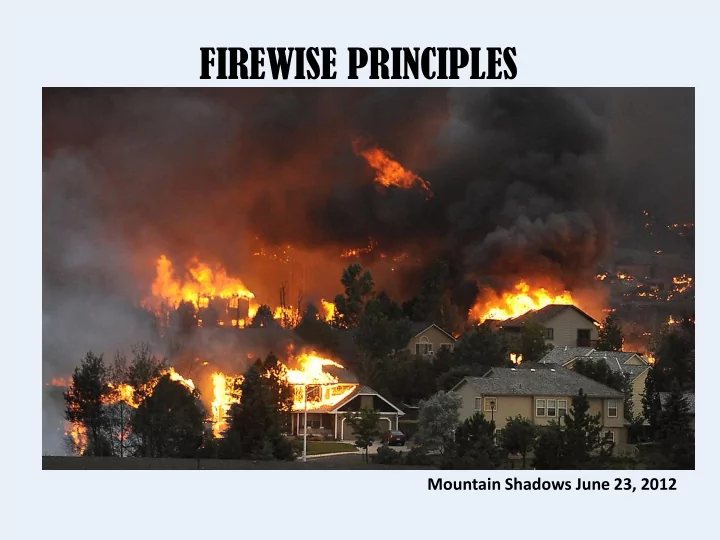
Mountain Shadows June 23, 2012
FIREWISE PRINCIPLES

slide-2
SLIDE 2

3) The ) The only y wa way y to to mi miti tigate gate yo your r fi fire e ri risk sk is s to to r red educe uce th the e amount unt of f fu fuel el!

Fire Behavior and Firewise:

1) You can’t change the topography ; 2) “Everybody talks about the weather, but nobody does anything about it”;

  • ---Mark Twain
slide-3
SLIDE 3

Shoup Road, Black Forest, Aug 1, 2013

slide-4
SLIDE 4

THE HOME IGNITION ZONE

The home ignition zone (HIZ) includes the fuels surrounding your home . . . . . .and the home itself.

slide-5
SLIDE 5

Most homes are not ignited by direct contact with flames, but from the firebrands (embers) that precede and follow the passage of the flame front.

slide-6
SLIDE 6

Fire Hardening Structures

Not all structures are created equal

slide-7
SLIDE 7

What hazar ards s do roof

  • f corners

rners pres esent ent?

If wind blown snow collects in roof corners so will leaves and needles during the fire season. Debris on roofs and in gutters can be ignited by firebrands.

Clean flammable debris from roofs and gutters.

slide-8
SLIDE 8
  • Note the firewood stacked next to the building.
  • Wood piles should be thirty feet away and up hill from structures.
  • Screen the undersides of decks with metal or noncombustible material.

Do not store firewood or any combustible material under decks. Deck furniture, or cushions can catch fire.

slide-9
SLIDE 9

Screen foundation as well as attic vents

Vents should be metal and screened with 1/8 metal screens.

slide-10
SLIDE 10

Window dows

Windows can allow heat from a fire to enter buildings. Double or triple pane windows cut down on the amount of heat transference. Metal frames don’t melt.

slide-11
SLIDE 11

Not all Fuels are ‘natural’

Wood fences and landscape ties can wick a fire to a structure

slide-12
SLIDE 12

Mark k areas as wher here e flammabl mmable e mater eria ials ls are stor

  • red

ed.

Does this discourage smoking?

Don’t Store flammable materials near a house.

slide-13
SLIDE 13

HIZ: Zone One

Includes the house and 15-30 feet from the edge of the eaves. Increase the distance on slopes—especially downhill! Clear most trees within 15 feet of a structure. Ten Feet of tree crown separation from 15 - 30 feet. Remove ladder fuels & down wood.

slide-14
SLIDE 14

Gardening Mistakes Can Burn Houses.

  • Mulch with non-combustible materials within five feet of

foundations and under decks and around propane tanks.

  • Plant FireWise plants near foundations and decks.
  • Junipers (pfitzers) are gasoline on a stick!
  • Plant nothing within five feet of foundation vents, dryer vents
  • r under windows.
  • Wooden Landscape timbers or cedar fences can wick fires to

houses.

slide-15
SLIDE 15
  • Plant in isolated small clumps. Separate shrubs by 2.5 times the height of

the mature shrub.

  • Mow grasses (less than eight inches) in zone one and irrigate, if possible.
  • Do not plant “ladder fuels”.
  • Gravel or stone walkways break up fuel continuity.
  • Beware of wooden planters. They can burn!

Firewise Gardening Practices:

slide-16
SLIDE 16
  • Rake up combustible debris frequently.
  • Build retaining walls with stone or noncombustible

materials.

  • Deciduous trees are the safest choice in zones one and two
  • f the HIZ.
  • Don’t screen firewood piles or propane tanks with plantings.
  • Prune dead woody material often.
slide-17
SLIDE 17

Fire Adapted Native Trees

  • Aspen
  • Plains Cottonwood
  • Narrow Leaf Cottonwood
  • Ponderosa pine
slide-18
SLIDE 18

Moderately Fire Adapted Native Trees

  • Douglas-fir
  • Bristlecone pine
  • Piñon pine
  • Limber pine
slide-19
SLIDE 19

Fire Prone Native Trees

  • Colorado Blue Spruce
  • Engelmann Spruce
  • White or subalpine fir
  • Gambel (scrub) Oak
  • Lodgepole Pine
  • Rocky Mountain Juniper
slide-20
SLIDE 20

HIZ: Zone Two

Increase width downhill from structures. Zone 2 extends along driveways 50 feet from each edge! Driveways should have 12 feet of horizontal clearance and 13 feet of vertical clearance Plastic culverts can melt! Always leave healthy trees! Beware of windthrow in spruce & lodgepole—they aren’t deeply rooted trees. Remove ladder fuels and most spruce regeneration in aspen patches. Ideally, propane tanks and firewood should be in this zone

slide-21
SLIDE 21

HIZ: Zone Three

Normal forest thinning to your property lines. Leave spruce in clumps Take most of the small spruce from the understory of aspen Expand openings in the conifer canopy by thinning along the edges of aspen stands. Remove ladder fuels. Diverse age and species of trees. Isolated junipers are OK. Clean wood from the understory, but 2-3 snags per acre and some down woody logs should remain.

slide-22
SLIDE 22

Pruning Height Guidelines

On trees larger than 30 feet tall, prune up to at least eight feet. You can remove dead limbs higher up if you can do so safely.

Beware of reaching too high with a chainsaw. It is dangerous!

On trees Less than 30 feet tall, ALWAYS leave at least 2/3 of the green needles.

  • Trees need enough needles (leaves) to

make food for themselves.

  • “Lollypop” trees look ridiculous!
slide-23
SLIDE 23

Hard Hat Ear Protection Face & Eye Protection Leather Gloves Chaps Leather boots with 8’ tops & non-skid soles

The Last Word . . . Be Safe

Dave Root, Assistant District Forester (719) 687-2921 david.root@colostate.edu