
SLIDE 1
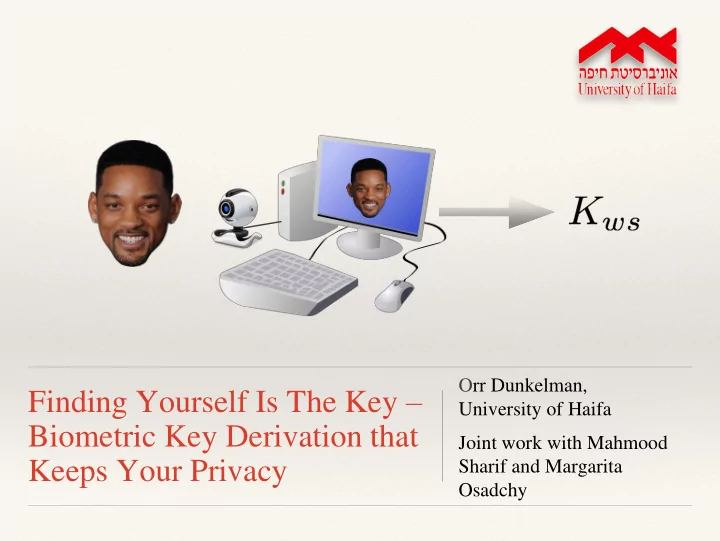
Finding Yourself Is The Key – Biometric Key Derivation that Keeps Your Privacy
Orr Dunkelman, University of Haifa Joint work with Mahmood Sharif and Margarita Osadchy
Finding Yourself Is The Key University of Haifa Biometric Key - - PowerPoint PPT Presentation
Orr Dunkelman, Finding Yourself Is The Key University of Haifa Biometric Key Derivation that Joint work with Mahmood Sharif and Margarita Keeps Your Privacy Osadchy Overview Motivation Background : The Fuzziness Problem
Orr Dunkelman, University of Haifa Joint work with Mahmood Sharif and Margarita Osadchy
❖ Motivation ❖ Background:
❖ Our System:
❖ Experiments ❖ Conclusions
❖ Key-Derivation: generating a secret key, from information
❖ Passwords, the most widely used mean for key derivation, are
??
pwd
What’s up doc?
❖ Suggestion: use biometric data for key generation ❖ Problems :
1
❖ Motivation ❖ Background:
❖ Our System:
❖ Experiments ❖ Conclusions
❖ Two images of the same face are rarely identical (due to
❖ Yet we want to consistently create the same key for the user
❖ The fuzziness in the samples is handled by:
1 1 1
reduces changes due to viewing conditions and small distortions Feature extraction Binarization Error correction converts to binary representation and removes most of the noise removes the remaining noise
training step produces user specific parameters, stored for feature extraction No training, no user specific information is required
Previous Work
❖ ]FYJ10] used Fisherfaces - public data looks like the users: ❖ Very Discriminative (better recognition) ❖ But compromises privacy – cannot be used!
Generic Features?
❖ Yes, but require caution. ❖ In [KSVAZ05] high-order dependencies between different channels
❖ ➜ correlations between the bits of the suggested representation
❖ Essential for using the cryptographic constructions ❖ Some claim: non-invertibile ]TGN06] ❖ By :
Biometric features can be approximated
Quantization is more accurate, but requires storing additional private information.
❖ Fuzzy Commitment [JW99]: ❖ Other constructions: Fuzzy Vault [JS06], Fuzzy Extractors [DORS08]
s Encode s Decode k
Enrollment Key Generation
Binary Representation of the biometrics Binary Representation of the biometrics
𝑙 ← {0,1}∗
Problems
fuzzy commitment scheme
cryptographic key (A.K.A. Strong biometric privacy)
1. Consistency: identify a person as himself (low FRR) 2. Discrimination: impostor cannot impersonate an enrolled user (low FAR) ]BKR08]: 3. Weak Biometric Privacy (REQ-WBP): computationally infeasible to learn the biometric information given the helper data 4. Strong Biometric Privacy (REQ-SBP): computationally infeasible to learn the biometric information given the helper data and the key 5. Key Randomness (REQ-KR): given access to the helper data, the key should be computationally indistinguishable from random
❖ Motivation ❖ Background:
❖ Our System:
❖ Experiments ❖ Conclusions
❖ Face landmark localization [ZR12] and affine transformation to a
canonical pose:
❖ An essential step, due to the inability to perform alignment between
enrolled and newly presented template
❖ Local Binary Patterns (LBPs) descriptors are computed from 21 regions
defined on the face:
❖ The same is done with Scale Invariant Feature Transform (SIFT)
descriptors
❖ Histograms of Oriented Gradients (HoGs) are computed on the whole face
Dimension Reduction and Concatenation
Removing Correlations Between the Features Rescaling for the [0,1] Interval
1 2 1 ) ( x W sign x h
T
x
+1
Wi
1 2 1 ) ( x W sign x h
T
x
1 ) ( x hi
+1
Wi
1 2 1 ) ( x W sign x h
T
x
) ( x hi
+1
Wi h(x’) ?
1 2 1 ) ( x W sign x h
T
x
) ( x hi
+1
Wi
1 2 1 ) ( x W sign x h
T
x ) ' ( ) ( x h x h
i i
+1
Wi
1 2 1 ) ( x W sign x h
T
x 1 ) ' ( 1 ) ( x h x h
i i
+1
Wi
+1
Wj
❖ Requirements from the binary representation:
❖ We find a discriminative projection space W by generalizing an
algorithm from [WKC10] (for solving ANN problem)
❖ For
:
❖ The aim is to find hyperplanes , s.t. for
:
if
if the pair belongs to the same user
Dimension Reduction and Concatenation
X
Dimension Reduction and Concatenation
Removing Correlations Between the Features Rescaling for the [0,1] Interval
w
A
X Z=AtX
Dimension Reduction and Concatenation
Removing Correlations Between the Features Rescaling for the [0,1] Interval
31
w
A
X Z=AtX
1 2 1 ) ( z W sign z h
T
mutually independent bits
Projection onto orthogonal hypeplanes W
❖ Enrollment: ❖ Key-Generation:
Feature Extraction
Binarization
s Encode
s
Feature Extraction
Binarization
Decode and Hash
𝑙 ← {0,1}∗
Is this Alice? Instead of learning … Is this Bob? … Same? We learn Different? A more generic question that can be learnt for population.
❖ Motivation ❖ Background:
❖ Our System:
❖ Experiments ❖ Conclusions
Constructing the Embedding
View Number of Subjects Images Per Subject Number of Hyperplanes Frontal 949 3-4 800 Profile 1117 1-8 800
Evaluation
❖ Data:
(not in the training set) were used
❖ Recognition tests:
TPR-vs-FPR while increasing the threshold (ROC-curves)
❖ Key generation tests:
authentication attempts
Recognition
ROC curves
Key Generation
❖ There is a trade-off between the amount of errors that the error-
correction code can handle and the length of the produced key
❖ The Hamming-bound gives the following relation:
Key Generation
t k≤ FRR our method FRR Random Projection 595 80 0.30 0.32 609 70 0.16 0.23 624 60 0.12 0.19
For FAR= 0 :
Reed-Solomon Followed by Concatenation (PUFKY)
…
5 bits 5 bits 5 bits
X Reed-Solomon, GF(25): 15 symbols
31 symbols
Let X be the biometrics Probability of error in symbol 1-0.75≈0.83 Probability of error in bit 0.3
X RS,GF(29): 171 Symbols
511 Symbols
Probability of error in bit 0.3 Probability of error in symbol 0.3 X … X X 9 bits
X X X X X 511 9 ECC(K) Encoding: s1 s2 … s8 s9
X’ X’ … X’ X’ Decoding: s1 s2 … s8 s9 511 9 decode(C) K C
1539 bits Key Length 171 bits Security level 511 bits Biometrics’ length 494.17 Entropy FAR (480 subjects) 18.5% FRR
uniformly distributed, as shown in [JW99]
Uniformity of the Representation
❖ No correlation between the bits - way 1
No correlation between the bits + high min-entropy ⇒ uniform distribution
uniformly distributed, as shown in [JW99]
REQ-KR
❖ Show that is high ❖ x~U ➜ all possible results of have an almost
❖ Thus, is high
❖ Motivation ❖ Background:
❖ Our System:
❖ Experiments ❖ Conclusions
❖ We showed a system for Key-Derivation that achieves:
❖ Key derivation schemes – your face is your key ❖ Can be easily transformed into a login mechanism ❖ Can be used in biometric databases (identify double acquisition
without hurting honest users’ privacy(