Finding the Spatial (in order to teach it) Karl Grossner, PhD - - PowerPoint PPT Presentation

finding the spatial
SMART_READER_LITE
LIVE PREVIEW

Finding the Spatial (in order to teach it) Karl Grossner, PhD - - PowerPoint PPT Presentation

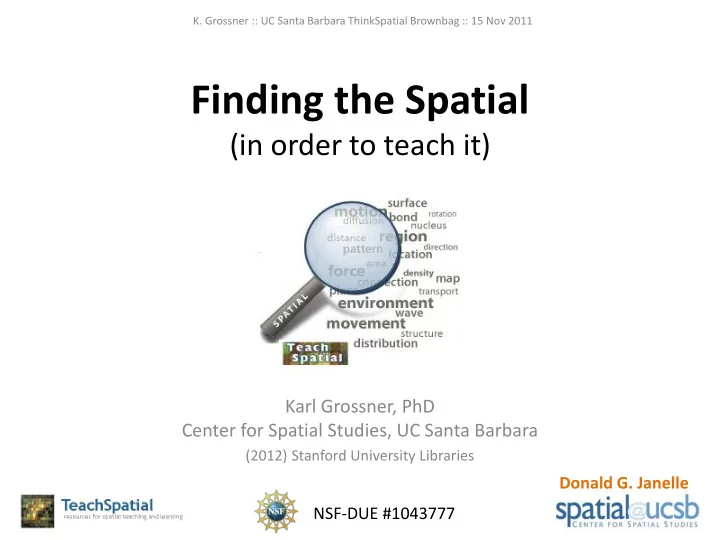
K. Grossner :: UC Santa Barbara ThinkSpatial Brownbag :: 15 Nov 2011 Finding the Spatial (in order to teach it) Karl Grossner, PhD Center for Spatial Studies, UC Santa Barbara (2012) Stanford University Libraries Donald G. Janelle NSF-DUE

slide-1
SLIDE 1

Finding the Spatial

(in order to teach it)

Karl Grossner, PhD Center for Spatial Studies, UC Santa Barbara

(2012) Stanford University Libraries

NSF-DUE #1043777 Donald G. Janelle

  • K. Grossner :: UC Santa Barbara ThinkSpatial Brownbag :: 15 Nov 2011
slide-2
SLIDE 2

NRC (2006) Conclusions

  • Geographers, geoscientists,

psychologists, incl. Golledge, Goodchild, Hegarty

  • Spatial thinking a skill, having

3 elements:

– Concepts of space – Representation – Reasoning processes

  • Underpins success in science

and math

  • Can be taught, improved
  • By and large, is not taught

explicitly

  • K. Grossner :: UC Santa Barbara ThinkSpatial Brownbag :: 15 Nov 2011
slide-3
SLIDE 3

Spatial thinking in the geosciences, and...

  • Describing the shape of an object,

rigorously and unambiguously

  • Identifying and classifying objects

by shape

  • Ascribing meaning to shape
  • Recognizing shapes or patterns

against a noisy background

  • Visualizing 3-dimensional

structure and processes – and motion of objects -- from one or two dimensional information

  • Describing the position or
  • rientation of objects relative to a

coordinate system

  • K. Grossner :: UC Santa Barbara ThinkSpatial Brownbag :: 15 Nov 2011
slide-4
SLIDE 4

Spatial thinking in the geosciences, and...

  • Describing the shape of an object,

rigorously and unambiguously

  • Identifying and classifying objects

by shape

  • Ascribing meaning to shape
  • Recognizing shapes or patterns

against a noisy background

  • Visualizing 3-dimensional

structure and processes – and motion of objects -- from one or two dimensional information

  • Describing the position or
  • rientation of objects relative to a

coordinate system

  • K. Grossner :: UC Santa Barbara ThinkSpatial Brownbag :: 15 Nov 2011
slide-5
SLIDE 5

Spatial thinking in the geosciences, and...

  • Describing the shape of an object,

rigorously and unambiguously

  • Identifying and classifying objects

by shape

  • Ascribing meaning to shape
  • Recognizing shapes or patterns

against a noisy background

  • Visualizing 3-dimensional

structure and processes – and motion of objects -- from one or two dimensional information

  • Describing the position or
  • rientation of objects relative to a

coordinate system

  • K. Grossner :: UC Santa Barbara ThinkSpatial Brownbag :: 15 Nov 2011
slide-6
SLIDE 6

Spatial thinking in the geosciences, and...

  • Describing the shape of an object,

rigorously and unambiguously

  • Identifying and classifying objects

by shape

  • Ascribing meaning to shape
  • Recognizing shapes or patterns

against a noisy background

  • Visualizing 3-dimensional

structure and processes – and motion of objects -- from one or two dimensional information

  • Describing the position or
  • rientation of objects relative to a

coordinate system

  • K. Grossner :: UC Santa Barbara ThinkSpatial Brownbag :: 15 Nov 2011
slide-7
SLIDE 7

Spatial thinking in the geosciences, and...

  • Describing the shape of an object,

rigorously and unambiguously

  • Identifying and classifying objects

by shape

  • Ascribing meaning to shape
  • Recognizing shapes or patterns

against a noisy background

  • Visualizing 3-dimensional

structure and processes – and motion of objects -- from one or two dimensional information

  • Describing the position or
  • rientation of objects relative to a

coordinate system

  • K. Grossner :: UC Santa Barbara ThinkSpatial Brownbag :: 15 Nov 2011
slide-8
SLIDE 8

NRC (2006) Recommendations

  • Needed: a “systematic

research program”

– SILC, 2006 www.spatiallearning.org

  • Heightened awareness of

its importance

  • Highlight within (and/or

adjust) the curriculum, leading to increased “spatial literacy”

  • Six GIS-specific

recommendations

– Software/Ed partnerships, teacher development, etc.

  • K. Grossner :: UC Santa Barbara ThinkSpatial Brownbag :: 15 Nov 2011
slide-9
SLIDE 9

Elements of Spatial Thinking

  • K. Grossner :: UC Santa Barbara ThinkSpatial Brownbag :: 15 Nov 2011
slide-10
SLIDE 10

A Strategy for TeachSpatial

  • Immediate objective: a resource portal to

teaching resources...but

  • If you’re going to teach spatial concepts and

principles explicitly, first enumerate them, then define some learning objectives

  • First step: identify concepts from various

disciplinary perspectives

  • Learning objectives could be “demonstrate

understanding and practical application of {spatialPrinciple},” so what are the principles?

  • K. Grossner :: UC Santa Barbara ThinkSpatial Brownbag :: 15 Nov 2011
slide-11
SLIDE 11

www.teachspatial.org

  • K. Grossner :: UC Santa Barbara ThinkSpatial Brownbag :: 15 Nov 2011
slide-12
SLIDE 12

www.nsdl.org

  • K. Grossner :: UC Santa Barbara ThinkSpatial Brownbag :: 15 Nov 2011
slide-13
SLIDE 13

www.nsdl.org

  • K. Grossner :: UC Santa Barbara ThinkSpatial Brownbag :: 15 Nov 2011
slide-14
SLIDE 14

www.nsdl.org

  • K. Grossner :: UC Santa Barbara ThinkSpatial Brownbag :: 15 Nov 2011
slide-15
SLIDE 15

www.nsdl.org

  • K. Grossner :: UC Santa Barbara ThinkSpatial Brownbag :: 15 Nov 2011
slide-16
SLIDE 16

NSDL PATHWAYS

  • K. Grossner :: UC Santa Barbara ThinkSpatial Brownbag :: 15 Nov 2011
slide-17
SLIDE 17

NSDL PATHWAYS

  • K. Grossner :: UC Santa Barbara ThinkSpatial Brownbag :: 15 Nov 2011
slide-18
SLIDE 18
  • K. Grossner :: UC Santa Barbara ThinkSpatial Brownbag :: 15 Nov 2011
slide-19
SLIDE 19

Enumerating Concepts (1)

  • What’s a concept? Please discuss...
  • ~180 terms culled from 20 source documents

in 8 fields:

– Geography, cognitive psychology, geoscience, math, urban design, science education

  • Reduced to ~120, and binned arbitrarily
  • K. Grossner :: UC Santa Barbara ThinkSpatial Brownbag :: 15 Nov 2011
slide-20
SLIDE 20
  • K. Grossner :: UC Santa Barbara ThinkSpatial Brownbag :: 15 Nov 2011
slide-21
SLIDE 21

120 in 9 bins

  • K. Grossner :: UC Santa Barbara ThinkSpatial Brownbag :: 15 Nov 2011
slide-22
SLIDE 22

Spatial Term Density, NSF Abstracts

adjacency, alignment, angle, anisotropic, area (2), areal, arrangement, attraction, autocorrelation, border, boundary, branching, center, centroid, chaos, chirality, circuit, cluster, cognitive map, coil, collision, compactness, conduit, congruence, connection, container, convex, cube, deformation, dense, density, diffusion, dimension, direction, dispersion, distance, enclosure, energetics, environment (8), euclidian, flow, fluid, folding, force,

form (9), geography, geometric, geometry, global, gradient, granularity,

gravitation, gravity, grid, imagery, interaction (3), interlock, isomorphism, isotropic, kinetic, landmark, landscape, length, local (10), location, manifold, map, mental model, microscale, migration, morphology, motion, movement, navigation, neighbor, network (4), orientation, overlay, packing, part, path, pattern, perimeter, periphery, place, planar, point, polygon, polymorphism, position, proximity, reference frame, region (7), representation, rotation, route, rupture, scale (6), section, separation, shape, size, slope, space, space- time, spatial, spatiotemporal, spatio-temporal, stratum, structure (1),

surface (5), symmetrical, symmetry, topology, transport, visual, void,

volume, wave, web

  • K. Grossner :: UC Santa Barbara ThinkSpatial Brownbag :: 15 Nov 2011
slide-23
SLIDE 23

Spatial Term Density, NSF Abstracts

adjacency, alignment, angle, anisotropic, area (2), areal, arrangement, attraction, autocorrelation, border, boundary, branching, center, centroid, chaos, chirality, circuit, cluster, cognitive map, coil, collision, compactness, conduit, congruence, connection, container, convex, cube, deformation, dense, density, diffusion, dimension, direction, dispersion, distance, enclosure, energetics, environment (8), euclidian, flow, fluid, folding, force,

form (9), geography, geometric, geometry, global, gradient, granularity,

gravitation, gravity, grid, imagery, interaction (3), interlock, isomorphism, isotropic, kinetic, landmark, landscape, length, local (10), location, manifold, map, mental model, microscale, migration, morphology, motion, movement, navigation, neighbor, network (4), orientation, overlay, packing, part, path, pattern, perimeter, periphery, place, planar, point, polygon, polymorphism, position, proximity, reference frame, region (7), representation, rotation, route, rupture, scale (6), section, separation, shape, size, slope, space, space- time, spatial, spatiotemporal, spatio-temporal, stratum, structure (1),

surface (5), symmetrical, symmetry, topology, transport, visual, void,

volume, wave, web

  • K. Grossner :: UC Santa Barbara ThinkSpatial Brownbag :: 15 Nov 2011
slide-24
SLIDE 24

How Spatial Is It?

  • K. Grossner :: UC Santa Barbara ThinkSpatial Brownbag :: 15 Nov 2011
slide-25
SLIDE 25

How Spatial Is It?

  • K. Grossner :: UC Santa Barbara ThinkSpatial Brownbag :: 15 Nov 2011
slide-26
SLIDE 26

How Spatial Is It?

Index of Spatiality 0.728 rank correlation with human judgments

  • f spatiality
  • K. Grossner :: UC Santa Barbara ThinkSpatial Brownbag :: 15 Nov 2011
slide-27
SLIDE 27

Enumerating Concepts (2)

  • 129 Culled from NSES and Geography teaching

standards

text spatial terms avg spatial stdev

Physical Science

B-04-2.2 An object's motion can be described by

tracing and measuring its position over time. position, motion, tracing, object, trajectory, path, time, measurement 0.913 0.118

B-04-2.3 The position and motion of objects can be changed by pushing

  • r pulling. The size of the change is related to the strength of the

push or pull. position, motion, pull, push, size, force, direction 0.850 0.191 B-04-2.4 Sound is produced by vibrating objects. The pitch of the sound can be varied by changing the rate of vibration. vibration, motion 0.463 0.304

Life Science

C-58-1.1 Living systems at all levels of organization demonstrate the complementary nature of structure and function. Important levels of organization for structure and function include cells,

  • rgans, tissues, organ systems, whole organisms, and

ecosystems. structure, organization, hierarchy, function, composition, cell, level 0.490 0.351 C-58-1.2 All organisms are composed of cells--the fundamental unit of

  • life. Most organisms are single cells; other organisms, including

humans, are multicellular. composition, cell, unit, multicellular 0.380 0.368

Earth and Space Science

D-58-3.2 Most objects in the solar system are in regular and predictable

  • motion. Those motions explain such phenomena as the day, the

year, phases of the moon, and eclipses. motion, object, phase, eclipse 0.817 0.144 D-58-3.3 Gravity is the force that keeps planets in orbit around the sun and governs the rest of the motion in the solar system. Gravity alone holds us to the earth's surface and explains the phenomena of the tides. surface, orbit, motion, gravity, force, attraction, tides, tide 0.625 0.227

  • K. Grossner :: UC Santa Barbara ThinkSpatial Brownbag :: 15 Nov 2011
slide-28
SLIDE 28

Size corresponds to the number of standards a term appears in multiplied by those standards’ average spatial rating

  • K. Grossner :: UC Santa Barbara ThinkSpatial Brownbag :: 15 Nov 2011
slide-29
SLIDE 29
  • K. Grossner :: UC Santa Barbara ThinkSpatial Brownbag :: 15 Nov 2011
slide-30
SLIDE 30
  • K. Grossner :: UC Santa Barbara ThinkSpatial Brownbag :: 15 Nov 2011
slide-31
SLIDE 31
  • K. Grossner :: UC Santa Barbara ThinkSpatial Brownbag :: 15 Nov 2011
slide-32
SLIDE 32
  • K. Grossner :: UC Santa Barbara ThinkSpatial Brownbag :: 15 Nov 2011
slide-33
SLIDE 33
  • K. Grossner :: UC Santa Barbara ThinkSpatial Brownbag :: 15 Nov 2011
slide-34
SLIDE 34
  • K. Grossner :: UC Santa Barbara ThinkSpatial Brownbag :: 15 Nov 2011
slide-35
SLIDE 35

Thanks to Josh Bader!

  • K. Grossner :: UC Santa Barbara ThinkSpatial Brownbag :: 15 Nov 2011
slide-36
SLIDE 36

Thanks to Josh Bader!

  • K. Grossner :: UC Santa Barbara ThinkSpatial Brownbag :: 15 Nov 2011
slide-37
SLIDE 37

Teaching Spatial Thinking

  • Mary Hegarty (UCSB Psychologist) has one:

“Spatial Thinking”; Winter 2012

– The nature of spatial thinking, at object/tabletop scale; in the environment; metaphorically

  • Diana Sinton

– Foundations of Spatial Thinking (Fall 2010) – Spatial Thinking: The Why of Where (Winter 2012)

  • Kim Kastens (Columbia) and Michael Passow

– Professional Development to Improve the Spatial Thinking

  • f Earth Science Teachers and Students (NSF #1034994)

– Studying Regents exams to “find the spatial”

  • K. Grossner :: UC Santa Barbara ThinkSpatial Brownbag :: 15 Nov 2011
slide-38
SLIDE 38
  • K. Grossner :: UC Santa Barbara ThinkSpatial Brownbag :: 15 Nov 2011
slide-39
SLIDE 39

Demonstrate understanding of:

  • Research on spatial thinking and learning, nature-

deficit disorder, and learning in the outside world

  • Spatial vocabulary, processes, and skills
  • The elements of graphicacy
  • The importance of spatial thinking on science,

technology, engineering and math (STEM) learning

  • The relationship between spatial literacy and
  • ther literacies
  • The role of spatial literacy in curriculum ”

Diana Sinton, University of Redlands || Spatial Thinking: The Why of Where

  • K. Grossner :: UC Santa Barbara ThinkSpatial Brownbag :: 15 Nov 2011
slide-40
SLIDE 40

Benchmarks for Spatial Literacy

  • What constitutes spatial literacy?
  • Being conversant with core spatial concepts and

principles...

  • And familiar with their application in multiple

scientific and humanistic fields??

  • Aware of the role of spatial thinking in scientific

explanation; and the “habit of mind” to use it

  • Knowing that “how long is the coast of

California?” is a meaningless question.

  • K. Grossner :: UC Santa Barbara ThinkSpatial Brownbag :: 15 Nov 2011
slide-41
SLIDE 41
  • K. Grossner :: UC Santa Barbara ThinkSpatial Brownbag :: 15 Nov 2011
slide-42
SLIDE 42

watd.wuthering-heights.co.uk Benjamin Reese Neuroscience Research Institute and Department of Psychology University of California at Santa Barbara

  • K. Grossner :: UC Santa Barbara ThinkSpatial Brownbag :: 15 Nov 2011
slide-43
SLIDE 43

A small molecule (ligand) docked to a much larger protein: http://en.wikipedia.org/wiki/Docking_(molecular)

Gahegan, M. (2011) Is space—its representation and analysis in computational systems—common ground in the sciences? COSIT Workshop on Spatial Ontology

  • K. Grossner :: UC Santa Barbara ThinkSpatial Brownbag :: 15 Nov 2011
slide-44
SLIDE 44

Benchmarks for Spatial Literacy (1)

  • There are multiple ways to consider and analyze space and

spatiality

– Two distinct spatial perspectives are those of continuous fields and of discrete objects. – Space-time may be viewed as 3D + 1 (time) or 4D (everything’s an

  • ccurrence).
  • Spatial context matters

– Natural phenomena—things and happenings—are significantly impacted by their surroundings (environment or setting), including neighboring things, and any networks or ecosystems they are part of. – Observations and analyses of phenomena have a frame of reference— spatial, temporal and thematic bounds for what is being considered. This concept is strongly tied to those of scale and granularity. Reference frames may be global or local in absolute or relative terms, and representations may be high-resolution or coarse and highly generalized.

  • K. Grossner :: UC Santa Barbara ThinkSpatial Brownbag :: 15 Nov 2011
slide-45
SLIDE 45

Benchmarks for Spatial Literacy (2)

  • Spatial dependence and autocorrelation

– Attributes of places that are near to each other tend to be more similar than attributes of places that are far apart (Tobler's First Law of Geography); such similarity leads to assertions of clusters, regions, neighborhoods, and kinds of places.

  • Patterns result from, reveal processes; process explains pattern

– The arrangement of things-in-the-world is a result of processes— ‘natural’ (i.e. environmental and without agency), man-made, or both.

  • Form follows function

– The spatial form of natural objects (size, shape, structure, orientation, texture) is strongly related to function; – The same holds true for utilitarian artifacts (if well-designed) where function is purposeful.

  • K. Grossner :: UC Santa Barbara ThinkSpatial Brownbag :: 15 Nov 2011
slide-46
SLIDE 46

Benchmarks for Spatial Literacy (3)

  • Distance decay

– The level of interaction between entities at two locations declines as the distance between them increases.

  • Spatial change

– A significant proportion of the phenomena scientists (and others)

  • bserve, measure, analyze, and seek to explain concerns spatial

change: change of position, form, orientation, and spatial identity (splitting and merging, e.g.). The same holds true for many non- scientific (i.e. humanistic) fields. – Things move. A great many processes at all scales are fundamentally spatial and dynamic: diffusion, dispersion, transport, migration, erosion, radiation, etc.

  • K. Grossner :: UC Santa Barbara ThinkSpatial Brownbag :: 15 Nov 2011
slide-47
SLIDE 47

A Course Outline?

  • Week 1: Space and time

– Space v. place – Subjective space/place and cognitive maps

  • Week 2: The nature of spatial

thinking

– Cognitive abilities

  • Week 3: Spatial is special

– Form and function; pattern and process; spatial context, association, dependence, autocorrelation; indexing and integrating information

  • Week 4: Scale matters

– Spatial information v. spatial reality

  • Week 5: Spatial structures (1)

– Objects and fields – Measurement and computation

  • Week 6: Spatial structures (2)

– Neighborhood, Clusters and Regions – Measurement and computation

  • Week 7: Spatial structures (3)

– Network I – Measurement and computation

  • Week 8: Spatial structures (4)

– Network II: Interaction and flow – Measurement and computation

  • Week 9: Spatialization

– Graphs and surfaces – N-dimension concept spaces

  • K. Grossner :: UC Santa Barbara ThinkSpatial Brownbag :: 15 Nov 2011
slide-48
SLIDE 48

NSF-DUE #1043777 www.teachspatial.org

  • K. Grossner :: UC Santa Barbara ThinkSpatial Brownbag :: 15 Nov 2011