SLIDE 1
Finding parking when not commuting
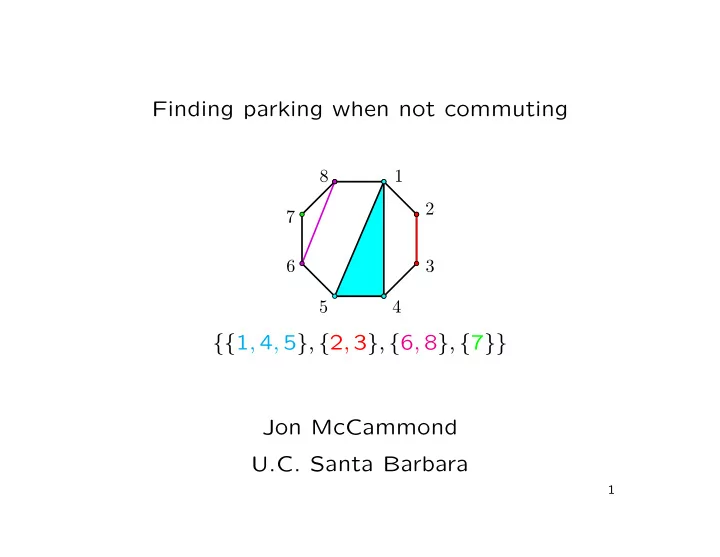
1 2 3 4 5 6 7 8
{{1, 4, 5}, {2, 3}, {6, 8}, {7}} Jon McCammond U.C. Santa Barbara
1
SLIDE 2 A common structure The goal of this talk will be to introduce you to a mathematical
- bject that has a habit of appearing in a vast array of guises.
I. Non-crossing partitions II. Symmetric groups III. Braid groups IV. Parking functions V. Non-commutative geometry and free probability 1 2 3 4 5 6 7 8 {{1, 4, 5}, {2, 3}, {6, 8}, {7}}
2
SLIDE 3
Motivating example I: Fibonacci numbers I. Dominoe tilings of a 2 × n strip II. Continued fractions and golden ratio III. Diagonals of a regular pentagon IV. Tridiagonal matrices
1 1+
1 1+ 1 1+ 1 1+1 1
= 5
8
See Neal Sloane’s online encyclopedia of integer sequences for more connections. http://www.research.att.com/∼njas/sequences/
3
SLIDE 4
Motivating example II: Catalan numbers I. Triangulations of an n-gon II. Rooted (planar) binary trees III. Ways to associate n letters IV. Dyck paths from (0, 0) to (n, n)
(1(2(3(45)))) (1(2((34)5))) (1((23)(45))) (1((2(34))5)) (1(((23)4)5)) ((12)(3(45))) ((12)((34)5)) ((1(23))(45)) ((1(2(34)))5) ((1((23)4))5) (((12)3)(45)) (((12)(34))5) (((1(23))4)5) ((((12)3)4)5)
... and many more (See R. Stanley’s list of 106 distinct combi- natorial interpretations of these numbers)
4
SLIDE 5
- I. Non-crossing partitions
Def: A noncrossing partition is a partition of the vertices of a regular n-gon so that the convex hulls of the blocks are disjoint. 1 2 3 4 5 6 7 8 The figure illustrates the partition {{1, 4, 5}, {2, 3}, {6, 8}, {7}}.
5
SLIDE 6
Non-crossing partition lattice One noncrossing partition σ is contained in another τ if each block of σ is contained in a block of τ. Let NCn be the poset (partially ordered set) of all non-crossing partitions of an n-gon under this relation.
6
SLIDE 7
Non-crossing partition lattice on 4 elements For n = 4 we get the following:
1 2 3 4
7
SLIDE 8
Non-crossing partition lattice on 4 elements The abstracted version of NC4 looks like this:
8
SLIDE 9 Properties of NCn Thm: NCn is a graded, bounded lattice with Catalan many
- elements. It is also self-dual.
- Lattice means that least upper bounds and greatest lower
bounds always exist.
- Self-dual means that it looks the same when we flip it over
9
SLIDE 10
Def: Sn is the group of permutations of the set [n] := {1, . . . , n}.
2 3 4 1 1 2 3 4
(34) (23) (12) (34) (23) (12) (23) (34) (12) (23)
Thm: Every trivial product of 2-cycles is of even length. Cor: The parity of a factorization is well-defined.
10
SLIDE 11 Factorization into 2-cycles Lem: The poset of suffixes
- f minimal factorizations of
the n-cycle (123 · · · n) into 2-cycles is exactly NCn. [(123) = (12)(23) = (23)(13) = (13)(12)] Rem: This makes for an easy proof of self-duality (and it explains the colors assigned to the edges of the Hasse diagram).
11
SLIDE 12
Factorization into 2-cycles The colors here describe all factorizations of (1234) into three 2-cycles.
12
SLIDE 13
Def: The braid group Bn keeps track of how n strings can be twisted. Clearly Bn maps onto Sn. 1 1 2 2 3 3 4 4 Braid groups are related to many, many areas of mathematics, including mathematical physics, quantum groups, and, not sur- prisingly, 3-manifold topology. They are also intimately related to non-crossing partitions.
13
SLIDE 14
A Space for the Braid Groups The noncrossing partition lattice can be used to build a space whose “fundamental group” is the braid group. In fact, it is something called an Eilenberg-MacLane space for these groups because when it is completely unwrapped it is contractible. The procedure involves turning chains into simplices and then gluing according to labels and orientations.
14
SLIDE 15
Def: A parking function of length n is a sequence (a1, . . . , an)
- f positive integers whose nondecreasing rearrangement
b1 ≤ b2 ≤ . . . ≤ bn satisfies bi ≤ i. 1 2 3 4 5 6 7 The number of parking functions is (n + 1)n−1. There are a number of bijections with labeled rooted trees on [n] (or equivalently the number of acyclic functions on [n]).
15
SLIDE 16
Parking functions and NCn+1 Let σ−τ be an edge of covering relation in NCn+1 and let B and B′ be the blocks which are joined. If min B < min B′ we define the label as the largest element of B which is below all of B′.
1 2 3 4
16
SLIDE 17
Parking functions and NCn+1 Lem: The labels on the maximal chains in NCn+1 are the park- ing functions. Rem: There are also connections along these lines with the theory of symmetric functions and Hopf algebras. f(x, y) = x2 + xy + y g(x, y) = x2 + xy + y2
17
SLIDE 18
Let X be a random variable having a probability density function f(x) (discrete or continuous). The expectation of u(x) is E(u(X)) =
∞
−∞ u(x)f(x)dx.
Ex: mean µ = E(X) Ex: variance σ2 = E((X − µ)2) Ex: moment generating function M(t) = E(etX) =
E(Xn)tn n!.
18
SLIDE 19 Moments and cumulants The coefficents in the moment generating function are called the moments of f(X). The coefficients of log M(t) are called the (classical) cumulants of X. The main advantage of the cumulants is that they contain the same information as the moments but the cumulant of the sum
- f two random variables X and Y are the sum of their cumulants
– so long as they are independent.
19
SLIDE 20
Non-commutative geometry Non-commuatative geometry is a philosophy whereby standard geometric arguments on (topological) spaces are converted into algebraic arguments on their commutative C∗-algebras of func- tions. The goal is then to find analogous arguments on non-commutative C∗-algebras which reduce to the standard results in the commu- tative case.
20
SLIDE 21 Free Probability There is a definition of a non-commutative version of probability and a non-commutative version of independence is “freeness”. The combinatorics of non-crossing partitions is very closely in- volved in this non-commutative version of cumulants. In fact, some researchers who study free probability describe the passage from the commutative to the non-commutative version as a tran- sition from the combinatorics of partitions to the combinatorics
- f non-crossing partitions.
21
SLIDE 22 Summary The lattice of non-crossing partitions might play a role in any situation which involves
- the symmetric groups
- the braid groups
- free probablity
- r anywhere where the Catalan numbers can be found (includ-
ing the combinatorics of trees and the combinatorics of parking functions). They also show up in lots of other mathematics: real hyperplane arrangements, Pr¨ ufer codes, quasisymmetric functions,...
22
SLIDE 23 Final illustration: Associahedra The Catalan numbers count the ways to assosciate a list of
- numbers. If we include partial assoications we get an ordering.
This ordering can be used to construct a polytope called the associahedron, and the “Morse theory” of this polytope has in- timate connections with the non-crossing partition lattice.
23
SLIDE 24
Associahedra in Low Dimensions (12)(34) 1(2(34)) 1((23)4) (1(23))4 ((12)3)4
(1(2(3(45)))) (1(2((34)5))) (1((23)(45))) (1((2(34))5)) (1(((23)4)5)) ((12)(3(45))) ((12)((34)5)) ((1(23))(45)) ((1(2(34)))5) ((1((23)4))5) (((12)3)(45)) (((12)(34))5) (((1(23))4)5) ((((12)3)4)5) 24