SLIDE 1
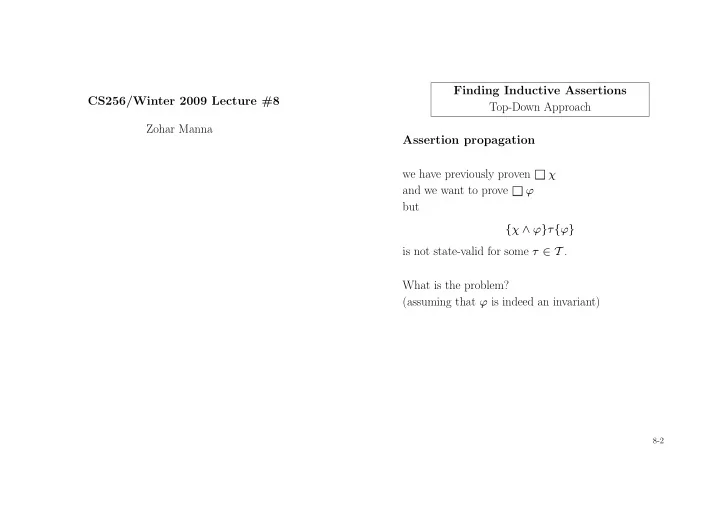
CS256/Winter 2009 Lecture #8 Zohar Manna Finding Inductive Assertions Top-Down Approach Assertion propagation we have previously proven
χ
and we want to prove
ϕ
but
{χ ∧ ϕ}τ{ϕ}
is not state-valid for some τ ∈ T . What is the problem? (assuming that ϕ is indeed an invariant)
8-2
SLIDE 2
Top-Down Approach (Con’d) Σ
ϕ τ ϕ ∧ χ P-accessible
Solution: Take the largest set of states that will result in a ϕ-state when τ is taken. How?
8-3
Precondition of ϕ w.r.t. τ pre(τ, ϕ) : ∀V ′ . ρτ → ϕ′ pre(τ, ϕ)
ϕ
a state s satisfies pre(τ, ϕ) iff all τ-successors of s satisfy ϕ. Note:
s trivially satisfies pre(τ, ϕ) if it does not have any τ-
successors (i.e., τ is not enabled in s).
8-4
SLIDE 3 Precondition of ϕ w.r.t. τ (Con’d) Example:
V : {x} integer ρτ : x > 0 ∧ x′ = x − 1 ϕ : x ≥ 2
pre(τ, ϕ) :
∀x′ . x > 0 ∧ x′ = x − 1
→ x′ ≥ 2
ϕ′
x > 0 → x − 1 ≥ 2 x ≤ 0 ∨ x ≥ 3 j τ j+1
x ≥ 2
8-5
Properties of pre(τ, ϕ) By the definition of pre(τ, ϕ),
{χ ∧ ϕ ∧ pre(τ, ϕ)} τ {ϕ}
is guaranteed to be state-valid. pre(τ, ϕ)
ϕ χ∧ϕ τ P-accessible
But we have to justify adding the conjunct pre(τ, ϕ) to the antecedent. This can be done in two ways:
pre(τ, ϕ)
0 (ϕ ∧ pre(τ, ϕ))
8-6
SLIDE 4
Properties of pre(τ, ϕ) (Con’d) Claim: If ϕ is P-invariant then so is pre(τ, ϕ) for every
τ ∈ T .
Proof: Suppose ϕ is P-invariant, but pre(τ, ϕ) is not P-invariant. Then there exists a P-accessible state s such that
s
q/ pre(τ, ϕ).
But then, by the definition of pre(τ, ϕ), there exists a
τ-successor s′ of s such that s′
q/ ϕ.
Since s is P-accessible, s′ is also P-accessible, contradicting that ϕ is a P-invariant.
8-7
Properties of pre(τ, ϕ) (Con’d) Definition: A transition τ is said to be self-disabling if for every state s, τ is disabled in all τ-successors of s. Claim: For every assertion ϕ and self-disabling transition
τ {ϕ ∧ pre(τ, ϕ)} τ {ϕ ∧ pre(τ, ϕ)}
is state-valid. Proof: Assume s
q ϕ ∧ pre(τ, ϕ).
Then by definition of pre(τ, ϕ), for every s′,
τ-successor of s, s′
q ϕ.
Since τ is self-disabling, τ is disabled in all
τ-successors s′ of s, and so trivially s′
q pre(τ, ϕ)
Thus for all τ-successors s′ of s,
s′
q ϕ ∧ pre(τ, ϕ).
8-8
SLIDE 5 Heuristic If the verification condition
{χ ∧ ϕ}τ{ϕ}
is not state-valid: Find pre(τ, ϕ) and then
strengthen ϕ by adding the conjunct pre(τ, ϕ) prove
0 (ϕ ∧ pre(τ, ϕ))
prove pre(τ, ϕ) and add pre(τ, ϕ) to χ. Note: pre(τ, ϕ) is not guaranteed to be an inductive invariant, so the premises of inv have to be checked again.
8-9
Example: local x: integer where x = 1
ℓ0 : request x ℓ1 : critical ℓ2 : release x
We want to prove
(at−ℓ1 → x = 0)
Problem:
{at−ℓ1 → x = 0} τℓ0 {at−ℓ1 → x = 0}
is not state-valid. If we use the above heuristic we get pre(τℓ0, ϕ) =
∀x′, π′ . (move(ℓ0, ℓ1) ∧ x > 0 ∧ x′ = x − 1)
→ (at′
−ℓ1 → x′ = 0)
8-10
SLIDE 6 Example (Con’d): pre(τℓ0, ϕ) =
∀x′, π′ . (move(ℓ0, ℓ1) ∧ x > 0 ∧ x′ = x − 1)
→ (at′
−ℓ1 → x′ = 0)
Since move(ℓ0, ℓ1) → at−ℓ0 = t, at′
−ℓ1 = t
x′ = x − 1 ∧ x′ = 0 → x = 1
it simplifies to pre(τℓ0, ϕ): at−ℓ0 ∧ x > 0 → x = 1 Strengthened assertion
ϕ ∧ pre(τℓ0, ϕ): (at−ℓ1 → x = 0) ∧ (at−ℓ0 → x = 1)
what we “guessed” before Show that ϕ ∧ pre(τℓ0, ϕ) is inductive (“strengthening approach”)
8-11
Substituted form of pre(τ, ϕ) Many transition relations have the form
ρτ: Cτ ∧ V ′ = E
where Cτ is the enabled condition of τ. And so pre(τ, ϕ): ∀V ′ . Cτ ∧ V ′ = E → ϕ′ can be simplified to
∀V ′ . Cτ → ϕ[E/V ]
replacing all primed variables by its corresponding expression, thus the quantifier can be eliminated to obtain pre(τ, ϕ): Cτ → ϕ[E/V ]
8-12
SLIDE 7 Example: Program mux-pet1(Fig. 2.25) (Peterson’s Algorithm for mutual exclusion) local
y1, y2: boolean where y1 = f, y2 = f s : integer
where s = 1
P1 :: ℓ0 :
loop forever do
ℓ1 :
noncritical
ℓ2 : (y1, s) := (t, 1) ℓ3 :
await (¬y2) ∨ (s = 1)
ℓ4 :
critical
ℓ5 : y1 := f
m0 :
loop forever do
m1 :
noncritical
m2 : (y2, s) := (t, 2) m3 :
await (¬y1) ∨ (s = 2)
m4 :
critical
m5 : y2 := f
8-13
Example: Program mux-pet1 (Fig. 2.25) (Con’d) We want to prove mutual exclusion:
¬(at−ℓ4 ∧ at−m4)
Bottom-up invariants:
ϕ0: s = 1 ∨ s = 2 ϕ1: y1 ↔ at−ℓ3..5 ϕ2: y2 ↔ at−m3..5
Problem: the verification conditions
{ϕ0 ∧ ϕ1 ∧ ϕ2 ∧ ψ} ℓ3 {ψ} {ϕ0 ∧ ϕ1 ∧ ϕ2 ∧ ψ} m3 {ψ}
are not state-valid
8-14
SLIDE 8 Example: Program mux-pet1 (Fig. 2.25) (Con’d) pre(τℓ3, ψ): ∀π′: move(ℓ3, ℓ4) ∧ (¬y2 ∨ s = 1)
→ ¬(at′
−ℓ4 ∧ at′ −m4)
since move(ℓ3, ℓ4) implies at′
−ℓ4 = t, at′ −m4 = at−m4
pre(τℓ3, ψ) simplifies to: at−ℓ3 ∧ (¬y2 ∨ s = 1) → ¬at−m4
ϕ3: at−ℓ3 ∧ at−m4 → y2 ∧ s = 1
pre(τm3, ψ): ∀π′ . . . . . . simplifies to:
ϕ4: at−ℓ4 ∧ at−m3 → y1 ∧ s = 2
Show that ϕ3: pre(τℓ3, ψ) and ϕ4: pre(τm3, ψ) are inductive relative to ϕ0 ∧ ϕ1 ∧ ϕ2 (“incremental approach”) Then show that ψ is inductive relative to
ϕ0 ∧ . . . ∧ ϕ4.
8-15
Example: Program mux-pet1 (Fig. 2.25) (Con’d) Proof tree:
¬(at−ℓ4 ∧ at−m4)
Init
ℓ0 ℓ1 ℓ2 ℓ3 ℓ4 ℓ5 m0 m1 m2 m3 m4 m5
t t t t t t t t t t t not state- valid not state- valid WPC
| |
WPC pre(τℓ3, ϕ) pre(τm3, ϕ) t . . . t . . . t t . . . t . . . t t = state-valid (relative to the bottom-up invariants) inv inv
8-16
SLIDE 9 Example: pre may never terminate The transition is
ρτ : x′ = x + y ∧ y′ = y
The property is
ϕ : x ≥ 0
The VC is
x′ = x + y ∧ y′ = y
x ≥ 0 → x′ ≥ 0 ρτ ϕ ϕ′
which is not state valid. Step 1: The precondition is pre(τ, x ≥ 0) : ∀x′, y′: x′ = x+y ∧ y′ = y → x′ ≥ 0 that is y ≥ −x. Attempting to prove pre(τ, ϕ) state valid, the VC
x′ = x + y ∧ y′ = y
y ≥ −x
y′ ≥ −x′
pre pre′ is not state-valid.
8-17
Step 2: Compute pre(τ, y ≥ −x)
∀x′, y′: x′ = x + y ∧ y′ = y
y′ ≥ −x′
pre′ that is y ≥ −x
2.
In general the precondition pre
n
x n + 1
Taking the limit as n approaches infinity, we obtain
y ≥ 0
which is what we want.
8-18
SLIDE 10 Finite-State Algorithmic Verification
finite-state program P each x ∈ V assumes only finitely many values in all P-computations Therefore, there are only finitely many distinct
P-accessible states.
Example: mux-pet1 (Fig 2.25) is finite-state program:
s = 1, 2 y1 = t, f y2 = t, f π can assume at most 36 different values
8-19
Example: Program mux-pet1 (Fig. 2.25) (Peterson’s Algorithm for mutual exclusion) local
y1, y2: boolean where y1 = f, y2 = f s : integer
where s = 1
P1 :: ℓ0 :
loop forever do
ℓ1 :
noncritical
ℓ2 : (y1, s) := (t, 1) ℓ3 :
await (¬y2) ∨ (s = 1)
ℓ4 :
critical
ℓ5 : y1 := f
m0 :
loop forever do
m1 :
noncritical
m2 : (y2, s) := (t, 2) m3 :
await (¬y1) ∨ (s = 2)
m4 :
critical
m5 : y2 := f
8-20
SLIDE 11 Algorithm (transition-graph) For a given finite-state program P Incrementally construct the state-transition graph GP, where each node represents a state.
Place as nodes in GP all initial states (satisfy Θ)
- Repeat until no new nodes or
new edges can be added to GP
For some s ∈ GP, let s1, . . . , sk be its succes- sors Add to GP all new nodes in {s1, . . . , sk} and draw edges connecting s to si,
i = 1, . . . , k
8-21
Algorithmic Verification of Invariance For assertion q, To check validity of
q over finite-state program P:
- 1. Construct the state-transition graph Gp.
- 2. Check if q holds in each state of the graph.
Example: Program mux-sem (Fig 2.26) Generates finite state-transition graph (Fig 2.27) Check assertion
ϕ: ¬(at−ℓ3 ∧ at−m3)
in the graph.
ϕ holds over all accessible states.
Thus,
ϕ for mux-sem.
8-22
SLIDE 12
Program mux-sem (Fig. 2.26) (mutual exclusion by semaphores) local y: integer where y = 1
P1 ::
ℓ0: loop forever do
ℓ1 : noncritical ℓ2 : request y ℓ3 : critical ℓ4 : release y
|| P2 ::
m0: loop forever do
m1: noncritical m2: request y m3: critical m4: release y
8-23
Program mux-sem state-transition graph (Fig. 2.27)
8-24
SLIDE 13 Example: Program mux-pet1 (Fig 2.25) State-transition graph GP (Fig 2.28)
(i, j, v)
means
π: {ℓi, mj}, s: v
No y1, y2 since
y1 = t
iff
3 ≤ i ≤ 5 y2 = t
iff
3 ≤ j ≤ 5
Property checked
¬(at−ℓ4 ∧ at−m4)
8-25
Example: Program mux-pet1(Fig. 2.25) (Peterson’s Algorithm for mutual exclusion) local
y1, y2: boolean where y1 = f, y2 = f s : integer
where s = 1
P1 :: ℓ0 :
loop forever do
ℓ1 :
noncritical
ℓ2 : (y1, s) := (t, 1) ℓ3 :
await (¬y2) ∨ (s = 1)
ℓ4 :
critical
ℓ5 : y1 := f
m0 :
loop forever do
m1 :
noncritical
m2 : (y2, s) := (t, 2) m3 :
await (¬y1) ∨ (s = 2)
m4 :
critical
m5 : y2 := f
8-26
SLIDE 14
mux-pet1 State-transition graph (Fig 2.28)
8-27
Completeness of rule inv
Rule inv (general invariance) For assertions ϕ, q, I1.
q
ϕ → q
I2.
q Θ → ϕ
I3.
q {ϕ} T {ϕ} q
q
Theorem (Relative completeness of rule inv) For every assertion q such that
q is P-valid
there exists an assertion ϕ such that I1 – I3 are provable from state validities
8-28
SLIDE 15 We actually show “completeness relative to first-order reasoning” taking all state-valid assertions as axioms Outline of proof Given FTS P with system variables (program + control variables)
y = (y1, . . . , ym)
q is P-valid, i.e.,
(†) q holds over every P-accessible state
- Construct (to be shown) accessibility assertion
accP (y) such that for any state s, (*) s is P-accessible state iff
s
q accP
We have to show :
- 1. accP satisfies I1 – I3
- 2. accP can be “constructed”
8-29
- 1. accP satisfies I1 – I3
- Premise I1:
accP
ϕ
→ q s
q accP
(∗)
⇒ s is P-accessible state
(†)
⇒ s
q
q
Thus accP
ϕ
→ q
is state-valid
Θ → accP
ϕ
s
q Θ
⇒ s is P-accessible
(∗)
⇒ s
q accP
ϕ
Thus Θ → accP
ϕ
is state-valid
8-30
SLIDE 16
for every τ ∈ T ,
ρτ ∧ accP → acc′
P
where acc′
P = accP (y′).
Take s′ to be a y-variant of s (s agrees with s′ on all variables other than y) and for each yi take
s′[yi] = s[y′
i]
Then
s
q
ρτ ⇒ s′ is a τ-successor of s s
q accP
(∗)
⇒ s is P-accessible
⇒
⇒ s′ is P-accessible
(∗)
⇒ s′
q accP
⇒ s
q acc′
P
Example:
V : {y}
Θ: y = 0
T : {τI, τ}, where ρτ: y′ = y + 2
For this program: accP (y): y ≥ 0 ∧ even(y)
8-31
Assume assertion language includes dynamic array a over D Array a is viewed as function,
a: [1..n] → D
where n is the size of the array The assumption is not essential We can use G¨
(k1, . . . , kn) → n = pk1
1 · · · pkn n
where pi is the ith prime number
8-32
SLIDE 17 Case: single-variable y Define accP (y):
(∃n > 0) (∃a ∈ [1..n] → D) .
init ∧ last ∧ evolve where init: Θ(a[1]) last:
a[n] = y
evolve:
∀i . 1 ≤ i < n .
ρτ(a[i], a[i+1])
i.e., there exists an array a, such that
- a[1] is an initial state
- a[n] has value y (last element)
- every two consecutive elements are
related by some transition relation
8-33
array a represents a prefix
s1, . . . , sn
- f a computation where a[i] stands for
the value of y at state si Claim: For any value d ∈ D, accP (d) = t iff
d is a possible value of y in a P-accessible state
accP (d) asserts the existence of a computation prefix that leads to a state where y = d.
8-34
SLIDE 18 Example: Transition system even
V : {y}
ranges over Z (the integers) Θ: y = 0
ρτ: y′ = y + 2
accP (y):
(∃n > 0)(∃a ∈ [1..n] → Z) .
a[1] = 0 ∧ a[n] = y ∧
∀i . 1 ≤ i < n . a[i + 1] = a[i] + 2
(∃n > 0)(∃a ∈ [1..n] → Z) .
a[n] = y ∧
∀i . 1 ≤ i ≤ n . a[i] = 2 · (i − 1)
y ≥ 0 ∧
even(y) Precisely characterizes the values that y may assume in P-accessible states of even
8-35
Discussion Although the assertion accP is inductive and strengthens any P-invariant, it is not very useful in practice. Σ
ϕ1 ϕ
accP
ϕ2
The shaded area is preserved by all transitions. Its description is much simpler than that of accP.
8-36
SLIDE 19 Multivariable y = (y1, . . . , ym) case Use 2-dimensional array a
y1 ym a[1, 1] . . . . a[1, m] a[2, 1] . . . . a[2, m] . . . . . .
8-37
Example: Transition system fact
y,z ranging over N (the nonnegative integers)
Θ: y = 1 ∧ z = 1
ρτ: y′ = y + 1 ∧ z′ = (y + 1) · z
Construction of accP:
(∃n > 0)(∃a ∈ [1..n] × [1, 2] → N) .
a[1, 1] = 1 ∧ a[1, 2] = 1 ∧ a[n, 1] = y ∧ a[n, 2] = z
- ∀i: 1 ≤ i < n: a[i + 1, 1] = a[i, 1] + 1 ∧
a[i + 1, 2] = (a[i, 1] + 1) · a[i, 2]
8-38
SLIDE 20 (∃n > 0)(∃a ∈ [1..n] × [1, 2] → N) .
a[1, 1] = 1 ∧ a[1, 2] = 1 ∧ a[n, 1] = y ∧ a[n, 2] = z
- ∀i: 1 ≤ i < n: a[i + 1, 1] = a[i, 1] + 1 ∧
a[i + 1, 2] = (a[i, 1] + 1) · a[i, 2]
simplifies to
(∃n > 0)(∃a ∈ [1..n] × [1, 2] → N) .
a[n, 1] = y ∧ a[n, 2] = z ∧ ∀i: 1 ≤ i ≤ n: a[i, 1] = i ∧ a[i, 2] = i!
simplifies to
y ≥ 1 ∧ z = y!
Precisely characterizes the P-accessible states for the transition system fact
8-39