FINANCIAL REPORTING FOR INSTITUTIONS OFFERING ISLAMIC FINANCIAL - - PDF document

financial reporting for
SMART_READER_LITE
LIVE PREVIEW

FINANCIAL REPORTING FOR INSTITUTIONS OFFERING ISLAMIC FINANCIAL - - PDF document

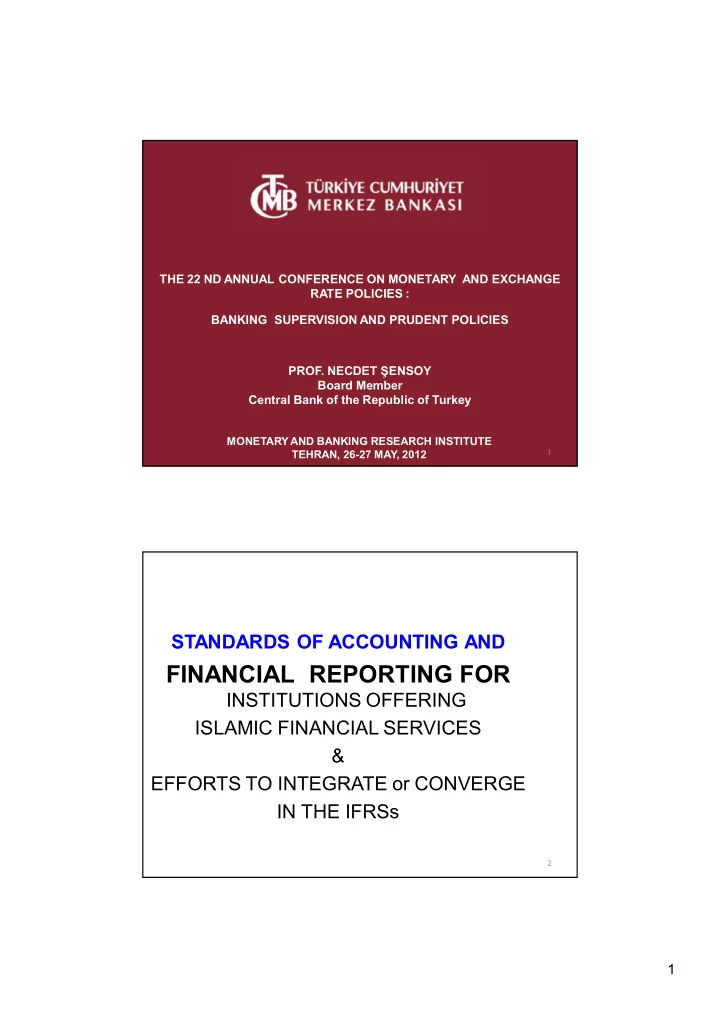
THE 22 ND ANNUAL CONFERENCE ON MONETARY AND EXCHANGE RATE POLICIES : BANKING SUPERVISION AND PRUDENT POLICIES PROF. NECDET ENSOY Board Member Central Bank of the Republic of Turkey MONETARY AND BANKING RESEARCH INSTITUTE 1 TEHRAN, 26-27


slide-1
SLIDE 1

1

1

MONETARY AND BANKING RESEARCH INSTITUTE TEHRAN, 26-27 MAY, 2012

THE 22 ND ANNUAL CONFERENCE ON MONETARY AND EXCHANGE RATE POLICIES : BANKING SUPERVISION AND PRUDENT POLICIES

  • PROF. NECDET ŞENSOY

Board Member Central Bank of the Republic of Turkey

2

STANDARDS OF ACCOUNTING AND

FINANCIAL REPORTING FOR

INSTITUTIONS OFFERING ISLAMIC FINANCIAL SERVICES & EFFORTS TO INTEGRATE or CONVERGE IN THE IFRSs

slide-2
SLIDE 2

2

3

OUTLINE

  • 1. FSB’ s initiative for global standards
  • 2. Standard Setting Bodies
  • 3. Debatable Issues & Comparisons
  • 4. Efforts for Convergence of FinanciaI

Reporting issues relating to Islamic Finance to IFRS

  • 5. Conclusion
  • 6. References

4

Transparency –Financial Stability

Hans Hoogervorst – Chairman of the IASB “Without transparency, there can be no enduring stability”. This not only holds for financial reporting, but also more broadly for securities markets supervision.

slide-3
SLIDE 3

3

5

Reform Initiatives in the Financial Sector

5

Financial Stability Board (FSB) G-20 Leaders Basel Committee on Banking Supervision (BCBS) Group of Governors and Heads of Supervision (GHOS) G-20 Finance Ministers and Central Bank Governors Standard Setting Bodies (IOSCO, IASB, IAASB, IAIS etc.) National Authorities International Organizations (IMF, WB) Committee on Payment and Settlement Systems (CPSS)

6

Working Area 12 Key Standards Issuing Body Macroeconomic Policy and Data Transparency Monetary and financial policy transparency IMF Fiscal policy transparency IMF Data dissemination IMF Financial Regulation and Supervision Banking supervision BCBS Securities regulation IOSCO Insurance supervision IAIS Institutional and Market Infrastructure Crisis resolution and deposit insurance BCBS/IADI Insolvency World Bank Corporate governance OECD

Accounting and Auditing

International Financial Reporting Standards (IFRS)

IASB

International Standards on Auditing (ISA)

IAASB Payment, clearing and settlement CPSS/IOSCO Market integrity FATF
slide-4
SLIDE 4

4

7

Importance of Standards Development, adoption, and successful implementation of international standards yields both national and international benefits Promote international financial stability by facilitating better-informed lending and investment decisions, improving market integrity

8

Standard Setting Bodies

Conventional

  • IOSCO,
  • IASB,
  • IAASB (auditing )
  • IAIS (insurance )
  • Asian Oceanian

Standard Setters Group Islamic

  • IFSB
  • AAOFIFI
  • MASB
  • ICAP
  • IAI
slide-5
SLIDE 5

5

9

Asian Oceanian Standard Setters Group

AOSSG is a grouping of the accounting standard-setters in the Asian-Oceanian region The group has been formed to discuss issues and share experiences

  • n the adoption of International Financial Reporting

Standards (IFRS) and to contribute to the development of a high-quality set

  • f global accounting standards

The AOSSG plans to play an important role in encouraging the adoption of IFRSs in the region.

10

Accounting and Auditing Organisation for Islamic Financial Institutions (AAOIFI)

An Islamic international autonomous non-for-profit corporate body that prepares accounting, auditing, governance, ethics and Sharia'a standards for Islamic financial institutions and the industry. .

slide-6
SLIDE 6

6

11

AAOIFI

It was founded in 1991 and ,has so far

issued a total of 80 standards covering the areas of accounting, auditing, ethics, and governance for Islamic financial institutions

  • 26 accounting standards,
  • 5 auditing standards,
  • 7 governance standards (incl. on Shari’a supervision),
  • 2 codes of ethics, and
  • 40 Shari’a standards (rules for application of Shari’a).

12

MASB Malaysian Accouting Standards Board

  • Statement of Principles – SOP

SOP i-1 : Financial Reporting from an Islamic Perspective

  • Technical Release – TR

TR i-1 : Accounting For Zakat on Business TR i-2 : Ijara TR i-3 :Presentation of Financial Statements of

Islamic Finacial Institutions

TR i-4 : Sharia Compliant Sale Contracts

slide-7
SLIDE 7

7

13

ICAP Institute of Chartered Accountants of Pakistan

Islamic Financial Accounting Standard (IFAS) IFAS 1: Murabaha IFAS 2: Ijarah

14

IAI Indonesian Accounting Institute

IAI-Sharia Accounting Standards Board

  • A framework for Preparation and

Presentation of Shariah Financial Statemets

  • PSAK- Pernyataan Standar Akuntasi

Keuangan

slide-8
SLIDE 8

8

15

Indonesian Accounting Institute-PSAKs

PSAK 101: Presentation of Sharia Financial Statements PSAK 102: Accounting For Murabaha PSAK 103: Accounting For Salam PSAK 104: Accounting For Istishna PSAK 105: Accounting For Mudarabah PSAK 106: Accounting For Musarakah PSAK 107: Accounting For Ijarah PSAK 108: Sharia Insurance Transactions

16

Accounting For Islamic Financial Transactions

View A Such Transactions can generally be accounted for using IFRS View B A seperate set of Islamic accounting standards would be required to report Islamic Financial Transactions

slide-9
SLIDE 9

9

17

AAOIFI

Review the standards which have been developed by prevailing accounting thought ( ie,IFRS) test them against Sharia and then adopt those which are consistent with the sharia and exclude those which are not

18

AAOIFI

IFRS / IASB standards can be adopted by IFIs AAOIFI standards issued because IFRS / IASB standards cannot be adopted in whole by Islamic financial institutions (IFIs) AAOIFI standards are issued for specific Islamic banking and finance practices which are not covered by IFRS / IASB standards.

slide-10
SLIDE 10

10

19

MASB Malaysian Accouting Standards Board

  • The Financial Reporting priciples in the

IFRS do not conflict with Sharia

  • Financial Reporting isa recording function

that would neither sanctify nor nullify the Sharia validity of transaction

  • The primary difference is not that of

recognition and measurement, but the extent of information that needed to be provided to users

20

Two Main Debatable Issues

Time Value of Money Is it appropriate to reflect a time value of money in reporting an Islamic Financial Transaction ? Substance Over Form Is there any priority of

The Form of the Contract

  • ver its economic

substance?

slide-11
SLIDE 11

11

21

Time Value of Money

View A

It is inappropiate to reflect a time value of money in reporting an islamic financial transaction when no overt interest is chaged or incurred in such transactions

View B

Although charging interest on a loan is prohibited Showing the financial effect of a transaction would not be so would provide information that would benefit users

22

Recognizing a Financing Effect

Conventional In sale of good with deferred payment, IAS 18 requires the difference between the fair value and the nominal amount

  • f consideration

is recognized as interest revenue Islamic

AAOIFI FAS 2 on Murabaha

refers to profit and requires either;

“proportionate allocation

  • f profits over the

period of credit” or “ as and when instalments are received”

slide-12
SLIDE 12

12

23

Difference in the Definition

Conventional Deferred Payment Fee is “interest” Islamic Deferred Payment Fee is “profit”

24

Malaysian Shariah Advisory Council of BNM Time Value of Money TVM is recognised in Sharia May be applied to contracts of exchange Economic value to time Fuqaha had long accepted that there is an economic value to time permits an increase in value due to lapse of time

slide-13
SLIDE 13

13

25

Substance Over Form

View A The recognition and measurement of an Islamic Financial Transaction should give prominence to its LEGAL FORM to differentiate it from a perceived equivalent View B To show the economic substance

  • f an Islamic

Financial Transaction Users will benefit more information about legal form can be disclosed at footnotes

26

AAOIFI – Statement of Financial Accounting No 2 Concepts of Financial Accounting for Banks &Financial Institutions ( Superseded by “Conceptual Framework” as Jan1,2011) Reliability means that based on all the specific circumstances surrounding a particular transaction

  • r event, the method chosen to measure and/or

disclose its effects produces information that

reflects the substance of the event or

  • transaction. Estimates and judgments in applying

accounting methods are not inconsistent with Shari’a principles which permit the use of persuasive evidence in the absence of conclusive evidence. (para ١١١ )

slide-14
SLIDE 14

14

27

Example for Substance over time contradiction

AAOIFI standards

Both Operating Ijarah and IjarahMuntahia Bittamleek to be treated similar to Operating Lease.

In contrast,based on IFRS,

Ijarah

(especially if lease term is for major part of economic life of lease asset) and IjarahMuntahia Bittamleek (due to the transfer of asset

  • wnership by the end of lease

term)

would normally be classified and treated as Finance Lease.

28

AAOIFI-Statement of Financial Accounting No.1

CONCEPTUAL FRAMEWORK FOR FINANCIAL REPORTING BY ISLAMIC FINANCIAL INSTITUTIONS İn effect by Jan.1 2011 Supersedes SFA 1 and SFA2

slide-15
SLIDE 15

15

29

AAOIFI-Statement of Financial Accounting No.1

A paragraph is available for “Substance over Form” : 8 / 3 / 3 8.3.3 Substance and form If information is to represent faithfully the transactions and other events that it purports to represent, it is necessary that

they are accounted for and presented in accordance with its substance and economic reality as well as the legal

  • form. Financial reporting involves

consideration of the substance of an economic phenomenon as well as its legal form.

30

Substance vs. Form

Substance > Form.........................IFRS Substance < Form.........................XXX Substance = Form......................Islamic(*) (*) AAOIFI Revised Framework

slide-16
SLIDE 16

16

31

AOSSG working Group on Financial Reporting Relating to Islamic Finance

The Working Group was set up to provide input and feedback on the adequacy and appropriateness of proposed and existing IFRS to Islamic financial transactions and events.

The Working Group comprises staff from

the standard-setters of Australia, China, Dubai, Indonesia,Korea, Malaysia, Pakistan, and Saudi Arabia.

32

AOSSG working Group on Financial Reporting Relating to Islamic Finance Publications

  • AOSSG Survey – Accounting for Islamic Financial Transactions and Entities

Dec 2011

  • Financial Reporting Issues relating to Islamic Finance Oct 2010

Submissions to IASB

  • Comments on IASB ED/2011/6 Revenue from Contracts with Customers

AOSSG20 Mar 2012

  • Comments on IASB Exposure Draft ED/2011/1 Offsetting Financial Assets

and Financial Liabilities 28 Apr 2011

  • Comments on IASB Supplement to Exposure Draft ED/2009/12 Financial

Instruments: Impairment 1 Apr 2011

  • Comments on ED/2010/13 Hedge Accounting 9 Mar 2011
  • Comments on IASB ED/2010/9 Leases 14 Dec 2010
slide-17
SLIDE 17

17

33

Source: Deloitte-IAS Plus-Mar 26, 2012

The Islamic Finance Working Group of the Asian-Oceanic Standard-Setters Group (AOSSG) has submitted a comment letter to the IASB on ED/2011/6 'Revenue from Contracts with Customers', noting "gaps in guidance for Islamic finance transactions".

34

Source: Deloitte-IAS Plus-Mar 26, 2012

The Working Group comment letter, which is in addition to the main AOSSG submission on the exposure draft, notes a number of issues. Some of these issues were previously raised in response to the earlier revenue recognition exposure draft (ED/2010/6).

slide-18
SLIDE 18

18

35

The issues raised in the comment letter include

  • The ED could result in a sale that is a financing transaction

being reported differently from other financings under IAS 39

  • The application of ‘enforceable’ and ‘unconditional’ in relation

to promises to repurchase must be clear

  • Contracts with multiple unrelated parties can still be ‘a single

contract’. Also, what constitutes ‘a contract’ may be interpreted differently in Islamic finance

  • The description of a customer appears to exclude commercial

customers

  • It would be useful to include an example of a deferred

payment sale in the Illustrative Examples

36

CONCLUSION 1

1. After Global Financial Crisis G 20-FSB took initiative for global standards

  • 2. “Rapid growth of Islamic finance

is increasing pressure for the industry to enter the accounting mainstream, by seeking guidance from the International Accounting Standards Board (IASB), the global body which sets the tone for book-keeping in conventional finance” (Reuters Apr 5, 2012 )

slide-19
SLIDE 19

19

37

CONCLUSION 2

  • 3. Asean – Ocean standard setters group

lead by Malaysian Accounting Standards Board making efforts for convergence

  • 4. Contradictory issues may be resolved by

integrating several standards relevant to Islamic Finance to IFRS

38

References

1. AAOIFI, Statement of Financial Accounting No1. Conceptual Framework for Financial Reporting by Islamic Financial Institutions 2. Asian-Oceanian Standard Setters Group, Research Paper, Financial Reportinissues relating to Islamic Finance 3. www.iasplus.com/en /resources/resource64 4. www.coffis.fr/coffis/index/.php?option..file... islamic finance

slide-20
SLIDE 20

20

39

.

THANK YOU necdet.sensoy@tcmb.gov.tr