Financial: Profit before tax, adjusted for exceptional items, of - - PDF document

financial profit before tax adjusted for exceptional
SMART_READER_LITE
LIVE PREVIEW

Financial: Profit before tax, adjusted for exceptional items, of - - PDF document

31 May 2013 LONDONMETRIC PROPERTY PLC (LondonMetric or the Group or the Company) FULL YEAR RESULTS FOR THE YEAR ENDED 31 MARCH 2013 MERGED GROUP DELIVERS STRONG TOTAL PROPERTY RETURN OUTPERFORMANCE LondonMetric, a UK REIT, today


slide-1
SLIDE 1

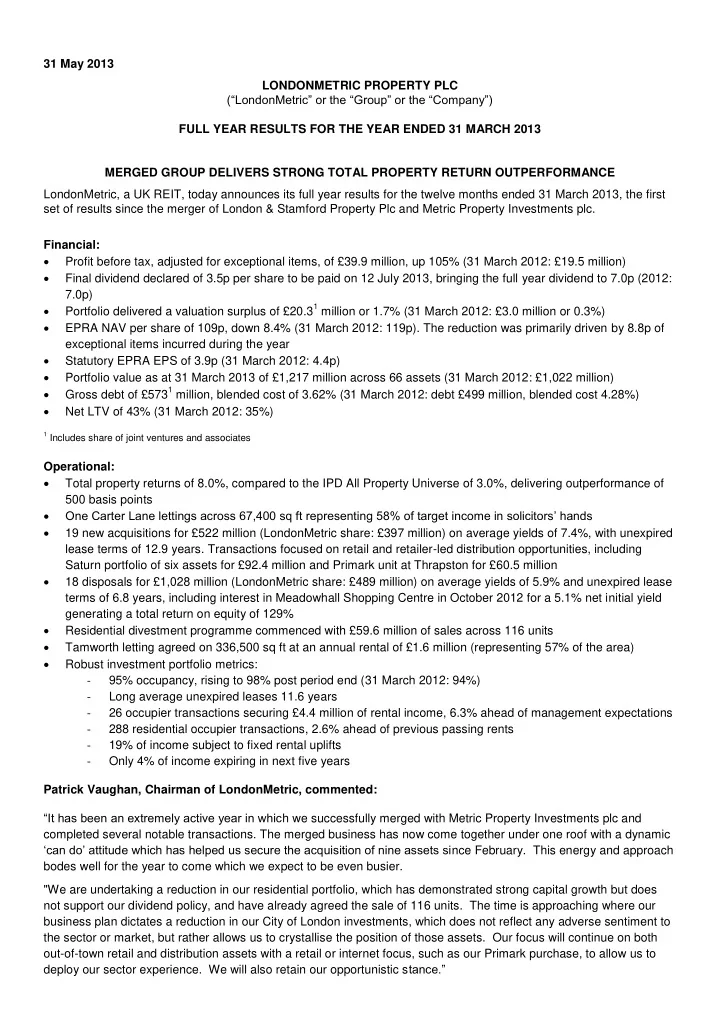
31 May 2013 LONDONMETRIC PROPERTY PLC (“LondonMetric” or the “Group” or the “Company”) FULL YEAR RESULTS FOR THE YEAR ENDED 31 MARCH 2013 MERGED GROUP DELIVERS STRONG TOTAL PROPERTY RETURN OUTPERFORMANCE LondonMetric, a UK REIT, today announces its full year results for the twelve months ended 31 March 2013, the first set of results since the merger of London & Stamford Property Plc and Metric Property Investments plc. Financial:  Profit before tax, adjusted for exceptional items, of £39.9 million, up 105% (31 March 2012: £19.5 million)  Final dividend declared of 3.5p per share to be paid on 12 July 2013, bringing the full year dividend to 7.0p (2012: 7.0p)  Portfolio delivered a valuation surplus of £20.31 million or 1.7% (31 March 2012: £3.0 million or 0.3%)  EPRA NAV per share of 109p, down 8.4% (31 March 2012: 119p). The reduction was primarily driven by 8.8p of exceptional items incurred during the year  Statutory EPRA EPS of 3.9p (31 March 2012: 4.4p)  Portfolio value as at 31 March 2013 of £1,217 million across 66 assets (31 March 2012: £1,022 million)  Gross debt of £5731 million, blended cost of 3.62% (31 March 2012: debt £499 million, blended cost 4.28%)  Net LTV of 43% (31 March 2012: 35%)

1 Includes share of joint ventures and associates

Operational:  Total property returns of 8.0%, compared to the IPD All Property Universe of 3.0%, delivering outperformance of 500 basis points  One Carter Lane lettings across 67,400 sq ft representing 58% of target income in solicitors’ hands  19 new acquisitions for £522 million (LondonMetric share: £397 million) on average yields of 7.4%, with unexpired lease terms of 12.9 years. Transactions focused on retail and retailer-led distribution opportunities, including Saturn portfolio of six assets for £92.4 million and Primark unit at Thrapston for £60.5 million  18 disposals for £1,028 million (LondonMetric share: £489 million) on average yields of 5.9% and unexpired lease terms of 6.8 years, including interest in Meadowhall Shopping Centre in October 2012 for a 5.1% net initial yield generating a total return on equity of 129%  Residential divestment programme commenced with £59.6 million of sales across 116 units  Tamworth letting agreed on 336,500 sq ft at an annual rental of £1.6 million (representing 57% of the area)  Robust investment portfolio metrics:

  • 95% occupancy, rising to 98% post period end (31 March 2012: 94%)
  • Long average unexpired leases 11.6 years
  • 26 occupier transactions securing £4.4 million of rental income, 6.3% ahead of management expectations
  • 288 residential occupier transactions, 2.6% ahead of previous passing rents
  • 19% of income subject to fixed rental uplifts
  • Only 4% of income expiring in next five years

Patrick Vaughan, Chairman of LondonMetric, commented: “It has been an extremely active year in which we successfully merged with Metric Property Investments plc and completed several notable transactions. The merged business has now come together under one roof with a dynamic ‘can do’ attitude which has helped us secure the acquisition of nine assets since February. This energy and approach bodes well for the year to come which we expect to be even busier. "We are undertaking a reduction in our residential portfolio, which has demonstrated strong capital growth but does not support our dividend policy, and have already agreed the sale of 116 units. The time is approaching where our business plan dictates a reduction in our City of London investments, which does not reflect any adverse sentiment to the sector or market, but rather allows us to crystallise the position of those assets. Our focus will continue on both

  • ut-of-town retail and distribution assets with a retail or internet focus, such as our Primark purchase, to allow us to

deploy our sector experience. We will also retain our opportunistic stance.”

slide-2
SLIDE 2

2

Andrew Jones, Chief Executive of LondonMetric, added: “The merger of London & Stamford and Metric Property has led to transformational change both in respect of the newly integrated LondonMetric and in reshaping the portfolio to meet our new strategic priorities. The enlarged group is more focused yet remains opportunistic, operating in areas where we have a high level of expertise which allows us to capitalise on the combined skill sets of the former companies. “We have made good initial progress with our programme to dispose of, and recycle capital from, low-yielding assets where our asset management initiatives are completed. Our new, high-yielding acquisitions have produced a positive spread of 150bps over those which were sold and we currently have an exciting pipeline of opportunities that will allow us to add substantially to income as we work towards securing a covered dividend.” For further information, please contact: LondonMetric Property Plc Andrew Jones / Martin McGann Tel: +44 (0) 20 7484 9000 FTI Consulting Stephanie Highett / Dido Laurimore Tel: +44 (0) 20 7831 3113 Meeting and conference call for investors and analysts A meeting for investors and analysts will be held at 9.00am today at: FTI Consulting Holborn Gate 26 Southampton Buildings London WC2A 1PB In addition, a simultaneous conference call will also be available and the presentation will be available to download from the Company’s website www.londonmetric.com To participate in the call, please dial: Dial in number: +44 (0)20 3427 1913 Conference ID: 2693667 Event title: LondonMetric Property Full Year Results About LondonMetric Property Plc LondonMetric (ticker: LMP) is a UK REIT admitted on the Official List and to trading on the Main Market of the London Stock Exchange (“LSE”) on 28 January 2013 as a result of the merger between London & Stamford Property Plc (LSP) and Metric Property Investments plc (METP). LondonMetric aims to deliver attractive returns for shareholders through a strategy of increasing income and improving capital values. It invests across the UK in Retail and Distribution properties as well as Greater London real estate opportunities. It employs an occupier-led approach to property investments through opportunistic acquisitions, joint ventures, active asset management and short cycle developments. The asset focus is on properties with enduring occupier appeal providing opportunities to improve both rental values and the security and longevity of income; and limited risk redevelopments with the aim of enhancing shareholder returns. Further information on LondonMetric is available at www.londonmetric.com.

slide-3
SLIDE 3

3

CHAIRMAN’S STATEMENT I believe it is time to be bolder… the changes underway in the balance and mix of our business will provide the Company with a strong and exciting future. The year to 31 March 2013 fell into two distinct halves. In the first half, we were still seeing an environment where caution was required while, in the second half, we began to see signs of improvement, which augur well for the coming year. In my predecessor’s statement for the half year to September, he highlighted his belief that one must remain patient in our investment approach. While we will certainly remain cautious going forward, I believe it is also time to be bolder. The second half of the year was very significant, because it involved a merger with Metric Property Investments plc ("Metric"). Since the year end, the merged business, renamed LondonMetric Property Plc, has come together in a single office at One Curzon Street with a dynamic “can do” approach. I have known and worked for many years with Andrew Jones, Valentine Beresford and Mark Stirling. I believe the addition to our business of the Metric team will generate great progress. It was also the moment Raymond Mould decided it was time to retire, given this strengthening of the team. After working with him as my close business partner and friend for 44 years, that represents a big change, but one which I know from the early dynamics of the merger will nonetheless allow us to move ahead very successfully. On behalf of all of us, I offer him our very best wishes and thanks. Results The income statement reflects the activity of London & Stamford for the period from 1 April 2012 until the merger and then shows the combined activity of the enlarged Group for the two months to 31 March 2013. These results have been impacted over the year by an unusual weight of exceptional items which together amount to £49.5 million and are largely not recurring. These include the net loss on the sale of our investment in the Meadowhall Shopping Centre as a result of a debt mark to market adjustment which amounted to £23.2 million. It also includes a further £26.3 million of exceptional items, in respect of the amortisation of part of the purchase consideration paid for the acquisition and internalisation of LSI Management in 2010, the amortisation of the cost of the Green Park Property Advisory Agreement, and the merger costs. The bonds and merger costs are non-recurring items. One more half year

  • f amortisation of the purchase consideration will occur this September, then that is finished. The Green Park

intangible asset of £9.6 million will remain and will continue to be amortised to March 2015. Profit before the deduction of these exceptional items and tax amounted to £39.9 million, which is an increase of £20.4 million, or +105% on last year. If that was adjusted to include the full year’s activity of Metric to give a real year-

  • n-year comparison, the total for the year would have been £45.6 million, a 39% increase in the profits of the

combined business over 2012. With the exceptional costs falling away and the combined business operating at full steam, I believe you will see real progress in our current year. Net assets at 31 March 2013 were £676.7 million for the combined business, after our return of £100 million of capital to shareholders, compared to £630.9 million in 2012. This is equivalent to 108p per share on our enlarged capital compared to 116p per share in 2012. The reduction of 8p in net asset value includes the deduction of 9p of exceptional items, as referred to above, and after the payment of 7p in dividend for the year. At property level, the total return was +8.0%, compared to the IPD return of +3.0%. A further breakdown shows our income return was +5.6% versus +6.0% for IPD and our capital performance was +2.4% against –2.8% for IPD. The Board has proposed a final dividend of 3.5p per share, to be paid on 12 July 2013 which, when taken with the interim dividend of the same amount paid on 7 December 2012, will give a total dividend in respect of the year of 7p. The Portfolio In addition to our merger, the year has been an extremely active one. We made a number of well reported disposals, including Meadowhall and the Triangle distribution portfolio which delivered returns on equity of 129% and 33%

  • respectively. The two businesses made acquisitions totalling £522 million (LondonMetric share: £397 million), the

most significant of which include the Saturn out-of-town retail park portfolio, the Leatherhead offices of Unilever, a major office scheme at Globe Park, Marlow, and a large Primark distribution centre. The average yield of these acquisitions was 7.4% with a WAULT of 12.9 years. In the current year we expect to be busier. It is our primary objective to achieve a run rate of recurring net rents at the level of our current dividend, so we can move on from there. We shall be undertaking major reductions in our

slide-4
SLIDE 4

4

residential portfolio, which has grown strongly in value, but does not support our dividend policy. The time is also fast approaching when our business plan calls for a reduction in our City of London investments. These are not sector or market calls; they are the result of the planned evolution of those assets. We shall continue to focus on out-of-town retail to take full advantage of our expertise in the sector and we shall also concentrate on distribution, with emphasis, such as our Primark purchase, on where that distribution involves retail and the internet, so we can fully deploy our sector skills. The Board Following the retirement of Richard Crowder at the merger, Andrew Huntley has decided not to stand for re-election to the Board at the AGM and Mark Burton has decided to retire. This is obviously very sad, as they have been very strong Non-Executive Directors and they will be much missed. It takes us from eight to six Non-Executive Directors, alongside our three Executive Directors. On behalf of all parties involved with the Company, I give them our thanks. I believe the enlarged management team together with the changes underway in the balance and mix of our business will provide the Company with a strong and exciting future. Patrick Vaughan Chairman 31 May 2013

slide-5
SLIDE 5

5

CHIEF EXECUTIVE’S REVIEW We are more focused yet remain opportunistic, operating in areas where we have a high level of expertise, that help create key points of difference The merger has led to transformational change both in respect of the newly integrated LondonMetric and in reshaping the portfolio to meet our new strategic priorities. Bringing together capital and complementary skill sets One of the key objectives of the merger was to capitalise on the combined skill sets across both organisations to allow LondonMetric to execute on opportunities that neither predecessor could have achieved on its own. Retail and retailer distribution… a multi-channel approach to asset allocation Shortly after completing the merger we acquired a portfolio of six retail parks, the “Saturn” portfolio, for £92.4 million, at a net initial yield of 7.8%. We are expanding our presence in the retailer-led distribution market where we believe there are considerable

  • pportunities for growth as retailers look to satisfy consumers’ insatiable demand for multi-channel shopping. We

acquired Primark’s main distribution centre in Thrapston for £60.5 million in March, at a net initial yield of 6.4% and expect to make further investments in this sector over the next few months. Significant capital recycling and reducing our exposure to lower yielding, shorter lease length income We have a divestment programme across selected assets which allows us to release relatively low yielding capital and recycle the proceeds into higher yielding, stronger covenant assets where we have an exciting pipeline of retail and retailer-led distribution opportunities. This is evidenced by the spread between our disposals and acquisitions where we have generated a positive yield spread of 150bps, improved the portfolio’s average lease length by 6.1 years and occupancy by 7 percentage points. Across our residential portfolio, terms have been agreed for the sale on 116 units for £59.6 million, releasing c. £48 million of equity. We have recently begun formal marketing of One Fleet Place, EC4 at an asking yield of 5.25% and are pleased by the strong interest from overseas buyers. Positive momentum on residential lettings and unit sales Our prime central London residential portfolio comprises 520 units with a capital value of £374 million (LondonMetric share: £259 million) and generates net rents of £4.9 million. Seward Street (rebranded the Clerkenwell Quarter), our 107 unit development in Islington, was acquired in December 2012 for £45.7 million. We have recently launched a successful marketing programme in both Asia and London and to date have agreed 57 sales for £32.1 million at a premium over book value of 2.7%. We remain on target to release

  • ver £60 million of equity from this investment over the next six months.

Our residential investment portfolio is 98% let having agreed 141 new lettings for £3 million, at rents 1.1% ahead of previous passing and concluding 147 lease renewals, 4.3% ahead of previous passing rents securing £2.8 million. We have commenced a divestment programme of individual unit sales within this wholly owned residential portfolio and expect to have largely monetised this investment over the next year. To date we have agreed 59 sales generating £27.5 million. In July 2012 we acquired Moore House, Chelsea for £147.1 million (LondonMetric share: £58.9 million) on behalf of

  • ur joint venture with Green Park Investments and the Public Sector Pension Investment Board. We continue our

letting programme and have let 81 units over the period, increasing occupancy to 54%. Valuation surplus +1.7% or £20.3 million The portfolio was valued at £1,217 million delivering a valuation surplus (net of acquisition costs) for the year of £20.3 million, up from the £3.0 million surplus delivered last year. Asset management actions made a considerable valuation contribution of +2.0% which was partly offset by an outward movement in market yields of 6bps, or –0.3%. By sector, the largest contributor to the valuation movement was residential, in particular Moore House. Total return of 8.0% – 500bps outperformance We outperformed the IPD All Property Quarterly Index by 500ps, delivering a property level total return of 8.0% compared with IPD at 3.0%. We generated a capital return of 2.4% against the IPD index which witnessed capital

slide-6
SLIDE 6

6

declines of 2.8% overall. On a total return basis we are pleased to have outperformed at each sector level, with retail generating the largest outperformance of 500bps followed by residential at 490bps. Robust portfolio metrics Our occupancy at the end of the period was 95%1 rising to 98% post period end. The average unexpired lease term is 11.6 years (10.8 years to first break). There are no temporary lettings and 19% of portfolio income benefits from fixed rental uplifts. Like-for-like rental growth of 3.5%1 We are a total return business and, as a REIT, income forms an important component. In a year of tremendous activity we have continued to focus on income growth and delivered like-for-like rental growth of 3.5%. The retail portfolio delivered like-for-like rental growth of 5.7% with the office and industrial portfolio delivering 1.7% and the residential portfolio 2.6%. Our contracted rent roll as at 31 March 2013 was £62.5 million2 with the investment portfolio contributing £55.5 million in annualised rents and the development and residential portfolio the remaining £7 million. Net rental income for the year is £29.2 million, which includes two months’ of Metric’s contribution. Net income for the full year is £39.4 million when combining both businesses for the full 12 months. Looking forward our financial position next year will reflect the full year’s contribution for acquisitions in the last two months of this year. EPRA EPS of 3.9p includes two months of Metric’s contribution and is down 11.4% year-on-year. Stable dividend of 7.0p We have announced a final dividend of 3.5p per share to be paid on 12 July 2013, bringing total dividends for the year to 7.0p, flat over the previous year. The Board have agreed to pursue a stable dividend policy which will be reviewed

  • nce the dividend is sufficiently covered.

Path to achieving dividend cover We aim to achieve an attractive spread between the lower yields on disposal and higher reinvestment yields to grow

  • income. We will also generate additional income from new lettings and the letting up of our developments. We expect

each to contribute meaningfully to our cumulative income to ensure that our recurring profits cover the dividend. £100 million tender offer taken up The share capital has changed substantially as a result of the merger, adding 178.6 million shares to the register on 28 January, representing the 190 million Metric shares at the agreed exchange ratio of 0.94. As part of the merger in February, we offered shareholders a £100 million tender offer which was taken up in full and reduced the register by 88.6 million shares, resulting in a position at the year end of 628.0 million shares. The full take-up of the tender offer allowed us to right-size our balance sheet and start LondonMetric in a more financially efficient position. EPRA NAV of 109p, NAV adjusted for exceptional items of 116p ERPA NAV per share of 109p is 10p or –8.4% lower than last year’s 119p. The EPRA NAV is reduced by dividends paid, the merger costs and exceptional items of which the impairment recognised on the sale of Meadowhall Shopping Centre was the largest. Excluding the exceptional items the NAV would have been 116p compared to the previous year’s NAV per share. The EPRA NAV movement is driven by positive movements in valuation surplus of 3.7p, underlying profits of 3.8p

  • ffset by dividends paid of –7.0p, the impairment recognised on the sale of Meadowhall Shopping Centre of –4.1p and
  • ther exceptional items of –4.7p and other items of –0.9p.

LTV of 43% with undrawn facilities of £54 million As at 31 March 2013, the LTV ratio was 43% with committed undrawn facilities of £53.6 million. Our average cost of debt over the year was 3.62%. Going forward, assuming the facilities were fully drawn, our all-in cost of debt today based on current LIBOR swap rates would be 3.58%. Market outlook Over the last few months we have seen a noticeable increase in both the number of parties and quantum of money looking across all sectors of the real estate market.

1 For the commercial investment portfolio excluding properties under development. 2 Includes a deduction of £1.5m for residential running costs

slide-7
SLIDE 7

7

Rising investor appetite The outward yield shift that we witnessed in the first half of our financial year was not repeated in the second half and the depth and breadth of investor interest today is now beginning to put downward pressure on yields across the various sectors. This is partly owing to an increased appetite for risk across most sectors with more investors moving up the risk curve in search of higher income returns. As a result, the divergence between prime and good secondary assets is widely expected to contract, although conversely the yield gap to poorer secondary assets will continue to widen. We continue to believe that assets with long and strong income offer good value relative to the low cost of borrowing; especially where there is high occupier contentment, limited asset obsolescence, sustainable rental levels and no income “leakage”. These disciplines continue to drive our approach to new opportunities, as we focus our capital on higher yielding, sustainable income opportunities and new short-cycle redevelopments which offer us a margin of safety. This will ensure that we will only invest in assets that we are happy to own, even if the market were to shut down for many years. Retailers are reassessing the extent of their store portfolios and distribution warehouse requirements Retailers’ real estate portfolios are coming under ever increasing focus as the retail market continues to evolve with polarisation of shopping habits and a drive towards a multi-channel strategy. The impact is not only on retailers’ shop networks but also significantly affects their distribution requirements which will play an increasing role within their supply chains. This evolution will continue over the next few years as many occupational leases expire, allowing retailers to reduce the number of existing shops. We expect retail vacancies to increase putting downward pressure on rental values, particularly in-town, as impending lease expiries allow retailers to vacate poorly performing shop units. A number of the weaker retailers have already failed, so we anticipate the rate of failures will start to decline and the retailers who have survived will continue to benefit from the reduced capacity and grow their market share. We believe that lease expiries rather than administrations are now the chief risk to rental income. Retailers have a clear vision of the right size and shape of their store portfolios, however, distribution strategies are continuing to evolve. These will be increasingly driven by the needs of e-tailing as retailers reconfigure supply chains to cater for multi-channel retailing. Understanding these occupier trends is critical to succeeding in the real estate sector today. The dynamic nature of the retail market is such that increased occupier mobility will undoubtedly create opportunities for those able to build and deliver modern space that is fit for purpose in today’s market. We continue to try to position ourselves as the preferred real estate provider of choice and will continue to stay close to our customers across these asset classes. Andrew Jones Chief Executive 31 May 2013

slide-8
SLIDE 8

8

INVESTMENT Reshaping the portfolio and monetising selected assets will generate a strong platform to grow the portfolio and its income potential Nine assets acquired since completion of the merger To date we have made 20 acquisitions (19 during the period) across the retail, distribution, residential and office sectors for £532 million (£408 million at our share) at average yields of 7.4%. We were also actively recycling capital divesting 18 assets which generated total sales proceeds of £1,028 million (LondonMetric share: £489 million) at average disposal yields of 5.9%. The table summarises our activity over the year, including post-period end transactions. We have consciously worked towards improving the portfolio metrics by divesting across selected assets that allow us to release relatively low yielding capital and recycle the proceeds into higher yielding, stronger covenant schemes. The 150bps positive yield spread between our disposals and acquisitions, improved lease length of 6.1 years and improved occupancy spread of 7 percentage points are all evidence that we are creating a stronger platform to grow income. Since the merger we have spent £170.6 million (LondonMetric share: £165.7 million) acquiring nine properties in the retail and retailer distribution sectors at average yields of 7.2% with unexpired lease terms of 13.9 years and

  • ccupancy of 98%.

Shortly after completing the merger we acquired a portfolio of six retail parks, the “Saturn” portfolio, for £92.4 million, at a net initial yield of 7.8%. Five of the parks are fully occupied with Luton at 89% occupancy. The purchase offers secure, well-let income with additional asset management opportunities and the ability to add value. Investment activity Acquisitions Sector

  • No. of

assets Date Cost £(m) NIY (%) Ipswich – post year end Retail 1 May 2013 10.4 6.5 Ashford – MIPP Retail 1 Mar 2013 7.4 6.8 Thrapston Distribution 1 Mar 2013 60.5 6.4 Saturn portfolio Retail 6 Feb 2013 92.4 7.8 Clerkenwell Quarter Residential 107 units Dec 2012 45.7 – Marlow International Office 1 Jul 2012 50.2 8.9 MIPP JV Retail 5 Various 47.1 7.1 Leatherhead Office 1 Jun 2012 61.2 6.9 Retail parks Retail 2 Various 10.3 7.4 Moore House Residential 149 units Jul 2012 147.1 – Subtotal 20 532.3 7.4 Disposals Sector

  • No. of

assets Date Proceeds £(m) NIY (%) Meadowhall Shopping Centre Retail 1 Oct 2012 762.5(1) 5.1 Triangle portfolio Distribution 17 Apr 2012 265.0 6.6 Subtotal 18 1,027.5 5.9 (1) Represents 50% of the gross sales proceeds of £1.525 billion.

slide-9
SLIDE 9

9

Saturn portfolio NIY Occupancy WAULT (years) Area 1. Christchurch 7.1% 100% 7.9 101,700 sq ft 2. Leicester 7.2% 100% 14.4 77,300 sq ft 3. Luton 8.5% 89% 9.2 47,100 sq ft 4. Milton Keynes 8.4% 100% 9.4 57,400 sq ft 5. Southampton 9.4% 100% 8.8 52,300 sq ft 6. Tonbridge 7.3% 100% 10.1 57,400 sq ft Extending our occupier relationships The occupier is at the centre of our business model impacting every investment decision we make. As such, we are extending our breadth of experience and deep occupier relationships into retailer-led distribution, which is benefiting from strong occupier interest as retailers’ multichannel strategies continue to evolve. Our investment activity since completion of the merger illustrates our desire to grow both the retail and retailer-led distribution segments of the portfolio, where we have an attractive pipeline of opportunities. We are primarily targeting retailer-led distribution where we have a competitive advantage as a result of our strong retailer relationships. Our acquisition of the Primark Distribution Centre, Thrapston, which we acquired for £60.5 million at a net initial yield of 6.4%, illustrates the attractive lease terms afforded by retailers. The lease term is just under 20 years with annual fixed uplifts of 1.5% and upward only open market rent reviews every five years. We have recently begun formal marketing of One Fleet Place, EC4 and are pleased by the strong interest from

  • verseas buyers. The property comprises 170,000 sq ft and is primarily let to the law firm SNR Denton LLP with 12.3

years unexpired. We acquired the asset in January 2009 for £74 million and are marketing at a disposal yield of 5.25% reflecting a price of £109.3 million. The investment market appears to be receptive to this prime offering and we aim to conclude the sale in the summer. Positive momentum on residential unit sales Our prime Central London residential portfolio comprises 520 units with a capital value of £374 million (LondonMetric share £259 million) and generates net rents of £6.3 million (LondonMetric share: £4.9 million). We have commenced a divestment programme with terms agreed for the sale of 116 units for £59.6 million, at 1% over book values. We expect to monetise our residential investments over the next year. Our residential investment portfolio comprising Bridges Wharf, Battersea, Highbury Stadium Square, Islington and Clapham Road, Stockwell is 98% let having agreed 141 new lettings for £3 million, at rents 1.1% ahead of previous passing and concluding 147 lease renewals, 4.3% ahead of previous passing rents securing £2.8 million. We commenced a programme of individual unit sales in February 2013 and to date have agreed 59 sales generating £27.5 million. In July 2012 we acquired Moore House, Chelsea for £147.1 million (LondonMetric’s 40% share: £58.9 million) on behalf of the joint venture with Green Park Investments and Public Sector Pension Investment Board. We continue our letting programme and have let 81 units over the period, increasing occupancy to 54%. In December 2012 we acquired the Clerkenwell Quarter development in Islington for £45.7 million. We launched a successful marketing programme in April in both Asia and London and to date have agreed 57 sales for £32.1 million at a premium over book value of 2.6%. We remain on target to release over £60 million of equity from this investment

  • ver the next six months.

Deep pipeline of opportunities Our acquisitions have predominantly been off market and we continue to find this a good source of product, particularly for retailer partnering deals in both the retail and distribution sectors. We are seeing a strong pipeline of

  • pportunities primarily from institutions and bank “motivated” vendors. We have a good pipeline of product for both our

wholly owned and joint venture portfolios and are in a position to quickly reinvest the proceeds from the residential

  • sales. We are already undertaking due diligence on a pipeline of c.£100 million at average yields in excess of 7%.
slide-10
SLIDE 10

10

ASSET MANAGEMENT AND DEVELOPMENT Creating desirable real estate is fundamental to our business model and drives our leasing, planning and development strategies The commercial investment portfolio generates a rent roll of £55.5 million, has a capital value of £834.7 million and benefits from unexpired lease terms of 11.6 years (10.8 years to first break) and occupancy of 95%. A significant level of activity has been generated across all asset management fronts, having completed 14 new lettings across 526,000 sq ft securing £1.7 million, 4.8% ahead of anticipated levels. We concluded new lettings on average lease terms of 11.8 years (10 years to first break). We have also completed 12 rent reviews and re-gears

  • ver the same time period across 236,300 sq ft securing £2.7 million, 7.5% ahead of previous passing rents.

Post-period end an additional seven deals were contracted across 670,000 sq ft securing £3.9 million of rental income

  • n average lease lengths of 10.0 years (7.8 years to first break).

At Carter Lane we have agreed pre-lets on 58% of the building by income. Encouragingly, all rents agreed to date have been at levels in excess of £60 psf. Valuation uplift of £20.3 million The portfolio was valued at £1,217 million at 31 March 2013, reflecting a valuation uplift of 1.7% over the 12 month

  • period. Our weighted capital return for the period was 2.4% which compares to –2.8% for the IPD All Property

Quarterly Index. Asset management actions made a considerable valuation contribution of +2.0% which was only partly offset by an

  • utward movement in market yields of 6bps, or -0.3%. Asset management actions include occupier transactions (new

lettings, re-gears and lease renewals), development of new space and improving the quality of the lease, by extending the lease length, enhancing the terms of the lease or improving the lease covenant. Asset management yield shift, or improving the quality of the lease, generated 15bps of inward yield shift. By sector, the largest contributor to the valuation movement was residential, in particular Moore House. The largest valuation declines came from our legacy portfolio, primarily of land, and our distribution joint venture. Valuation contributors

Contributors Valuation change (£m) % contribution to valuation uplift

Occupational deals 10.7 52.6 New space 4.2 20.7 Asset management yield shift 9.4 46.3 Market yield shift

  • 4.0
  • 19.6

Valuation surplus 20.3 100.0 Retail

  • No. of assets: 32

Occupancy: 99% Capital value: £409.6m WAULT: 11.1 years (LondonMetric share: £348.4m) (10.3 years to first break) The portfolio continues to perform well with an intense level of activity. There are a number of future opportunities on the existing portfolio and the newly added six retail warehouses acquired towards the end of the financial year in the Saturn portfolio.  23 occupier transactions (12 lettings and 11 rent reviews) securing £3.4 million of rental income, at terms 8.3% ahead of existing rental levels on average WAULT of 13.7 years (11.2 years to first break)  Additional three lettings currently in solicitors’ hands securing a further £0.6 million of rental income.  11 rent reviews agreed at terms 9.1% ahead of previous passing  26% of income subject to fixed uplift  Like-for-like rental income growth of 5.7%  Planning gains of 161,500 sq ft with a further 205,000 sq ft of retail planning consents submitted

slide-11
SLIDE 11

11

Distribution

  • No. of assets: 15

Occupancy: 86% Capital value: £362.6m WAULT: 12.9 years (LondonMetric share: £243.8m) (12.8 years to first break) The distribution portfolio comprises 15 warehouses with a retail focus, 11 of which are owned in joint venture with Green Park Investments. Tenants include Tesco (Harlow), Hillary’s Blinds (Nottingham), Primark (Thrapston) and Co-

  • p (Wellingborough). We expect to execute on an attractive pipeline of opportunities to grow this sector over the near

term. Offices

  • No. of assets: 4

Occupancy: 100% Capital value: £242.4m WAULT: 11.1 years (9.9 years to first break)  At One Fleet Place, EC4 we are targeting a yield on disposal of 5.25% and have received early positive interest from mainly overseas buyers.  At Leatherhead, Unilever have received a planning consent for a decked car park providing an additional 136 car parking spaces. We have now agreed to contribute to developing the car park in exchange for a re-geared lease and a rental increase. This initiative delivers a return on marginal capex of almost 15% Residential

  • No. of assets: 5

Occupancy: 82% Capital value: £374m Number of units: 520 (LondonMetric share: £258.8m) Occupancy across the residential investment portfolio (Highbury; Clapham Road & Battersea) remains robust at 98% and reflects a period of intense activity.  At Clerkenwell Quarter, post-period end we have launched the sales of individual units both in London and Asia. We have now agreed sales on 57 units for £32.1 million at 2.6% over book value.  Sales agreed for £27.5 million on 59 units, in line with book value  Concluded 147 lease renewals securing £2.8 million of rental income at 4.3% ahead of previous passing rents  Agreed 141 new lettings, securing rental income of £3.0 million, 1.1% ahead of previous passing rents Moore House, held in a joint venture, represents an opportunistic hold as we believe further capital appreciation is to come owing to its prime location and proximity to the Chelsea Barracks, where we expect a future luxury residential development to be valued significantly higher. We have let 81 of the available flats bringing occupancy to 54% and generating a net rent of £2.4 million (LondonMetric share: £1.0 million). Developments

  • No. of assets: 5

Level of pre-lets on retail assets under development: 78% Capital value: £112.2m The development portfolio comprises of five schemes (Berkhamsted, Bristol – Channons Hill, Bishop Auckland Phases II and III, Leeds and One Carter Lane, EC3). Achievements over the period include:  Completed developments at Sheffield, Bristol (Longwell Green), Bishop Auckland Phase I and Cannock, delivering a return on capital expenditure of 16%  Onsite retail development portfolio (comprising Berkhamsted and Bristol) is now 78% pre-let securing £1.0 million of rent

slide-12
SLIDE 12

12

 Invested £14.5 million across seven retail assets in development and asset management capital expenditure delivering a return of 15.7%  At One Carter Lane, EC3 the building remains vacant and is undergoing a substantial refurbishment and leasing

  • exercise. 58% of the space has now been agreed at rents in excess of £60 psf and on average lease lengths of 15

years  Planned capital expenditure pipeline of £36.8 million across four assets (Berkhamsted, Bristol – Channon Hill, Leatherhead and One Carter Lane)  Conditional capital expenditure pipeline across three schemes (Bishop Auckland Phases II and III, Leeds and St Austell) for £57.2 million  Planning gains achieved over 161,500 sq ft with a further 205,000 sq ft of planning applications submitted Legacy

  • No. of assets: 5

Income producing: 2 Capital value: £10.95m Plots of land: 3 The legacy portfolio comprises of a retail park in Newcastle, a distribution warehouse in Stoke on Trent and parcels of land in Gillingham, Nottingham and Yeovil. We will look to monetise the value of this portfolio over the near term.  Post year end we have conditionally exchanged to sell Gillingham for £3.4 million, reflecting the March 2013 book value  At Newcastle, we let the former Cannons Fitness unit (previously vacant for four years) on a new 15 year lease to xercise4less, at a rental of £175,000 per annum  At Stoke on Trent we have let the former Michelin Factory to WRS Ltd on a two year lease at a rental of £297,000 to generate income whilst we pursue planning Diverse tenant mix and robust portfolio metrics The merger has dramatically improved the level of tenant diversity across the portfolio; with our top ten tenants accounting for only 49% of total contracted rent and 19% of rental income is subject to fixed rental uplifts. Our lease expiry profile is well staggered with only 4% of rental income due to expire over the next five years. Tenant exposure (weighted by income) Tenant Rent (£m) % SNR Denton 5.9 9.4 Unilever UK 4.4 7.1 Primark 3.9 6.2 B&Q 3.8 6.0 DSG 3.2 5.1 Allergan 2.4 3.8 Somerfield 1.8 2.9 DFS 1.7 2.8 Next 1.7 2.7 Dun & Bradstreet 1.6 2.5 Total top ten tenants 30.4 48.5 Other 32.1 51.5 Total income 62.5 100.0

slide-13
SLIDE 13

13

FINANCE REPORT The results for the year ended 31 March 2013 reflect 10 months of London & Stamford and two months of the enlarged Group. Income Statement 2013 2012 Group £m Share of JV £m Total £m Group £m Share of JV £m Total £m Net income 39.6 14.4 54.0 41.9(1) 19.2 61.1 Corporate costs (11.0) (2.1) (13.1) (9.5) (2.8) (12.3) Net finance costs (11.7) (7.9) (19.6) (13.4) (11.1) (24.5) Underlying profit 16.9 4.4 21.3 19.0 5.3 24.3 Revaluation surplus 8.4 11.9 20.3 3.2 (0.2) 3.0 Derivative movement (1.7) (1.1) (2.8) (5.2) (3.7) (8.9) Profit on sales 1.1 – 1.1 1.1 – 1.1 Adjusted profit before tax 24.7 15.2 39.9 18.1 1.4 19.5

1 Excludes profit on sale of trading properties of £0.3 million

The Group’s total adjusted profit before tax and exceptional items in 2013 was £39.9 million (2012: £19.5 million), representing a 105% increase in the year. A key component of this increase was the valuation surplus of £20.3 million (2012: £3.0 million) which included £11.9 million (2012: deficit of £0.2 million) from our share of joint ventures and

  • associates. Of most significance was the Group’s share of the uplift at Moore House, London of £13.9 million. In

addition, the movement in the fair value of derivatives decreased by £6 million compared with the previous year as new borrowings were increasingly hedged by way of interest rate caps replacing expensive interest rate swaps. Underlying profit, being an important focus for management to support the Group’s dividend payment, was £21.3 million, a fall of £3.0 million or 12% compared to 2012. The underlying profit is identified as the sustainable net income after net finance costs and overheads. It excludes, in particular, the accounting impact of the internalisation of the management of London & Stamford in 2010, goodwill and costs associated with the merger with Metric, the impairment of Meadowhall and property and derivative valuations. Underlying profit has fallen primarily as a result of the sale of the Triangle portfolio of 17 distribution warehouses in April 2012 and associated loss of net income after interest of c.£13 million pa, which was replaced in July 2012 with c. £6.8 million of net income after interest following the acquisition of the office portfolio at Leatherhead and Marlow. Like-for-like rental income reported on a statutory basis increased by £1.76 million or 8% due to a full year of income at Carter Lane and Clapham Road. The acquisitions of the Saturn portfolio of six retail warehouses in February 2013 and the Primark Distribution Unit at Thrapston in March 2013 have added a further £11.4 million to the Group’s contracted rent roll, which at 31 March 2013 was £62.5 million. Dividend cover, expressed as a percentage of underlying profit, was 52% compared with 64% in the previous year. Management fee income has increased by £2.1 million or 33% to £8.5 million in 2013 with the establishment of the Residential Joint Venture with Green Park and The Public Sector Pension Investment Board and following the sale of the Group’s interest in the Meadowhall Shopping Centre in October 2012 which generated performance fees. Corporate overheads have increased to £11 million from £9.5 million in the previous year, reflecting the two months of increased post merger overhead. Careful consideration is given to the management of our interest exposure across the various debt arrangements we

  • have. Currently our hedging arrangements are a combination of interest rate swaps, caps and fixed interest

borrowings. In managing our interest rate risk, we take independent advice from J C Rathbone Associates, details of which are regularly discussed at Board meetings. Exceptional one-off costs in the year were £49.5 million (2012: £14.5 million) categorised as follows:

slide-14
SLIDE 14

14 2013 £m 2012 £m

Merger with Metric 11.9 – Internalisation of management in 2010 14.4 17.4 Impairment of Meadowhall 23.2 – Goodwill on other acquisitions – (2.9) 49.5 14.5 The merger with Metric has resulted in £11.9 million of costs in the year that are not expected to recur and comprise goodwill written off of £6.3 million, as the fair value of the assets acquired was less than the fair value of the consideration paid, and professional fees of £5.7 million. The merger was implemented by way of a Scheme of Arrangement under Part 26 of the Companies Act 2006 whereby each Metric shareholder received 0.94 ordinary shares in the Company in exchange for every share held in Metric. The goodwill arising was fully impaired and charged to the profit and loss account in the year as it was due in large part to the £4.1 million of professional fees incurred by Metric and which did not form part of the pricing negotiations, which was based on a share exchange ratio and was subject to movements in the Company's share price between the date of announcement of the merger to its effective date of 25 January 2013. The costs of the internalisation of management in 2010 reflect a share-based payment charge of £10.5 million and the amortisation of the Property Advisory Agreement acquired of £4.0 million. In October 2012 the Group disposed of its 15.7% investment in the Meadowhall Shopping Centre held in joint venture with Green Park Investments. The carrying value of the Group’s investment was impaired at the half year by £23.2 million as a result of a debt mark to market adjustment that was recognised on sale. The asset was sold at a gross price of £1,525 million (LondonMetric share: £239.4 million) which represented its market value at the half year and generated a return on equity of 129%. Balance sheet 2013 2012 Group £m Share of JV £m Total £m Group £m Share of JV £m Total £m Investment property(1) 990.6 226.1 1,216.7 663.9 358.5 1,022.4 Gross debt 464.6 108.5 573.1 322.8 176.3 499.1 Cash 37.6 8.3 45.9 136.9 8.5 145.4 Net gearing 43% 44% 43% 28% 47% 35% Cost of debt 3.59% 3.75% 3.62% 4.12% 4.63% 4.28% Undrawn facilities 37.0 16.7 53.7 22.3 – 22.3

1 Includes assets held for sale and trading property.

The Group’s portfolio was valued at 31 March 2013 at £1,217 million including its share of joint ventures and associates and assets held for sale (2012: £1,022 million). This included a restatement to decrease the 2012 valuation

  • f Clerkenwell Quarter by £2.7 million. The Group spent £575 million on acquisitions including the Metric portfolio of

assets valued on acquisition at £255.5 million and reduced its holding in joint ventures by £132 million as a result of the disposal of its interest in Meadowhall offset in part by the acquisition of a 40% interest in apartments at Moore House, London. The net asset value per share at 31 March 2013 was 108p (2012: 116p).

slide-15
SLIDE 15

15

The movement in net assets in the year can be summarised as follows: Net asset value £m At 1 April 2012 630.9 Loss for the year (13.5) Share issue on merger with Metric 202.7 Tender offer share awards (100.7) Clawback and share awards (4.7) Dividends paid (38.0) At 31 March 2013 676.7 Debt Our on balance sheet debt amounts to £464.5 million including £76.7 million acquired on merger. Net of cash of £37.6 million, the LTV is 43%. On a look through basis, taking account of our joint venture banking arrangements, gross debt is £573.0 million and the LTV is 43%. We have been successful in raising new debt finance in the year as follows:  £61.8 million with Dekabank and Deutsche Postback AG in July 2012 to finance the acquisition of our offices at Leatherhead and Marlow.  £65 million (LondonMetric share £26 million) in August 2012 with the Royal Bank of Scotland to finance the acquisition of Moore House through our residential joint venture.  £130 million amendment of our revolving credit facility with Bank of Scotland of which £122.3 million was drawn to finance the acquisitions of the Saturn portfolio and the Primark Distribution Unit at Thrapston. The average interest rate payable by the Group was 3.59% (2012: 4.12%) and including its share of joint ventures was 3.62% (2012: 4.28%). The Group has hedged 80% (2012: 84%) of its exposure to interest rate fluctuation and has complied throughout the year with its loan covenants. Liquidity and cash management During the year we obtained third party advice on the management of our cash resources in terms of liquidity, returns and counterparty risk which is taken into consideration at each meeting of the Board. Deposits are placed with a diverse mix of institutions subject to credit rating, rates of return and overall exposure. The year-end cash position is £37.6 million. Following the planned disposals of our residential assets our ungeared firepower is expected to be c £160 million.

slide-16
SLIDE 16

16

Group Income Statement For the year ended 31 March Note 2013 £000 As restated 2012 £000 Gross rental income 3 32,752 38,526 Property operating expenses (3,511) (2,982) Net rental income 29,241 35,544 Property advisory fee income 8,466 6,360 Net proceeds from sales of trading properties 3 – 333 Other operating income 1,913 – Net income 39,620 42,237 General corporate costs (10,956) (9,515) Share-based payments 4 (10,484) (13,450) Write down of goodwill on acquisition of subsidiaries 17 (6,251) – Amortisation of intangible asset (3,954) (3,965) Acquisition costs 17 (5,661) – Total administrative costs (37,306) (26,930) Profit on revaluation of investment properties 10 8,394 3,260 (Loss)/profit on sale of investment properties (10) 56 Profit on sale of subsidiaries 1,086 646 Impairment of investment in associate 11 (23,178) – Share of profits of associates and joint ventures 11 15,969 4,346 Operating profit 4 4,575 23,615 Finance income 6 730 684 Finance costs 6 (12,553) (14,113) Change in fair value of derivative financial instruments 6 (1,704) (5,171) (Loss)/profit before tax (8,952) 5,015 Taxation 7 (4,441) (1,131) (Loss)/profit after tax (13,393) 3,884 (Loss)/profit for the year and total comprehensive income attributable to: Equity shareholders (13,456) 2,689 Non-controlling interest 63 1,195 (13,393) 3,884 (Loss)/earnings per share Basic and diluted 9 (2.4)p 0.5p All amounts relate to continuing activities.

slide-17
SLIDE 17

17

Group Balance Sheet As at 31 March Note 2013 £000 As restated 2012 £000 Non current assets Investment properties 10 927,983 660,022 Investment in equity accounted associates and joint ventures 11 120,919 161,575 Assets held for sale 10 58,810 – Intangible assets 12 9,638 12,424 Other tangible assets 311 383 Deferred tax assets 7 2,311 6,097 1,119,972 840,501 Current assets Trading properties 3,837 3,837 Trade and other receivables 13 11,731 22,739 Cash and cash equivalents 14 37,572 136,934 53,140 163,510 Total assets 1,173,112 1,004,011 Current liabilities Trade and other payables 15 26,232 35,217 26,232 35,217 Non current liabilities Borrowings 16 460,328 319,833 Derivative financial instruments 16 9,883 12,274 470,211 332,107 Total liabilities 496,443 367,324 Net assets 676,669 636,687 Equity Called up share capital 19 62,804 54,280 Capital redemption reserve 9,636 300 Other reserve 227,920 47,069 Retained earnings 376,309 529,255 Equity shareholders’ funds 676,669 630,904 Non-controlling interest – 5,783 Total equity 676,669 636,687 Net asset value per share 9 107.7p 116.2p The financial statements were approved and authorised for issue by the Board of Directors on 31 May 2013 and were signed on its behalf by: M F McGann Finance Director

slide-18
SLIDE 18

18

Group Statement of Changes in Equity For the year ended 31 March Note

Share capital £000 Capital redempt- ion reserve £000 Other reserve £000 Retained earnings £000 Subtotal £000 Non- controlling interest £000 Total £000

At 1 April 2012 (as previously reported) 54,280 300 47,069 531,905 633,554 5,783 639,337 Restatement 10 – – – (2,650) (2,650) – (2,650) At 1 April 2012 (after restatement) 54,280 300 47,069 529,255 630,904 5,783 636,687 Profit for the year and total comprehensive income – – – (13,456) (13,456) 63 (13,393) Share issue on merger with Metric 17,860 – 184,851 – 202,711 – 202,711 Clawback and cancellation of own shares (479) 479 (5,015) (479) (5,494) – (5,494) Purchase and cancellation of own shares following Tender Offer (8,857) 8,857 – (100,650) (100,650) – (100,650) Share-based awards – – 1,015 (365) 650 – 650 Distribution paid to non-controlling interest – – – – – (5,846) (5,846) Dividends paid 8 – – – (37,996) (37,996) – (37,996) At 31 March 2013 62,804 9,636 227,920 376,309 676,669 – 676,669

slide-19
SLIDE 19

19

Note

Share capital £000 Capital redemption reserve £000 Other reserve £000 Retained earnings £000 Subtotal £000 Non- controlling interest £000 Total £000

At 1 April 2011 (as previously reported) 54,580 – 47,551 566,589 668,720 4,987 673,707 Profit for the year and total comprehensive income as restated – – – 2,689 2,689 1,195 3,884 Purchase and cancellation of own shares (300) 300 – (3,157) (3,157) – (3,157) Purchase of shares held in trust – – (482) – (482) – (482) Share-based payments – – – 248 248 – 248 Distribution paid to non-controlling interest – – – – – (399) (399) Dividends paid 8 – – – (37,114) (37,114) – (37,114) At 31 March 2012 (as restated) 54,280 300 47,069 529,255 630,904 5,783 636,687

slide-20
SLIDE 20

20

Group Cash Flow Statement For the year ended 31 March

2013 £000 As restated 2012 £000 Cash flows from operating activities (Loss)/profit before tax (8,952) 5,015 Adjustments for non-cash items: Profit on revaluation of investment properties (8,394) (3,260) Loss/(profit) on sale of investment properties 10 (56) Profit on sale of subsidiaries (1,086) (646) Share of post-tax profit of associates and joint ventures (15,969) (4,346) Share-based payment 10,484 13,450 Impairment of investment 23,178 – Write down of intangible asset 3,954 3,965 Write down of positive goodwill on acquisition of subsidiary 6,251 – Net finance costs 13,527 18,600 Cash flows from operations before changes in working capital 23,003 32,722 Change in trade and other receivables (2,774) 6,828 Movement in lease incentives (604) 63 Change in trade and other payables 1,304 21,273 Disposal of trading properties – 1,923 Cash flows from operations 20,929 62,809 Interest received 743 680 Interest paid (9,775) (12,687) Tax received/(paid) 454 (10,489) Financial arrangement fees and break costs (2,682) (2,359) Cash flows from operating activities 9,669 37,954 Investing activities Purchase of subsidiary undertakings net of cash acquired 3,610 – Purchase of investment properties (319,224) (115,732) Purchase of other tangible assets – (136) Capital expenditure on investment properties (712) (3,034) Sale of investment property 900 2,254 Sale of subsidiary undertakings net of cash disposed 72,144 34,411 Investments in associates and joint ventures (44,297) (9,341) Distributions from associates and joint ventures 101,449 5,575 Cash flow from investing activities (186,130) (86,003) Financing activities Dividends paid (37,996) (37,513) Purchase of shares held in trust – (482) Sale of shares held in trust 650 – Purchase of own shares (100,650) (3,157) New borrowings 215,095 142,980 Repayment of loan facilities – (73,630) Cash flows from financing activities 77,099 28,198 Net decrease in cash and cash equivalents (99,362) (19,851) Opening cash and cash equivalents 136,934 156,785 Closing cash and cash equivalents 37,572 136,934

slide-21
SLIDE 21

21

NOTES FORMING PART OF THE GROUP FINANCIAL STATEMENTS For the year ended 31 March 1 Accounting policies The financial information set out herein does not constitute the Company's statutory accounts for the years ended 31 March 2013 or 2012, but is derived from those accounts. Statutory accounts for the years ended 31 March 2013 and 31 March 2012 have been reported on by the independent auditors. The independent auditors' reports on the annual reports and financial statements for 2013 and 2012 were unqualified, did not draw attention to any matters by way of emphasis and did not contain a statement under 498(2) or 498(3) of the Companies Act 2006. Statutory accounts for the year ended 31 March 2012 have been filed with the Registrar of Companies. The statutory accounts for the year ended 31 March 2013 will be delivered to the Registrar following the Company's Annual General Meeting. The financial information set out in this preliminary results release has been prepared using the recognition and measurement principles of International Accounting Standards, International Financial Reporting Standards and Interpretations adopted for use in the European Union (collectively Adopted IFRSs). The accounting policies adopted in these preliminary results have been consistently applied to all the years presented and are consistent with the policies used in the preparation of the statutory accounts for the year ended 31 March 2012. a) General information On 25 January 2013 the merger between London & Stamford Property Plc and Metric Property Investments plc (“Metric”) became effective by way of a Scheme of Arrangement under Part 26 of the Companies Act 2006. The Company issued 178,599,912 New Ordinary Shares in exchange for the entire issued share capital of Metric. The Company changed its name to LondonMetric Property Plc and the New Ordinary Shares were admitted to the premium segment of The Official List to trade on the Main Market of the London Stock Exchange on 28 January 2013. b) Statement of compliance The consolidated financial statements have been prepared in accordance with International Financial Reporting Standards (“IFRS”) as adopted by the European Union. c) Basis of preparation At the request of the Financial Reporting Council, the Company has agreed to restate the valuation of its property at Clerkenwell Quarter, Islington in the 31 March 2012 financial statements. As this relates to the year ended 31 March 2012, there is no restatement required to any financial information for the year ended 31 March 2011 or earlier. While the Directors consider that the valuation of investment property assets in the group balance sheet was materially accurate, they have acknowledged that because of the specific circumstances surrounding the property concerned, it had not been valued in accordance with IFRS or valuation standards. The Directors have accordingly restated the figures previously reported, including the profit on revaluation shown in the Group income statement. The functional and presentational currency of the Company and all subsidiaries (“the Group”) is sterling. The financial statements are prepared on the historical cost basis except that investment and development properties and derivative financial instruments are stated at fair value. The accounting policies have been applied consistently in all material respects. i) Estimates and judgements The preparation of financial statements in conformity with IFRS requires management to make judgements, estimates and assumptions that affect the reported amounts of assets and liabilities at the date of the financial statements and the reported amounts of revenues and expenses during the reporting period. Significant items subject to such assumptions and estimates include the fair value of investment properties, the recognition of deferred tax assets and liabilities for potential corporation tax, amortisation of intangible assets and the fair value of derivative financial instruments. The most critical accounting polices in determining the financial condition and results of the Group are those requiring the greatest degree of subjective or complex judgements. These relate to property valuation, business combinations and goodwill, intangible assets, investment in associates and joint ventures, derivative financial instruments and taxation and these are discussed in the policies below. The estimates and associated assumptions are based on historical experience and various other factors that are believed to be reasonable under the circumstances, the results of which form the basis of making the judgements about carrying

slide-22
SLIDE 22

22

values of assets and liabilities that are not readily apparent from other sources. Actual results may differ from these estimates. Revisions to accounting estimates are recognised in the period in which the estimate is revised if the revision affects

  • nly that period. If the revision affects both current and future periods, the change is recognised over those periods.

ii) Adoption of new and revised standards Standards and interpretations effective in the current period No new standards or interpretations issued by the International Accounting Standards Board (“IASB”) or the International Financial Reporting Interpretations Committee (“IFRIC”) have led to any material changes in the Group’s accounting policies or disclosures during the year. Standards and interpretations in issue not yet adopted The IASB and the International Financial Reporting Interpretations Committee have issued the following standards and interpretations that are mandatory for later accounting periods and which have not been adopted early. These are: Name Description Effective date IAS 1 Amendments to IAS 1 1 July 2012 IFRS 7 Amendments to IFRS 7 1 January 2013 IFRS 10 Consolidated financial statements 1 January 2013 IFRS 11 Joint arrangements 1 January 2013 IFRS 12 Disclosure of interests in other entities 1 January 2013 IFRS 13 Fair value measurement 1 January 2013 IAS 27 Amendments to IAS 27 1 January 2013 IAS 28 Amendments to IAS 28 1 January 2013 IAS 32 Amendments to IAS 32 1 January 2013 Annual improvements to IFRSs (2009–2011 cycle) 1 January 2013 IFRS 9 Financial instruments 1 January 2015 The Directors do not anticipate that the adoption of these standards and interpretations will have a material impact on the Group’s financial statements in the period of initial application, other than on presentation and disclosure. d) Basis of consolidation i) Subsidiaries The consolidated financial statements include the accounts of the Company and its subsidiaries using the purchase

  • method. Subsidiaries are those entities controlled by the Group. Control is assumed when the Group has the power to

govern the financial and operating policies of an entity to gain benefits from its activities. In the consolidated balance sheet, the acquiree’s identifiable assets, liabilities and contingent liabilities are initially recognised at their fair value at the acquisition date. The results of subsidiaries are included in the consolidated financial statements from the date that control commences until the date that control ceases. Where properties are acquired through corporate acquisitions and there are no significant assets or liabilities other than property, the acquisition is treated as an asset acquisition, in other cases the purchase method is used. ii) Joint ventures and associates Joint ventures are those entities over whose activities the Group has joint control. Associates are those entities over whose activities the Group is in a position to exercise significant influence but does not have the power to jointly control. Joint ventures and associates are accounted for under the equity method, whereby the consolidated balance sheet incorporates the Group’s share of the net assets of its joint ventures and associates. The consolidated income statement incorporates the Group’s share of joint venture and associate profits after tax. The Group’s joint ventures and associates adopt the accounting policies of the Group for inclusion in the Group financial statements.

slide-23
SLIDE 23

23

iii) Intangible assets Intangible assets, such as property advisory and management agreements acquired through business combinations, are measured initially at fair value and are amortised on a straight-line basis over their estimated useful lives. Intangible assets are subject to regular reviews for impairment. iv) Goodwill Any excess of the purchase price of business combinations over the fair value of the assets, liabilities and contingent liabilities acquired and resulting deferred tax thereon is recognised as goodwill. This is recognised as an asset and is reviewed for impairment at least annually. Any impairment is recognised immediately in profit or loss within administration expenses and is not subsequently reversed. Any excess of the fair value of the assets, liabilities and contingent liabilities acquired and resulting deferred tax thereon over the purchase price of business combinations is recognised immediately in profit or loss. e) Property portfolio i) Investment properties Investment properties are properties owned or leased by the Group which are held for long-term rental income and for capital appreciation. Investment property includes property that is being constructed, developed or redeveloped for future use as an investment property. Investment property is initially recognised at cost, including related transaction

  • costs. They are subsequently carried at each published balance sheet date at fair value on an open market basis as

determined by professionally qualified independent external valuers. Where a property held for investment is appropriated to development property, it is transferred at fair value. A property ceases to be treated as a development property on practical completion. The determination of the fair value of each property requires, to the extent applicable, the use of estimates and assumptions in relation to factors such as future rental income, current market rental yields, future development costs and the appropriate discount rate. In addition, to the extent possible, the valuers make reference to market evidence

  • f transaction prices for similar properties. Gains or losses arising from changes in the fair value of investment

properties are recognised in the income statement in the period in which they arise. In accordance with IAS 40 “Investment Property”, no depreciation is provided in respect of investment properties. Investment property is recognised as an asset when:  it is probable that the future economic benefits that are associated with the investment property will flow to the Group;  there are no material conditions precedent which could prevent completion; and  the cost of the investment property can be measured reliably. All costs directly associated with the purchase of an investment property are capitalised. Capital expenditure that is directly attributable to the redevelopment or refurbishment of investment property, up to the point of it being completed for its intended use, is capitalised in the carrying value of the property. ii) Assets held for sale Non-current assets and disposal groups are classified as held for sale if their carrying amount will be recovered through a sale transaction rather than through continuing use. This condition is regarded as met only when the sale is highly probable and the asset is available for sale in its present condition. Management expect the sale to complete with one year from the date of its classification and are committed to the sale. Investment properties classified as held for sale are transferred from investment properties and carried at fair value. iii) Trading properties Trading properties are initially recognised at cost and subsequently at the lower of cost and net realisable value. iv) Tenant leases Management has exercised judgement in considering the potential transfer of the risks and rewards of ownership in accordance with IAS 17 for all properties leased to tenants and has determined that such leases are operating leases. v) Net rental income Revenue comprises rental income.

slide-24
SLIDE 24

24

Rental income from investment property leased out under an operating lease is recognised in the profit or loss on a straight-line basis over the lease term. Contingent rents, such as turnover rents, rent reviews and indexation, are recorded as income in the periods in which they are earned. Rent reviews are recognised when such reviews have been agreed with tenants. Where a rent free period is included in a lease, the rental income foregone is allocated evenly over the period from the date of lease commencement to the lease termination date. Lease incentives and costs associated with entering into tenant leases are amortised over the lease term. Revenue from the sale of trading properties is recognised in the period within which there is an unconditional exchange of contracts. Property operating expenses are expensed as incurred and any property operating expenditure not recovered from tenants through service charges is charged to profit or loss. vi) Surplus on sale of investment properties Surpluses on sales of investment properties are calculated by reference to the carrying value at the previous valuation date, adjusted for subsequent capital expenditure. f) Financial assets and financial liabilities Financial assets and financial liabilities are recognised in the balance sheet when the Group becomes a party to the contractual terms of the instrument. Unless otherwise indicated, the carrying amounts of the financial assets and liabilities are a reasonable approximation of their fair values. i) Loans and receivables These are non-derivative financial assets with fixed or determinable payments that are not quoted in an active market. Loans and receivables comprise trade and other receivables, intra-group loans and cash and cash equivalents. Loans and receivables are initially recognised at fair value, plus transaction costs that are directly attributable to their acquisition or issue, and are subsequently carried at amortised cost using the effective interest rate method, less provision for impairment. Cash and cash equivalents include cash in hand, deposits held at call with banks and other short-term highly liquid investments with original maturities of three months or less. ii) Other financial assets These comprise deposits held with banks where the original maturity was more than three months. iii) Equity instruments Equity instruments issued by the Company are recorded at the proceeds received, net of direct issue costs. iv) Other financial liabilities Other financial liabilities include interest bearing loans, trade payables (including rent deposits and retentions under construction contracts) and other short-term monetary liabilities. Trade payables and other short-term monetary liabilities are initially recognised at fair value and subsequently carried at amortised cost using the effective interest

  • method. Interest bearing loans are initially recorded at fair value net of direct issue costs, and subsequently carried at

amortised cost using the effective interest method. Finance charges, including premiums payable on settlement or redemption and direct issue costs, are accounted for on an accruals basis to the profit and loss account using the effective interest method and are added to the carrying amount of the instrument to the extent that they are not settled in the period in which they arise. v) Derivative financial instruments The Group uses derivative financial instruments to hedge its exposure to interest rate risks. Derivative financial instruments are recognised initially at fair value, which equates to cost and subsequently remeasured at fair value, with changes in fair value being included in profit or loss. g) Finance costs Net finance costs include interest payable on borrowings, net of interest capitalised and finance costs amortised. h) Finance income Finance income includes interest receivable on funds invested, measured at the effective rate of interest on the underlying sum invested.

slide-25
SLIDE 25

25

i) Dividends Dividends on equity shares are recognised when they become legally payable. In the case of interim dividends, this is when paid. In the case of final dividends, this is when approved by the shareholders at the Annual General Meeting. j) Tax Tax is included in profit or loss except to the extent that it relates to items recognised directly in equity, in which case the related tax is recognised in equity. Current tax is the expected tax payable on the taxable income for the year, using tax rates enacted or substantively enacted at the balance sheet date, together with any adjustment in respect of previous years. Deferred tax is provided using the balance sheet liability method, providing for temporary differences between the carrying amounts of assets and liabilities for financial reporting purposes and their tax bases. The following differences are not provided for:  the initial recognition of goodwill;  goodwill for which amortisation is not tax deductible;  the initial recognition of an asset or liability in a transaction which is not a business combination and at the time of the transaction affects neither accounting or taxable profit; and  investments in subsidiaries, associates and jointly controlled entities where the Group is able to control the timing of the reversal of the difference and it is probable that the difference will not reverse in the foreseeable future. The amount of deferred tax provided is based on the expected manner or realisation or settlement of the carrying amount of assets and liabilities, using tax rates enacted or substantively enacted at the balance sheet date. A deferred tax asset is recognised only to the extent that it is probable that future taxable profits will be available against which the asset can be utilised. k) Share-based payments The fair value of equity-settled share-based payments to employees is determined at the date of grant and is expensed on a straight line basis over the vesting period based on the Group’s estimate of shares that will eventually vest. l) Shares held in Trust The cost of the Company’s shares held by the Employee Benefit Trust is deducted from equity in the Group balance

  • sheet. Any shares held by the Trust are not included in the calculation of earnings per share.

m) Capital management policy The Group manages its capital to ensure that entities in the Group will be able to continue as a going concern while maximising the return to stakeholders through the optimisation of the debt and equity balance. In managing its capital, the Group’s primary objective is to ensure its continued ability to provide a consistent return for its equity shareholders through a combination of capital growth and distributions. In order to achieve this objective, the Group seeks to maintain a gearing ratio that balances risks and returns at an acceptable level and also maintain a sufficient funding base to enable the Group to meet its working capital and strategic investment needs. In making decisions to adjust its capital structure to achieve these aims, either through altering its dividend policy, new share issues, or the reduction of debt, the Group considers not only its short-term position but also its long-term operational and strategic objectives. n) Operating lease commitments Where substantially all of the risks and rewards incidental to ownership are not transferred to the Group, the total rentals payable under the lease are charged to profit or loss on a straight line basis over the lease term. The aggregate benefit of lease incentives is recognised as a reduction of the rental expense over the lease term on a straight line basis.

slide-26
SLIDE 26

26

2 Segmental information

2013 As restated 2012

Property value

100%

  • wned

£000 Assets held for sale £000 Trading property £000 Share

  • f JV

£000 Total £000 100%

  • wned

£000 Trading property £000 Share

  • f JV

£000 Total £000

Retail 347,540 – 30,567 378,107 – – 237,667 237,667 Distribution 125,075 – 118,763 243,838 320,784 – 120,849 441,633 Offices 242,438 – – 242,438 203,905 – – 203,905 Residential 119,355 58,810 3,837 76,800 258,802 122,718 3,837 – 126,555 Development 82,624 – – 82,624 – – – – Other 10,951 – – 10,951 12,615 – – 12,615 At 31 March valuation 927,983 58,810 3,837 226,130 1,216,760 660,022 3,837 358,516 1,022,375 2013 As restated 2012 Gross Property Income 100%

  • wned

£000 Assets held for sale £000 Share

  • f JV

£000 Total £000 100%

  • wned

£000 Share

  • f JV

£000 Total £000 Retail 3,476 – 6,119 9,595 – 12,643 12,643 Distribution 3,668 – 8,279 11,947 22,107 7,210 29,317 Offices 20,310 – – 20,310 12,132 – 12,132 Residential 5,180 – 547 5,727 4,225 – 4,225 Development – – – – – – – Other 118 – – 118 62 – 62 At 31 March 32,752 – 14,945 47,697 38,526 19,853 58,379 An operating segment is a distinguishable component of the Group that engages in business activities, earns revenue and incurs expenses, whose results are reviewed by the Group’s chief operating decision makers and for which discrete financial information is available. The Group operates entirely in the United Kingdom and no geographical split is provided in information reported to the Board. 3 Net income 2013 £000 2012 £000 Gross rental income 32,752 38,526 Property operating expenses (3,511) (2,982) 29,241 35,544 Proceeds from sales of trading properties – 2,300 Cost of sales of trading properties – (1,967) – 333 For the year ended 31 March 2013 19%, 19% and 10% (2012: 15% and 12%) of the Group’s gross rental income was receivable from three tenants (2012: two tenants). Property outgoings of £0.8 million (2012: £1.1 million) related to investment properties that did not generate rental income in the year.

slide-27
SLIDE 27

27

4 Profit from operations 2013 £000 2012 £000 This has been arrived at after charging: Share-based payments 14,759 13,450 Effect of cancellation of Consideration Shares (4,275) – 10,484 13,450 Operating lease expense 674 664 Auditors’ remuneration: Audit of the Group and Company Financial Statements, pursuant to legislation 189 155 Fees payable to the Company’s auditors for other services to the Group: – Statutory audit of subsidiary accounts, pursuant to legislation 32 32 – Corporate advisory services 326 – – Other advisory services 30 – A share-based payment prepayment was created for £39.5 million of the total purchase consideration payable under the LSI Acquisition Agreement as reported in the 2011 financial statements. This was based on a total of 34,346,378 Consideration Shares issued to the members of the former Property Advisor (LSI Management LLP) at the market price on the date of its acquisition of 115p per share, of which 6,244,796 were subject to clawback provisions. In addition, bad leaver provisions and lock in arrangements prohibiting the disposal of such Consideration Shares apply for the three years to September 2013. On 25 January 2013 the Company acquired and then cancelled 4,777,268 of the Consideration Shares pursuant to the terms of the Existing Management Incentive Termination Agreement. This has resulted in the reversal of share based payments charged in previous periods of £4.3 million. The remaining 1,467,258 Consideration Shares were awarded to members. Mr Mould was deemed a good leaver on his resignation from the Company and retained 9,916,367 of the total Consideration Shares. The remaining 19,652,743 Consideration Shares remain subject to bad leaver provisions and the reduced share-based payment prepayment of £3.8 million is being charged evenly to the profit and loss account

  • ver the period to 30 September 2013.

In the year to 31 March 2013 £10.5 million (2012: £13.5 million) has been charged to the profit and loss, and £5.5 million has been charged to reserves, reducing the share-based payment prepayment to £3.8 million (2012: £19.8 million). 5 Employee costs 2013 £000 2012 £000 Employee costs, including those of Directors, comprise the following: Wages and salaries 5,719 4,499 Social security costs 780 622 Other pension costs 395 333 6,894 5,454 Share-based payment (365) 248 6,529 5,702 The staff share incentive scheme that was in place throughout the current and previous years allowed eligible employees to receive an award of shares, held in trust, dependent on performance conditions based on the net asset value of the Group over a three-year period. The Group expenses the estimated number of shares likely to vest over the three-year period based on the market price at the date of grant.

slide-28
SLIDE 28

28

The scheme was terminated following the merger with Metric and 178,716 shares were awarded to staff. The remaining 763,533 shares held by the Company’s Employee Benefit Trust were sold. The average number of employees including Executive Directors during the year was: 2013 Number 2012 Number Head office and property management 27 22 6 Finance income and costs 2013 £000 2012 £000 Finance income Interest on short-term deposits 730 684 730 684 Finance costs Interest payable on bank loans 11,261 12,800 Loan break costs and amortisation of loan issue costs 1,292 1,313 12,553 14,113 Fair value loss on derivative financial instruments 1,704 5,171 14,257 19,284 7 Taxation 2013 £000 As restated 2012 £000 The tax charge comprises: Current tax UK tax charge/(credit) on profit 32 (655) Deferred tax Change in deferred tax 4,409 1,786 4,441 1,131 The tax assessed for the year varies from the standard rate of corporation tax in the UK. The differences are explained below: 2013 £000 2012 £000 (Loss)/profit before tax (8,952) 5,015 (Loss)/profit at the standard rate of corporation tax in the UK of 24% (2012: 26%) (2,148) 1,304 Effects of: Expenses not deductible for tax purposes 10,790 4,842 Tax effect of income not subject to tax (4,809) (4,876) Share of post-tax profit of associates and joint ventures (3,833) (1,130) Temporary differences 1,978 1,786 Utilisation of tax losses 2,431 – Prior year tax adjustments 32 (795) UK tax charge on profit 4,441 1,131

slide-29
SLIDE 29

29

Deferred tax asset Losses £000 Intangible assets £000 Total £000 At 31 March 2012 1,808 4,289 6,097 Acquisition of subsidiary 623 – 623 Charged during the year (2,431) (1,978) (4,409) At 31 March 2013 – 2,311 2,311 As the Group is a UK-REIT there is no provision for deferred tax arising on the revaluation of properties. The Group has unprovided deferred tax assets in respect of trading losses of £3.2 million (2012: nil). 8 Dividends For the year to 31 March 2013 £000 2012 £000 Ordinary dividends paid 2011 Final dividend: 3.3p per share – 18,011 2012 Interim dividend: 3.5p per share – 19,103 2012 Final dividend: 3.5p per share 18,998 – 2013 Interim dividend: 3.5p per share 18,998 – 37,996 37,114 Proposed for approval by shareholders at Annual General Meeting Final dividend: 3.5p per share 21,982 18,998 The proposed final dividend was approved by the Board on 30 May 2013 and is subject to approval at the Annual General Meeting on 10 July 2013. It has not been included as a liability or deducted from retained earnings as at 31 March 2013. The proposed final dividend of 3.5p per share, of which 1.5p per share is a Property Income Distribution, is payable on 12 July 2013 to ordinary shareholders on the register at the close of business on 14 June 2013 and will be recognised as an appropriation of retained earnings in 2014. 9 Earnings and net assets per share Earnings per share of (2.4p) (2012: 0.5p) is calculated on a weighted average of 561,508,387 (2012: 544,775,895)

  • rdinary shares of 10p each and is based on losses attributable to ordinary shareholders of £13.5 million (2012: profit
  • f £2.7 million). There are no potentially dilutive or anti-dilutive share options in the year.

Net assets per share is based on equity shareholders’ funds at 31 March 2013 of £676.7 million (2012: £630.9 million) and 628,043,905 ordinary shares in issue at that date (2012: 542,795,171).

slide-30
SLIDE 30

30

Adjusted earnings and adjusted net assets per share are calculated in accordance with the Best Practice Recommendations of the European Public Real Estate Association (EPRA) as follows: For the year to 31 March 2013 £000 As restated 2012 £000 Basic and adjusted earnings Basic earnings attributable to ordinary shareholders (13,456) 2,689 Revaluation of investment property(1) (20,320) (3,038) Fair value of derivatives(1) 2,803 8,859 Goodwill on acquisitions(1) 6,251 (2,876) Write down of intangible assets 3,954 3,965 Share-based payments 10,484 13,450 Acquisition costs 5,661 – Deferred tax 4,409 1,786 Cost on closing out of derivatives – 111 Profit on disposal of investment and trading property and subsidiaries (1,076) (1,035) Impairment of investments held for sale 23,178 – Minority interest in respect of the above 63 50 EPRA adjusted earnings 21,951 23,961 Cost on closing out of derivatives – (111) Minority interest – 1,145 Current tax credit(1) (679) (704) Underlying profit 21,272 24,291 (1) Including share of associates and joint ventures. As at 31 March 2013 Number of shares 2012 Number of shares Number of shares Opening ordinary share capital 542,795,171 545,795,171 Purchase and cancellation of own shares – (501,370) Shares held in employee trust (863,424) (517,906) Issue of 178,599,912 ordinary shares (28 January 2013) 30,337,519 – Clawback and cancellation of 4,777,268 shares (28 January 2013) (811,481) – Purchase and cancellation of tender offer shares (18 February 2013) (9,949,398) – Weighted average number of ordinary shares 561,508,387 544,775,895 Basic earnings per share (2.4)p 0.5p EPRA adjusted earnings per share 3.9p 4.4p

slide-31
SLIDE 31

31

As at 31 March 2013 £000 As restated 2012 £000 Net assets per share Equity shareholders’ funds 676,669 630,904 Fair value of derivatives 9,883 12,274 Cost of cap and swaption (336) – Revaluation of trading properties 633 408 Fair value of associate and joint ventures’ derivatives 2,723 4,272 Deferred tax (2,311) (4,289) EPRA adjusted net assets 687,261 643,569 Basic net assets per share 107.7p 116.2p EPRA adjusted net assets per share 109.4p 118.6p 10 Investment properties 2013 As restated 2012 As at 31 March Investment Properties Freehold £000 Long leasehold £000 Total £000 Freehold £000 Long leasehold £000 Total £000 Opening balance 474,435 185,587 660,022 583,553 164,722 748,275 Reclassifications – – – 67,225 (67,225) – Acquisitions 487,979 81,319 569,298 34,039 81,625 115,664 Other capital expenditure 857 (168) 689 1,932 1,102 3,034 Disposals (242,151) (6,198) (248,349) (207,896) (2,252) (210,148) Transfer to development properties – (77,000) (77,000) – – – Transfer to assets held for sale – (58,810) (58,810) – – – Revaluation movement (1,606) 9,760 8,154 (4,393) 7,653 3,260 Movement in tenant incentives and rent free uplifts (8,650) 5 (8,645) (25) (38) (63) At 31 March valuation 710,864 134,495 845,359 474,435 185,587 660,022 2013 As restated 2012 As at 31 March Freehold £000 Long leasehold £000 Total £000 Freehold £000 Long leasehold £000 Total £000 Investment properties under development Opening balance – – – – – – Acquisitions 5,360 – 5,360 – – – Other capital expenditure 24 – 24 – – – Transfer from investment properties – 77,000 77,000 – – – Revaluation movement 240 – 240 – – – At 31 March valuation 5,624 77,000 82,624 – – – Total investment properties 716,488 211,495 927,983 474,435 185,587 660,022

slide-32
SLIDE 32

32

At 31 March 2013, the Group’s freehold and leasehold investment properties were externally valued by the Royal Institution of Chartered Surveyors (“RICS”) registered valuers of CBRE Limited (“CBRE”) and Savills Advisory Services Limited (“Savills”), both Chartered Surveyors, at £928.0 million. Apartments held at Clerkenwell Quarter, Islington were valued by Savills Advisory Services Limited at £58.8 million and have been transferred at valuation as held for sale at the year-end as the property was being actively marketed for sale. Investment property in the course of construction at Clerkenwell Quarter, Islington in the previous year was valued by the Directors at £10.4 million. At the request of the Financial Reporting Council, the Company has agreed to restate the valuation for this property in the 31 March 2012 financial statements reducing its value by £2.65 million. While the Directors consider that the valuation of investment property assets in the group balance sheet was materially accurate, they have acknowledged that because of the specific circumstances surrounding the property concerned, it had not been valued in accordance with IFRS or valuation standards. The Directors have accordingly restated the figures previously reported, including the profit on revaluation shown in the Group income statement. The valuations were undertaken in accordance with the RICS Valuation - Professional Standards 2012 on the basis of fair value and were primarily derived using comparable recent market transactions on arm’s length terms. Fair value represents the price that would be received to sell an asset, or paid to transfer a liability, in an orderly transaction between market participants at the measurement date. The total fees earned by CBRE and Savills from the Company represent less than 5% of their total UK revenues. CBRE and Savills have continuously been the signatory of valuations for the Company since October 2007 and September 2010 respectively. Included within the investment property valuation is £0.8 million (2012: £9.6 million) in respect of lease incentives and rent free periods. The historical cost of all of the Group’s investment properties at 31 March 2013 was £885.3 million (2012: £599.5 million). Capital commitments have been entered into amounting to £5.6 million (2012: nil) which have not been provided for in the financial statements. 11 Investment in associate and joint venture As at 31 March 2013 £000 2012 £000 Opening balance 161,575 115,345 Additions at cost 68,002 47,459 Share of profit in the year 15,969 4,346 Disposals (119,165) – Profit distributions received (5,462) (5,575) At 31 March 120,919 161,575 In February 2009 the Group established the LSP Green Park Property Trust with Green Park Investments, a wholly-

  • wned subsidiary of a major Gulf institution, in which it held a 31.4% interest.

The Trust acquired a 50% interest in the Meadowhall Shopping Centre in February 2009, which was equity accounted for the Group as an associate in the financial statements to 31 March 2012. The investment was transferred to current assets and classified as an investment held for sale at 30 September 2012 in accordance with IFRS 5 at its fair value less costs of disposal, of £95.8 million. An impairment loss of £23.2 million is reflected in the income statement. The disposal of the Group’s interest in the Meadowhall Shopping Centre completed on 6 October 2012. In May 2011 the Group disposed of a 50% interest in its distribution portfolio of 10 prime assets acquired in November 2010 to Green Park. It retained a 50% interest in the joint venture company, LSP Green Park Distribution Holdings Limited. In June 2012, the Group entered into a joint venture arrangement with Green Park Investments and the Public Sector Pension Investment Board to invest in residential property. On 19 July 2012, the joint venture arrangement, LSP London Residential Investments Limited, in which the Group has a 40% interest, acquired 149 apartments at Moore House, London, for £147.1 million.

slide-33
SLIDE 33

33

11 Investment in associate and joint venture (continued) As part of the merger with Metric, the Group acquired a one-third interest in Metric Income Plus Limited Partnership (MIPP). The Universities Superannuation Scheme Limited holds the remaining two-third stake. All Group interests are equity accounted for in these financial statements. The Group’s share of the profit after tax and net assets of its associates and joint ventures is as follows:

LSP Green Park Property Trust (Meadowh- all) £000 LSP Green Park Distribut- ion Holdings £000 LSP London Residential Investment s £000 Metric Income Plus £000 2013 £000 LSP Green Park Property Trust (Meadowh- all) £000 LSP Green Park Distribution Holdings £000 2012 £000

Summarised income statement Net rental income 5,628 8,257 152 359 14,396 11,980 7,189 19,169 Administration expenses (909) (895) (279) (25) (2,108) (1,871) (914) (2,785) Movement in fair value

  • f net assets acquired
  • ver consideration

paid – – – – – 2,876 – 2,876 Surplus/(deficit) on revaluation of investment properties – (2,075) 13,948 53 11,926 (4,952) 4,730 (222) Net interest payable (3,938) (3,179) (634) (106) (7,857) (8,330) (2,723) (11,053) Movement in fair value

  • f derivatives

(544) (329) (151) (75) (1,099) (1,294) (2,394) (3,688) Tax 226 485 – – 711 49 – 49 Profit after tax 463 2,264 13,036 206 15,969 (1,542) 5,888 4,346 Summarised balance sheet Investment properties – 118,763 76,800 30,567 226,130 237,667 120,849 358,516 Other current assets – 358 310 – 668 491 298 789 Cash – 4,209 1,970 2,085 8,264 4,116 4,430 8,546 Current liabilities – (3,251) (487) (544) (4,282) (10,971) (3,800) (14,771) Bank debt – (74,040) (26,000) (8,433) (108,473) (102,243) (74,040) (176,283) Unamortised finance costs – 621 399 315 1,335 – 848 848 Derivative financial instruments – (2,493) (151) (79) (2,723) (2,109) (2,163) (4,272) Other non-current liabilities – – – – – (11,798) – (11,798) Net assets – 44,167 52,841 23,911 120,919 115,153 46,422 161,575 At 31 March 2013, the freehold and leasehold investment properties were externally valued by Royal Institution of Chartered Surveyors (RICS) Registered Valuers of CBRE Limited and Savills Advisory Services Ltd.

slide-34
SLIDE 34

34

12 Intangible assets As at 31 March 2013 £000 2012 £000 Cost Opening balance 53,260 53,260 Additions 1,168 – At 31 March 54,428 53,260 Amortisation Opening balance 40,836 36,871 Amortisation during the year 3,954 3,965 At 31 March 44,790 40,836 Net carrying amount 9,638 12,424 An intangible asset of £53.3 million was created on the acquisition by the Company of the LSP Green Park Property Trust Property Advisory Agreement and is being amortised on a straight-line basis over the remaining period of the contract to May 2015. As part of the merger with Metric the Group created a further intangible asset of £1.2 million, representing the fair valuation of the Management Agreement with Metric Income Plus Limited Partnership. This is being amortised on a straight-line basis over the remaining period of the contract to November 2016. 13 Trade and other receivables As at 31 March 2013 £000 2012 £000 Trade receivables 1,942 288 Performance fees receivable 3,457 – Amounts receivable from income guarantees – 557 Share-based payment prepayment 3,789 19,767 Corporation tax debtor – 752 Prepayments and accrued income 1,057 1,068 Other receivables 1,486 307 11,731 22,739 All amounts fall due for payment in less than one year. Trade receivables comprise rental income which is due on contractual quarter days with no credit period. All trade receivables are considered recoverable at the balance sheet date and as such no allowance for doubtful debts has been made. Since the year end all trade receivables have been collected. At 31 March 2013 there were no trade receivables which were overdue or impaired. There is no provision for impairment of trade receivables as at 31 March 2013 as the risk of impairment of the amounts outstanding is not considered to be significant. 14 Cash and cash equivalents Cash and cash equivalents include £9.6 million (2012: £29.1 million) retained in rent and restricted accounts which are not readily available to the Group for day to day commercial purposes.

slide-35
SLIDE 35

35

15 Trade and other payables As at 31 March 2013 £000 2012 £000 Trade payables 2,096 775 Amounts payable on property acquisitions and disposals 4,499 51 Rent received in advance 8,051 8,156 Accrued interest 2,739 2,239 Other payables 1,263 2,009 Other accruals 7,584 1,971 Deferred income – 20,016 26,232 35,217 The Group has financial risk management policies in place to ensure that all payables are paid within the credit timeframe. 16 Borrowings and financial instruments a) Non current financial liabilities As at 31 March 2013 £000 2012 £000 Secured bank loans 464,564 322,769 Unamortised finance costs (4,236) (2,936) 460,328 319,833 The bank loans are secured by fixed charges over certain of the Group’s investment properties with a carrying value

  • f £884 million and are repayable within five years of the balance sheet date.

b) Financial risk management Financial risk factors The Group’s overall risk management programme focuses on the unpredictability of financial markets and seeks to minimise potential adverse effects on the Group’s financial performance. The Group’s financial risk management

  • bjectives are to minimise the effect of risks it is exposed to through its operations and the use of debt financing.

The principal financial risks to the Group and the policies it has in place to manage these risks are summarised below: i) Credit risk Credit risk is the risk of financial loss to the Group if a client or counterparty to a financial instrument fails to meet its contractual obligations. The Group’s principal financial assets are cash balances and deposits and trade and other receivables. The Group’s credit risk is primarily attributable to its cash deposits and trade receivables. The Group mitigates financial loss from tenant defaults by dealing with only creditworthy tenants. The trade receivable amounts presented in the balance sheet are net of allowances for doubtful receivables. An allowance for impairment is made where there is objective evidence that the Group will not be able to collect amounts due according to the original terms of the receivables concerned. The balance is low relative to the scale of the balance sheet and therefore the credit risk of trade receivables is considered to be low. Cash is placed on deposit with a diverse mix of institutions with suitable credit ratings and rates of return and for varying periods of time. At the year end deposits were spread across eight different banks. The credit ratings of the banks are monitored by J C Rathbone Associates Limited and reported to the Board at least quarterly in order to make necessary changes and manage risk.

slide-36
SLIDE 36

36

The credit risk on liquid funds and derivative financial instruments is limited due to the Group’s policy of monitoring counterparty exposures with a maximum exposure equal to the carrying amount of these instruments. The Group has no significant concentration of credit risk, with exposure spread over a large number of counterparties. ii) Liquidity risk Liquidity risk arises from the Group’s management of working capital and the finance charges and principal repayments on its debt instruments. It is the risk that the Group will encounter difficulty in meeting its financial

  • bligations as they fall due.

The Group actively maintains a mixture of long-term and short-term committed facilities that are designed to ensure that the Group has sufficient available funds for operations and committed investments. The Group’s funding sources are diversified across a range of banks. Quarterly cash flow forecasts are prepared for the Board in order to ensure sufficient resources of cash and undrawn borrowing facilities are in place to meet liabilities as they fall due. The Group deposits surplus cash with a number of banks and for varying periods of time to ensure diversification, liquidity of resources and so as to deliver appropriate returns. The Group had cash reserves of £37.6 million (2012: £136.9 million) and available and undrawn bank loan facilities at 31 March 2013 of £37.0 million (2012: £22.3 million). The following table shows the contractual maturity profile of the Group’s financial liabilities on an undiscounted cash flow basis and assuming settlement on the earliest repayment date. Less than

  • ne year

£000 One to two years £000 Two to five years £000 Total £000 At 31 March 2013 Bank loans 41,622 41,243 420,708 503,573 Derivative financial instruments 4,507 3,750 2,792 11,049 46,129 44,993 423,500 514,622 Less than

  • ne year

£000 One to two years £000 Two to five years £000 Total £000 At 31 March 2012 Bank loans 8,553 8,553 335,134 352,240 Derivative financial instruments 5,272 5,346 4,493 15,111 13,825 13,899 339,627 367,351 iii) Market risk – Interest rate risk The Group is exposed to interest rate risk from the use of debt financing at a variable rate. It is the risk that future cash flows of a financial instrument will fluctuate because of changes in interest rates. It is Group policy that a reasonable portion of external borrowings are at a fixed interest rate in order to manage this risk. The Group uses interest rate swaps and caps to manage its interest rate exposure and hedge future interest rate risk for the term of the bank loan. Although the Board accepts that this policy neither protects the Group entirely from the risk of paying rates in excess of current market rates nor eliminates fully the cash flow risk associated with interest payments, it considers that it achieves an appropriate balance of exposure to these risks. At 31 March 2013 the Group had £370 million (2012: £289 million) of hedges in place, and its debt was 80% (2012: 84%) fixed. Consequently, based on year end debt levels, a 1% change in interest rates would decrease or increase the Group’s annual loss before tax by £1.9 million and £1.0 million respectively. The average interest rate payable by the Group on all bank borrowings at 31 March 2013 excluding undrawn facility commitment fees was 3.59% (31 March 2012: 4.12%). iv) Capital risk management The Group’s objectives when maintaining capital are to safeguard the entity’s ability to continue as a going concern so that it can provide returns to shareholders and as such it seeks to maintain an appropriate mix of debt and equity. The capital structure of the Group consists of debt, which includes long-term borrowings and undrawn debt facilities, and equity comprising issued capital, reserves and retained earnings. The Group balances its overall capital structure

slide-37
SLIDE 37

37

through the payment of dividends, new share issues as well as the issue of new debt or the redemption of existing debt. c) Financial instruments i) Categories of financial instruments Loans and receivables As at 31 March 2013 £000 2012 £000 Current assets Cash and cash equivalents 37,572 136,934 Trade receivables (note 13) 1,942 288 Amounts receivable from income guarantees (note 13) – 557 Performance fees receivable (note 13) 3,457 – Corporation tax receivable – 752 Other receivables (note 13) 1,486 307 44,457 138,838 Measured at amortised cost Measured at fair value As at 31 March 2013 £000 2012 £000 2013 £000 2012 £000 Non-current liabilities Borrowings (note 16a) 460,328 319,833 – – Current liabilities Trade payables (note 15) 2,096 775 – – Accrued interest (note 15) 2,739 2,239 – – Other accruals (note 15) 7,584 1,971 – – Deferred income (note 15) – 20,016 – – Other payables (note 15) 1,263 2,009 – – Derivative financial instruments (see 16c(iii)) – – 9,883 12,274 474,010 346,843 9,883 12,274 ii) Fair values To the extent financial assets and liabilities are not carried at fair value in the consolidated balance sheet, the Directors are of the opinion that book value approximates to fair value at 31 March 2013.

slide-38
SLIDE 38

38

(iii) Derivative financial instruments Details of the fair value of the Group’s derivative financial instruments that were in place at 31 March 2013 are provided below:

Protected rate % Expiry Market value 31 March 2012 £000 Acquired in the period £000 Disposed in the period £000 Movem- ent recognis- ed in income statement £000 Market value 31 March 2013 £000

£85 million swap(1) 3.68 October 2014 (5,689) – 5,689 – – £40.7 million swap(1) 1.88 October 2012 (213) – – 213 – £40.7 million swaption(1) 2.35 March 2016 25 – – (25) – £26.5 million cap(2) 4.00 October 2014 20 – – (20) – £38.1 million swap(3) 2.69 January 2015 (1,796) – – 309 (1,487) £55.3 million swap 3.77 October 2014 (3,840) – – 975 (2,865) £25.0 million fixed rate 2.03 July 2016 (767) – – (417) (1,184) £17.6 million fixed rate 1.31 July 2016 (14) – – (400) (414) £61.8 million swap 1.07 July 2017 – – – (874) (874) £100.0 million swaption(4) 4.00 March 2016 – 172 – (149) 23 £4.0 million cap 4.00 July 2015 – 9 – (8) 1 £40.7 million swap(5) 1.19 July 2015 – – – (879) (879) £17.7 million cap 2.00 June 2016 – 47 – (11) 36 £5.8 million cap 2.00 June 2016 – 108 – (45) 63 £20.0 million swap 1.48 October 2015 – (424) – (53) (477) £20.0 million swap 2.03 October 2016 – (161) – (74) (235) £10.0 million swap 1.56 October 2016 – (266) – (63) (329) £10.0 million swap 1.19 October 2016 – (126) – (73) (199) £10.0 million swap 1.20 October 2016 – (119) – (80) (199) £10.5 million fixed rate 3.34 April 2016 – (861) – (20) (881) £17.5 million cap 3.00 April 2016 – 27 – (10) 17 (12,274) (1,594) 5,689 (1,704) (9,883) (1) Derivatives disposed or lapsed in the period. (2) Increased from £17.5 million in October 2012. (3) Decreased from £48.1 million in October 2012. (4) Exercisable in July 2015. (5) Increases to £96 million in October 2014. All derivative financial instruments are non-current interest rate derivatives, and are carried at fair value following a valuation as at 31 March 2013 by J C Rathbone Associates Limited. The market values of hedging products change with interest rate fluctuations, but the exposure of the Group to movements in interest rates is protected by way of the hedging products listed above. In accordance with accounting standards, fair value is calculated on a replacement basis using mid-market rates. For all derivative financial instruments this equates to a Level 2 fair value measurement as defined by IFRS 7 Financial Instruments:

  • Disclosures. The valuation therefore does not reflect the cost or gain to the Group of cancelling its interest rate

protection at the balance sheet date, which is generally a marginally higher cost (or smaller gain) than a market valuation.

slide-39
SLIDE 39

39

17 Acquisitions On 25 January 2013 the Company issued 178,599,912 ordinary shares as consideration in exchange for the entire share capital of Metric Property Investments plc (“Metric”). The merger was implemented by way of a Scheme of Arrangement under Part 26 of the Companies Act 2006. Each Metric shareholder received 0.94 ordinary shares in the Company for each ordinary share held in Metric. The fair value of the consideration payable by the Company was £202.7 million, being 178,599,912 ordinary shares at 113.5p, the closing share price of the Company at 25 January 2013. The fair value of assets acquired was £196.5 million and the goodwill arising of £6.3 million has been fully impaired and charged to the profit and loss. Exceptional administration costs associated with the merger and integration of £5.7 million have been charged to the profit and loss in the year. The fair value of assets and liabilities acquired is set out in the table below: Assets Book value

  • f net

assets acquired £000 Intangible asset £000 Deferred tax £000 Fair value

  • f net

assets acquired £000 Investment properties 255,502 – – 255,502 Investment in joint ventures 23,705 – – 23,705 Intangible asset – 1,168 – 1,168 Tangible assets 45 – – 45 Deferred tax – – 623 623 Trade and other receivables 2,867 – – 2,867 Cash and cash equivalents 3,610 – – 3,610 Total assets 285,729 1,168 623 287,520 Liabilities Trade and other payables (13,501) – – (13,501) Borrowings (75,629) – – (75,629) Derivative financial instruments (1,930) – – (1,930) Total liabilities (91,060) – – (91,060) Net assets 194,669 1,168 623 196,460 Fair value of consideration paid 202,711 Goodwill on acquisition of subsidiaries 6,251 A detailed review of the existence of intangible assets other than goodwill was undertaken and an intangible asset was recognised representing the fair value of the Metric Income Plus Partnership Management Agreement acquired by the Group. The value attributed to the contract of £1.2 million will be amortised over the remaining period of the contract to November 2016. In addition, tax losses available to the Group of £2.7 million have given rise to a deferred tax asset of £0.6 million. The properties acquired complement the existing portfolio and an adjustment was made to the carrying value of two investment properties at Bishop Auckland and Cannock which had completed development and refurbishment work in the period prior to acquisition, giving rise to a revaluation uplift of £1.5 million. It is anticipated that the Group will benefit from proposed asset management, refurbishment and development enhancements within the acquired portfolio which has not been incorporated into the fair value of the assets in accordance with IAS 36. The acquisition has contributed £2.6 million to gross rental income and £0.1 million to profit before tax since

  • acquisition. If the acquisition had occurred on 1 April 2012, the contribution to gross rental income and profit before tax

would have been £13.2 million and £1.7 million respectively. The goodwill arising on acquisition of £6.3 million has been fully impaired and charged to the profit and loss account in the year. It primarily reflects exceptional costs associated with the merger of £4.1 million which were committed to and charged by Metric in the pre-acquisition period and which did not form part of the pricing negotiations for the merger which was based on a share exchange ratio and was subject to movements in the Company’s share price between the date of announcement of the merger to its effective date of 25 January 2013.

slide-40
SLIDE 40

40

18 Commitments under operating leases The Group’s minimum lease rentals receivable under non-cancellable operating leases, excluding associates and joint ventures, are as follows: 2013 £000 2012 £000 Less than one year 49,728 37,190 Between one and five years 186,337 98,579 Between six and ten years 182,679 81,679 Between 11 and 15 years 76,158 41,273 Between 16 and 20 years 22,716 2,094 517,618 260,815 The Group’s minimum lease payments under non-cancellable operating leases, excluding associates and joint ventures, are as follows: 2013 £000 2012 £000 Less than one year 213 673 Between one and five years 3,240 1,682 After five years 339 – 3,792 2,355 19 Share capital As at 31 March 2013 Number 2013 £000 2012 Number 2012 £000 Authorised Ordinary shares of 10p each Unlimited Unlimited Unlimited Unlimited As at 31 March 2013 Number 2013 £000 2012 Number 2012 £000 Issued, called up and fully paid Ordinary shares of 10p each 628,043,905 62,804 542,795,171 54,280 On 25 January 2013, the Company issued 178,599,912 New Ordinary Shares in exchange for the entire issued share capital of Metric Property Investments Plc pursuant to the merger of the two organisations. In addition 4,777,268

  • rdinary shares were acquired by the Company from the former LSI Management LLP members (the former Property

Advisor to the Group) and subsequently cancelled. The Company acquired 88,573,910 ordinary shares on 18 February 2013 from shareholders following a Tender Offer as set out in a Circular published on 31 January 2013. The Tender Offer was taken up in full at a price of 112.9p per ordinary share. 20 Reserves The following describes the nature and purpose of each reserve within equity: Share capital The nominal value of shares issued. Capital redemption reserve Amounts transferred from share capital on redemption of issued ordinary shares. Other reserve A reserve relating to the application of merger relief in the acquisition of LSI Management Limited and Metric Property Investments Plc by the Company, the cost of the Company’s shares held in treasury and the cost of shares held in trust to provide for the Company’s future obligations under share award schemes. Retained earnings The cumulative profits and losses after the payment of dividends.

slide-41
SLIDE 41

41

21 Related party transactions and balances During the year the Group received property advisory fees of £6.6 million (2012: £5.5million) from LSP Green Park Property Trust, in which it has a 31.4% interest. It also received £1.4 million (2012: £1.1 million) from LSP Green Park Distribution Holdings Limited, in which it has a 50% interest and £0.4 million (2012: nil) from LSP London Residential Investments Limited, in which it has a 40% interest. In the post-merger period the Group received fees of £0.1 million from Metric Income Plus Partnership, in which it has a one third interest. None of the fees were outstanding at 31 March 2013 (2012: £nil). Transactions between the Company and its subsidiaries which are related parties have been eliminated on consolidation. 22 Events after the balance sheet date On 14 May 2013 the Group completed the acquisition of Martlesham Heath Retail Park, Ipswich for £10.35 million.