SLIDE 1
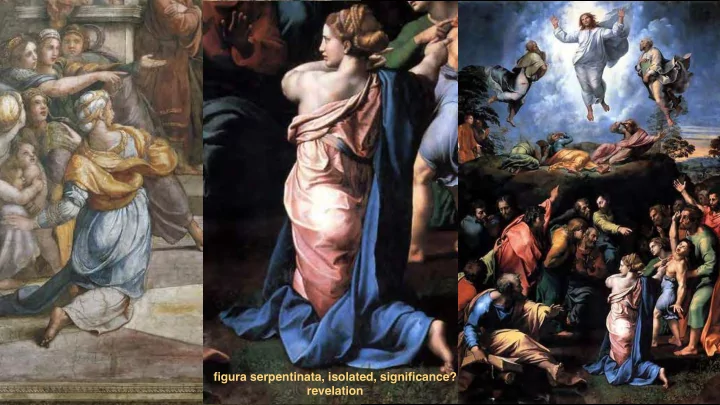
figura serpentinata, isolated, significance? revelation
SLIDE 2
Michelangelo, Doni Tondo
SLIDE 3
Cardinal Giulio de Medici inspired the competition in order to get the best work
SLIDE 4
Raphael, St Michael, 1518 also gift for Francis I Raphael (and assts), Holy Family, 1518, commissioned by Leo X as gift to Claude, wife of Francis I Sebastiano letter to Michelangelo art as diplomacy courtly artifice dramatic light
SLIDE 5
Sebastiano, Visitation, 1518-19 gift from Republic of Venice to Claude, wife of Francis I exhibited outside the Roman house of Cardinal Cornaro, 1519 perhaps commissioned by Cornaro as birth present Luke 1:36-56 “My soul magnifies the Lord, and my spirit rejoices in God my Savior” Titian (or Giorgione), Portrait of a Man, c. 1510
SLIDE 6
Michelangelo, Taddei Tondo, c. 1504-05 Sebastiano del Piombo, Virgin and Child with St Joseph, John the Baptist and a Donor, 1517, NGA
SLIDE 7
On Good Friday, April 6, 1520 Raffaello Sanzio died, age 37 buried in Pantheon Groom of the Papal Chamber Knight of the Papal Order of the Golden Spur inscription composed by Pietro Bembo “Ille hic ese Raffael, timuit quo sospite vinci, rerum magna parens et morente mori.” “Here lies that famous Raphael by whom Nature feared to be conquered while he lived, and when he was dying, feared herself to die.” grand funeral - 4 cardinals carried his body Leo X kissed his hand
SLIDE 8
Quid miriam, si qua Christus tu luce peristi? Naturae ille deus, tu deus artis eras. (No wonder you died on the day Christ died: He was the God of nature, you were god of art.) Tebaldeo To the memory of Raphael son of Giovanni Santi of Urbino, the most eminent painter and rival of the ancients. Behold his almost breathing images and you will easily see the alliance of nature and art. With his works of painting and architecture he swelled the glory of Popes Julius II and Leo X. He lived virtuously 37 virtuous years and died on the day of his birth, April 6, 1520 This is Raphael. In his life great Mother Nature feared defeat and in his death She herself feared to die. Pietro Bembo
SLIDE 9
Lorenzetto, Madonna del Sasso, c. 1520
Antiquarianism and Diversity Raphael was keeper of antiquities for the papacy
Minerva and infant Dionysus
SLIDE 10
loggetta and stufetta of Cardinal Bibbiena - resided in the Vatican powerful prelate, tied to the Medici family close friend of Raphael wanted Raphael to marry his niece, Maria Bibbiena Raphael’s heritage - ANTIQUARIANISM and WORKSHOP antiquarian to Leo X Raphael, Portrait of Cardinal Bernardo Dovizi, c. 1516 known as Bibbiena - died in 1520 papal secretary apartment above Leo - with connecting staircase letter addressed to the pope
SLIDE 11
“At this very moment, as I was writing, Raphael entered, guessing, I suppose, that I was writing about him, and he asked me to add these few words, namely, asking you to send him more stories to paint in your stufetta, that is to say, the text of the stories; because the painting of those you have sent him will be finished this week.” April 19, 1516 Pietro Bembo letter to Cardinal Bibbiena first spaces to be entirely decorated in classical style grotteschi
SLIDE 12 mythological scenes alluding to the power of love Omnia vincit Amor inspired by Virgil and Servius …My bathroom may be used and praised by you on my behalf, now and then, but that does not mean you can touch the closet, nor the linens, without permission of the owner, unless the canon needs a better shirt to go over his undergarment. Recommend me to all those who would willingly hear my
- recommendations. And you stay well in your sweet little rooms.
June 4, 1517 letter from Cardinal Bibbiena to Giulio Sadoleto
SLIDE 13
Raphael designs - Giulio Romano + Giovanni da Udine imitation of ancient calidarium entirely in antique style > not fresco but encaustic vault - inspired by Volta Dorata of Nero’s Golden House lunettes > grotesques also from Nero’s palace river gods - reference to bathing lion > Leo? rediscovered in 19th century > now in the apartment/offices of cardinal secretary of state
SLIDE 14
Giovanni da Udine > stucco guided Raphael in Nero’s palace left his signature Trajan filled Nero’s palace with rubble and built his baths on top a gift to Roman people
SLIDE 15
Loggetta heavily influenced by Domus Aurea Cryptoporticus Nero’s Palace
SLIDE 16
Loggetta heavily influenced by Domus Aurea scenes of Apollo and Marsyas puns innovative - not mere copies Giovanni da Udine worked directly on the wall studied under Giorgione Cryptoporticus Nero’s Palace
SLIDE 17
loggia of Cardinal Bibbiena filled with exotic animals Leo’s courtly menagerie Domus Aurea Domus Aurea
SLIDE 18
Giovanni da Udine imitated loose brush strokes of antiquity celebration of artist’s free invention no unified iconography
SLIDE 19
Raphael, Miraculous Draught of Fishes, cartoon for Sistine Tapestry, 1515 Pliny > cranes = vigilant 16c = emblem of papal authority pope watches over congregation like crane over flock ravens - swans contemporary proverb about converting sinners “one may as well try to make ravens white or swans black” Giovanni da Udine
SLIDE 20
Giovanni da Udine (after design by Giulio Romano) Stufetta of Clement VII 1527-30 Castel Sant’Angelo
SLIDE 21
Raphael’s Loggia (also called Raphael’s Bible), 1518-20 13 bays (12 OT scenes, 1 NT scene) Genesis-Adam and Eve - Noah - Abraham and Loth - Isaac Jacob - Joseph - Moses - Joshua - David - Solomon - Christ each vault has 4 narrative scenes begun by Raphael, finished by his workshop widely varying styles Giovanni da Udine Giulio Romano Giovanni Francesco Penni Perino del Vaga Polidoro da Caravaggio Raffaellino del Colle Tommaso Vincidor Pelligrino da Modena Vincenzo Tamagni Guillaume de Marcillat Pedro Machuca
JMW Turner, Rome seen from the Vatican
SLIDE 22
Raphael’s Loggia (also called Raphael’s Bible), 1518-20 “The glory of classical antiquity and the glory of nature, all sanctified by Christian revelation.”
history of the world ante legem: Creation and Original Sin sub lege: Exodus through time of the kings sub gratia: redemption by Christ of the people of Israel and all humanity pattern of 4 scenes = clear narrative slow at start, crescendo in central 2 scenes, happy and solemn ending cycle begins by the interior wall and proceeds counterclockwise as viewer processes > sees dramatic scenes when looks back - happy endings all violent or licentious elements - banished positive outlook God intervenes to help not punish He saves Noah, preserves Lot, ensures descendants for Abraham and Isaac, protects Jacob and then Joseph emphasis on God’s support and promise of salvation propaganda - reinforcement
SLIDE 23
pilaster stucco and frescoes > Giovanni da Udine plants, flowers, fruits, mythological figures and fabulous creatures reminiscent of manuscript margins and ancient Roman wall decoration incredible variety artistic autonomy > unique nature of R’s workshop
SLIDE 24 not all of the stucco decoration is based on antique models borrowings from Michelangelo and Raphael incredible sense of abundance and celebration
- riginally adorned with antiquities in collection of Leo X
no iconographic program fertility of imagination and antique sources homages to Leo X and his good governance new vision > modern > fusion of antique, mythological and Christian hunting = Leo’s favorite pastime menagerie in the Cortile del Belvedere animals kept in cages all along the Passetto > bear from Hungary, lion and lioness with cubs rediscovery of Roman wall painting is complemented by stucco Giovanni da Udine rediscovered the Roman formula inspired by friezes on the Coliseum
SLIDE 25