
SLIDE 1
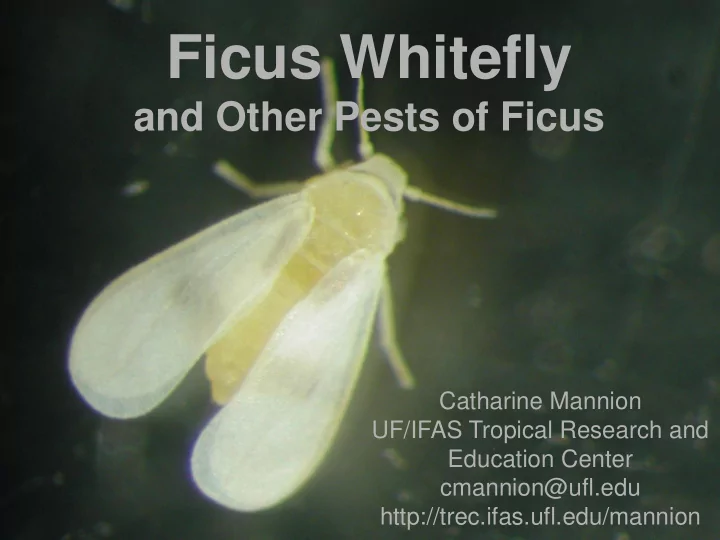
Ficus Whitefly
and Other Pests of Ficus
Catharine Mannion UF/IFAS Tropical Research and Education Center cmannion@ufl.edu http://trec.ifas.ufl.edu/mannion
Ficus Whitefly and Other Pests of Ficus Catharine Mannion UF/IFAS - - PowerPoint PPT Presentation
Ficus Whitefly and Other Pests of Ficus Catharine Mannion UF/IFAS Tropical Research and Education Center cmannion@ufl.edu http://trec.ifas.ufl.edu/mannion Whiteflies Approximately 75 species of whiteflies in Florida.
Catharine Mannion UF/IFAS Tropical Research and Education Center cmannion@ufl.edu http://trec.ifas.ufl.edu/mannion
wings.
Photos: H. Glenn, UF/IFAS
Photos: H. Glenn, UF/IFAS
Singhiella simplex (Hemiptera: Aleyrodidae)
Photo: A. Roda, USDA APHIS Photo: H. Glenn, UF/IFAS
Singhiella simplex (Hemiptera: Aleyrodidae)
Photo: H. Glenn, UF/IFAS
Photo: H. Glenn, UF/IFAS
– F. benjamina (weeping fig) – F. altissima – F. bengalensis (“banyan tree”) – F. aurea (strangler fig) – F. microcarpa (Cuban laurel) – F. maclellandii (banana- leaf fig) – Leaf yellowing – Rapid leaf drop
Photo: H. Glenn, and C. Mannion, UF/IFAS
Photos: H. Glenn, UF/IFAS
Chilocorus nigritis Curinus coeruleus Exochomus childreni Harmonia axyridis Olla v-nigrum
Encarsia protransvena
Photos: H. Glenn, UF/IFAS
Amitus bennetti
Photo: H. Glenn, UF/IFAS
– Allow leaves to dry before removing
– Subject to change as more information is gathered – Apply a systemic insecticide to the soil – Limited foliar recommendations
Professional Use (Landscape and Nursery)
– Soil Application (Systemic insecticides)
Allectus*)
– The goal is to get the insecticide to the roots around the base of the tree – Use as much water as possible (0.5 to 2.5 gallons of water per tree) – Apply at the base of the tree; splashing on to the trunk is okay – Prior to drench; remove mulch or leaf litter to increase uptake – Apply as best you can around the trunk, however, with hedges with trunks less than 3 feet apart, you can apply a band along the tree row.
Professional Use (Landscape and Nursery)
Abamectin (Avid) Acetamiprid (TriStar) Azadirachtin (Azatin XL) Bifenthrin (Talstar) Buprofezin, (Talus) Clothianidin (Arena) Endosulfan (Endosulfan; Thiodan) Flonicamid (Aria) Horticultural oil Imidacloprid (Merit, Marathon, Discus, Allectus) Pymentrozine (Endeavor) Pyriproxyfen (Distance) Spiromesifen (Judo)
Professional Use (Landscape and Nursery)
plant starts to put on new leaves
soluble neonicotinoids for faster control depending on size of the tree
products
1. Determine the number of trees within the hedge
hedge and divide by the space between the trees.
The space between trunks is approximately 3 feet. 150 divided by 3 is 50. There are approximately 50 trees in this hedge.
2. Determine total shrub height by multiplying the number of trees by the approximate height of the hedge.
hedge is approximately 6 feet, you have 300 feet of shrub height.
Program developed by Dr. Lance Osborne and others for management of whiteflies with emphasis on insecticide resistance – based on growth stage Propagation Mist - on Mist - off Cuttings – not anchored Cuttings – anchored in the soil Roots well established Roots not well developed Plants actively growing Plants showing color or nearing flowering stage
(http://mrec.ifas.ufl.edu/lso/IAWG/FIG/default.asp)
Suggested Products
IRAC Class Notes
Neonicotinoid Soil Drench: Celero (clothianadin) Flagship (thiamethoxam) Marathon (imidacloprid) Safari (dinotefuran) 4
After drenching, apply foliar sprays as needed if whiteflies are present. Avoid repeated application with a single mode of action (products with the same number in the attached chart). If plants have received a neonicotinoid drench, DO NOT spray with a neonicotinoid during this phase, if at all possible. If absolutely necessary, make only a single spray prior to shipping. Tank mixes of pyrethroids with abamectin, azadiractin, or acephate may provide a suitable way to manage whiteflies when other pests need to be managed at the same time.
* IRAC Class 9B exhibits cross
resistance with IRAC Class 4 Foliar Applications: Aria (flonicamid) 9C Avid (abamectin) 6 Azadirachtin 18 Beauveria bassiana n/a Celero (clothianadin) 4 Distance (pyriproxyfen) 7C Endeavor (pymetrozine) 9B * Endosulfan 2 Enstar II (kinoprene) 7A Flagship (thiamethoxam) 4
Suggested Products
IRAC Class Notes
Horticultural Oil n/a Insecticidal Soap n/a Judo (spiromesifen) 23 Marathon (imidacloprid) 4 MilStop (potassium bicarbonate) n/a Safari (dinotefuran) 4 Sanmite (pyridaben) 21 Talus (buprofezin) 16 TriStar (acetamiprid) 4 Foggers and other products whose use is not restricted by the label Many
Photo: H. Glenn, UF/IFAS
Photo: H. Glenn, UF/IFAS
– Horticultural oil or insecticidal soap
– Insecticides recommended for scale control – Large trees may require a soil application
systemic properties and long term control
– Reported in 2007 in Naples
Photos: D. Caldwell, UF/IFAS
http://www.doacs.state.fl.us/pi/enpp/ento/fig_horidiplosis.html
Photos: UF/IFAS MREC
damage on Ficus benjamina in south Florida
spots on leaves. Leaves tend to curl and fold inward.
folded leaves
a predatory bug helps control this pest
acephate (Orthene), acetamiprid (TriStar), azadirachtin (Azatin), cyfluthrin (Decathlon), dinotefuran (Safari) imidacloprid (Merit), novaluron (Pedestal), and spinosad (Conserve).
Predatory bug feeding
Adults and nymphs
Damage
Photo: H. Glenn, UF/IFAS
– University of Florida (http://extlab7.entnem.ufl.edu/pestalert/) – DOACS (http://doacs.state.fl.us/~pi/enpp/pi- pest-alert.html)
UF/IFAS
University of Florida, IFAS Tropical Research and Education Center 18905 SW 280th Street Homestead, FL 33031 305-246-7000 cmannion@ifas.ufl.edu http://trec.ifas.ufl.edu/mannion