Fermilab Program and Plans Dmitri Denisov, Fermilab Instrumentation - - PowerPoint PPT Presentation

fermilab program and plans
SMART_READER_LITE
LIVE PREVIEW

Fermilab Program and Plans Dmitri Denisov, Fermilab Instrumentation - - PowerPoint PPT Presentation

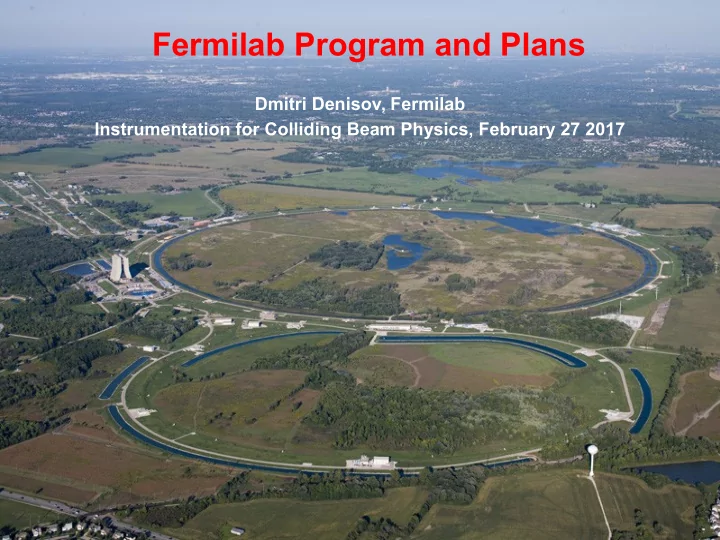
Fermilab Program and Plans Dmitri Denisov, Fermilab Instrumentation for Colliding Beam Physics, February 27 2017 U.S. Particle Physics Strategy In 2014 U.S. strategic planning panel provided recommendations covering all main topics of the

slide-1
SLIDE 1

Fermilab Program and Plans

Dmitri Denisov, Fermilab Instrumentation for Colliding Beam Physics, February 27 2017

slide-2
SLIDE 2

U.S. Particle Physics Strategy

  • In 2014 U.S. strategic planning panel

provided recommendations covering all main topics of the U.S. particle physics

  • They are grouped around “science

drivers”

  • Use the Higgs boson as a new tool for

discovery

  • Pursue the physics associated with

neutrino mass

  • Identify the new physics of dark matter
  • Understand cosmic acceleration: dark

energy and inflation

  • Explore the unknown: new particles,

interactions, and physical principles

  • Fermilab is leading and actively involved

in the experiments devoted to all “science drivers”

2 Denisov - INSTR 2017

slide-3
SLIDE 3

8 GeV Proton Booster 120 GeV Main Injector

SeaQuest Test beams Muon Campus: (g-2, Mu2e)

Long Baseline Neutrino: NOvA, MINERvA (DUNE)

Short Baseline Neutrino: MicroBooNE (ICARUS, SBND)

3 Denisov - INSTR 2017

slide-4
SLIDE 4

Long Term Beam Delivery Plans

  • The accelerator complex is focusing on delivering beams to
  • Neutrino, fixed target, high intensity muon beams and test beam experiments
  • Increased beam power from ~ 350 kW to ~700 kW (PIP project)

2012 Plot

4 Denisov - INSTR 2017

slide-5
SLIDE 5

Main Injector Beam Delivery in FY 2017

Providing ~5 . 1020 protons at 120 GeV to the neutrino program per year

5 Denisov - INSTR 2017

slide-6
SLIDE 6

Beam Power to Main Injector Neutrino Program

  • Upgraded booster and main injector over last three years
  • Doubled beam power to ~700 kW

6 Denisov - INSTR 2017

slide-7
SLIDE 7

Fermilab Muon Campus

  • Re-use of the antiproton production tunnels for muon production/cooling
  • First muon beam to g-2 experiment this year, to mu2e experiment in 2020

mu2e g-2

7 Denisov - INSTR 2017

slide-8
SLIDE 8

Muon Magnetic Moment g-2 experiment

  • Puzzle of ~3σ from BNL 2004 result
  • New physics?
  • Experimental effect?
  • Coil moved to Fermilab from BNL
  • Higher intensity beam
  • Better systematics
  • ~4 times better accuracy, x20 data by 2019
  • Start data collection in 2017

BNL 39 ppm RMS FNAL 10 ppm RMS

8 Denisov - INSTR 2017

slide-9
SLIDE 9

Lepton Flavor Violation: Mu2e

  • Constructing experiment mu2e
  • High intensity muon flux

stopped on a nuclear target

  • Monochromatic electron

emission from µ to e conversion

  • ~4 orders of magnitude

improvement vs today’s limits down to ~10-17 branching Mu2e Building

9 Denisov - INSTR 2017

slide-10
SLIDE 10

Short Baseline Neutrino (SBN) Program

The three detector SBN program can make a definitive statement on the LSND/miniBooNE anomaly with the potential for discoveries in neutrino physics and developments in LAr technology for DUNE

10 Denisov - INSTR 2017

slide-11
SLIDE 11

MiniBooNE Excess and ICARUS

  • Excess of low energy neutrino

events might be an indication of new physics

  • ICARUS detector is under

refurbishment at CERN and will arrive at Fermilab this year

  • Largest LAr TPC detector

ICARUS building construction at Fermilab ICARUS refurbishment at CERN

11 Denisov - INSTR 2017

slide-12
SLIDE 12

MicroBooNE Experiment Operational

  • MicroBooNE is the first LAr TPC

detector designed and built at Fermilab

  • 170 tons of ultra-pure argon
  • Collecting data since 2015
  • Expect first physics results this

year MicroBooNE Event Display

12 Denisov - INSTR 2017

slide-13
SLIDE 13

Long Baseline Neutrino Program

13 Denisov - INSTR 2017

slide-14
SLIDE 14

NOvA Experiment at Fermilab

  • “Off axis” neutrino experiment with 14 kton

far detector and 300 ton near detector

  • Expected 3σ mass hierarchy sensitivity
  • Summer 2016 result
  • 33 electron neutrino events at far

detector tends to favor Normal Mass Hierarchy

Collecting data since 2014 Liquid Scintillator Detector

14 Denisov - INSTR 2017

slide-15
SLIDE 15

Projects Overview: LBNF and DUNE

  • LBNF: DOE project with support from non-DOE partners. Provides facility

infrastructure at two locations to support the experiment

  • Near site: Fermilab – facilities to create neutrino beam
  • Far site: Sanford Underground Research Facility, South Dakota
  • DUNE: Deep Underground Neutrino Experiment – 40 kt of LAr at Stanford
  • Near and far site detectors: U.S. as partner in international project

15 Denisov - INSTR 2017

slide-16
SLIDE 16

DUNE Experiment Physics Program

Normal hierarchy Inverted hierarchy

  • Neutrino oscillation physics
  • Discover CP Violation in the leptonic sector
  • Determine Mass Hierarchy
  • Nucleon decay
  • Supernova burst physics and astrophysics

16 Denisov - INSTR 2017

slide-17
SLIDE 17

L B N F / D U N E

1 7 D e n i s

  • v
  • I

N S T R 2 1 7

slide-18
SLIDE 18

L B N F / D U N E

1 8 D e n i s

  • v
  • I

N S T R 2 1 7

slide-19
SLIDE 19

LAr-TPC Development Path

  • Fermilab and CERN neutrino platform provide a strong LArTPC

development and prototyping program

D U N E A l t e r n a t i v e D e s i g n WA 1 5

2 1 6 2 1 8

WA 1 5

D u a l

  • P

h a s e

I C A R U S M i c r

  • B
  • N

E D U N E R e f e r e n c e D e s i g n

2 1 5

P r

  • t
  • D

U N E a t C E R N

S i n g l e

  • P

h a s e 2 1 8

19 Denisov - INSTR 2017

slide-20
SLIDE 20

The DUNE Collaboration

As of today: 965 collaborators from 161 institutions in 30 nations

A r m e n i a , B r a z i l , B u l g a r i a , C a n a d a , C E R N , C h i l e , C h i n a , C

  • l
  • m

b i a , C z e c h R e p u b l i c , F i n l a n d , F r a n c e , G r e e c e , I n d i a , I r a n , I t a l y , J a p a n , M a d a g a s c a r , M e x i c

  • ,

N e t h e r l a n d s , P e r u , P

  • l

a n d , R

  • m

a n i a , R u s s i a , S

  • u

t h K

  • r

e a , S p a i n , S w e d e n , S w i t z e r l a n d , T u r k e y , UK, U k r a i n e , U S A

D U N E h a s b r

  • a

d i n t e r n a t i

  • n

a l s u p p

  • r

t a n d i s g r

  • w

i n g

6 0%n

  • n
  • U

S

20 Denisov - INSTR 2017

slide-21
SLIDE 21

CERN Neutrino Program

  • DUNE is the first large scale experiment CERN is participating “outside CERN”
  • Major infrastructure developments (protoDUNE) and hardware contributions
  • Critical for the success of the LBNF/DUNE participation

C E R N i n f r a s t r u c t u r e i n v e s t m e n t f

  • r

D U N E :

N e w b u i l d i n g : E H N 1 e x t e n s i

  • n

i n t h e N

  • r

t h a r e a

T w

  • t

e r t i a r y c h a r g e d

  • p

a r t i c l e b e a m l i n e s

T w

  • l

a r g e ( 8 x 8 x 8 m

3

) c r y

  • s

t a t s & c r y

  • g

e n i c s y s t e ms

P r

  • toD

UN E

  • D

P P r

  • toD

UN E

  • S

P B e ne ficia loccu p a ncy la te rth isye a r

21 Denisov - INSTR 2017

slide-22
SLIDE 22

LBNF/DUNE Timeline

2017: Far Site Construction Begins 2018: protoDUNEs at CERN

2021: Far Detector Installation Begins 2024: Physics Data Begins (20 kt) 2026: Neutrino Beam Available

22 Denisov - INSTR 2017

slide-23
SLIDE 23

Fermilab Test Beam Facility - FTBF

Test beams operate ~10 months per year, except July-August shutdown Test beam experiments from a few hours to a few months are welcome!

The Ferm ilab T est Beam Facility

  • S

i n c e 2 5 , F T B F h a s h

  • s

t e d m

  • r

e t h a n 1 u s e r s f r

  • m

1 7 7 i n s t i t u t i

  • n

s a n d 3 c

  • u

n t r i e s

– B r

  • a

d r a n g e

  • f

r e s e a r c h t

  • p

i c s , n

  • t

j u s t H E P

  • T

w

  • b

e a m l i n e s

– M T e s t : 1 2 G e V p r

  • t
  • n

s , 2

  • 8

G e V m i x – M C e n t e r : 2 M e V t

  • 8

G e V m i x

Neutrino Collider Muon Gen R&D Outreach

23 Denisov - INSTR 2017

slide-24
SLIDE 24

Fermilab Accelerators Long Range Plan

24 Denisov - INSTR 2017

slide-25
SLIDE 25

Generic Detectors R&D

  • Fermilab is actively engaged in generic detectors R&D program
  • Efforts are concentrated along long term plans of the experiments at Fermilab
  • We

e n c

  • u

r a g e a h i g h d e g r e e

  • f

c

  • l

l a b

  • r

a t i

  • n

w i t h t h e u n i v e r s i t y c

  • m

m u n i t y a n d

  • t

h e r n a t i

  • n

a l l a b s .

  • P

r e s e n c e

  • f

r e s e a r c h f a c i l i t i e s s u c h a s :

  • T

e s t b e a m f a c i l i t y

  • S

i l i c

  • n

D e t e c t

  • r

f a c i l i t y

  • P

r e c i s i

  • n

M e t r

  • l
  • g

y f a c i l i t y

  • R

a p i d p r

  • t
  • t

y p i n g a n d S p e c i a l M a t e r i a l s

  • S

c i n t i l l a t

  • r

D e t e c t

  • r

D e v e l

  • p

m e n t

  • T

h i n

  • F

i l m F a c i l i t y

  • L

i q u i d A r g

  • n

D e t e c t

  • r

D e v e l

  • p

m e n t

  • A

S I C D e v e l

  • p

m e n t F a c i l i t y

  • E

x p e r i e n c e d , w e l l e s t a b l i s h e d e n g i n e e r i n g g r

  • u

p s , s u c h a s

  • A

S I C d e v e l

  • p

m e n t

  • C

r y

  • g

e n i c s

  • D

a t a A c q u i s i t i

  • n
  • M

e c h a n i c a l & E l e c t r

  • n

i c s E n g i n e e r i n g C l e a n r

  • m

s a n d m e t r

  • l
  • g

y a t S i D e t C A L I C E a t t h e t e s t b e a m S c i n t i l l a t

  • r

e x t r u s i

  • n

a t L a b 5

25 Denisov - INSTR 2017

slide-26
SLIDE 26

Fermilab Coordinates US-CMS Program

  • CMS is steady progressing with FNAL making critical contributions
  • ~50 Fermilab’s scientists involved
  • Phase 1 upgrades are on track
  • HL-LHC upgrades are under development
  • Major project with over $200 million U.S. contribution
  • LHC Accelerator Research Program (LARP) is developing interaction

region quadroupoles for the high luminosity LHC Pixel Detector Reintegration at CERN

Fermilab Test Beam

Prototype Sensor + PCB Module

26 Denisov - INSTR 2017

slide-27
SLIDE 27

Dark Energy Survey - DES

  • DES goal is creating scans of night sky using 4 meters telescope and 570

megapixels camera (camera built at Fermilab) located in Chile

  • Started data collection in September of 2013
  • 40+ papers already published or in review
  • Major scientific areas: studies of dark matter, dark energy, supernova, solar

system survey, spectroscopically-confirmed quasars and many other topics

Left: cutout of DES image Right: the stars from one of the dwarf galaxies

27 Denisov - INSTR 2017

slide-28
SLIDE 28

Dark Matter Direct Detection

  • Many models expect dark matter to consist
  • f heavy WIMP particles
  • Multiple methods used to detect elastic

scattering of WIMPs

  • Ionization, scintillation, phonons
  • Fermilab is actively involved in CDMS

experiment in Soudan mine (and others)

  • 9kg SuperCDMS is currently
  • perating at Sudan
  • Observed best low mass

WIMP limit

28 Denisov - INSTR 2017

slide-29
SLIDE 29

Planned Accelerator Upgrade – PIP II

  • Proton linear accelerator

with flexible beam structure based on SCRF technology

  • Increase of beam power

to ~1 MW

  • Large scale partnership

with India

  • Platform for future neutrino

and muon facilities

29 Denisov - INSTR 2017

slide-30
SLIDE 30

SCRF Developments at Fermilab

  • Superconducting RF is the key technology for the ILC where U.S. is

interested to contribute

  • Coherence with production of cryo-modules by Fermilab for LCLS-II light

source at SLAC and PIP-II upgrade at Fermilab

30 Denisov - INSTR 2017

slide-31
SLIDE 31

High Field Magnets Developments

  • Area of Fermilab’s experitse since design and construction of the first

superconducting accelerator – the Tevatron

  • Breakthroughs in materials, systems, engineering are needed for higher

fields

  • F

e r mi l a b f

  • c

u s e s

  • n

N b

3

S n ( c

  • n

d u c t

  • r

a n d ma g n e t e n g i n e e r i n g )

  • M

e d i u m t e r m g

  • a

l i s t

  • b

u i l d 1 5

  • 1

6 T ma g n e t s u i t a b l e f

  • r

F C C a t C E R N 1 meter long Nb3Sn magnet successfully tested at Fermilab to 11.6T

31 Denisov - INSTR 2017

slide-32
SLIDE 32

Future Energy Frontier Colliders

  • Fermilab is participating in future colliders developments, including ILC and

FCC

  • Based on Fermilab’s experience in accelerator and detector technologies

ILC - Japan CepC - China

32 Denisov - INSTR 2017

slide-33
SLIDE 33

2 1 7

  • 5

y e a r s

  • f

F e r mi l a b

3 3 D e n i s

  • v
  • I

N S T R 2 1 7

slide-34
SLIDE 34

Fermilab Program Overview

  • Accelerator complex is running providing powerful beams
  • LHC Run 2 is progressing, CMS detector is running well
  • LBNF/DUNE program is actively progressing
  • NOvA and MicroBooNE neutrino experiments all running well
  • g-2 experiment will be ready for beam this year
  • Mu2e experiment construction actively progressing
  • Experiments on direct dark matter search progressing
  • The Dark Energy Survey produces excellent results
  • Developing future accelerator/detector technologies
  • Theory group supporting LHC, neutrinos, lattice
  • Several Tevatron analyses are concluding
  • Modest involvement in future colliders activities, including ILC

34 Denisov - INSTR 2017

slide-35
SLIDE 35

Backup Slides

Denisov - INSTR 2017 35

slide-36
SLIDE 36

Long Baseline Neutrino Experiment

  • Superior option to resolve mass hierarchy
  • Find proton decay up to lifetime of 1035 years
  • Detect supernova neutrinos

Normal Inverted

36 Denisov - INSTR 2017

slide-37
SLIDE 37

MINERvA Experiment

  • MINERvA (just in front of MINOS) is studying neutrino interactions in

unprecedented detail on a variety of different nuclei – He,C,CH2,H2O,Fe,Pb

  • Important information for all neutrino based experiments

37 Denisov - INSTR 2017

slide-38
SLIDE 38
  • Primary proton beam at 60-120 GeV extracted from the Main Injector
  • Initial 1.2 MW beam power, upgradable to 2.4 MW
  • Embankment allows target complex to be at grade and

neutrino beam to be aimed to South Dakota mine

  • Decay region followed by the absorber
  • Four surface support buildings
  • DUNE Near Detector

Overview - Near Site – LBNF/DUNE at Fermilab

Beamline design based on Fermilab’s NOvA beam, currently the most powerful neutrino beam in the world

38 Denisov - INSTR 2017

slide-39
SLIDE 39

Overview – Far Site – LBNF/DUNE at South Dakota

  • Conventional Facilities:
  • Two caverns for detectors and

connection tunnels

  • Central utility cavern for conventional

and cryogenic equipment

  • Surface and shaft Infrastructure

including utilities

  • Cryostats:
  • Four membrane cryostats supported

by external steel frames

  • Cryogenic Systems:
  • LN2 refrigeration system for cooling

and re-condensing gaseous Argon

  • Systems for purification and

recirculation of LAr

  • Argon: 70kt LAr (~40kt fiducial mass)
  • DUNE LAr-TPC Detectors

D U N E c a v e r n s a n d t u n n e l s l a y

  • u

t S i n g l e c r y

  • s

t a t

Extensive prototyping program in progress to scale LAr TPC detector technology to 10kt fiducial volume

39 Denisov - INSTR 2017

slide-40
SLIDE 40

Tevatron Program Analysis

  • From the top quark discovery to the Higgs

boson evidence – 25 years program

  • Over 1200 papers cementing Standard Model

Most accurate measurement of W boson mass

40 Denisov - INSTR 2017