SLIDE 1 Feb 16, 2012
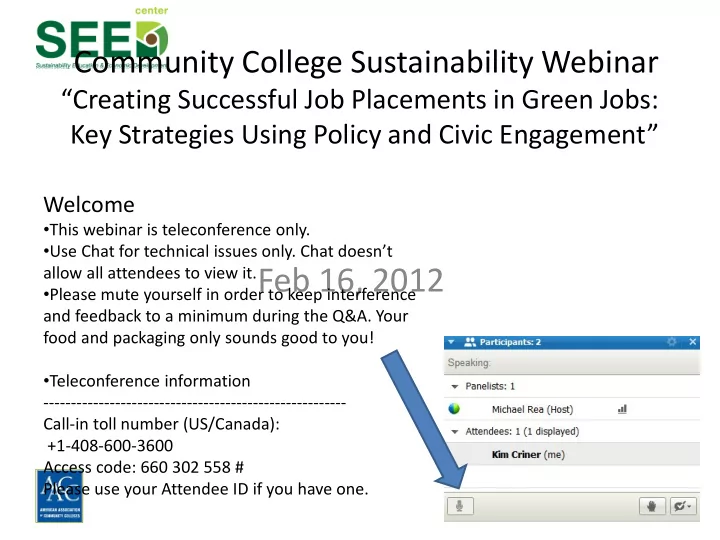
Community College Sustainability Webinar
“Creating Successful Job Placements in Green Jobs: Key Strategies Using Policy and Civic Engagement”
Welcome
- This webinar is teleconference only.
- Use Chat for technical issues only. Chat doesn’t
allow all attendees to view it.
- Please mute yourself in order to keep interference
and feedback to a minimum during the Q&A. Your food and packaging only sounds good to you!
- Teleconference information
- Call-in toll number (US/Canada):
+1-408-600-3600 Access code: 660 302 558 # Please use your Attendee ID if you have one.
SLIDE 2 Next Webinar will be Wednesday March 21 12-1:00pm
http://blogs.jccc.edu/sustainability/events/webinars/
SLIDE 3 CC v 2.0
Putting Sustainability to Work at the Community College
March 11-13, 2012 Register soon at: http://blogs.jccc.edu/sustainability/events/cc-v2/
SLIDE 4
Community Colleges Supporting Green Jobs Through Public Policy and Civic Engagement
Webinar: 2/16/12
SLIDE 5 Policy-The Quickest Way to Sustainable Green Jobs
- Policy and regulatory changes at state/local levels:
the strongest determinants of where green jobs will flourish
- Right now, hundreds of cities and states are
considering new renewable standards, building code changes, tax credits….that will drive demand
- Community colleges can be a critical voice
5
SLIDE 6 Green Policy Action Group
Description: An organized cohort of community colleges interested in energy and related green regulations and public policies that: 1) lead directly to institutions becoming more energy efficient and green; and 2) promote a stronger green industry with job creation potential. Outcomes:
- More colleges aware of regulations and policies that impact their institutions
and their institutions’ education and training opportunities
- Organized group prepared to influence regional and national energy /green-
related policy Activities:
- Webinars and phone conferences
- Conferences and meetings held as part of these conferences
- Ongoing policy alerts
- Local pilot projects
6
SLIDE 7 Speakers
- Jay Murdoch, CEO, Efficiency First
- Debra Rowe, Oakland Community College
- Amanda Evans, Program Manager, Energy $mart
Academy, Santa Fe Community College
7
SLIDE 8
SLIDE 9
Efficiency First - What we Do:
Helping member companies accomplish their mission – To retrofit America’s homes
SLIDE 10
Challenges for Home Performance Companies
Lack of market awareness High regulatory barriers and program participation costs Young industry where many companies are just starting to get on their feet / transition into the space
SLIDE 11
Efficiency First - What we Do:
Uniting home performance companies, building product manufacturers and related businesses and organizations Represent our members in public policy and regulatory discussions Promote the benefits of energy efficiency retrofitting Create demand for member products and services Provide tools for companies to member succeed
SLIDE 12
Making Progress
Incentives, financing options to encourage retrofit demand: REEP, Home Star, 25E PACE, SAVE Act, others Model for state/utility retrofit programs
National Legislation:
SLIDE 13
Making Progress :
National Reach 632 Member companies in 50 states to support a united national industry
SLIDE 14 Making Progress Chapter Network
Launched 19 state and local chapters and growing
Denver North Bay San Francisco Los Angeles
San Diego Long Island Fairfax, VA
Richmond, VT Portland Hartford Lansing, MI Kansas City Chicag
Portland Sacrament
Albany
Maryland
SLIDE 15 State and Local Advocacy
State and Local Advocacy
- Policy solutions to scale demand in
states
- Identify solutions and best
practices to export elsewhere.
Efficiency First NY Chapter Members advocating for On-Bill Financing legislation
SLIDE 16 State and Local Advocacy
Example: New York State
- On Bill Financing:
- Finance EE upgrades on utility bills.
- Bill passage due directly to member advocacy
- Total Resource Cost Test:
- Cost effectiveness test that can severely impact
the kinds of HP upgrades.
SLIDE 17 Industry Growth in 2012
Helping Companies Grow
- Succeeding in a post-ARRA world
- Running an effective home performance
business
- Our philosophy: Successful home
performance companies = thriving industry.
SLIDE 18 Policy Agenda in 2012
- Suite of EE tax credits:
- 25E tax credit –performance-based
- 25C reinstatement/expansion
- Develop models for state legislation
- Re-instate PACE financing
- Improve access to utility data: E-KNOW
- Ensure smooth transition of Energy Star
from EPA to DOE
Washington, DC
SLIDE 19 Developing Partnerships
- Educating the industry on running a
successful HP business
- Feedback from local industry on courses
and curriculum-
- Educating/advocating policymakers to
get it right. Potential Opportunities for Collaboration
SLIDE 20 Efficiency First Membership
- Support the growth of the local and national industry
- Member benefits – discounts on conferences, etc
- Educating policymakers to get it right.
Efficiency First Membership for Non-profits and Local Govt
SLIDE 21 Connecting with Efficiency First Companies
www.efficiencyfirst.org
Join Efficiency First Contact local Efficiency First Chapter www.efficiencyfirst.org/chapters Host chapter meetings? Learn about local issues
SLIDE 22 Every One of These Policies has Implications for Colleges
22
SLIDE 23 AACC’s SEED Policy Action Plan Toolkit written for you! http://www.theseedcenter.org/R esources/SEED-Resources/SEED- Toolkits/AACC-s-SEED-Green- Action-Plan-Series
23
SLIDE 24 Energy Policy Advocacy: Not Just for Government Relations Staff
Who should be involved in policy engagement:
- President/Governmental Relations
- Workforce administrators
- Sustainability officers
- Faculty for themselves and their classrooms
- Students
24
SLIDE 25 Core Steps
25
- 1. Identify a campus lead and
include policy on the college’s ongoing sustainability agenda. Make it someone’s job to track green economy-related regional, state and federal policy, regulatory and program initiatives
Bergen Community College (NJ), Finger Lakes Community College (NY), Howard Community College (MD), Mesa Community College (AZ), and Rockingham Community College (NC) are just a few colleges that have a designated climate commitment policy liaison dedicated to this function
SLIDE 26
- 2. Get informed of local and state
policy landscape
Colleges should tap the most up-to-date related legislative/policy issues. These should become part of existing college research and communication strategies.
26
- Building Codes Assistance Project
- Efficiency First
- American Council for an Energy
Efficient Economy
- Solar Energy Industries Association
- American Council On Renewable
Energy
- Database for State Incentives for
Renewables and Efficiency.
SLIDE 27 Some of these orgs will support colleges in taking state action
At no expense, the American Wind Energy Association (www.awea.org) will supply issue briefs, legislative talking points, and help colleges set up meetings at congressional representatives’ offices. (For more information, email grassroots@awea.org.)
27
SLIDE 28
- 3. Join Forces With Local Unusual
Suspects
- State energy office
- Local Home Builders
- Utilities
- Environmental Defense Fund chapters
- U.S. Green Building Council chapters
- Energy Efficiency Alliances
- Economic development
Where appropriate, community colleges should be incorporated as board or advisory members, volunteers, etc…
28
SLIDE 29
- 4. Act as the regional energy
strategy convener
Northern Maine Community College as the key convener in a multi-stakeholder collaborative to create a sustainable region & an alternative energy industry sector
29
Mobilize Northern Maine’s comprehensive planning process includes reps from the regional development commission, the business community, nonprofits, government, and higher
- education. NMCC hosts the meetings and the partnership is
now moving aggressively on several fronts including expanding biomass conversion and designing financing structures to support regional energy efficient modifications
SLIDE 30
- 5. Civic Engagement for Students
Look here to integrate civic engagement into curricular and co-curricular activities:
- www.350.org
- Energy Action Coalition http://energyactioncoalition.org
- Students at many colleges have written letters, made
phone calls and testified too. ICARE in the student union too (I Care About Renewable Energies phone calls to elected representatives.)
30
SLIDE 31
- 6. Engage the Public
- Sustainability conferences,
- Green speaker series
- Sustainable products fairs
- Specialized workshops to
help the public, business
become more effectively engaged in advocating for smarter energy policies
31
Chandler-Gilbert Community College has a standing civic engagement committee that hosts an annual public forum
SLIDE 32 Next Steps: Join
- 1. Join AACC’s Policy Community of Action to get your
questions answered and have a support community to make your actions more effective! Email us at sustainability@aacc.nche.edu to join and then tell us what you need.
Bimonthly calls Shared promising practices Policy briefings and action opportunities Additional webinars
32
SLIDE 33 Alert you can act upon now
Wind Energy – www.awea.org Wind power advocates are hoping that an extension of the renewable-energy Production Tax Credit will be taken up as part of a payroll tax-cut package this month rather than during the lame duck session after the November
- election. The PTC extension "needs to happen in the
payroll tax extension" because many projects will shut down and many jobs will be lost if Congress waits until the end of the year, said Peter Kelley, vice president of public affairs at the American Wind Energy Association. http://act.awea.org/p/dia/action3/common/public/?action _KEY=10
33
SLIDE 34
SLIDE 35
Why Collaborate and Advocate?
Know your community Respond to training needs rapidly Help shape policy and codes that create needs for training and provide jobs for students
SLIDE 36 Our Recent Partners
NM State Department of Energy City of Santa Fe County of Santa Fe Santa Fe Area Homebuilders Association Santa Fe Area Realtors Association Mortgage Finance Authority USGBC NM New Mexico CID – Regulation and Licensing Habitat for Humanity Build Green New Mexico NM Energy Retrofit Working Group Santa Fe New Mexican
SLIDE 37 Our Educational Partners
Central New Mexico Community College Dona Ana Community College Luna Community College
SLIDE 38
Case Study 1: City of Santa Fe Residential Green Code Involved with code writing Advocacy at Council Meetings for code adoption Curricula with SFAHBA to support code Trainings for area homebuilders Points toward the code for trainings
SLIDE 39
Case Study 2: City and County HERS Rater concerns Meetings with city and county officials and local HERS raters Certification Developed Training to support certification
SLIDE 40
Case Study 3: Energy Efficiency Tax Credit Bill in the House Bill introduced in House with limitations SFCC staff propose last minute amendment Speak at Tax and Rev committee meetings Amendment unanimously accepted Currently in the Senate Tax and Finance committee.
SLIDE 41
Contact Info: Amanda Evans Director, Center of Excellence for Green Building and Energy Efficiency Santa Fe Community College Amanda.evans@sfcc.edu 505-428-1805
SLIDE 42 More Information
Todd Cohen AACC/SEED sustainability@aacc.nche.edu
42