FDA Regulation brand and sub-brand. At the request of the - - PDF document

fda regulation
SMART_READER_LITE
LIVE PREVIEW

FDA Regulation brand and sub-brand. At the request of the - - PDF document

> LEGISLATIVE FOCUS The Act also imposes substantial in- gredient reporting requirements and would require that within six months after the passage of the act, each tobacco product manufacturer or importer must submit the following to the


slide-1
SLIDE 1

T

he newest attempt by Congress to empower the Food and Drug Administration with the authori- ty to regulate tobacco products has been given the seemingly innocuous title of the “Family Smoking Prevention and To- bacco Control Act.” It has garnered pow- erful support — and equally powerful

  • pposition. If passed in its current form,

the legislation, introduced concurrently in both the Senate and House of Repre- sentatives on February 15, 2007, would grant the FDA wide-reaching authority to regulate current and new tobacco products and would place tight restric- tions on tobacco marketing. But what ex- actly would this new legislation require? NEW REGISTRATION AND RECORD-KEEPING REQUIREMENTS In addition to the state-level certification requirements that tobacco product manu- facturers must currently fulfill, this legis- lation imposes a completely new federal registration requirement upon manufac-

  • turers. Specifically, the legislation requires

that on or before December 31 of each year, every person who owns or operates any business that is “engaged in the man- ufacture, preparation, compounding, or processing of a tobacco product or tobac- co products shall register with the Secre- tary of Health and Human Services.” Manufacturers must supply a prod- uct list of all tobacco products manufac- tured or processed, and the Secretary may require production of all advertise- ments for a particular tobacco product. In addition, every new manufacturer must immediately register with the Sec-

  • retary. The information submitted as

part of the registration process can be made publicly available. Further, every manufacturer will be inspected by the designated agents of the Secretary at least once every two years. The Act also imposes substantial in- gredient reporting requirements and would require that within six months after the passage of the act, each tobacco product manufacturer or importer must submit the following to the Secretary of Health and Human Resources: A listing of all ingredients, including tobacco, substances, compounds, and additives that are, as of the date of fil- ing, added by the manufacturer to the tobacco, paper, filter or other part of each tobacco product by brand and by quantity in each brand and sub-brand. DESCRIBING, IN DETAIL, EACH TOBACCO PRODUCT A listing of all constituents, including smoke constituents as applicable, identi- fied by the Secretary as being harmful

  • r potentially harmful to health in each

tobacco product, and as applicable in the smoke of each tobacco product, by brand and sub-brand. At the request of the Secretary, a to- bacco product manufacturer or importer must submit data related to research and research findings conducted, supported,

  • r possessed by the manufacturer relat-

ed to the health, toxicological, behav- ioral, or physiologic effects of tobacco products and their constituents, ingredi- ents, or additives. Also required is re- search related to marketing involving the use of tobacco products or marketing practices as well as the effectiveness of such marketing practices. This would re- quire disclosure of the underlying scien- tific and financial information related to the company’s marketing. After reviewing and compiling this data, the Secretary would publish a brand-specific list of harmful and poten- tially harmful constituents within 12 months of the enactment of the Act. Fi- nally, the Act requires manufacturers and importers to establish and maintain records to assure that their tobacco prod- ucts are not adulterated or misbranded and to “otherwise protect public health.” ADDITIONAL REGULATION OF ADVERTISING The Act authorizes additional regula- tion of tobacco product advertising if

94

SMOKESHOP April 2007

>

LEGISLATIVE FOCUS

Congress Again Considers

FDA Regulation

An inside look at the newest tobacco legislation being considered by

  • Congress. >BY BRYAN M. HAYNES AND PAIGE S. FITZGERALD
slide-2
SLIDE 2

the Secretary determines that “such regulation would be appropriate for the protection of public health.” This broad statement leaves many unan- swered questions for tobacco manufac- turers as to how far the FDA might go in this area. As a first step, however, in restricting advertising and marketing of tobacco product, the Act requires that the FDA’s 1996 Rule, which restricted tobacco mar- keting and sales to minors, be repub- lished within one month and take effect within one year of enactment of the Act. The major restrictions imposed would be:

  • Ban on all outdoor tobacco advertising

within a thousand feet of schools and playgrounds;

  • Ban on all remaining tobacco brand

sponsorships of sports and entertain- ment events;

  • Ban on giving away non-tobacco items

with the purchase of a tobacco product

  • r in exchange for coupons or proofs
  • f purchase;
  • Ban on free samples and the sale of

cigarettes in packages that contain fewer than twenty cigarettes;

  • Requirement that all outdoor and

point-of-sale advertising be in black- and-white text only;

  • A limitation on advertising in publica-

tions with significant teen readership to black-and-white text only;

  • A restriction on vending machines

and self-service displays to adult-only facilities;

  • A requirement that retailers verify the

age of those who purchase tobacco products

  • ver-the-counter

and additional provision for federal enforcement and penalties against retailers who sell to minors; The Act specifically establishes that its provisions won’t limit or diminish the authority of the Federal Trade Commis- sion to enforce its own laws regulating the advertising, sale, or distribution of to- bacco products. The Act would, howev- er, eliminate the current federal law that prohibits states from banning or restrict- ing the time, place or manner of cigarette advertising under the Federal Cigarette Labeling and Advertising Act. As such, states would be allowed to address the location, size, number, and placement of cigarette advertising resulting in an addi- tional layer of regulatory compliance. NEW LABELING REQUIREMENTS The legislation also provides the Secre- tary of Health and Human Services with the authority to require prior ap- proval of all statements contained on the labels of tobacco products. The Act would further require adoption of stronger, more specific health warnings which would cover the top 30% of the front and rear panels of the package and would bear the word “WARNING” in 17-point type. The FDA would be empowered to revise labeling require- ments, which could include restrictions

  • n text, format, size, and the use of

color graphics. These same warning la- bels would be required for advertising and must comprise at least 20% of the area of the advertisement. An area that has been the source of more recent controversy in the tobacco industry — flavored tobacco products — is also addressed by the Act. The leg- islation would prohibit cigarettes from

96

SMOKESHOP April 2007

LEGISLATIVE FOCUS

>

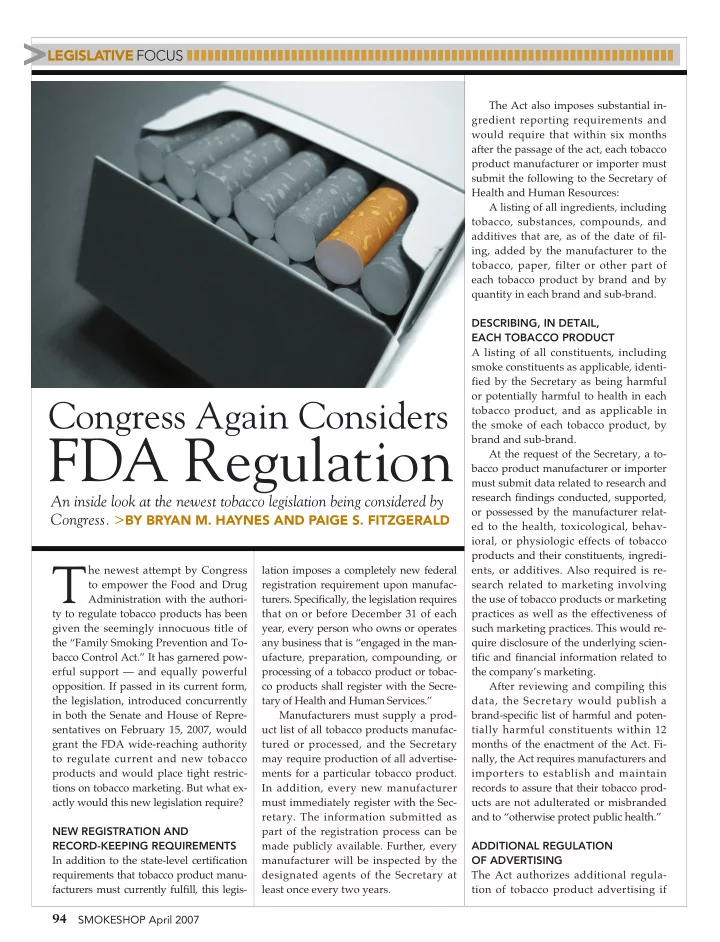
>The Act would require adoption of stronger,

more specific health warnings which would cover 30% of the front and rear panels of cigarette packages.

slide-3
SLIDE 3

containing any artificial or natural fla- vor (other than tobacco or menthol) or any herb or spice, including strawberry, grape, orange, vanilla, chocolate, cherry, cinnamon, or coffee. The Act would also ban the use on labels or advertising of terms such as “light,” “mild,” or “low.” NEW REGULATION OF TOBACCO PRODUCT “CONTENT STANDARDS” The Act further requires the FDA to establish tobacco product standards to protect the “public health,” such as the reduction or elimination of harmful in- gredients, additives, and constituents (including those in tobacco smoke). The FDA would also be given the ability to reduce nicotine yields to any level other than zero, as the Act specifically pro- vides that only Congress has the power to ban any tobacco product or reduce the allowable nicotine level to zero. Howev- er, the practical effect of the provision is that the FDA could require the reduction

  • f nicotine to very minimal levels with-
  • ut further Congressional intervention.

OTHER PROVISIONS The Act would establish an eleven- member “Tobacco Products Scientific Advisory Committee” to advise the FDA on nicotine and “other safety, de- pendence, or health issues.” The Com- mittee is required to include a represen- tative from the tobacco industry and as well as a representative of tobacco

  • growers. In addition, the bill includes

very specific standards that must be met prior to FDA approval and sale of cer- tain “reduced harm” tobacco products. CONCLUSION With all of these new layers of regula- tion, a question arises: who will bear the costs of this legislation if passed? The answer should be no surprise: the new FDA activity would be funded through a fee on tobacco product manufacturers allocated by market share. As this legis- lation works its way through Congress, it undoubtedly will be vigorously de- bated and if passed, the final version may be significantly different from the current bill. Thus, any participant in the tobacco industry would be well-advised to stay abreast of the developments in this important legislation. Bryan M. Haynes and Paige S. Fitzgerald are attorneys in the Richmond office of Troutman Sanders LLP. They are mem- bers of the firm’s tobacco team, which represents tobacco product manufactur- ers, importers, distributors and retailers.

>The FDA would also be given the ability

to reduce nicotine yields to very minimal levels without Congressional intervention.

98

SMOKESHOP April 2007

LEGISLATIVE FOCUS

>