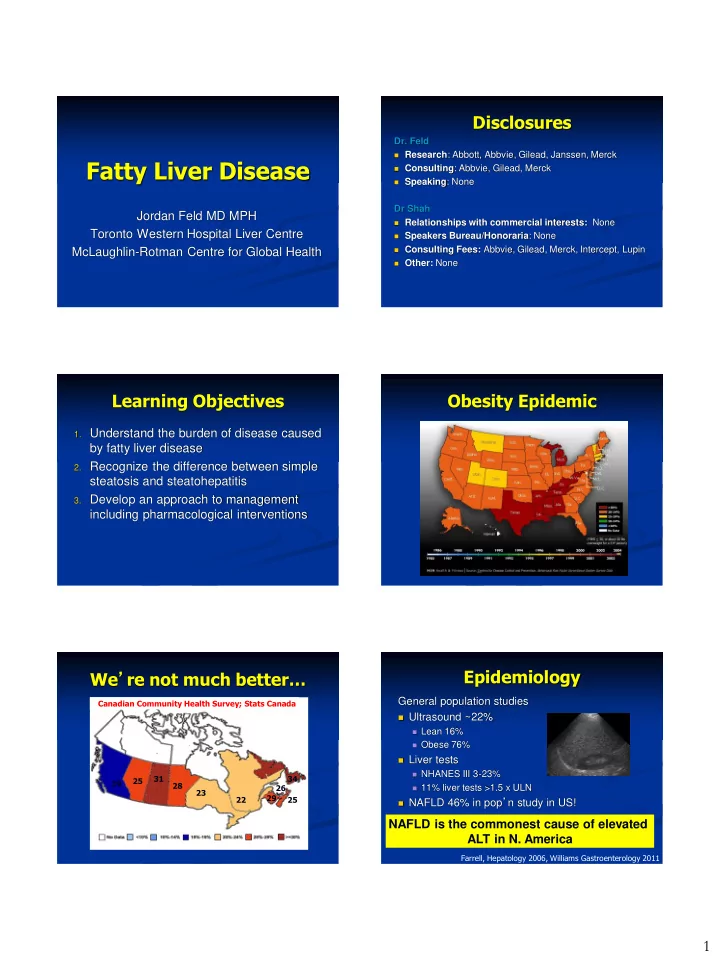
Fatty Liver Disease Consulting : Abbvie, Gilead, Merck Speaking : - - PDF document

fatty liver disease
SMART_READER_LITE
LIVE PREVIEW

Fatty Liver Disease Consulting : Abbvie, Gilead, Merck Speaking : - - PDF document

Disclosures Dr. Feld Research : Abbott, Abbvie, Gilead, Janssen, Merck Fatty Liver Disease Consulting : Abbvie, Gilead, Merck Speaking : None Dr Shah Jordan Feld MD MPH Relationships with commercial interests: None Toronto


slide-1
SLIDE 1

1

Fatty Liver Disease

Jordan Feld MD MPH Toronto Western Hospital Liver Centre McLaughlin-Rotman Centre for Global Health

Disclosures

  • Dr. Feld

 Research: Abbott, Abbvie, Gilead, Janssen, Merck  Consulting: Abbvie, Gilead, Merck  Speaking: None

Dr Shah

 Relationships with commercial interests: None  Speakers Bureau/Honoraria: None  Consulting Fees: Abbvie, Gilead, Merck, Intercept, Lupin  Other: None

Learning Objectives

  • 1. Understand the burden of disease caused

by fatty liver disease

  • 2. Recognize the difference between simple

steatosis and steatohepatitis

  • 3. Develop an approach to management

including pharmacological interventions

Obesity Epidemic We’re not much better…

19 25 31 28 23 22 29 25 26 34 Canadian Community Health Survey; Stats Canada

Epidemiology

General population studies

 Ultrasound ~22%

 Lean 16%  Obese 76%

 Liver tests

 NHANES III 3-23%  11% liver tests >1.5 x ULN

 NAFLD 46% in pop’n study in US! Farrell, Hepatology 2006, Williams Gastroenterology 2011

NAFLD is the commonest cause of elevated ALT in N. America

slide-2
SLIDE 2

2

Summary of NAFLD Prevalence

 AASLD estimates:

NAFLD

Global prevalence 6.3-33% Median 20%

NASH

3-5%

NASH Cirrhosis

Unknown Chalasani et al Gastro 2012

What about high risk groups?

 DM

 62% NAFLD by US  87% confirmed by bx

 Hyperlipidemia clinic

 NAFLD 50%

 Bariatric surgery

 Up to 90% NAFLD  5% unsuspected cirrhosis!

Clinical Features

  • Mainly asymptomatic

(48-100%)

  • Uncommonly:
  • RUQ discomfort
  • Fatigue
  • Malaise
  • Hepatomegaly (75%)
  • Splenomegaly

(if cirrhosis)

  • Uncommonly:
  • Palmar erythema
  • Spider naevi
  • Ascites

Diagnosis of Exclusion

 Labs

 ALT>AST (usually AST:ALT<1, never>2)  May have GGT elevation, ALP elevation 1/3  Ferritin often high – (50-62%) – more suggestive of

NASH

 Exclude: Viral hepatitis (HBV/HCV)

Autoimmune hepatitis (IgG, ANA, SMA) Wilson’s** - (ceruloplasmin, Ur Cu) Drug

Associated Conditions

 Obesity  HTN  DM  Hyperlipidemia  Weight gain or LOSS

 Common with anorexia!

 TPN

Metabolic Syndrome

Spectrum of NAFLD

Macrovesicular Hepatic Steatosis NonAlcoholic Fatty Liver Disease

Steatosis Cirrhosis Steatohepatitis (NASH) Steatosis +

Inflammation

Alcoholic Liver Disease

slide-3
SLIDE 3

3

Diagnosis

 US, CT, MRI can detect steatosis

 US is cheaper but less sensitive

 Liver biopsy is gold standard

 If diagnostic uncertainty  R/O advanced fibrosis

 Fibroscan / Fibrotest

 Must exclude ETOH (>20 g/day)

Without biopsy – CANNOT distinguish Steatosis from NASH

Are there alternatives to biopsy?

 NAFLD Fibrosis Score

 Age  BMI  Hyperglycemia  Platelet count  Albumin  AST/ALT ratio

http://nafldscore.com

Angulo Hepatology 2007

Performance

 Meta-analysis of 13 studies, 3,064 patients Exclude advanced fibrosis Sens 90% Spec 60% Detect advanced fibrosis Sens 67% Spec 97%

  • 1.455

0.676

Gambino Annals of Med 2011 Angulo Hepatology 2007

Histology – More than Fat

Fat=Steatosis Cirrhosis Fibrosis Neutrophils Mallory Hyaline Inflammation=Hepatitis

The Hallmark of NASH

Ballooning Hepatocytes – necessary to dx NASH

NASH vs Steatosis… Does it matter?

slide-4
SLIDE 4

4

Natural History

Type 1 Fat alone Type 2 Fat + Inflammation Type 3 Fat + ballooning degeneration Type 4 Fat + fibrosis and/or Mallory bodies

P<0.001

Ten year follow up of 132 patients with biopsy proven NAFLD by type. Matteoni et al. Gastroenterology 1999

Patients with NASH have a significantly higher liver related mortality than patients with simple steatosis.

1 2 3 4

Natural History – it’s not all liver!

NAFLD vs Gen pop’n

 Causes of death  Liver - 3rd vs 13th  Over 7 years  5% cirrhosis  2% liver-related

mortality

 1 required LT  2 HCC Adams, Gastroenterology 2005

NAFLD & Mortality

1.

Individuals with NAFLD increased mortality vs. general population

2.

Most common cause of death with NAFL or NASH is CARDIAC

3.

Patients with NASH, but not NAFL, have increased liver-related mortality

Chalasani et al Gastro 2012

NAFLD = hepatic manifestation of the metabolic syndrome

NAFLD Obesity Diabetes HTN Syndrome X DM & obesity risk factors for progressive fibrosis DM is a risk factor for death

74% NAFLD 22% NASH

Harrison Gastro 2011

What does NAFLD really mean?

You will get diabetes!!

So what can we do? Start with lifestyle

slide-5
SLIDE 5

5

Can we make this happen? Principles of Lifestyle Management

 Weight loss

 Diet and exercise

 Control of metabolic risk factors

 DM  BP  Cholesterol

 Limit alcohol

How much weight do they need to lose?

5-10% weight loss adequate to improve ALT and histology

Harrison Hepatology 2009 Promrat Hepatology 2010

Weight Loss Approaches

 Any diet that achieves weight loss is effective  Options:

 Low carbohydrate (less injera!)  Low fat (replace saturated with unsaturated), <30% total  Low caloric  Mediterranean  Others…

 Add exercise

 Aim 20 minutes of aerobic exercise 3 x per week  Simple things like walking…  Attending internal medicine rounds on the 8th floor!

How strict do we have to be? Some alcohol may actually be helpful…

  • Multiple studies showing that 1-2 drinks per day may reduce

progression of NASH

  • If significant fibrosis  complete abstinence
slide-6
SLIDE 6

6

What about drugs?

Lipid Lowering Agents

Adams & Angulo, Postgrad Med J 2006 Chalasani Gastro 2012

  • Statins are SAFE in NAFLD
  • Association with ALT/AST elevation but not fibrosis
  • Hyperlipidemia is a bigger issue
  • May even improve NASH

Therapies Study Design – PIVENS trial

 247 non-DM patients with biopsy proven NASH  Randomized – placebo

Vitamin E – 800 IU/day Pioglitazone 30 mg od

 2 years of treatment – f/u liver biopsy  Primary endpoint:

 Improved histology – decreased ballooning score,

with no worsening of fibrosis, NASH score down

Sanyal et al NEJM 2010

ALT improved

Sanyal et al NEJM 2010

Pioglitazone worked…

Sanyal et al NEJM 2010

slide-7
SLIDE 7

7

Histology

* * * * * * * * * * p<0.05 vs plac Sanyal et al NEJM 2010

Weight Gain????

Sanyal et al NEJM 2010

But before we put Vit E in the drinking water…

Is vitamin E safe? Other therapies?

 If BMI>35 + end-organ damage

  • r BMI>40  consider surgery

 Seems to benefit NASH  Reduced inflammation &

fibrosis at 1 & 5 yrs post surgery

 Benefits beyond NASH

 Improved mortality!

Mathurin Gastro 2009

My Practice

 Exclude other causes  Non-invasive assessment of fibrosis (labs,

fibrotest/NAFLD Fibrosis score, Fibroscan)

 If suggestive of fibrosis or other etiology – consider biopsy  If not – lifestyle changes x 6-12 mo

 No improvement  biopsy!

slide-8
SLIDE 8

8

Action based on biopsy

 Biopsy with steatosis only – no action

 Monitor for metabolic complications  Reassess in 3-5 years

 Biopsy with NASH

 No fibrosis – lifestyle changes  follow  Fibrosis – if lean, pioglitazone

  • if obese, vit E – 400 or 800 IU/d

Summary

 NAFLD is increasing  everywhere  Feature of the metabolic syndrome  Spectrum from steatosis to NASH  Steatosis  very good prognosis – worry about the

heart, not the liver

 NASH – worry about the liver too!  Lifestyle first – 5-10% weight loss with diet/exercise  Modest alcohol probably okay, coffee helpful  Treatment options: Vitamin E, pioglitazone, surgery