Fatigue Example Andrew Ning December 5, 2016 The figure below shows - - PDF document

fatigue example
SMART_READER_LITE
LIVE PREVIEW

Fatigue Example Andrew Ning December 5, 2016 The figure below shows - - PDF document

Fatigue Example Andrew Ning December 5, 2016 The figure below shows a stationary (non-rotating) torsion bar spring statically loaded with a force F = 35 kN, and a torque T that varies from 0 to 8 kN-m. It is simply supported at both ends. The


slide-1
SLIDE 1

Fatigue Example

Andrew Ning December 5, 2016

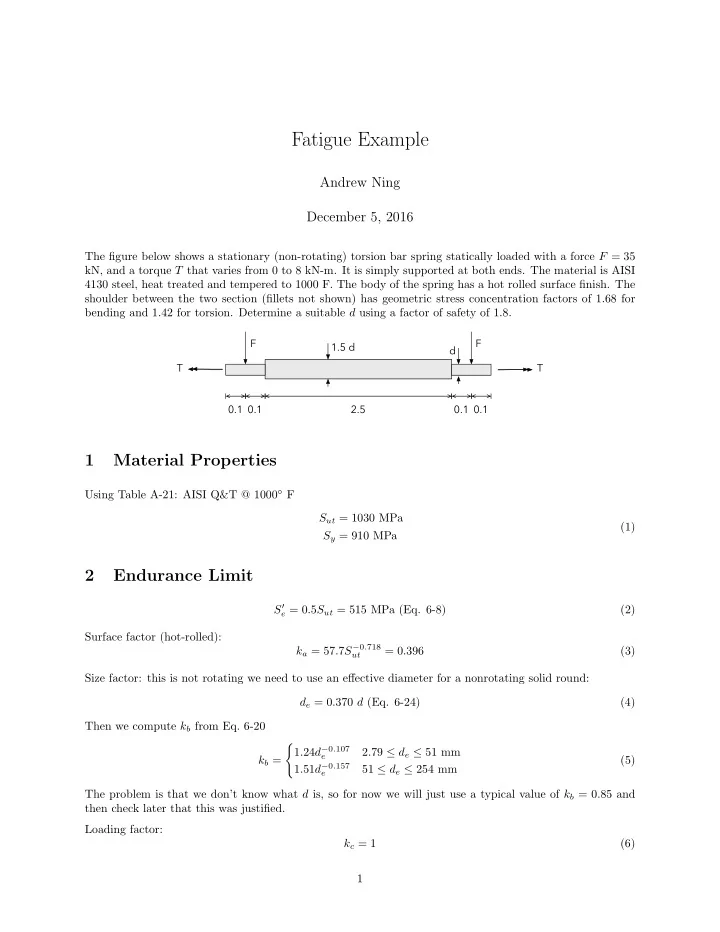
The figure below shows a stationary (non-rotating) torsion bar spring statically loaded with a force F = 35 kN, and a torque T that varies from 0 to 8 kN-m. It is simply supported at both ends. The material is AISI 4130 steel, heat treated and tempered to 1000 F. The body of the spring has a hot rolled surface finish. The shoulder between the two section (fillets not shown) has geometric stress concentration factors of 1.68 for bending and 1.42 for torsion. Determine a suitable d using a factor of safety of 1.8.

F F T T 0.1 2.5 0.1 0.1 0.1 1.5 d d

1 Material Properties

Using Table A-21: AISI Q&T @ 1000◦ F Sut = 1030 MPa Sy = 910 MPa (1)

2 Endurance Limit

S′

e = 0.5Sut = 515 MPa (Eq. 6-8)

(2) Surface factor (hot-rolled): ka = 57.7S−0.718

ut

= 0.396 (3) Size factor: this is not rotating we need to use an effective diameter for a nonrotating solid round: de = 0.370 d (Eq. 6-24) (4) Then we compute kb from Eq. 6-20 kb =

  • 1.24d−0.107

e

2.79 ≤ de ≤ 51 mm 1.51d−0.157

e

51 ≤ de ≤ 254 mm (5) The problem is that we don’t know what d is, so for now we will just use a typical value of kb = 0.85 and then check later that this was justified. Loading factor: kc = 1 (6) 1

slide-2
SLIDE 2

Remember, that we need to use kc = 1 because we have a combined load situation, and the loading factors we be applied later to the individual alternating loads. Temperature factor: kd = 1 (7) Nothing was said about the operational temperature being anything different than room temperature. Reliability: ke = 1 (8) No mention of a reliability factor. Se = kakbkckdkeS′

e = 173.3 MPa

(9)

3 Stress Concentration Factors

We are given the static stress concentration factors. We don’t know what the geometry is in terms of notch radius, so to be conservative we will just use q = 1, and thus Kf = 1.68 (bending) and Kfs = 1.42 (torsion).

4 Compute Stresses

Here is the shear and bending (and torsion) diagram: The torque is everywhere constant, and after the first 0.1 m from either end, the bending moment is constant. The critical location will be at the shoulder (location where diameter changes) because that is where there will be a stress concentration. This critical location is marked with a black circle in the figure above. Note that transverse shear stress is very small for beams (unless the beam is stout), so we will ignore it in our calculation. We can also plot how the stress at that critical location varies in time. 2

slide-3
SLIDE 3

The bending stress is constant, so it just has a mean value and no alternating component (remembering to apply the stress concentration factor). Note that we use d rather than 1.5d as the side of the shoulder with the smaller diameter will be more critical. σm = Kf Mc I = Kf M(d/2) (πd4/64) = Kf 32M πd3 = 59893 d3 (10) σa = 0 (11) The torsion varies between its min and max τmax = Kfs Tr J = Kfs T(d/2) (πd4/32) = Kf 16M πd3 = 57856 d3 (12) τmin = 0 (13) Thus, the mean and alternating shear stress is τm = τmax + τmin 2 = 28928 d3 τa = τmax − τmin 2 = 28928 d3 (14) The von Mises stress for the mean and alternating stresses separately are: σ′

m =

  • σ2

m + 3τ 2 m = 78088

d3 (Pa with d in meters) σ′

a =

  • σ2

a + 3τ 2 a = 50105

d3 (Pa with d in meters) (15)

5 Check for Infinite Life

Using Goodman criteria: σa Se + σm Sut = 1 nf 50105 d3(173.3 × 10⁶) + 78088 d3(1030 × 106) = 1 1.8 (16) Solving for d yields d = .0869 m = 86.9 mm. Let’s check that our assumption on kb was reasonable. Using Eqs. (4) and (5) we find that kb = .855, which is really close to the value we used previously. We should probably iterate once more, but since it is so close we will just round up d to the nearest size (i.e., d = 90 m). 3

slide-4
SLIDE 4

6 Check Number of Cycles for Finite Life

Not applicable, because we designed d to be big enough for infinite life (safety factor larger than 1).

7 Check for Yielding

ny ≈ Sy σ′

m + σ′ a

= (910 × 106) 78088/0.08693 + 50105/0.08693 =4.66 (17) Design is not critical in yielding, but is governed by fatigue. 4