Fair Credit Reporting Act: Litigation, Regulatory and Enforcement - - PowerPoint PPT Presentation

fair credit reporting act litigation regulatory and
SMART_READER_LITE
LIVE PREVIEW

Fair Credit Reporting Act: Litigation, Regulatory and Enforcement - - PowerPoint PPT Presentation

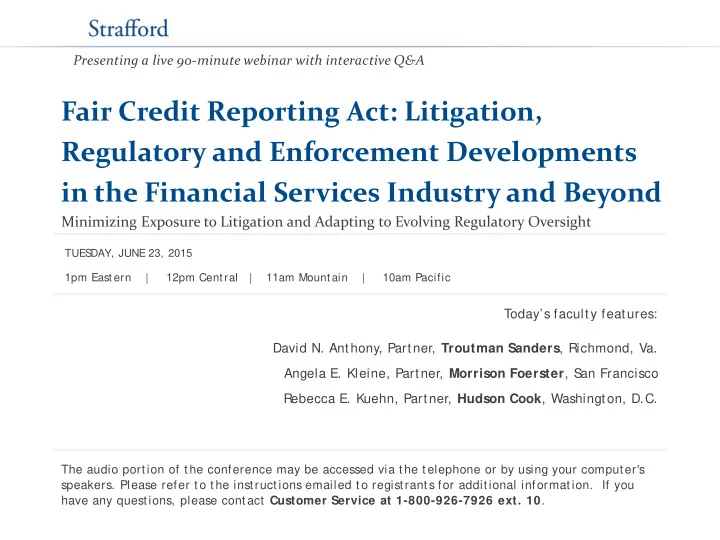
Presenting a live 90-minute webinar with interactive Q&A Fair Credit Reporting Act: Litigation, Regulatory and Enforcement Developments in the Financial Services Industry and Beyond Minimizing Exposure to Litigation and Adapting to Evolving


slide-1
SLIDE 1

The audio portion of the conference may be accessed via the telephone or by using your computer's

  • speakers. Please refer to the instructions emailed to registrants for additional information. If you

have any questions, please contact Customer Service at 1-800-926-7926 ext. 10.

Fair Credit Reporting Act: Litigation, Regulatory and Enforcement Developments in the Financial Services Industry and Beyond

Minimizing Exposure to Litigation and Adapting to Evolving Regulatory Oversight

Today’s faculty features:

1pm East ern | 12pm Cent ral | 11am Mount ain | 10am Pacific TUES DAY, JUNE 23, 2015

Presenting a live 90-minute webinar with interactive Q&A

David N. Anthony, Partner, Troutman Sanders, Richmond, Va. Angela E. Kleine, Partner, Morrison Foerster, S an Francisco Rebecca E. Kuehn, Partner, Hudson Cook, Washington, D.C.

slide-2
SLIDE 2

Tips for Optimal Quality

S

  • und Qualit y

If you are listening via your computer speakers, please note that the quality

  • f your sound will vary depending on the speed and quality of your internet

connection. If the sound quality is not satisfactory, you may listen via the phone: dial 1-866-328-9525 and enter your PIN when prompted. Otherwise, please send us a chat or e-mail sound@ straffordpub.com immediately so we can address the problem. If you dialed in and have any difficulties during the call, press *0 for assistance. Viewing Qualit y To maximize your screen, press the F11 key on your keyboard. To exit full screen, press the F11 key again.

FOR LIVE EVENT ONLY

slide-3
SLIDE 3

Continuing Education Credits

In order for us to process your continuing education credit, you must confirm your participation in this webinar by completing and submitting the Attendance Affirmation/ Evaluation after the webinar. A link to the Attendance Affirmation/ Evaluat ion will be in the thank you email that you will receive immediately following the program. For additional information about CLE credit processing call us at 1-800-926-7926

  • ext. 35.

FOR LIVE EVENT ONLY

slide-4
SLIDE 4

Fair Credit Reporting Act: Litigation, Regulatory and Enforcement Developments in the Financial Services Industry and Beyond

Angela Kleine, Morrison & Foerster, LLP akleine@mofo.com Rebecca E. Kuehn, Hudson Cook, LLP

rkuehn@hudco.com

David Anthony, Troutman Sanders, LLP

david.anthony@troutmansanders.com

slide-5
SLIDE 5

OVERVIEW OF THE FCRA

5

slide-6
SLIDE 6

What Is the Fair Credit Reporting Act?

  • Enacted in 1970

– Concern about “secret” files used to make important decisions – Seeking to balance privacy & fairness with benefits of system

  • Provides consumers with rights to access and correct data
  • Imposes obligations on “users”

– To notify consumers when “adverse” decisions made

  • Imposes duties on “consumer reporting agencies” to

– Protect data and only provide for a “permissible purpose” – Maintain accuracy and investigate disputes – Report certain data and not report other data

  • Requires “furnishers” to maintain accuracy and investigate disputes

6

slide-7
SLIDE 7

What Is the Fair Credit Reporting Act?

  • Not just about credit

– FCRA regulates the collection, disclosure and use

  • f consumer report information
  • Information used by businesses to make

important decisions about consumers

– Such as credit, insurance, employment, check cashing, rental

7

slide-8
SLIDE 8

What Is a Consumer Report?

  • A communication of information by a

consumer reporting agency

  • Bearing on a consumer's credit worthiness,

credit standing, credit capacity, character, general reputation, personal characteristics, or mode of living

8

slide-9
SLIDE 9

What Is a Consumer Report?

  • Which is used, or expected to be used, or collected in

whole or in part

  • For the purpose of serving as a factor in establishing

the consumer's eligibility for

– credit or insurance to be used primarily for personal, family, or household purposes

  • NOT business purposes

– employment purposes, or – any other eligibility “permissible purpose” authorized under the FCRA

9

slide-10
SLIDE 10

What Is a Consumer Report?

  • “Consumer Reporting Agency” (“CRA”)

– any person which – for monetary fees, dues, or on a cooperative nonprofit basis, – regularly engages in whole or in part – in the practice of assembling or evaluating consumer credit information or other information on consumers – for the purpose of furnishing consumer reports to third parties.

  • No federal registration or licensing required

10

slide-11
SLIDE 11

What Is NOT a Consumer Report?

  • Information that does NOT bear on the 7 characteristics

– Only ID information – “header data” – Non-identifiable information – e.g., aggregated or blind data

  • Information that is NOT collected or expected to be used for

eligibility for a permissible purpose

– Claims administration, ID verification, law enforcement, portfolio review – Non-consumer (e.g., business) purposes – Marketing

11

slide-12
SLIDE 12

What Is NOT a Consumer Report?

  • Statutory Exclusions – FCRA § 603(d)(2)(A)

– Transaction and experience (“T&E”) information

  • Permits financial institutions to report to one another and to CRAs

– T&E, when shared among affiliates – Non-T&E, when shared among affiliates after notice & opt-out

  • Includes consumer report information, application information
  • Exceptions to the exclusion for medical information (very broadly defined)
  • Other Exclusions

– Employment agencies (FCRA § 603(o)) – Employment investigations (FCRA § 603(y)) – Point-of-sale approvals (FCRA § 603(d)(2)(B))

12

slide-13
SLIDE 13

Duties of Consumer Reporting Agencies

13

slide-14
SLIDE 14

Duties of CRAs

  • Permissible purposes and data security
  • Content of a consumer report and accuracy of data
  • Consumer file disclosures

– Credit score disclosures

  • Disputes and reinvestigations
  • Identity theft and fraud
  • Special types of consumer reports

– Employment reports – Investigative consumer reports

14

slide-15
SLIDE 15

Special Types of CRAs

  • Nationwide CRA

– A consumer reporting agency that – Regularly engages in assembling or evaluating, and maintaining

  • public record information regarding consumers residing nationwide; and
  • credit account information

– regarding consumers residing nationwide – from persons who furnish that information regularly and in the ordinary course of business

– For the purpose of furnishing consumer reports bearing on creditworthiness (i.e., credit reports)

  • Prohibition on circumventing status as Nationwide CRA

– FCRA § 629; 16 CFR § 611

  • TransUnion, Equifax, Experian

15

slide-16
SLIDE 16

Obligations of a Nationwide CRA

  • Annual credit report

– Centralized source

  • Centralized prescreening opt-out
  • Toll-free telephone assistance
  • Fraud alerts and referrals

– Additional free reports

  • Address discrepancy notices
  • Centralized automated consumer dispute verification system
  • Referral of ID theft complaints and report to CFPB
  • Respond to CFPB consumer complaint referrals

16

slide-17
SLIDE 17

Special Types of CRAs

  • Nationwide Specialty CRA

– A consumer reporting agency that – compiles and maintains files on consumers – on a nationwide basis – relating to

  • medical records or payments
  • residential or tenant history
  • check writing history
  • employment history, or
  • insurance claims
  • Telecheck, MIB, CLUE
  • Free annual credit report (no central source)

17

slide-18
SLIDE 18

Special Types of CRAs

  • Reseller

– A consumer reporting agency that – Assembles and merges information – Contained in the database of another CRA or multiple CRAs – For purposes of furnishing such information to any third party, and – Does not maintain a database of the assembled or merged information from which new consumer reports are produced

  • Residential mortgage credit reporting agency

– “Merge and purge”

18

slide-19
SLIDE 19

Obligations of Businesses That Use Consumer Reports

19

slide-20
SLIDE 20

Overview of User Duties

  • Permissible purpose

– Prescreening

  • Adverse action
  • Disposal of consumer report information
  • Medical information
  • Notice of address discrepancy
  • Employment – notice and consent, pre-adverse action
  • Fraud alert duties for lenders
  • Red Flags Rule

20

slide-21
SLIDE 21

Obligations of Businesses that Provide Information to Consumer Reporting Agencies

21

slide-22
SLIDE 22

Overview of Furnisher Duties

  • Generally no private right of action
  • Accuracy duty – “knows or has reason to believe”
  • Duty to correct and update
  • Duty to investigate disputed information

– Rules for direct disputes – CFPB v. Syndicated Office Systems, LLC, 2015-CFPB-0012 (June 18, 2015)

  • Duties with respect to specific information
  • Lender duties

– Negative information notice

  • Red Flags Rule

§§ 611, 623 * See the additional enforcement actions discussed below.

22

slide-23
SLIDE 23

Furnisher Rule

The FCRA requires a furnisher to:

  • “[N]ot furnish any information . . . [it] knows or has reasonable cause to

believe . . . is inaccurate.”

  • “Completeness” issue
  • Correct & Update Information
  • Investigate Disputes

Furnisher Policies and Procedures:

  • Reasonable written policies and procedures re:
  • accuracy and integrity of information
  • appropriate to the nature, size, complexity and scope of the

furnisher’s activities

Regulation V, 12 C.F.R. 1022, et seq.

23

slide-24
SLIDE 24

SHIFTING LITIGATION, REGULATORY, AND ENFORCEMENT ENVIRONMENT

24

slide-25
SLIDE 25

History of FCRA Guidance

  • Before Dodd-Frank, primary enforcement

authority for FCRA rested with FTC.

– FTC’s 40 Years Report

  • Post-Dodd-Frank, CFPB is charged with

primary enforcement, guidance and rulemaking authority.

  • CFPB also vested with examination authority.

25

slide-26
SLIDE 26

CFPB Supervision

  • General Exam Manual Includes Modules for FCRA (furnisher

responsibilities)

  • Adopts New Rule to Supervise Larger CRAs
  • Releases Exam Procedures for Consumer Reporting Market

– Effective September 30, 2012

  • Issues Warning to Specialty CRAs
  • Supervisory Highlights – Furnishing issues, credit reporting
  • Issues Reports on Consumer Reporting Market

– Credit Scores – Medical Debt – Credit Invisibles

  • Accepts Consumer Complaints on Credit Reporting

26

slide-27
SLIDE 27

CFPB Guidance

  • CFPB Bulletin 2014-01: Obligation of

furnishers to conduct investigations

  • CFPB Bulletin 2013-09: Obligations of CRAs

and furnishers to consider “all relevant information”

  • CFPB Bulletin 2013-08: Representations

regarding effect of debt payments on credit reports and scores

27

slide-28
SLIDE 28

Administrative Enforcement

  • Banking Agencies

– Through examinations and enforcement actions

  • Consumer Financial Protection Bureau

– All “covered persons” – $1 million per day penalties

  • FTC enforcement

– $3,500 for each “knowing” FCRA violation

  • That is part of a pattern or practice of violations
  • Recent orders: $1 million +
  • State AG enforcement

– $1,000 for negligent or willful FCRA violations

28

slide-29
SLIDE 29

CFPB and FTC Enforcement

  • First Investors - accuracy of furnished

information, vendor oversight

  • Drive Time – accuracy of furnished

information, Furnisher Rule

  • American Express – noting items as disputed
  • Certegy and Telecheck – Furnisher Rule,

investigation of disputes

  • Time Warner Cable – Risk Based Pricing Rule

29

slide-30
SLIDE 30

Private Right of Action

  • Most common area for developing case law
  • Allows suits for negligent and/or willful

violations of most provisions of the FCRA

  • Willful damages provision has led to increase

in class action litigation

– Frequent, repetitive transactions – Legal uncertainty for complex statute – No need to prove actual damages

30

slide-31
SLIDE 31

CUTTING EDGE LEGAL THEORIES

31

slide-32
SLIDE 32

Robins v. Spokeo

  • Background: Website aggregates

information from public sources. Allegedly sells it to employers evaluating possible hires.

  • Claim: Spokeo is a CRA and

published inaccurate info about Robins.

  • Alleged Injury: Invasion of statutory
  • rights. No actual concrete $$ injury.
  • Impact: “No injury” class actions

under the FCRA, and beyond.

(See our alert.)

32

slide-33
SLIDE 33

Suits Against CRAs

  • General Theories

– Providing a consumer report to users without a permissible purpose - § 1681b – Establish and/or follow reasonable procedures to assure maximum possible accuracy of information reported about the consumer - § 1681e(b) – Provide the consumer with all information in his or her file upon a request from the consumer - § 1681g(a)(1) – Clearly and accurately disclose the source of reporting - § 1681g(a)(2) – Provide the consumer a notice of issuance of public record reports for employment purposes – § 1681k – Taking adverse action for employers without sending out pre- adverse action notice to the consumer - § 1681b(b)

33

slide-34
SLIDE 34

Suits Against CRAs

  • Common Reinvestigation Claims – Failures to . . .

– Conduct a reasonable investigation of dispute by a consumer - § 1681i(a)(1) – Send the furnisher all relevant information that it received from a consumer’s dispute - § 1681i(a)(2) – Review and consider all relevant information received from a consumer and instead “parroting” furnisher verifications - § 1681i(a)(4) – Delete information that was inaccurate or could not be verified - § 1681i(a)(5) – Accurately provide the notice of the reinvestigation results - § 1681i(a)(6)

34

slide-35
SLIDE 35

Suits Against CRAs

  • Claims against those who do not believe that

they are CRAs

– Fundamentally different category of claims – Not about technical compliance, but rather whether the FCRA applies at all

35

slide-36
SLIDE 36

Suits Against Furnishers

  • New Scenarios

– Bankruptcy

  • Horsch v. Wells Fargo, 2015 WL 1344836 (E.D. Pa. Mar. 25, 2015)

(reporting zero balances on mortgages not inaccurate or incomplete)

– Loan Mods / Foreclosure

  • Bartlett, No. 14–1895, 2015 WL 2387013 (4th Cir. May 20, 2015)

(1681g(g) disclosures not required in resopnse to loan mod application)

– ID Theft

  • No private right of action (§ 1681s–2(a))
  • But

– Duty to conduct “reasonable” investigation – Duty to correct – State statutes

36

slide-37
SLIDE 37

Suits Against Employers

  • § 1681b

– (b)(2)(A) – Providing a clear and conspicuous disclosure made in writing to the consumer before the consumer report is procured – (b)(2)(A) – Providing a disclosure “in a document that consists solely of the disclosure” – (b)(2)(A) – Having the consumer authorize in advance consent to the procurement of a consumer report for employment purposes – (b)(2)(B)(i) – Providing the applicant with notice that a consumer report may be obtained for employment purposes

37

slide-38
SLIDE 38

Suits Against Employers (cont’d)

  • § 1681b
  • (b)(3)(A)(i) – Providing a copy of the consumer report used

to make an employment decision before taking an adverse action based on report

  • (b)(3)(A)(ii) – Providing the consumer with a summary of

FCRA rights before taking adverse action

  • (b)(3) – Complying with the timing requirements before

taking adverse action

38

slide-39
SLIDE 39

Expansion Beyond Traditional Financial Services Targets

  • Alleged Data Aggregators

– Robins v. Spokeo, Inc., 2011 WL

1793334 (C.D. Cal. May 11, 2011)

– Sweet v. LinkedIn Corp., 2015 WL

1744254 (N.D. Cal. Apr. 14, 2015) (LinkedIn is not a CRA. The search results are not consumer reports.)

– Differences?

  • T&E exception
  • Self-provided information
  • Information not “about” consumer
  • Policy

39

slide-40
SLIDE 40

Expansion Beyond Traditional Financial Services Targets

  • Underwriting Software

– Thomas v. Cendant Mortg., 2004 WL 2600772 (E.D. Pa.

  • Nov. 15, 2004).

– McCalmont v. Fed. Nat'l Mortg. Ass'n, No. 2:13–cv–02107 (July 21, 2014)

  • Employers

40

slide-41
SLIDE 41

CLASS ACTION DEFENSE TACTICS AND STRATEGIES

41

slide-42
SLIDE 42

Alleged Technical Violations

  • High exposure
  • Easy to file
  • Commonly systematic or repetitive processes
  • Statutory Damages
  • Possibly still punitive damages
  • Significant defense costs

42

slide-43
SLIDE 43

Common Defenses

  • Defense to Merits of FCRA Claim
  • Elements to Certify a Class Action

– Generally – “rigorous analysis” – Numerosity – Commonality – Typicality – Adequacy of class counsel – Predominance/superiority – Ascertainability

43

slide-44
SLIDE 44

Common Defenses

  • Arbitration – individual or class
  • Standing
  • Statute of limitations
  • Damages sought

– Actual damages – Capable of measurement on classwide basis

  • Defeating willfulness

– Statutory damages – Punitive damages

44

slide-45
SLIDE 45

Negligence and Willfulness

1. Negligence

  • Penalty: “Actual Damages”
  • Spokeo questions
  • Alleged damages to credit score

2. Willfulness

  • Penalty: Actual Damages OR Statutory Damages
  • f $100-$1k
  • Using Safeco

– Standard – When to use it

3. Class Cert. Strategies

§§ 1681 n, o

45

slide-46
SLIDE 46

Q&A

To ask a question from your touchtone phone, press *# ("star" "pound"). To exit the queue, press *# ("star" "pound") again. Y

  • u may also use the Chat function to ask questions, or email questions to

bankinglaw@ straffordpub.com CLE CODE: TXB3CB

slide-47
SLIDE 47

Tell us how we did!

Look for our 'Thank Y

  • u'

email (which you should receive within 24 hours) for details and a link to the program survey and attendance attestation.

slide-48
SLIDE 48

Thanks.

S trafford Publications, Inc. 1-800-926-7926 www.straffordpub.com

Please j oin us for our next conference, “ Mortgage Loan Buyback and Indemnification Demands: Minimizing Risks for Loan S ellers and S ervicers,” scheduled on Tuesday, July 21, 2015 starting at 1pm EDT .