Faculty Development with Faculty Development with Universal Course - - PowerPoint PPT Presentation

faculty development with faculty development with
SMART_READER_LITE
LIVE PREVIEW

Faculty Development with Faculty Development with Universal Course - - PowerPoint PPT Presentation

Faculty Development with Faculty Development with Universal Course Design (UCD) Universal Course Design (UCD) Kirsten Behling, MA Kirsten Behling, MA Suffolk University Suffolk University Do all students learn alike? Do all students learn

slide-1
SLIDE 1

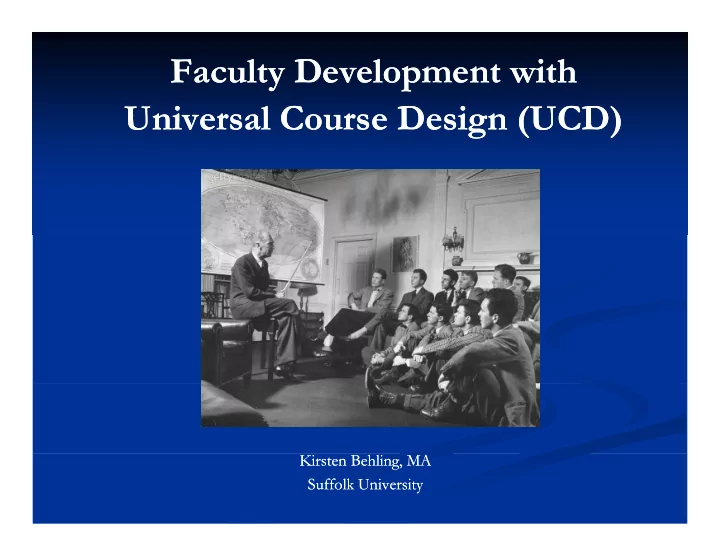
Faculty Development with Faculty Development with Universal Course Design (UCD) Universal Course Design (UCD)

Kirsten Behling, MA Kirsten Behling, MA Suffolk University Suffolk University

slide-2
SLIDE 2

Do all students learn alike? Do all students learn alike? Do all students learn alike? Do all students learn alike?

slide-3
SLIDE 3

No! No! No! No!

10 10 30 Visual Auditory 60 30 Auditory Kinesthic

slide-4
SLIDE 4

What is Universal Design? What is Universal Design? W s U ve s es g ? W s U ve s es g ?

Consider the Consider the needs needs of the

  • f the broadest possible range

broadest possible range of users

  • f users

from the from the beginning beginning.

slide-5
SLIDE 5

Quick Inquiry Quick Inquiry

i hi k f d i l i hi k f d i l Write, think of or draw your responses quietly Write, think of or draw your responses quietly

1. 1.

Who Who is the number one user of closed captioning? is the number one user of closed captioning?

2. 2.

Why do Why do you you use curb cuts? use curb cuts?

3. 3.

What are the benefits of unisex bathrooms? What are the benefits of unisex bathrooms?

slide-6
SLIDE 6

What is Universal Course Design? What is Universal Course Design? What is Universal Course Design? What is Universal Course Design?

Uni ersal Co rse Design (UCD) is the design of college co rses Uni ersal Co rse Design (UCD) is the design of college co rses Universal Course Design (UCD) is the design of college courses Universal Course Design (UCD) is the design of college courses including the course including the course curriculum curriculum, , instruction instruction, , assessment assessment and and the the environment environment, to be usable by all students, to the greatest , to be usable by all students, to the greatest extent possible, without the need for accommodations. extent possible, without the need for accommodations.

slide-7
SLIDE 7

A Study of Student Mean Grades in a A Study of Student Mean Grades in a UCD N UCD N UCD C UCD C UCD verses Non UCD verses Non-

  • UCD Course

UCD Course

100 95 100 90 95 85 90 Non-UCD UCD 80 85 80 Exam 1 Exam 2 Final Exam

slide-8
SLIDE 8

Course Evaluation Data: Course Evaluation Data: O i l Th O i l Th Occupational Therapy Occupational Therapy

4.5 5 3 3.5 4 2 2.5 3

  • Avg. Evaluation

score 0.5 1 1.5 0.5 Non UCD UCD

slide-9
SLIDE 9

Examples of UD benefiting all students Examples of UD benefiting all students Examples of UD benefiting all students Examples of UD benefiting all students

Perry Seagroves Perry Seagroves David Rose David Rose

slide-10
SLIDE 10

UCD Four Key Elements UCD Four Key Elements UCD Four Key Elements UCD Four Key Elements

1

Curriculum Curriculum

1. 1.

Curriculum Curriculum

2

Instruction Instruction

2. 2.

Instruction Instruction

3

Assessment Assessment

3. 3.

Assessment Assessment

4. 4.

Environment Environment

4. 4.

Environment Environment

slide-11
SLIDE 11

A Sampling of UCD Strategies for Curriculums A Sampling of UCD Strategies for Curriculums p g g p g g

  • Present the course syllabus in more than one way

Present the course syllabus in more than one way

  • Present the course syllabus in more than one way

Present the course syllabus in more than one way

  • Incorporate student interests into the curriculum

Incorporate student interests into the curriculum

  • Create an outline of each class, post it on the board or online prior to the beginning of

Create an outline of each class, post it on the board or online prior to the beginning of the class the class Ch d l i Ch d l i di i l h l ll di di i l h l ll di

  • Choose text and multi

Choose text and multi-media materials that are culturally diverse media materials that are culturally diverse

  • Put a statement the syllabus inviting students to meet with you to discuss disability

Put a statement the syllabus inviting students to meet with you to discuss disability-

  • related accommodations and other special learning needs.

related accommodations and other special learning needs. related accommodations and other special learning needs. related accommodations and other special learning needs.

  • Others?

Others?

slide-12
SLIDE 12

Example of a Traditional Syllabus Example of a Traditional Syllabus

slide-13
SLIDE 13

UCD Syllabi UCD Syllabi

slide-14
SLIDE 14

Incorporating UCD into Instruction Incorporating UCD into Instruction Incorporating UCD into Instruction Incorporating UCD into Instruction

slide-15
SLIDE 15

UCD Strategies for Instruction UCD Strategies for Instruction

  • Administer a learning style survey at the beginning of class, adjust your instructional

Administer a learning style survey at the beginning of class, adjust your instructional plan based on the results plan based on the results plan based on the results. plan based on the results. Alternate delivery methods (discussion, hands Alternate delivery methods (discussion, hands-

  • on activities)
  • n activities)
  • Face the class and speak clearly, avoid using pronouns

Face the class and speak clearly, avoid using pronouns P id i d i l l f d i h P id i d i l l f d i h

  • Provide printed materials early for students to prepare with

Provide printed materials early for students to prepare with If using a PowerPoint, make sure it is universally designed If using a PowerPoint, make sure it is universally designed

  • Post additional information on course websites

Post additional information on course websites

  • Others?

Others?

slide-16
SLIDE 16

Faculty Experiences with UCD Faculty Experiences with UCD d I i d I i and Instruction and Instruction

A Biology professor records all of

A Biology professor records all of his lectures. his lectures.

He posts each lecture online after

He posts each lecture online after

He posts each lecture online after

He posts each lecture online after the class is over. the class is over. H h 185 d i hi H h 185 d i hi

He has 185 students in his course.

He has 185 students in his course.

slide-17
SLIDE 17

Podcasting results: Podcasting results: Podcasting results: Podcasting results:

l d l d

39 lectures were posted.

39 lectures were posted.

The lecture was downloaded 1 333 times

The lecture was downloaded 1 333 times

The lecture was downloaded 1,333 times.

The lecture was downloaded 1,333 times.

Each student downloaded approximately 7 lectures throughout

Each student downloaded approximately 7 lectures throughout w pp y g w pp y g the course. the course.

89% of the downloads took place a week before an exam.

89% of the downloads took place a week before an exam.

slide-18
SLIDE 18

Student opinions of the podcasts Student opinions of the podcasts d p p d d p p d

  • Students said that the podcast helped them to:

Students said that the podcast helped them to:

Pay attention in class without furiously taking notes.

Pay attention in class without furiously taking notes.

Review the lecture later on to reinforce a concept in their text.

Review the lecture later on to reinforce a concept in their text. p

Allowed them to pause, rewind and fast forward a lecture

Allowed them to pause, rewind and fast forward a lecture

slide-19
SLIDE 19

Incorporating UCD into Assessment Incorporating UCD into Assessment Incorporating UCD into Assessment Incorporating UCD into Assessment

slide-20
SLIDE 20

UCD Strategies for Assessment UCD Strategies for Assessment UCD Strategies for Assessment UCD Strategies for Assessment

Pro ide feedback after the assignment is complete Pro ide feedback after the assignment is complete

Provide feedback after the assignment is complete

Provide feedback after the assignment is complete

Offer students a choice of final assessments

Offer students a choice of final assessments Offer students a choice of final assessments Offer students a choice of final assessments

Provide specific criteria and examples of good projects

Provide specific criteria and examples of good projects

Consider alignment between what you teach and test

Consider alignment between what you teach and test

Evaluate knowledge throughout the course

Evaluate knowledge throughout the course

slide-21
SLIDE 21

UCD Assessment in a Journalism Course UCD Assessment in a Journalism Course UCD Assessment in a Journalism Course UCD Assessment in a Journalism Course

  • Final Assignment:

Final Assignment:

1. 1.

Write a 15 page paper on the ethics journalist must adhere to. You Write a 15 page paper on the ethics journalist must adhere to. You may choose may choose between print, video or online journalism. between print, video or online journalism.

2. 2.

Spend a day shadowing a local journalist. Interview them on their code of ethics, Spend a day shadowing a local journalist. Interview them on their code of ethics, include a personal reflection. Submit your project in include a personal reflection. Submit your project in a medium that works best a medium that works best for you for you (paper, audio file, podcast, video). (paper, audio file, podcast, video).

slide-22
SLIDE 22

UCD Assessment in a Journalism Course UCD Assessment in a Journalism Course UCD Assessment in a Journalism Course UCD Assessment in a Journalism Course

Paper (10 total)

Paper (10 total)

5

i t j li i t j li

Alternative project: (15 total)

Alternative project: (15 total)

7

di fil i l di t l i t i 7 di fil i l di t l i t i

5

5 – print journalism print journalism

3

3 – – video journalism video journalism

2

2 – – online journalism

  • nline journalism

7 audio files, including actual interview

7 audio files, including actual interview and self and self-

  • reflections.

reflections.

6 written reports

6 written reports

2 short video movies documenting the

2 short video movies documenting the experience. experience.

slide-23
SLIDE 23

UCD Strategies for the Environment UCD Strategies for the Environment g

l h d l d l h d l d

Create a classroom environment that respects and values diversity

Create a classroom environment that respects and values diversity

Assure that classrooms labs and field work are accessible to individuals

Assure that classrooms labs and field work are accessible to individuals

Assure that classrooms, labs, and field work are accessible to individuals

Assure that classrooms, labs, and field work are accessible to individuals with a wide range of physical abilities and disabilities with a wide range of physical abilities and disabilities

Be aware of ambient noise, use amplification or captioning

Be aware of ambient noise, use amplification or captioning

Ask students if they can hear and see the presentation

Ask students if they can hear and see the presentation

slide-24
SLIDE 24

How do you bring UCD to your campus How do you bring UCD to your campus? How do you bring UCD to your campus How do you bring UCD to your campus?

It must come from within: It must come from within:

1. 1.

Develop a UCD Core Team Develop a UCD Core Team

2. 2.

Start small, start with interested parties Start small, start with interested parties

3. 3.

Commit to semester long meetings Commit to semester long meetings

4. 4.

Ensure each meeting functions as a workshop Ensure each meeting functions as a workshop

5. 5.

Aim to change only three components of a course Aim to change only three components of a course

slide-25
SLIDE 25

What is a UCD Core Team? What is a UCD Core Team?

A UCD Core Team is one of the keys to sustain UCD on a the keys to sustain UCD on a college campus. A UCD Core Team is a peer support t k d i d t h l network designed to help faculty learn about UCD and incorporate into their courses.

slide-26
SLIDE 26

Who should be on the team? Who should be on the team?

E h UCD C T h ld h 3 6 i b Each UCD Core Team should have 3 to 6 consistent team members. Representatives from the following offices have been on the team:

DSS Office Informational technology

Lib i

Librarian The Center Teaching and Excellence The Diversity Office The Student Academic Affairs Office

slide-27
SLIDE 27

UCD Core Team Responsibilities UCD Core Team Responsibilities

/

  • Meet once/month for a minimum of one hour, throughout the

semester

  • Spend the first semester learning about UCD
  • Recruit the initial 5 faculty members for the second semester

Recruit the initial 5 faculty members for the second semester

  • Work as a team to advise 5 faculty during the second semester
  • Promote the work of the faculty through presentations, poster

sessions, newsletters, websites

slide-28
SLIDE 28

UCD Core Team Timeline

First Semester

UCD Core Team Development Second Semester

Faculty & UCD Core Team Work Together

Fourth Semester

Faculty Mentors New Faculty Work w/ UCD Team Work Together

Third Semester Third Semester

Faculty Mentors New Faculty Work w/ UCD Team

slide-29
SLIDE 29

First Semester Agenda First Semester Agenda First Semester Agenda First Semester Agenda

  • August

August – – UCD Overview and Semester Planning UCD Overview and Semester Planning

Participate in the UCD Transformation activity

Participate in the UCD Transformation activity

Meeting dates and times

Meeting dates and times

UCD homework

UCD homework

UCD homework

UCD homework

  • September

September – – UCD Syllabi UCD Syllabi

  • October

October – – UCD Instruction UCD Instruction

  • November

November – – UCD Assessment UCD Assessment

  • December

December – UCD Faculty Recruitment Brainstorm planning for second semester UCD Faculty Recruitment Brainstorm planning for second semester

  • December

December UCD Faculty Recruitment Brainstorm, planning for second semester UCD Faculty Recruitment Brainstorm, planning for second semester

slide-30
SLIDE 30

Next Steps

  • Set meeting dates, times, locations

Next Steps

Set meeting dates, times, locations

  • Watch the introductory UCD video at: www.universalcoursedesign.org
  • Each person view one tutorial and familiarize yourself with it (assign

tutorials that the group thinks will be most valuable to NECC) g p )

  • Review your own day to day work. Think of examples where UCD

l d i t d h i ht t t i l t it already exists and where you might try to implement it.