Exponential Growth Exponential Growth Introduction Exponential - - PDF document

exponential growth
SMART_READER_LITE
LIVE PREVIEW

Exponential Growth Exponential Growth Introduction Exponential - - PDF document

Slide 1 / 175 Slide 2 / 175 Algebra I Algebraic Exponents & Exponential Functions 2015-11-02 www.njctl.org Slide 3 / 175 Slide 4 / 175 Table of Contents Click on the topic to go to that section Exponential Growth Exponential Growth


slide-1
SLIDE 1

Slide 1 / 175 Slide 2 / 175

Algebra I

Algebraic Exponents & Exponential Functions

2015-11-02 www.njctl.org

Slide 3 / 175

· Exponential Growth Introduction · Exponential Relationships in Equations, Tables and Graphs · Growth Rates and Growth Factors · Exponential Decay · Rules of Exponents

Click on the topic to go to that section

· Exponential Growth vs. Linear Growth

Table of Contents Slide 4 / 175

Return to Table of Contents

Exponential Growth Introduction

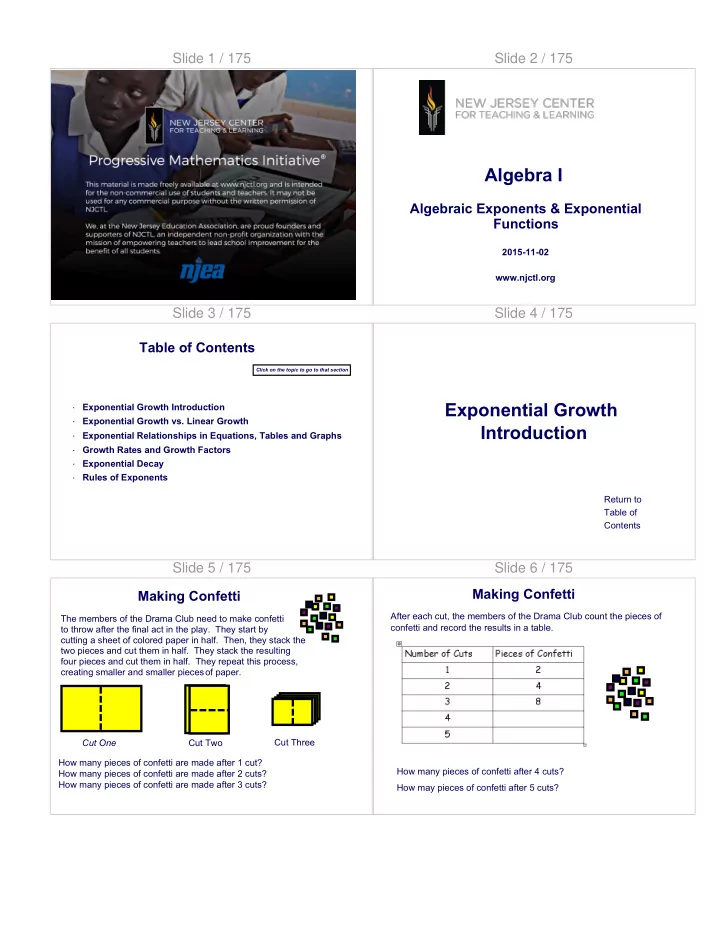
Slide 5 / 175 Making Confetti

The members of the Drama Club need to make confetti to throw after the final act in the play. They start by cutting a sheet of colored paper in half. Then, they stack the two pieces and cut them in half. They stack the resulting four pieces and cut them in half. They repeat this process, creating smaller and smaller pieces

  • f paper.

Cut One Cut Two Cut Three How many pieces of confetti are made after 1 cut? How many pieces of confetti are made after 2 cuts? How many pieces of confetti are made after 3 cuts?

Slide 6 / 175 Making Confetti

After each cut, the members of the Drama Club count the pieces of confetti and record the results in a table. How many pieces of confetti after 4 cuts? How may pieces of confetti after 5 cuts?

slide-2
SLIDE 2

Slide 7 / 175

The members of the Drama Club want to predict the number of pieces

  • f confetti after any number of cuts.

Look at the pattern in the way the number of pieces of confetti changes with each cut. Use your observations to extend your table to show the number of pieces of confetti for up to 10 cuts.

Making Confetti Slide 8 / 175

Suppose the members of the Drama Club make 20

  • cuts. How many pieces of

confetti would they have? How many pieces of confetti would they have if they made 30 cuts?

Making Confetti Slide 9 / 175

As opening night quickly approaches, the members

  • f the Drama Club need to speed up the process of

making confetti. They decide to cut the sheet of colored paper into thirds instead of cutting it in half. Then, they stack the three pieces and cut them in thirds. They repeat this process of cutting into thirds, creating smaller and smaller pieces of paper.

Making Confetti Slide 10 / 175

How many pieces of confetti are made after 1 cut? How many pieces of confetti are made after 2 cuts? How many pieces of confetti are made after 3 cuts? Cut One Cut Two Cut Three

Making Confetti Slide 11 / 175

3 9 After each cut, the members of the Drama Club count the pieces of confetti and record the results in a table. How many pieces of confetti are made after: 3 cuts? 4 cuts? 5 cuts? 10 cuts?

Making Confetti Slide 12 / 175

How is the process the same when the members cut the original sheet into halves and when they cut the first sheet into thirds? How is the process different? Is there a way to predict how many pieces of confetti they will have after any number of cuts? These problems are an example of exponential growth.

Making Confetti VS

slide-3
SLIDE 3

Slide 13 / 175

5 3

5 is the Base 3 is the Exponent

5 3 = 5 x 5 x 5 = 125 Exponential Form Slide 14 / 175

In the expression 5

3:

5 is the Base: The number being repeatedly multiplied 3 is the Exponent: How many times to multiply the base 5 3 = 5 x 5 x 5 = 125 53 is in Exponent Form 5 x 5 x 5 is in Expanded Form 125 is in Standard Form

Vocabulary

5 3

Slide 15 / 175 Common Powers

An exponent is also called a Power An exponent of 2 is called a "square" 72 is read "7 squared" A power of 3 is called a "cube" 53 is read "5 cubed"

Slide 16 / 175

  • a. 2 x 2 x 2
  • b. 6 x 6 x 6 x 6 x 6
  • c. 9 x 9 x 9 x 9 x 9 x 9 x 9 x 9

Example

Write each expression in exponential form.

Slide 17 / 175

  • a. 2 7
  • b. 3 5
  • c. 1.5

4

Example

Write each expression in standard form.

Slide 18 / 175

Explain how the meanings of 5 2, 25 and 5(2) differ.

Check Your Understanding

slide-4
SLIDE 4

Slide 19 / 175

1 Evaluate 53 A 53 B 15 C 125 D 35

Slide 20 / 175

2 Evaluate 35 A 35 B 243 C 15 D 53

Slide 21 / 175

3 Evaluate 46

Slide 22 / 175

4 Evaluate eight squared

Slide 23 / 175

5 Evaluate three cubed

Slide 24 / 175

6 Evaluate four raised to the seventh power

slide-5
SLIDE 5

Slide 25 / 175

Return to Table of Contents

Exponential Growth vs Linear Growth

Slide 26 / 175 The Five Million Dollar Mission

Adapted from Presentation Created By:

  • Mr. Kanauss

Algebra Teacher at Monongahela Middle School

Slide 27 / 175 Let's Imagine...

What would your dream job be? Any profession Working for any person/company Write down your dream job at the top of your page You will be working this job for 30 days straight so choose wisely!!!

Slide 28 / 175 Payroll Options

You must decide what payment option you would like before beginning your dream job: Option 1: You receive $35,000 a day for the next thirty days Option 2: You make $0.01 on the first day and then your salary will double every day for the next thirty days (You receive $0.01

  • n the first day of work, $0.02 on the second day of work, $0.04
  • n the third day of work, etc.)

Write down the number of the payroll option you prefer next to your dream job at the top of the page

Slide 29 / 175

7 Now, what payment Option would you prefer? A Option 1: $35,000 a day B Option 2: $0.01 day 1 and doubles each day after

Slide 30 / 175 Getting Paid

Why did you choose Option 1? Why did you choose Option 2? Let's see who would get paid more by the end of the 30 days.

slide-6
SLIDE 6

Slide 31 / 175 Option 1

30 days x $35,000 a day = $1,050,000 CONGRATULATIONS, you are a MILLIONAIRE!!!

Slide 32 / 175

This means for 7 days worth of work you earned $1.27. If you worked 40 hours in week 1, a typical number of hours for a work week, how much money have you made per hour? Do you want to keep this payroll option?

Option 2 Slide 33 / 175 Week 2

Although this is more money than the previous week, this is still a small amount of money for working 7 days. Anyone want to change to Option 1?!?

Slide 34 / 175 Let's Keep Going

What patterns/trends do you notice with this payment plan? What do you predict will happen by day 30?

Slide 35 / 175

8 Now, what payment Option would you prefer? A Option 1: $35,000 a day B Option 2: $0.01 day 1 and doubled each day after

Slide 36 / 175

After 30 days, those that chose payment Option 1 will only have $1,050,000. After 4 weeks we are up to $2,684,354.55 for payment Option 2 and we still have two more days to get paid!

Week 4

slide-7
SLIDE 7

Slide 37 / 175 Two More Days of Pay!!!

Although those workers that chose Option 2 got paid $0.01 on day 1 of work, they ended up making significantly more money than the workers that chose Option 1. Why do you think this occurred?

Slide 38 / 175 Linear Growth

Payment Option 1 is an example of Linear Growth. Linear Growth: Constant rate of change during a given interval Rate of Change = $35,000 Given Interval = Every day We can display linear growth in three forms:

  • Table
  • Equation
  • Graph

Slide 39 / 175

Equation y = 35000x

Different Representations: Linear Growth

Day Pay for the Day 1 $35,000 2 $35,000 3 $35,000 4 $35,000 5 $35,000 6 $35,000 7 $35,000

Table Graph

Slide 40 / 175 Linear Growth

Payment Option 1 pays the same amount of money each day. How does each display-form of the payment option represent the linear growth? y = 35000x

Day Pay for the Day 1 $35,000 2 $35,000 3 $35,000 4 $35,000 5 $35,000 6 $35,000 7 $35,000

Answer

Slide 41 / 175 Exponential Growth

Payment Option 2 is an example of Exponential Growth. Exponential Growth: Rate of change increases at a constantly growing rate Constantly Growing Rate = Doubling previous days pay We can also display the exponential growth in three forms:

  • Table
  • Equation
  • Graph

Slide 42 / 175

Equation

Day Pay for the Day 1 $0.01 2 $0.02 3 $0.04 4 $0.08 5 $0.16 6 $0.32 7 $0.64

Graph Table

Different Representations: Exponential Growth

slide-8
SLIDE 8

Slide 43 / 175 Exponential Growth

Payment Option 2 increases the Pay for the Day EACH day How does each form of the payment option represent the exponential growth?

Day Pay for the Day 1 $0.01 2 $0.02 3 $0.04 4 $0.08 5 $0.16 6 $0.32 7 $0.64

Answer

Slide 44 / 175 Slide 45 / 175

9 What type of growth has an increasing rate of change? A Exponential Growth B Linear Growth

Slide 46 / 175

10 Which equation(s) below represents linear growth? (Choose all that apply) A y = x2 B y = 25x + 3 C y = 25x + 32 D y = 2x

Slide 47 / 175

11 Which graph(s) below depicts linear growth? (Choose all that apply) A B C D

Slide 48 / 175

12 Choose the table(s) below that represents exponential

  • growth. (Choose all that apply)

A B C D

x y 1 3 2 11 3 27 4 59 5 123

x y 1.00 1 1.50 2 2.25 3 3.38 4 5.06 5 7.59 x y 0.00 1 0.50 2 1.00 3 1.50 4 2.00 5 2.50 x y 25 1 125 2 225 3 325 4 425 5 525

Answer

slide-9
SLIDE 9

Slide 49 / 175

Exponential Relationships in Equations, Tables and Graphs

Return to Table of Contents

Slide 50 / 175

Fish Exponential Growth.pdf Exponential Table "Graph" Equation.pdf There are handouts that can be used along with this section. They are located under the heading tabs on the Exponential page of PMI Algebra.

Click for link to materials.

Related Materials Slide 51 / 175

By now you have explored exponential growth and seen how it compares to linear growth. We will take a closer look at tables, graphs and patterns found in exponential relationships. Our exploration will lead us to recognize how the starting values and growth factors for exponential relationships are reflected in tables, graphs, and equations.

Learning Objectives: Slide 52 / 175

y = a(b x)

y = a(b x)

y-intercept Location where the graph of the equation will intersect the y-axis Growth F actor The quantity increasing at a growing rate

Equations

Exponential Equations can be written in the form:

Slide 53 / 175 Examples of Exponential Equations

Identify the y-intercept and growth factor for each equation y-intercept = 25 growth factor = 4 y-intercept = 3 growth factor = 17 y-intercept = 2 growth factor = 8 y-intercept = 6 growth factor = 3

Click Click Click Click Click Click Click Click

Slide 54 / 175

Create the exponential equation from the provided information.

Examples

y-intercept = 9 growth factor = 11 y-intercept = 32 growth factor = 4 y-intercept = 7 growth factor = 8 y-intercept = 8 growth factor = 7

Click Click Click Click
slide-10
SLIDE 10

Slide 55 / 175

In nature, populations have the tendency to grow or decline exponentially. We will explore several organisms where this type of growth is evident.

Exponential Population Growth & Decline Slide 56 / 175

x Number of years y Number of bunnies 5

Initial amount of bunnies

2 Growth factor

Example

The equation for the yearly growth of the rabbit population in a farmer's field is: y = 5(2x) What do x, y, 5 and 2 represent in this equation?

Slide 57 / 175

How many rabbits will be in the farmer's field after 3 years? y = 5 (23) y = 5(8) y = 40 rabbits

Rabbit Example cont.

The equation for the yearly growth of the rabbit population in a farmer's field is: y = 5(2x)

Slide 58 / 175

13 In the equation, y = abx what does the a represent? A The exponent B The growth factor C The linear equation D The y-intercept

Slide 59 / 175

14 Identify the growth factor in the following equation: y = 56(9x) A x B y C 9 D 56

Slide 60 / 175

15 Create an exponential equation using the given information: growth factor = 2 y-intercept = 7 A y = a(bx) B y = 7(2x) C y = 2(7x) D y = 14x

slide-11
SLIDE 11

Slide 61 / 175 Black-Eyed Susans

During Spring and Summer, some plants grow rapidly. One particular plant, a flower named the Black-eyed Susan grow exponentially. Black-eyed Susans (Rudbeckia hirta), the state flower of Maryland, can be recognized by their bright yellow flowers and dark center. They can grow over three feet tall and have green leaves up to six inches long. This flower flourishes during the summer months of June through August and needs little care other than rich soil, plenty of sunlight and water.

Slide 62 / 175 Black-Eyed Susan Example

In the bird garden at Monongahela Middle School, Mr. Evans planted several Black-eyed Susans one summer. The next summer he noticed that the flowers had reproduced significantly and were taking up a larger potion of the garden. Mr. Evans and his class wrote the following equation to represent the growth of the Black-eyed Susans

  • ver time:

n = 10(3t) In this equation, n represents the number of flowers after t time in years.

Slide 63 / 175 Black-Eyed Susan Example cont.

With your group, consider the following questions and be prepared to share how you arrived at your response. n = 10(3t)

  • a. How many flowers did Mr. Evans and the class plant the first

year?

  • b. What is the growth factor of teh Black-eyed Susan flower in the

garden?

  • c. How many flowers will be in the garden after 5 years?
  • d. In how many years will there be 270 flowers in the garden?

Slide 64 / 175 Solutions

n = 10(3t)

  • a. How many flowers did Mr. Evans and the class plant the first

year? n = 10(3t) n = 10(31) n = 10(3) n = 30 flowers

  • b. What is the growth factor of the Black-eyed Susan flower in

the garden? Growth Factor = 3

Slide 65 / 175

n = 10(3t)

  • c. How many flowers will be in the garden after 5 years?

n = 10(3t) n = 10(35) n = 10(243) n = 2,430 flowers

  • d. In how many years will there be 270 flowers in the garden?

n = 10(3t) 270 = 10(3t) 27 = (3t) t = 3 years

Solutions Continued Slide 66 / 175

16 What is the value of y when x = 6 for the given relationship? y = 2(3

x)

slide-12
SLIDE 12

Slide 67 / 175

17 We are given the equation, . What is the value of c when x = 3?

Slide 68 / 175

18 What is the value of m if n = 1,728 in the equation:

Slide 69 / 175

19 A newly discovered microbe has a growth factor of 5 for every hour. If we have a petri dish with 4 of the microbes

  • n it, what would the equation be to represent this

scenario? Let m = the number of microbes and t = time in hours. A m = 4(5t) B t = 4(5m) C m = 5(4t) D t = 5(4m)

Slide 70 / 175

20 A newly discovered microbe has a growth factor of 5 for every hour. If we have a petri dish with 4 of the microbes

  • n it, how many would we expect to see after 9 hours

have passed? A 18 B 180 C 1,310,720 D 7,812,500

Slide 71 / 175 Tables

y = initial amount (growth factor)x Now we will explore growth factors in exponential tables. We have already explored growth factor in exponential equations:

Slide 72 / 175

Year # of Frogs 2 4 3 12 4 36 5 108 6 324

Growth Factor in Tables

Identify the growth factor by choosing any two successive values in the dependent variable's column: = 3 4(3) = 12 = 3 12(3) = 36 = 3 36(3) = 108 Since the previous value is always multiplied by 3 to obtain the next value, the growth factor is 3.

slide-13
SLIDE 13

Slide 73 / 175 Slide 74 / 175

Create an equation for the given table: x y 6 1 18 2 54 3 162 4 486 5 1,458 Step 1: Identify the growth factor Step 2: Identify the y-intercept Step 3: Create the equation

Creating Exponential Equations From a Table Slide 75 / 175 Slide 76 / 175 Solution Continued

Step 2: Identify the y-intercept The y-intercept occurs when the x value is 0 y-intercept = 6 Step 3: Create the equation Use the growth factor and the y-intercept to create the exponential equation y-intercept x y 6 1 18 2 54 3 162 4 486 5 1,458

Slide 77 / 175 Slide 78 / 175

Step 3: Create equation

Solution

x y 3 686 4 4,802 5 33,614 6 235,298 7 1,647,08 6

slide-14
SLIDE 14

Slide 79 / 175

21 What is the growth factor of the given relationship? x y 1 20 2 40 3 80

Answer

Slide 80 / 175

22 What is the y-intercept of the given relationship? x y 1 20 2 40 3 80

Answer

Slide 81 / 175

23 Which equation matches the provided table? A y = 5(2x) B y = 2(5x) C y = 10(2x) D y = 2x

Hint: Identify the y-intercept and growth factor first.

Click

x y 5 1 10 2 20 3 40 4 80

Answer

Slide 82 / 175

24 Which equation matches the provided table? A y = 40(2x) B y = 2(40x) C y = 5(2x) D y = 2(5x) x y 3 40 4 80 5 160 6 320 7 640

Hint: Identify the y-intercept and growth factor first

Click

Answer

Slide 83 / 175

25 Which equation matches the provided table? A y = 12,288(4x) B y = 4(3x) C y = 4x D y = 3(4x) x y 6 12,288 7 49,152 8 196,608 9 786,432 10 3,145,728

Answer

Slide 84 / 175

The snakehead fish is a predatory species whose natural habitat is found in the waters of Africa and Asia. Recently, environmentalist and sport fisherman in the United States have become concerned when it was discovered that the snakehead fish has been introduced to American waters.

Exponential Graphs

slide-15
SLIDE 15

Slide 85 / 175

These fish are known as invasive fish because they have no natural predators, they can survive on land for up to four days, and they can travel distances of up to one-quarter mile across wetlands. In addition, the reproduction rate of the snakehead is extremely high, allowing them to completely take over bodies of water wiping

  • ut whole populations of other species of fish.

Snake-Head Fish Slide 86 / 175

The snakehead will double its population yearly. Currently, the Fish and Game Commission estimates that there are 100 snakehead fish living in the Schuylkill River. Complete the table below and create a graph to chart the yearly growth of the snakehead population: Year Population 100 1 2 3 4

Snake-Head Fish cont. Slide 87 / 175 Slide 88 / 175 Slide 89 / 175 Slide 90 / 175

slide-16
SLIDE 16

Slide 91 / 175 Slide 92 / 175 Slide 93 / 175

27 Choose the graph that corresponds to the following equation: A B C D

Slide 94 / 175 Slide 95 / 175 Slide 96 / 175

Return to Table of Contents

Growth Rates and Growth Factors

slide-17
SLIDE 17

Slide 97 / 175 Growth Rate vs Growth Factor

Growth Rate was previously defined as: The quantity increasing at a growing rate. Another way to define Growth Rate is: The percent increase. For Example: The student population increased by 2%, therefore the Growth Rate is 2% The Growth Factor is the sum of the percent increase and 100%. For Example: The student population increased by 2%, therefore the Growth Factor is 0.02 + 1.00 = 1.02 ***Growth Factor utilizes percents in decimal form***

Slide 98 / 175

Growth Rate Growth Factor

5% = 0.05 + 1.00 = 1.05

Growth Factor Growth Rate

1.05 = 1.05 - 1.00 = 0.05 =

5%

Example Slide 99 / 175 Examples

What is the Growth Rate of 27%? 27% What is the Growth Factor of 27%? 1.00 + 0.27 = 1.27 What is the Growth Rate if the Growth Factor is 1.084? 1.084 - 1.00 = 0.084 = 8.4%

Slide 100 / 175 Example

Taylor was researching interest rates at local banks in preparation for

  • pening a savings account. He discovered that The Main Street Bank

was offering 0.25% interest on new savings accounts. What is the Growth Rate for this bank's savings accounts? 0.25% What is the Growth Factor for this bank's savings accounts? 0.0025 + 1 1.0025

Slide 101 / 175

30 What is the growth factor for a growth rate of 15%?

Slide 102 / 175

31 What is the growth rate for a growth factor of 1.5?

slide-18
SLIDE 18

Slide 103 / 175

32 What is the growth factor for a growth rate of 95%?

Slide 104 / 175

33 What is the growth rate for a growth factor of 2.35?

Slide 105 / 175

34 What is the growth factor in the equation:

Slide 106 / 175

Ashley invested $1,200 at a 4% yearly interest rate. How much money will she have at the end of four years? Years 1 2 3 4 Money $1,200.00 $1,248.00 This problem can be solved using either Growth Rate or Growth Factor.

Application Example Slide 107 / 175

Method 1: Growth Rate Balance(Growth Rate) = Interest $1,200.00(0.04) = $48.00 Balance + Interest = Total at End of Year 1 $1,200.00 + $48.00 = $1,248.00 Method 2: Growth Factor Balance(Growth Factor) = Total at End of Year 1 $1,200.00(1.04) = $1,248

Method Comparison Slide 108 / 175

Years 1 2 3 4 Money $1,200.00 $1,248.00 $1,297.92 $1,349.84 $1,403.83

Solution

Complete the rest of the table using the Growth Factor Method.

slide-19
SLIDE 19

Slide 109 / 175 Application Example

The number of cell phone users in Centerville has been increasing

  • ver the last several years. The table below documents the number of

cell phone users by year. Analyzing the table and rate of growth can enable Centerville to make predictions about future usage levels. Approximately how many users can Centerville expect to have on their network in 2014 if they experience similar levels of growth? Year 2008 2009 2010 2011 2012 2013 Number of Users 498 872 1,527 2,672 4,677 8,186

Slide 110 / 175

= Growth Factor Value Previous Value Recall:

Solution

Year 2008 2009 2010 2011 2012 2013 Number of Users 498 872 1,527 2,672 4,677 8,186

Slide 111 / 175 Solution Continued

Year 2008 2009 2010 2011 2012 2013 Number of Users 498 872 1,527 2,672 4,677 8,186 Growth Factor 1.75 Year 2014 = 8,186(1.75) Year 2014 14,326 people

Slide 112 / 175

Years 1 2 3 4 Money $1,700.00 $1,802.00 $1,910.12 $2,024.72 $2,146.20

Example

Nicholas invest $1,700.00 at a 6% yearly interest rate. How much money will he have at the end of four years? How many methods can you find to complete the table below? Teacher Notes

Slide 113 / 175

35 Your parents open a savings account for your college education with an initial deposit of $2,000 at a growth rate of 7%. What would the growth factor on that account be?

Slide 114 / 175

36 Suppose there is an initial deer population in the forest of 750,000 deer and the growth factor for the populatoin is 1.3 per year. How large would the deer population be in two years?

slide-20
SLIDE 20

Slide 115 / 175

37 What is the equation for the table below?

A B C D

x 1 2 3 y 30 57 108 206

Answer

Slide 116 / 175

38 Evaluate the missing number in the table below: x 1 2 3 y 20 32 81.92

Answer

Slide 117 / 175

39 According to CNN.com, Facebook increased their total number of employees by 11% during the first quarter of

  • 2011. If the company started the year with 3,082

employees and planned to hire at the same rate for the second, third and fourth quarter, how many employees would they expect to have at the end of 2011?

http://money.cnn.com/2012/04/23/technology/facebook-q1/index.htm

Slide 118 / 175

Return to Table of Contents

Exponential Decay

Slide 119 / 175

ELIM&MANATION.pdf Decay Rate"Factor PDF.pdf Exponential Decay PDF.pdf These are handouts that can be used along with this section. They are located under the heading tabs on the Exponential page of PMI Algebra.

Click for link to materials.

Related Materials Slide 120 / 175

If we are given a cupful of M&M's and eat half of them every hour, what happens to the number of M&M's each hour? The number of M&M's decreases by half.

Click

Decay

Does this pattern remain consistent?

slide-21
SLIDE 21

Slide 121 / 175 Decay Continued

Is the M&M problem a linear relationship? Explain your reasoning. No, you are constantly dividing by 2 or multiplying by . If the relationship was linear, there would be constant subtraction/addition NOT multiplication/division. This relationship represents exponential decay. Exponential Decay: An exponential relationship in which the quantity decreases at each stage.

Slide 122 / 175

Decay Rate is the percent decrease. For Example: The car's value decreased by 2% each month, therefore the decay rate is 2%. The Decay Factor is the difference of 100% and the percent decrease. For Example: The car's value decreased by 2% each month, therefore the decay factor is 1.00 - 0.02 = 0.98 ***Decay Factor utilizes percents in decimal form***

Decay Rate vs Decay Factor Slide 123 / 175

Decay Rate Decay Factor

5% = 1.00 - 0.05 = 0.95

Decay Factor Decay Rate

0.95 = 1.00 - 0.95 = 0.05 =

5%

Example Slide 124 / 175

If we started with 1,000 M&M's, how many would we have after 5 hours? Hour M&M's 1,000 1 500 2 250 3 125 4 5 31

Example

Teacher Notes

Slide 125 / 175 Equation

x = number of hours y = number of M&M's If your experiment started with 1,000 M&M's, what is the equation that relates hours to the number of M&M's?

Slide 126 / 175

slide-22
SLIDE 22

Slide 127 / 175 Example: Half-life

Half-life is the amount of time it takes for half of a sample to decay. The half-life of caffeine in a healthy adult can take as long as 6 hours. Victoria is a healthy adult and consumed a Red Bull Energy Drink at 3 pm on Friday, which contains 80 mg of caffeine.

  • A. How many hours would it take for her body to reduce the

caffeine to 5 mg if Victoria does not consume any additional caffeine?

  • B. What time will it be when her caffeine level drops to 5 mg?

Slide 128 / 175 Solution

  • A. How many hours would it take for her body to reduce the caffeine to 5

mg if Victoria does not consume any additional caffeine?

  • B. What time will it be when her caffeine level drops to 5 mg?

Hour Caffeine Level 80 mg 1 40 mg 2 20 mg 3 10 mg 4 5 mg Hour 1 2 3 4 Time 3:00 pm 4:00 pm 5:00 pm 6:00 pm 7:00 pm

Slide 129 / 175

40 If you start with 200 M&M's and you eat half of them every 10 minutes, how many M&M's will you have after 30 minutes?

Slide 130 / 175

41 Given the same scenario as the previous question, how much time has elapsed if there are only 3 M&M's left?

Slide 131 / 175

42 A scientist has just discovered a new substance and is studying it to determine its half-life. The table provides the data collected during the experiment. What is the missing value?

Interval 1 2 3 4 Substance Weight 750.0 375.0 93.75 46.88 Answer

Slide 132 / 175

A person takes a dose of Tylenol for a headache. The medicine begins to break down in their blood system. With each hour, there is less medicine in the blood. The table and graph show the amount

  • f medicine in the person's bloodstream.
800 600 400 200 1 2 3 4 5 6 7 8

Time (Hour) Dose (mg) 800 1 200 2 50 3 12.5 4 3.125 5 0.78125

Medicine Activity

slide-23
SLIDE 23

Slide 133 / 175

Time (Hour) Dose (mg) 800 1 200 2 50 3 12.5 4 3.125 5 0.78125 How much medicine is initially in the person's body? 800 mg How much medicine is left in the person's system after 1 hour? 200 mg How much medicine is left in the person's system after 4 hours? 3.125 mg

Click Click Click

Decay Rate Slide 134 / 175

What is the Decay Rate of the medicine? 800 - 200 = 600 mg of medicine removed 200 - 50 = 150 mg of medicine removed Therefore the Decay Rate is 75%

Decay Rate Continued

Time (Hour) Dose (mg) 800 1 200 2 50 3 12.5 4 3.125 5 0.78125

Slide 135 / 175 Slide 136 / 175

x y 0 100 1 85 2 72.25 3 61.4 4 52.2 5 44.3 6 37.7

Example

The table below shows an exponential relationship: What is the decay rate? 100 - 85 = 15 85 - 72.25 = 12.75 Decay Rate = 15% What is the decay factor? 1.00 - 0.15 = 0.85

Slide 137 / 175 Slide 138 / 175

43 Identify the decay factor. Step M&M's 128 1 64 2 32 3 16 4 8 5 4

Answer

slide-24
SLIDE 24

Slide 139 / 175

44 If the decay rate is 20%, what is the decay factor?

Slide 140 / 175

45 If the decay factor is 0.73, what is the decay rate?

Slide 141 / 175

46 Choose the equation that matches the given table: A B C D Interval Weight 725.00 1 217.50 2 65.25 3 19.58 4 5.87 5 1.76

Answer

Slide 142 / 175

47 Choose the graph that matches the provided equation: A B C D

Slide 143 / 175

Return to Table of Contents

Rules of Exponents

Slide 144 / 175 Rules of Exponents

Exponential Table Questions.pdf Exponential Table.pdf Exponential Test Review.pdf There are handouts that can be used along with this section. They are located under the heading tabs on the Exponential page

  • f PMI Algebra.

Click for link to materials.

slide-25
SLIDE 25

Slide 145 / 175

x 1x 2x 3x 4x 5x 6x 7x 8x 9x 10x 1 2 3 4 5 6 7 8

The Exponential Table Slide 146 / 175

x 1x 2x 3x 4x 5x 6x 7x 8x 9x 10x 1 2 4 3 4 16 5 6 64 7 8 Why is 22 x 24 = 26?

Question 1

HINT: Write the expressions in expanded form and see if you can explain why

Slide 147 / 175

  • A. 2 3 x 2 2 = 2 5

(2 x 2 x 2) x (2 x 2) = (2 x 2 x 2 x 2 x 2)

  • B. 3 4 x 3 3 = 3 7

(3 x 3 x 3 x 3) x (3 x 3 x 3) = (3 x 3 x 3 x 3 x 3 x 3 x 3) Same Base Multiplication Rule: am x an = am+n

Multiplying with Same Base Slide 148 / 175

x 1x 2x 3x 4x 5x 6x 7x 8x 9x 10x 1 2 4 25 100 3 4 5 6 7 8 Why is 2

2 x 5 2 = 10 2?

Question 2

HINT: Write the expressions in expanded form and see if you can explain why

Slide 149 / 175

  • A. 2 3 x 3 3 = 6 3

(2 x 2 x 2) x (3 x 3 x 3) = (2 x 3)(2 x 3)(2 x 3)

  • B. 5 4 x 6 4 = 30

4

(5 x 5 x 5 x 5) x (6 x 6 x 6 x 6) = (5 x 6)(5 x 6)(5 x 6)(5 x 6) Same Exponent Multiplication Rule: am x bm = (a x b)

m

Multiplying with Same Exponent Slide 150 / 175

x 1x 2x 3x 4x 5x 6x 7x 8x 9x 10x 1 2 9 3 4 5 6 7 8

6561

Why is (3

2)4 = 38?

Question 3

HINT: Write the expressions in expanded form and see if you can explain why

slide-26
SLIDE 26

Slide 151 / 175

  • A. (22)3 = 26

(2 x 2)4 = (2 x 2)(2 x 2)(2 x 2)

  • B. (53)4 = 512

(5 x 5 x 5)4 = (5 x 5 x 5)(5 x 5 x 5)(5 x 5 x 5)(5 x 5 x 5) One Base Multiplication Rule: (am)n = am(n)

Multiplying Exponents with One Base Slide 152 / 175

Why is 5

6 ÷ 5 4 = 5 2?

Question 4

x 1x 2x 3x 4x 5x 6x 7x 8x 9x 10x 1 2

25

3 4

625

5 6

15,625

7 8

HINT: Write the expressions in expanded form and see if you can explain why

Slide 153 / 175 Slide 154 / 175 Exponent Rules

32 x 34 = 36

52 x 32 = 152

a m x a n = a m+n a m x b m = (ab)

m

(43)2 = 46

Examples

3 5 3 3 = 3 2

(a m )n = a mn a m a n = a m-n

Rules

Slide 155 / 175

48 Simplify: 43 x 45 415 42 48 47 B C D A

Slide 156 / 175

49

52 521 54 510 Simplify: 5 7 ÷ 53 B C D A

slide-27
SLIDE 27

Slide 157 / 175

50 Simplify: B C D A

Slide 158 / 175 Slide 159 / 175

52 The expression ( x2z3)(xy2z) is equivalent to

From the New York State Education Department. Office of Assessment Policy, Development and

  • Administration. Internet. Available from www.nysedregents.org/IntegratedAlgebra; accessed 17,

June, 2011.

x2y2z3 x3y2z4 x3y3z4 x4y2z5 B C D A

Slide 160 / 175

53 If the number of molecules in 1 mole of a substance is 6.02 X 10²³, then the number of molecules in 100 moles is

From the New York State Education Department. Office of Assessment Policy, Development and

  • Administration. Internet. Available from www.nysedregents.org/IntegratedAlgebra; accessed 17,

June, 2011.

6.02 X 10²¹ 6.02 X 10²² 6.02 X 1024 6.02 X 1025 B C D A

Slide 161 / 175

54 The expression is equivalent to

From the New York State Education Department. Office of Assessment Policy, Development and Administration. Internet. Available from www.nysedregents.org/IntegratedAlgebra; accessed 17, June, 2011.

B C D A 2w5 2w8 20w5 20w8

Slide 162 / 175

55 If x = - 4 and y = 3, what is the value of x - 3y2?

From the New York State Education Department. Office of Assessment Policy, Development and

  • Administration. Internet. Available from www.nysedregents.org/IntegratedAlgebra; accessed 17,

June, 2011.

B C D A

  • 23
  • 31
  • 85
  • 13
slide-28
SLIDE 28

Slide 163 / 175

56 When -9x5 is divided by -3x3, x ≠ 0, the quotient is A –3x2 B 3x2 C –27x15 D 27x8

From the New York State Education Department. Office of Assessment Policy, Development and

  • Administration. Internet. Available from www.nysedregents.org/IntegratedAlgebra; accessed 17,

June, 2011.

Slide 164 / 175

aman = a(m+n) So, what happens when n = 0? ama0 = a(m+0) = am But, since am(1) = am and ama0 = am, then am(1) = ama0 Dividing both sides by a m yields a0 = 1 This is true for all bases. Rule: Any number raised to the power of zero equals 1.

An Exponent of Zero Slide 165 / 175

aman = a(m+n) So, what happens when n = -m? ama-m = a(m+(-m)) = a0 = 1 But any number multiplied by its reciprocal is 1 so, am(1/am) = 1 = ama-m Dividing both sides by a m yields 1/am = a-m This is true for all bases. Rule: Raising a number to a negative power creates its reciprocal.

Negative Exponents Slide 166 / 175

Fraction Exponents

Additional Exponent Rules

Negative Exponents and and

Slide 167 / 175 Slide 168 / 175

slide-29
SLIDE 29

Slide 169 / 175

57 What is the value of 2

  • 3?

A B C

  • 6

D

  • 8

From the New York State Education Department. Office of Assessment Policy, Development and Administration.

  • Internet. Available from www.nysedregents.org/IntegratedAlgebra; accessed 17, June, 2011.

Slide 170 / 175

58 Which expression is equivalent to x-4? A B x4 C

  • 4x

D

From the New York State Education Department. Office of Assessment Policy, Development and

  • Administration. Internet. Available from www.nysedregents.org/IntegratedAlgebra; accessed 17,

June, 2011.

Slide 171 / 175

59 Which expression is equivalent to x-1(y2)? A xy

2

B C D xy-2

From the New York State Education Department. Office of Assessment Policy, Development and

  • Administration. Internet. Available from www.nysedregents.org/IntegratedAlgebra; accessed 17,

June, 2011.

Slide 172 / 175

60 What is the value of j in the expression below?

Slide 173 / 175

61 Solve for the value of x in the expression below:

Slide 174 / 175

62 Choose the expression that is NOT equivalent to:

(Choose all that apply) A B C D

slide-30
SLIDE 30

Slide 175 / 175

63 Choose the expression that is equivalent to:

A B C D