Exponent Laws With Numerical Bases MPM1D: Principles of Mathematics - - PDF document

exponent laws with numerical bases
SMART_READER_LITE
LIVE PREVIEW

Exponent Laws With Numerical Bases MPM1D: Principles of Mathematics - - PDF document

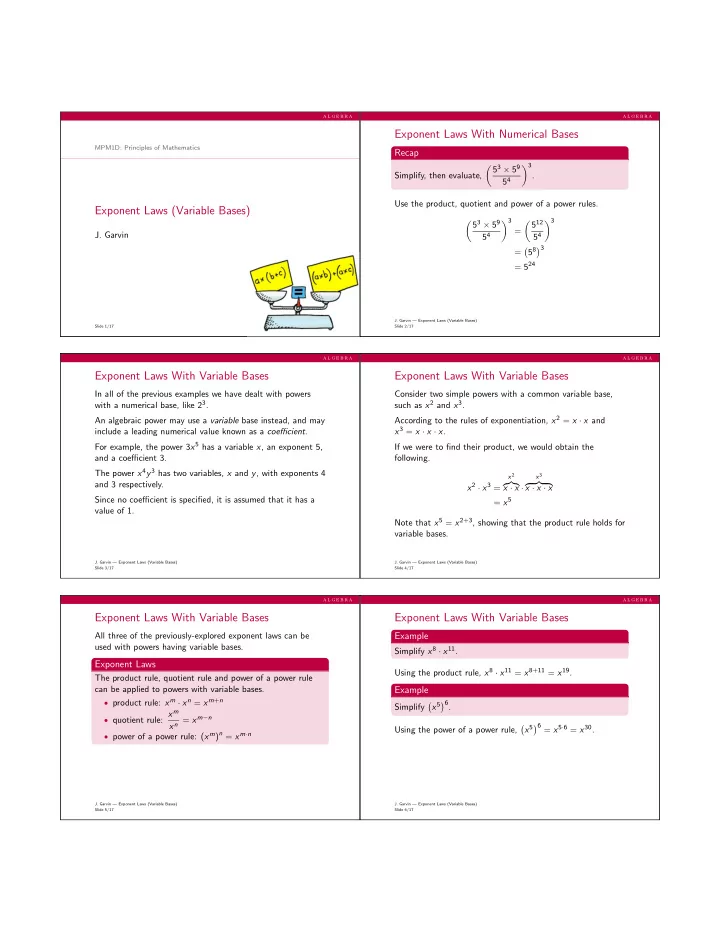
a l g e b r a a l g e b r a Exponent Laws With Numerical Bases MPM1D: Principles of Mathematics Recap 3 5 3 5 9 Simplify, then evaluate, . 5 4 Use the product, quotient and power of a power rules. Exponent Laws (Variable Bases)


slide-1
SLIDE 1

a l g e b r a

MPM1D: Principles of Mathematics

Exponent Laws (Variable Bases)

  • J. Garvin

Slide 1/17

a l g e b r a

Exponent Laws With Numerical Bases

Recap

Simplify, then evaluate, 53 × 59 54 3 . Use the product, quotient and power of a power rules. 53 × 59 54 3 = 512 54 3 =

  • 583

= 524

  • J. Garvin — Exponent Laws (Variable Bases)

Slide 2/17

a l g e b r a

Exponent Laws With Variable Bases

In all of the previous examples we have dealt with powers with a numerical base, like 23. An algebraic power may use a variable base instead, and may include a leading numerical value known as a coefficient. For example, the power 3x5 has a variable x, an exponent 5, and a coefficient 3. The power x4y3 has two variables, x and y, with exponents 4 and 3 respectively. Since no coefficient is specified, it is assumed that it has a value of 1.

  • J. Garvin — Exponent Laws (Variable Bases)

Slide 3/17

a l g e b r a

Exponent Laws With Variable Bases

Consider two simple powers with a common variable base, such as x2 and x3. According to the rules of exponentiation, x2 = x · x and x3 = x · x · x. If we were to find their product, we would obtain the following. x2 · x3 =

x2

  • x · x ·

x3

x · x · x = x5 Note that x5 = x2+3, showing that the product rule holds for variable bases.

  • J. Garvin — Exponent Laws (Variable Bases)

Slide 4/17

a l g e b r a

Exponent Laws With Variable Bases

All three of the previously-explored exponent laws can be used with powers having variable bases.

Exponent Laws

The product rule, quotient rule and power of a power rule can be applied to powers with variable bases.

  • product rule: xm · xn = xm+n
  • quotient rule: xm

xn = xm−n

  • power of a power rule: (xm)n = xm·n
  • J. Garvin — Exponent Laws (Variable Bases)

Slide 5/17

a l g e b r a

Exponent Laws With Variable Bases

Example

Simplify x8 · x11. Using the product rule, x8 · x11 = x8+11 = x19.

Example

Simplify

  • x56.

Using the power of a power rule,

  • x56 = x5·6 = x30.
  • J. Garvin — Exponent Laws (Variable Bases)

Slide 6/17

slide-2
SLIDE 2

a l g e b r a

Exponent Laws With Variable Bases

Example

Simplify x7 · x9 x12 8 Use all three exponent laws. x7 · x9 x12 8 = x16 x12 8 =

  • x48

= x32

  • J. Garvin — Exponent Laws (Variable Bases)

Slide 7/17

a l g e b r a

Exponent Laws With Variable Bases

Consider the expression 2x3 · 4x2. Since multiplication is commutative, we can rearrange the values. 2x3 · 4x2 = 2 · 4 · x3 · x2 = 8x5 The same is true for division. 6x7 2x4 = 6 2 · x7 x4 = 3x3

  • J. Garvin — Exponent Laws (Variable Bases)

Slide 8/17

a l g e b r a

Exponent Laws With Variable Bases

This suggests that the product and quotient rules are valid for powers involving coefficients, provided we multiply or divide the coefficients as necessary.

Product/Quotient Rules w/ Coefficients/Multiple Variables

When using the product/quotient rules with like-base powers involving coefficients, the new coefficient has a value equal to the product/quotient of the given coefficients.

  • J. Garvin — Exponent Laws (Variable Bases)

Slide 9/17

a l g e b r a

Exponent Laws With Variable Bases

Example

Simplify 5x2 · 7x10. Using the product rule, 5x2 · 7x10 = 5 · 7 · x2 · x10 = 35x12

Example

Simplify 18x9 10x5 . Using the quotient rule, 18x9 10x5 = 18 10 · x9 x5 = 9

5x4

  • J. Garvin — Exponent Laws (Variable Bases)

Slide 10/17

a l g e b r a

Exponent Laws With Variable Bases

Consider the expression (2x)3. Using the definition of exponentiation, we can rewrite the expression in its longer form. (2x)3 = (2x)(2x)(2x) = (2 · 2 · 2)(x · x · x) = 23x3 = 8x3 This suggests the following rule.

Power of a Power Rule w/ Coefficients/Multiple Variables

When using the power of a power rule with a power involving a coefficient, the new coefficient has a value equal to the given coefficient raised to the given power.

  • J. Garvin — Exponent Laws (Variable Bases)

Slide 11/17

a l g e b r a

Exponent Laws With Variable Bases

Example

Simplify

  • 3x74.

Apply the exponent to the coefficient and to the variable.

  • 3x74 = 34x7·4

= 81x28 Like the other exponent laws, this can be extended to examples involving more than one variable.

  • J. Garvin — Exponent Laws (Variable Bases)

Slide 12/17

slide-3
SLIDE 3

a l g e b r a

Exponent Laws With Variable Bases

Example

Simplify

  • 8x3y52.

Apply the exponent to the coefficient and to both variables.

  • 8x3y52 = 82x3·2y5·2

= 64x6y10

  • J. Garvin — Exponent Laws (Variable Bases)

Slide 13/17

a l g e b r a

Exponent Laws With Variable Bases

Example

Simplify 6x5y 9x2y3 2 . One method is to apply the exponent to all coefficients and variables, then simplify after. 6x5y 9x2y3 2 = 62x10y2 92x4y6 = 36x10y2 81x4y6 = 4x6 9y4

  • J. Garvin — Exponent Laws (Variable Bases)

Slide 14/17

a l g e b r a

Exponent Laws With Variable Bases

A better method is to simplify first, since the values will be smaller and (possibly) easier to work with. 6x5y 9x2y3 2 = 2x3 3y2 2 = 22x6 32y4 = 4x6 9y4 Both methods lead to the same answer, but the latter is preferred.

  • J. Garvin — Exponent Laws (Variable Bases)

Slide 15/17

a l g e b r a

Exponent Laws With Variable Bases

Example

Simplify

  • 2x34

(3x6)2 . Use the power of a power rule, and the quotient rule.

  • 2x34

(3x6)2 = 24x3·4 32x6·2 = 16x12 9x12 = 16

9

Note that the variable x cancels completely.

  • J. Garvin — Exponent Laws (Variable Bases)

Slide 16/17

a l g e b r a

Questions?

  • J. Garvin — Exponent Laws (Variable Bases)

Slide 17/17