
SLIDE 1
EXERCISING RESTRAINT
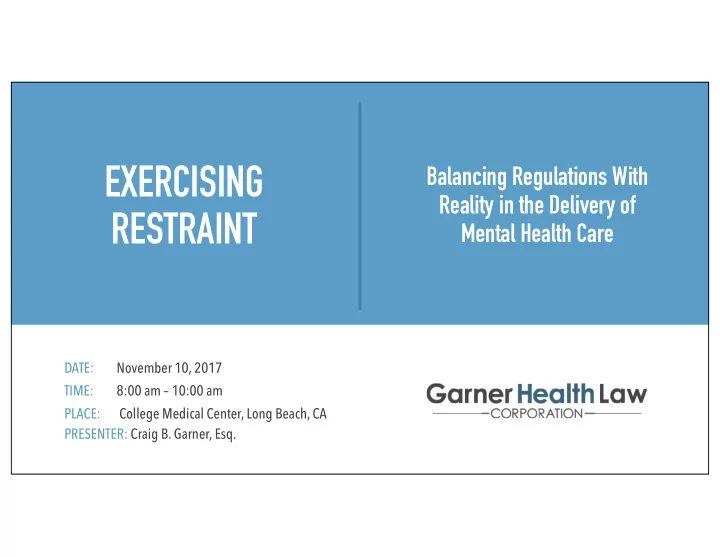
DATE: November 10, 2017 TIME: 8:00 am – 10:00 am PLACE: College Medical Center, Long Beach, CA PRESENTER: Craig B. Garner, Esq.
EXERCISING Balancing Regulations With Reality in the Delivery of - - PowerPoint PPT Presentation
EXERCISING Balancing Regulations With Reality in the Delivery of RESTRAINT Mental Health Care DATE: November 10, 2017 TIME: 8:00 am 10:00 am PLACE: College Medical Center, Long Beach, CA PRESENTER: Craig B. Garner, Esq. Introduction
DATE: November 10, 2017 TIME: 8:00 am – 10:00 am PLACE: College Medical Center, Long Beach, CA PRESENTER: Craig B. Garner, Esq.
“Crazy” is a term of art; “Insane” is a term of law. Remember that, and you will save yourself a lot of trouble.
EXERCISING RESTRAINT
Ba Bala lancin ing Regula lation ions wit ith Realit lity in in the Deliv livery of
l He Healt lth Ca Care
Craig B. Garner, Esq. Garner Health Law Corporation
§ In the twentieth century, the network of care facilities in the United States expanded from a mere 149 hospitals in 1873 to 6,665 by 1913. § Included among these were a growing number of specialized institutions that catered to specific conditions that had only recently been diagnosed as illnesses. § The burgeoning science of psychiatry and advances in the treatment of addiction were at the forefront of such change, creating a demand for stand- alone structures often based in rural settings.
EXERCISING RESTRAINT
Ba Bala lancin ing Regula lation ions wit ith Realit lity in in the Deliv livery of
l He Healt lth Ca Care
Craig B. Garner, Esq. Garner Health Law Corporation
§ California’s first state-run psychiatric hospital, Stockton State Hospital, opened in 1853. § For the next 50 years, municipalities in California shifted the financial burden for psychiatric treatment to state institutions. § Wealthy patients received treatment in secluded, private facilities. § By 1959, California’s 14 state hospitals cared for a population of 37,500 (one doctor for every 300 patients).
EXERCISING RESTRAINT
Ba Bala lancin ing Regula lation ions wit ith Realit lity in in the Deliv livery of
l He Healt lth Ca Care
Craig B. Garner, Esq. Garner Health Law Corporation
§ California’s inability to effectively and humanely treat these mental health patients necessitated change. § New antipsychotic and anti-depression medication in the 1950s started to replace previous treatments like the lobotomy. § The introduction of chlorpromazine (Thorazine) and other related medications created opportunities for community-based treatment.
Craig B. Garner, Esq. Garner Health Law Corporation
EXERCIS ISIN ING RESTRAIN INT
Ba Bala lancin ing Regula lation ions wit ith Realit lity in in the Deliv livery of
l He Healt lth Ca Care
§ As early as 1890, German scientist Friederich Golz surgically removed the temporal lobe in dogs to make a canine calmer. § By 1940, Dr. Walter Freeman convinced the world that the “icepick lobotomy” method worked, resulting in more than 18,000 lobotomies in the U.S. between 1939 and 1951. § By the 1970s, many U.S. states had banned the procedure. § The Soviet Union outlawed the lobotomy in 1940 because, according to Stalin, it turned “an insane person into an idiot.”
When dealing with the insane, the best method is to pretend to be sane.
EXERCISING RESTRAINT
Ba Bala lancin ing Regula lation ions wit ith Realit lity in in the Deliv livery of
l He Healt lth Ca Care
Craig B. Garner, Esq. Garner Health Law Corporation
The following are descriptions of the most common categories of mental illness in the United States: § Anxiety disorders are characterized by excessive fear or anxiety that is difficult to control and negatively impacts daily functioning. An estimated 40 million people in the United States experience an anxiety disorder in any given year. § Attention deficit hyperactivity disorder (ADHD) is defined by a persistent patter
EXERCISING RESTRAINT
Ba Bala lancin ing Regula lation ions wit ith Realit lity in in the Deliv livery of
l He Healt lth Ca Care
Craig B. Garner, Esq. Garner Health Law Corporation
EXERCISING RESTRAINT
Ba Bala lancin ing Regula lation ions wit ith Realit lity in in the Deliv livery of
l He Healt lth Ca Care
Craig B. Garner, Esq. Garner Health Law Corporation
EXERCISING RESTRAINT
Ba Bala lancin ing Regula lation ions wit ith Realit lity in in the Deliv livery of
l He Healt lth Ca Care
Craig B. Garner, Esq. Garner Health Law Corporation
§ Approximately one in five Americans experience mental illness. § As of 2014, six percent of the population was living with a severe mental illness like schizophrenia, major depression or bipolar disorder. § Mental health illness costs approximately $193.2 billion in lost earnings annually. § Two-thirds of the individuals with “potentially diagnosable disorders avoid treatment due to costs.
EXERCISING RESTRAINT
Ba Bala lancin ing Regula lation ions wit ith Realit lity in in the Deliv livery of
l He Healt lth Ca Care
Craig B. Garner, Esq. Garner Health Law Corporation
§ Mental health is subjective, just as diagnosis of schizophrenia relies on a spectrum, psychotic examples range from hallucinations to speech impediments, and bipolar affective disorder by definition alternates between periods of elevated mood and depression. § The International Statistical Classification of Diseases and Related Health Problems (ICD-10) contains more than 70,000 different physical health concerns, and the fifth edition of the Diagnostic and Statistical Manual of Mental Disorders (DSM-V) hovers close to 300 disorders from which to choose.
An alcoholic is someone you don’t like, who drinks as much as you do. -- Dylan Thomas
Craig B. Garner, Esq. Garner Health Law Corporation
EXERCIS ISIN ING RESTRAIN INT
Ba Bala lancin ing Regula lation ions wit ith Realit lity in in the Deliv livery of
l He Healt lth Ca Care
§ In 2014, an estimated 27 million Americans (10.2 percent of the population) aged 12 or older had used an illicit drug in the past month. § In 2014, approximately 21.5 million people aged 12 or older had a substance use disorder (includes 17 million people with an alcohol use disorder, 7.1 million with an illicit drug use disorder, and 2.6 million who had both). § Marijuana is the most used drug, with approximately 22.2 million current users in the United States (8.4% of the population aged 12 or older).
EXERCISING RESTRAINT
Ba Bala lancin ing Regula lation ions wit ith Realit lity in in the Deliv livery of
l He Healt lth Ca Care
Craig B. Garner, Esq. Garner Health Law Corporation
§ SAMHSA is charged with improving quality and availability of prevention, treatment and rehabilitation services. § SAMHSA Strategic Initiatives help provide treatment and services for people with mental and substance use disorders as well as support the families of people with mental and substance use disorders. § SAMHSA acts through advisory councils or committees to advance its goals, and at the same time draws advice from public members and professionals in the field of substance abuse and mental health.
EXERCISING RESTRAINT
Ba Bala lancin ing Regula lation ions wit ith Realit lity in in the Deliv livery of
l He Healt lth Ca Care
Craig B. Garner, Esq. Garner Health Law Corporation
SAMHSA advisory councils and committees: § SAMHSA National Advisory Council § Center for Mental Health Services National Advisory Council § Center for Substance Abuse Prevention National Advisory Council § Advisory Committee for Women’s Services § Drug Testing Advisory Board § Tribal Technical Advisory Committee
EXERCISING RESTRAINT
Ba Bala lancin ing Regula lation ions wit ith Realit lity in in the Deliv livery of
l He Healt lth Ca Care
Craig B. Garner, Esq. Garner Health Law Corporation
§ Department of Health Care Services’ (DHCS) Mental Health and Substance Abuse Services (MHSUDS) – Partners & Stakeholders webpage: http://www.dhcs.ca.gov/provgovpart/Pages/MH-SUD_Partners- Stakeholders.aspx § MHSUDS is committed to ensuring the best possible planning, delivery and monitoring.
EXERCISING RESTRAINT
Ba Bala lancin ing Regula lation ions wit ith Realit lity in in the Deliv livery of
l He Healt lth Ca Care
Craig B. Garner, Esq. Garner Health Law Corporation
§ California Proposition 36, the Substance Abuse and Crime Prevention Act of 2000, allows qualifying defendants convicted
non-violent drug possession offenses to receive a probationary sentence in lieu of incarceration. § As a condition of probation defendants are required to participate in and complete a licensed and/or certified community drug treatment program. § If the defendant fails to complete this program or violates any other term or condition of their probation, then probation can be revoked.
Madness is rare in individuals – but in groups, political parties, nations, and eras it’s the rule.
Craig B. Garner, Esq. Garner Health Law Corporation
EXERCIS ISIN ING RESTRAIN INT
Ba Bala lancin ing Regula lation ions wit ith Realit lity in in the Deliv livery of
l He Healt lth Ca Care
§ 5150 (California Welfare and Institutions Code § 5150): Applies to involuntary psychiatric holds lasting three days. § 5250: Applies to involuntary holds lasting up to 14 days. § 5260: Additional 14 days with threatened or attempted suicide. § 5270: Applies to involuntary holds lasting up to 30 days. § After 30 days, gravely disabled persons may require a conservatorship hearing (Section 5270.55). § The maximum time for involuntary detention is 47 days (6.7 weeks, 1128 hours, 67,680 minutes).
EXERCISING RESTRAINT
Ba Bala lancin ing Regula lation ions wit ith Realit lity in in the Deliv livery of
l He Healt lth Ca Care
Craig B. Garner, Esq. Garner Health Law Corporation
When a person, as a result of a mental health disorder is a danger to self or
certain in pe pers rsons may, upon probable cause, take the person into custody, or cause the person to be taken into custody, and place the person in a facility designated by the county and approved by DHCS as a facility for evaluation and treatment.
EXERCISING RESTRAINT
Ba Bala lancin ing Regula lation ions wit ith Realit lity in in the Deliv livery of
l He Healt lth Ca Care
Craig B. Garner, Esq. Garner Health Law Corporation
§ A pe peace of
§ A pr professional pe person in charge of a facility designated by the county for evaluation and treatment; or § A me memb mber of
the at attending st staff of a county-designated evaluation facility who is authorized to admit a patient involuntarily; § Designated members of a mo mobile cr crisis isis te team; § Any other professional person designated by the county.
EXERCISING RESTRAINT
Ba Bala lancin ing Regula lation ions wit ith Realit lity in in the Deliv livery of
l He Healt lth Ca Care
Craig B. Garner, Esq. Garner Health Law Corporation
When determining if pr proba babl ble ca cause use exists to take a person into custody, or cause a person to be taken into custody, pursuant to Section 5150, consider available relevant information about the historical course of the person’s mental disorder if the authorized person determines that the information has a reasonable bearing on the determination as to whether the person is a danger to others, or to himself or herself, or is gravely disabled as a result of the mental disorder.
EXERCISING RESTRAINT
Ba Bala lancin ing Regula lation ions wit ith Realit lity in in the Deliv livery of
l He Healt lth Ca Care
Craig B. Garner, Esq. Garner Health Law Corporation
For purposes of this section, “info informatio ion ab abou
the hi histori
al co cour urse se of
pe person’s me mental al di disorde der” includes evidence presented by the person who has provided or is providing mental health or related support services to the person subject to a determination, evidence presented by one or more members of the family of that person, and evidence presented by the person subject to a determination (or anyone designated by that person).
EXERCISING RESTRAINT
Ba Bala lancin ing Regula lation ions wit ith Realit lity in in the Deliv livery of
l He Healt lth Ca Care
Craig B. Garner, Esq. Garner Health Law Corporation
If the probable cause is based on the statement of a person other than the one authorized to take the person into custody pursuant to Section 5150, a member
shall be liable in a civil action for intentionally giving any statement that he or she knows to be false.
EXERCISING RESTRAINT
Ba Bala lancin ing Regula lation ions wit ith Realit lity in in the Deliv livery of
l He Healt lth Ca Care
Craig B. Garner, Esq. Garner Health Law Corporation
”G ”Grave vely d y disabled” means either of the following: § A condition in which a person, as a result of a mental health disorder, is unable to provide for his or her basic personal needs for food, clothing, or shelter. § A condition in which a person, has been found mentally incompetent. The term “gravely disabled” does not include persons with intellectual disabilities by reason of that disability alone.
EXERCISING RESTRAINT
Ba Bala lancin ing Regula lation ions wit ith Realit lity in in the Deliv livery of
l He Healt lth Ca Care
Craig B. Garner, Esq. Garner Health Law Corporation
A person is found mentally incompetent if al all of the following facts exist: § At the time of commitment there are charges of a felony involving death, great bodily harm, or a serious threat to the physical well-being of another person. § Charges have not been dismissed. § As a result of a mental health disorder, the person is unable to understand the nature and purpose of the proceedings taken against him or her and to assist counsel in the conduct of his or her defense in a rational manner.
EXERCISING RESTRAINT
Ba Bala lancin ing Regula lation ions wit ith Realit lity in in the Deliv livery of
l He Healt lth Ca Care
Craig B. Garner, Esq. Garner Health Law Corporation
The Lanterman-Petris-Short (LPS) Act did not create a private right of action against hospital and physician for allegedly failing to review “false” statement of probable cause submitted by school district's police officers in support of placing a teacher under a 72-hour hold, failing to determine that teacher did not meet the criteria for detention, failing to assess and evaluate teacher in accordance with the LPS Act, and failing to provide her with a written statement of her rights. Julian v. Mission Community Hospital (2017)
EXERCISING RESTRAINT
Ba Bala lancin ing Regula lation ions wit ith Realit lity in in the Deliv livery of
l He Healt lth Ca Care
Craig B. Garner, Esq. Garner Health Law Corporation
If a person is detained for 72 hours under Section 5150, or under court order for evaluation, and has received an evaluation, he or she may be certified for not more than 14 days of intensive treatment related to the mental health disorder
EXERCISING RESTRAINT
Ba Bala lancin ing Regula lation ions wit ith Realit lity in in the Deliv livery of
l He Healt lth Ca Care
Craig B. Garner, Esq. Garner Health Law Corporation
§ The professional staff of the agency or facility providing evaluation services has analyzed the person's condition and has found the person is, as a result
§ The facility providing intensive treatment is designated by the county to provide intensive treatment, and agrees to admit the person. No facility shall be designated to provide intensive treatment unless it complies with the certification review hearing required law.
accept, treatment on a voluntary basis.
EXERCISING RESTRAINT
Ba Bala lancin ing Regula lation ions wit ith Realit lity in in the Deliv livery of
l He Healt lth Ca Care
Craig B. Garner, Esq. Garner Health Law Corporation
§ A person is not “gravely disabled” if that person can survive safely without involuntary detention with the help of responsible family, friends, or others who are both willing and able to help provide for the person's basic personal needs for food, clothing, or shelter. § However, unless they specifically indicate in writing their willingness and ability to help, family, friends, or others shall not be considered willing or able to provide this help.
EXERCISING RESTRAINT
Ba Bala lancin ing Regula lation ions wit ith Realit lity in in the Deliv livery of
l He Healt lth Ca Care
Craig B. Garner, Esq. Garner Health Law Corporation
At the expiration of the 14–day period of intensive treatment any person who, as a result of mental disorder or impairment by chronic alcoholism, during the 14– day period or the 72–hour evaluation period, threatened or attempted to take his or her own life or who was detained for evaluation and treatment because he or she threatened or attempted to take his or her own life and who continues to present an imminent threat of taking his or her own life, may be confined for further intensive treatment pursuant to this article for an additional period not to exceed 14 days.
EXERCISING RESTRAINT
Ba Bala lancin ing Regula lation ions wit ith Realit lity in in the Deliv livery of
l He Healt lth Ca Care
Craig B. Garner, Esq. Garner Health Law Corporation
The following conditions must apply: § The person's condition is such that the person presents an imminent threat of taking his or her own life. § The person has been advised of, but has not accepted, voluntary treatment. [continued]
EXERCISING RESTRAINT
Ba Bala lancin ing Regula lation ions wit ith Realit lity in in the Deliv livery of
l He Healt lth Ca Care
Craig B. Garner, Esq. Garner Health Law Corporation
§ The facility providing additional intensive treatment is equipped and staffed to provide treatment, is designated by the county to provide that intensive treatment, and agrees to admit the person. § The person has, as a result of mental disorder or impairment by chronic alcoholism, threatened or attempted to take his or her own life during the 14– day period of intensive treatment or the 72–hour evaluation period or was detained for evaluation and treatment because he or she threatened or attempted to take his or her own life.
EXERCISING RESTRAINT
Ba Bala lancin ing Regula lation ions wit ith Realit lity in in the Deliv livery of
l He Healt lth Ca Care
Craig B. Garner, Esq. Garner Health Law Corporation
It is the intent of the Legislature to reduce the number of gravely disabled persons for whom conservatorship petitions are filed and who are placed under the extensive powers and authority of a temporary conservator simply to obtain an additional period of treatment without the belief that a conservator is actually needed and without the intention of proceeding to trial on the conservatorship petition.
EXERCISING RESTRAINT
Ba Bala lancin ing Regula lation ions wit ith Realit lity in in the Deliv livery of
l He Healt lth Ca Care
Craig B. Garner, Esq. Garner Health Law Corporation
Upon the completion of a 14–day period of intensive treatment pursuant to Section 5250, the person may be certified for an additional period of not more than 30 days of intensive treatment under both of the following conditions: § The professional staff of the agency or facility treating the person has found that the person remains gravely disabled as a result of a mental disorder or impairment by chronic alcoholism. § The person remains unwilling or unable to accept treatment voluntarily.
EXERCISING RESTRAINT
Ba Bala lancin ing Regula lation ions wit ith Realit lity in in the Deliv livery of
l He Healt lth Ca Care
Craig B. Garner, Esq. Garner Health Law Corporation
A person certified for an additional 30 days shall be provided a certification review hearing unless a judicial review is requested. § Reasonable attempts shall be made by the mental health facility to notify family members or any other person designated by the patient at least 36 hours prior to the certification review hearing, of the time and place of the certification hearing, unless the patient requests that this information not be provided.
EXERCISING RESTRAINT
Ba Bala lancin ing Regula lation ions wit ith Realit lity in in the Deliv livery of
l He Healt lth Ca Care
Craig B. Garner, Esq. Garner Health Law Corporation
§ The professional staff of the agency or facility providing intensive treatment shall analyze the person's condition at intervals of not to exceed 10 days, to determine whether the person continues to meet the criteria established for certification under this section, and shall daily monitor the person's treatment plan and progress.
EXERCISING RESTRAINT
Ba Bala lancin ing Regula lation ions wit ith Realit lity in in the Deliv livery of
l He Healt lth Ca Care
Craig B. Garner, Esq. Garner Health Law Corporation
A certification pursuant to this article shall be for no more than 30 days of intensive treatment, and shall terminate only as soon as the psychiatrist directly responsible for the person's treatment believes, as a result of the psychiatrist's personal observations, that the person no longer meets the criteria for the certification, or is prepared to voluntarily accept treatment on a referral basis or to remain on a voluntary basis in the facility providing intensive treatment.
EXERCISING RESTRAINT
Ba Bala lancin ing Regula lation ions wit ith Realit lity in in the Deliv livery of
l He Healt lth Ca Care
Craig B. Garner, Esq. Garner Health Law Corporation
However, in those situations in which both a psychiatrist and psychologist have personally evaluated or examined a person who is undergoing intensive treatment and there is a collaborative treatment relationship between the psychiatrist and the psychologist, either the psychiatrist or psychologist may authorize the release of the person but only after they have consulted with one another.
EXERCISING RESTRAINT
Ba Bala lancin ing Regula lation ions wit ith Realit lity in in the Deliv livery of
l He Healt lth Ca Care
Craig B. Garner, Esq. Garner Health Law Corporation
In the event of a clinical or professional disagreement regarding the early release of a person who is undergoing intensive treatment, the person may not be released unless the facility's medical director overrules the decision of the psychiatrist or psychologist opposing the release. Both the psychiatrist and psychologist shall enter their findings, concerns, or objections into the person's medical record.
EXERCISING RESTRAINT
Ba Bala lancin ing Regula lation ions wit ith Realit lity in in the Deliv livery of
l He Healt lth Ca Care
Craig B. Garner, Esq. Garner Health Law Corporation
If any other professional person who is authorized to release the person believes the person should be released before 30 days have elapsed, and the psychiatrist directly responsible for the person's treatment objects, the matter shall be referred to the medical director of the facility for the final decision. However, if the medical director is not a psychiatrist, he or she shall appoint a designee who is a psychiatrist.
EXERCISING RESTRAINT
Ba Bala lancin ing Regula lation ions wit ith Realit lity in in the Deliv livery of
l He Healt lth Ca Care
Craig B. Garner, Esq. Garner Health Law Corporation
If the matter is referred, the person shall be released before 30 days have elapsed only if the psychiatrist believes, as a result of the psychiatrist's personal
prepared to voluntarily accept treatment on referral or to remain on a voluntary basis in the facility providing intensive treatment.
EXERCISING RESTRAINT
Ba Bala lancin ing Regula lation ions wit ith Realit lity in in the Deliv livery of
l He Healt lth Ca Care
Craig B. Garner, Esq. Garner Health Law Corporation
Any person who has been certified for 30 days of intensive treatment under this article, shall be released at the end of 30 days unless one or more of the following is applicable: § The patient agrees to receive further treatment on a voluntary basis. § The patient is the subject of a conservatorship petition. § The patient is the subject of a petition for post certification treatment of a dangerous person.
EXERCISING RESTRAINT
Ba Bala lancin ing Regula lation ions wit ith Realit lity in in the Deliv livery of
l He Healt lth Ca Care
Craig B. Garner, Esq. Garner Health Law Corporation
Any individual who is knowingly and willfully responsible for detaining a person for more than 30 days in violation of the provisions of Section 5270.35 is liable to that person in civil damages.
EXERCISING RESTRAINT
Ba Bala lancin ing Regula lation ions wit ith Realit lity in in the Deliv livery of
l He Healt lth Ca Care
Craig B. Garner, Esq. Garner Health Law Corporation
§ If the provisions of Section 5270.35 have been met, the professional person in charge of the facility providing intensive treatment, his or her designee, and the professional person directly responsible for the person's treatment shall not be held civilly or criminally liable for any action by a person released before or at the end of 30 days pursuant to this article.
EXERCISING RESTRAINT
Ba Bala lancin ing Regula lation ions wit ith Realit lity in in the Deliv livery of
l He Healt lth Ca Care
Craig B. Garner, Esq. Garner Health Law Corporation
§ The attorney or advocate representing the person, the court-appointed commissioner or referee, the certification review hearing officer conducting the certification review hearing, or the peace officer responsible for detaining the person shall not be civilly or criminally liable for any action by a person released at or before the end of the 30 days of intensive treatment pursuant to this article.
EXERCISING RESTRAINT
Ba Bala lancin ing Regula lation ions wit ith Realit lity in in the Deliv livery of
l He Healt lth Ca Care
Craig B. Garner, Esq. Garner Health Law Corporation
Whenever it is contemplated that a gravely disabled person may need to be detained beyond the end of the 14-day period of intensive treatment and prior to proceeding with an additional 30-day certification, the professional person in charge of the facility shall cause an evaluation to be made, based on the patient's current condition and past history, as to whether it appears that the person, even after up to 30 days of additional treatment, is likely to qualify for appointment of a conservator.
EXERCISING RESTRAINT
Ba Bala lancin ing Regula lation ions wit ith Realit lity in in the Deliv livery of
l He Healt lth Ca Care
Craig B. Garner, Esq. Garner Health Law Corporation
§ If the appointment of a conservator appears likely, the conservatorship referral shall be made during the 14-day period of intensive treatment. § If it appears that with up to 30 days additional treatment a person is likely to reconstitute sufficiently to obviate the need for appointment of a conservator, then the person may be certified for the additional 30 days.
EXERCISING RESTRAINT
Ba Bala lancin ing Regula lation ions wit ith Realit lity in in the Deliv livery of
l He Healt lth Ca Care
Craig B. Garner, Esq. Garner Health Law Corporation
§ Where no conservatorship referral has been made during the 14-day period and where during the 30-day certification it appears that the person is likely to require the appointment of a conservator, then the conservatorship referral shall be made to allow sufficient time for conservatorship investigation and
EXERCISING RESTRAINT
Ba Bala lancin ing Regula lation ions wit ith Realit lity in in the Deliv livery of
l He Healt lth Ca Care
Craig B. Garner, Esq. Garner Health Law Corporation
§ If a temporary conservatorship is obtained, it shall run concurrently with and not consecutively to the 30-day certification period. The conservatorship hearing shall be held by the 30th day of the certification period. The maximum involuntary detention period for gravely disabled persons pursuant to Sections 5150, 5250 and 5270.15 shall be limited to 47 days.
EXERCISING RESTRAINT
Ba Bala lancin ing Regula lation ions wit ith Realit lity in in the Deliv livery of
l He Healt lth Ca Care
Craig B. Garner, Esq. Garner Health Law Corporation
Nothing in this article shall prohibit the professional person in charge of an intensive treatment facility, or a designee, from permitting a person certified for intensive treatment to leave the facility for short periods during the person's intensive treatment.
EXERCISING RESTRAINT
Ba Bala lancin ing Regula lation ions wit ith Realit lity in in the Deliv livery of
l He Healt lth Ca Care
Craig B. Garner, Esq. Garner Health Law Corporation
§ At the expiration of the 14-day period of intensive treatment, a person may be confined for further treatment for an additional 180 days if one of the following exists: § The person has or had attempted, inflicted, or made a serious threat of substantial physical harm upon the person of another after having been taken into custody, and while in custody, as a result of mental disorder or mental defect, presents a demonstrated danger of inflicting substantial physical harm upon others.
EXERCISING RESTRAINT
Ba Bala lancin ing Regula lation ions wit ith Realit lity in in the Deliv livery of
l He Healt lth Ca Care
Craig B. Garner, Esq. Garner Health Law Corporation
§ Any commitment to a licensed health facility under this article places an affirmative
person's mental disorder. § Amenability to treatment is not required for a finding that any person is a person as described above. § Treatment programs need only be made available to these persons. Treatment does not mean that the treatment be successful or potentially successful, and it does not mean that the person must recognize his or her problem and willingly participate in the treatment program.
EXERCISING RESTRAINT
Ba Bala lancin ing Regula lation ions wit ith Realit lity in in the Deliv livery of
l He Healt lth Ca Care
Craig B. Garner, Esq. Garner Health Law Corporation
§ “Custody” shall be construed to mean involuntary detainment under the provisions of this part uninterrupted by any period of unconditioned release from a licensed health facility providing involuntary care and treatment. § Conviction of a crime is not necessary for commitment under this article. § Demonstrated danger may be based on assessment of present mental condition, which is based upon a consideration of past behavior of the person within six years prior to the time the person attempted, inflicted, or threatened physical harm upon another, and other relevant evidence.
If you have ten thousand regulations you destroy all respect for the law.
EXERCISING RESTRAINT
Ba Bala lancin ing Regula lation ions wit ith Realit lity in in the Deliv livery of
l He Healt lth Ca Care
Craig B. Garner, Esq. Garner Health Law Corporation
§ “Acute psychiatric hospital” means a hospital having a duly constituted governing body with
provides 24-hour inpatient care for mentally disordered, incompetent or other patients, including the following basic services: medical, nursing, rehabilitative, pharmacy and dietary services. § “General acute care hospital” means a health facility having a duly constituted governing body with overall administrative and professional responsibility and an organized medical staff that provides 24-hour inpatient care, including the following basic services: medical, nursing, surgical, anesthesia, laboratory, radiology, pharmacy, and dietary services.
EXERCISING RESTRAINT
Ba Bala lancin ing Regula lation ions wit ith Realit lity in in the Deliv livery of
l He Healt lth Ca Care
Craig B. Garner, Esq. Garner Health Law Corporation
STANDARD (PC.03.05.01): § The hospital uses restraint or seclusion only when it can be clinically justified or when warranted by patient behavior that threatens the physical safety of the patient, staff or
EXERCISING RESTRAINT
Ba Bala lancin ing Regula lation ions wit ith Realit lity in in the Deliv livery of
l He Healt lth Ca Care
Craig B. Garner, Esq. Garner Health Law Corporation
ELEMENTS OF PERFORMANCE (PC.03.05.01): § The hospital uses restraint or seclusion only to protect the immediate physical safety of the patient, staff or others. § The hospital does not use restraint or seclusion as a means of coercion, discipline, or convenience, or staff retaliation. § The hospital uses restraint or seclusion only when less restrictive interventions are ineffective. § The hospital uses the least restrictive form of restraint or seclusion that protects the physical safety of the patient, staff, or others. § The hospital discontinues restraint or seclusion at the earliest possible time, regardless of the scheduled expiration of the order.
EXERCISING RESTRAINT
Ba Bala lancin ing Regula lation ions wit ith Realit lity in in the Deliv livery of
l He Healt lth Ca Care
Craig B. Garner, Esq. Garner Health Law Corporation
STANDARD (PC.03.05.03): § The hospital uses restraint or seclusion safely.
EXERCISING RESTRAINT
Ba Bala lancin ing Regula lation ions wit ith Realit lity in in the Deliv livery of
l He Healt lth Ca Care
Craig B. Garner, Esq. Garner Health Law Corporation
ELEMENTS OF PERFORMANCE (PC.03.05.03): § The hospital implements restraint or seclusion using safe techniques identified by the hospital’s policies and procedures in accordance with law and regulation. § The use of restraint and seclusion is in accordance with a written modification to the patient’s plan of care.
EXERCISING RESTRAINT
Ba Bala lancin ing Regula lation ions wit ith Realit lity in in the Deliv livery of
l He Healt lth Ca Care
Craig B. Garner, Esq. Garner Health Law Corporation
STANDARD (PC.03.05.05): § The hospital initiates restraint or seclusion based on an individual order.
EXERCISING RESTRAINT
Ba Bala lancin ing Regula lation ions wit ith Realit lity in in the Deliv livery of
l He Healt lth Ca Care
Craig B. Garner, Esq. Garner Health Law Corporation
ELEMENTS OF PERFORMANCE (PC.03.05.05): § A physician, clinical psychologist, or other authorized licensed independent practitioner primarily responsible for the patient’s ongoing care orders the use of restraint or seclusion in accordance with hospital policy and law and regulation. § The hospital does not use standing orders or PRN (“as needed”) orders for restraint or seclusion. § The attending physician or clinical psychologist is consulted as soon as possible, in accordance with hospital policy, if he or she did not order the restraint or seclusion.
EXERCISING RESTRAINT
Ba Bala lancin ing Regula lation ions wit ith Realit lity in in the Deliv livery of
l He Healt lth Ca Care
Craig B. Garner, Esq. Garner Health Law Corporation
ELEMENTS OF PERFORMANCE (PC.03.05.05) (continued): § Unless state law is more restrictive, orders for the use of restraint or seclusion used for the management of violent or self-destructive behavior that jeopardizes the immediate physical safety of the patient, staff, or others may be renewed within the following limits: § 4 hours for adults 18 years of age or older § 2 hours for children and adolescents 9 to 17 years of age § 1 hour for children 9 years of age § Orders may be renewed according to the time limits for a maximum of 24 consecutive hours
EXERCISING RESTRAINT
Ba Bala lancin ing Regula lation ions wit ith Realit lity in in the Deliv livery of
l He Healt lth Ca Care
Craig B. Garner, Esq. Garner Health Law Corporation
ELEMENTS OF PERFORMANCE (PC.03.05.05) (continued): § Unless state law is more restrictive, every 24 hours, a physician, clinical psychologist, or
seclusion used for the management of violent or self-destructive behavior that jeopardizes the immediate physical safety of the patient, staff, or others in accordance with hospital policy and law and regulation. § Orders for restraint used to protect the physical safety of the nonviolent or non-self- destructive patient are renewed in accordance with hospital policy.
EXERCISING RESTRAINT
Ba Bala lancin ing Regula lation ions wit ith Realit lity in in the Deliv livery of
l He Healt lth Ca Care
Craig B. Garner, Esq. Garner Health Law Corporation
STANDARD (PC.03.05.07): § The hospital monitors patients who are restrained or secluded.
EXERCISING RESTRAINT
Ba Bala lancin ing Regula lation ions wit ith Realit lity in in the Deliv livery of
l He Healt lth Ca Care
Craig B. Garner, Esq. Garner Health Law Corporation
ELEMENTS OF PERFORMANCE (PC.03.05.07) § Trained physicians, clinical psychologists, or other licensed independent practitioners or staff monitor the condition of patients in restraint or seclusion.
EXERCISING RESTRAINT
Ba Bala lancin ing Regula lation ions wit ith Realit lity in in the Deliv livery of
l He Healt lth Ca Care
Craig B. Garner, Esq. Garner Health Law Corporation
STANDARD (PC.03.05.09): § The hospital has written policies and procedures that guide the use of restraint or seclusion.
EXERCISING RESTRAINT
Ba Bala lancin ing Regula lation ions wit ith Realit lity in in the Deliv livery of
l He Healt lth Ca Care
Craig B. Garner, Esq. Garner Health Law Corporation
ELEMENTS OF PERFORMANCE (PC.03.05.09): The hospital’s policies and procedures regarding restraint or seclusion include the following: § Physician, clinical psychologist, and other authorized licensed independent practitioner training requirements § Staff training requirements § The determination of who has authority to order restraint and seclusion § The determination of who has authority to discontinue the use of restraint or seclusion § The determination of who can initiate the use of restraint or seclusion
EXERCISING RESTRAINT
Ba Bala lancin ing Regula lation ions wit ith Realit lity in in the Deliv livery of
l He Healt lth Ca Care
Craig B. Garner, Esq. Garner Health Law Corporation
ELEMENTS OF PERFORMANCE (PC.03.05.09): (continued): § The circumstances under which restraint or seclusion is discontinued § The requirement that restraint or seclusion is discontinued as soon as is safely possible § A determination of who can assess and monitor patients in restraint or seclusion § Time frames for assessing and monitoring patients in restraint or seclusion § A definition of restraint § A definition of seclusion § A definition or description of what constitutes the use of medications as a restraint
EXERCISING RESTRAINT
Ba Bala lancin ing Regula lation ions wit ith Realit lity in in the Deliv livery of
l He Healt lth Ca Care
Craig B. Garner, Esq. Garner Health Law Corporation
STANDARD (PC.03.05.09): § The hospital has written policies and procedures that guide the use of restraint or seclusion. STANDARD (PC.03.05.11): § The hospital evaluates and reevaluates the patient who is restrained or secluded. STANDARD (PC.03.05.13): § The hospital continually monitors patients who are simultaneously restrained and secluded. STANDARD (PC.03.05.15): § The hospital documents the use of restraint or seclusion.
EXERCISING RESTRAINT
Ba Bala lancin ing Regula lation ions wit ith Realit lity in in the Deliv livery of
l He Healt lth Ca Care
Craig B. Garner, Esq. Garner Health Law Corporation
ELEMENTS OF PERFORMANCE (PC.03.05.15): § Any in-person medical and behavioral evaluation for restraint or seclusion used to manage violate or self-destructive behavior § A description of the patient’s behavior and the intervention used § Any alternatives or other less restrictive interventions attempted § The patient’s response to the intervention(s) used, including the rationale for continued use
§ Individual patient assessments and reassessments
EXERCISING RESTRAINT
Ba Bala lancin ing Regula lation ions wit ith Realit lity in in the Deliv livery of
l He Healt lth Ca Care
Craig B. Garner, Esq. Garner Health Law Corporation
ELEMENTS OF PERFORMANCE (PC.03.05.15) (continued): § The intervals for monitoring § Revisions to the plan of care § The patient’s behavior and staff concerns regarding safety risks to the patient, staff, and others § Injuries to the patient § Death associated with the use of restraint or seclusion § The identity of the physician, clinical psychologist, or other licensed independent practitioner who
§ Orders for restraint or seclusion
Reason has always existed, but not always in a reasonable form.
EXERCISING RESTRAINT
Ba Bala lancin ing Regula lation ions wit ith Realit lity in in the Deliv livery of
l He Healt lth Ca Care
Craig B. Garner, Esq. Garner Health Law Corporation
§ Written policies and procedures concerning the use of restraints and postural supports shall be followed. § Restraints shall only be used with a written order of a licensed healthcare practitioner acting within the scope of his or her professional licensure. The order must specify the duration and circumstances under which the restraints are to be used. Orders must be specific to individual patients.There shall be no standing orders. § The only acceptable forms of physical restraints shall be cloth vests, soft ties, soft cloth mittens, seat belts and trays with spring release devices. Soft ties means soft cloth which does not cause abrasion and which does not restrict blood circulation.
EXERCISING RESTRAINT
Ba Bala lancin ing Regula lation ions wit ith Realit lity in in the Deliv livery of
l He Healt lth Ca Care
Craig B. Garner, Esq. Garner Health Law Corporation
§ Restraints of any type shall not be used as punishment, as a substitute for more effective medical and nursing care, or for the convenience of staff. § No restraints with locking devices shall be used or available for use in a skilled nursing facility. § Seclusion, which is defined as the placement of a patient alone in a room, shall not be employed. § Restraints shall be used in such a way as not to cause physical injury to the patient and to insure the least possible discomfort to the patient. § Physical restraints shall be applied in such a manner that they can be speedily removed in case of fire or other emergency.
EXERCISING RESTRAINT
Ba Bala lancin ing Regula lation ions wit ith Realit lity in in the Deliv livery of
l He Healt lth Ca Care
Craig B. Garner, Esq. Garner Health Law Corporation
§ Treatment restraints may be used for the protection of the patient during treatment and diagnostic procedures such as, but not limited to, intravenous therapy or catheterization procedures. Treatment restraints shall be applied for no longer than the time required to complete the treatment. § Physical restraints for behavior control shall only be used on the signed order of a physician (in certain instances also a psychologist, or other person lawfully authorized to prescribe care) except in an emergency which threatens to bring immediate injury to the patient or others. § In such an emergency an order may be received by telephone, and shall be signed within 5
the physical restraint used, the length of effectiveness of the restraint time and the name of the individual applying such measures shall be entered in the patient's health record.
EXERCISING RESTRAINT
Ba Bala lancin ing Regula lation ions wit ith Realit lity in in the Deliv livery of
l He Healt lth Ca Care
Craig B. Garner, Esq. Garner Health Law Corporation
§ Physical restraints for behavioral control shall only be used with a written order designed to lead to a less restrictive way of managing, and ultimately to the elimination of, the behavior for which the restraint is applied.There shall be no PRN orders for behavioral restraints. § Each patient care plan which includes the use of physical restraint for behavior control shall specify the behavior to be eliminated, the method to be used and the time limit for the use
§ Patients shall be restrained only in an area that is under supervision of staff and shall be afforded protection from other patients who may be in the area.
EXERCISING RESTRAINT
Ba Bala lancin ing Regula lation ions wit ith Realit lity in in the Deliv livery of
l He Healt lth Ca Care
Craig B. Garner, Esq. Garner Health Law Corporation
§ The specific behavior or manifestation of disordered thought process to be treated with the drug is identified in the patient's health record. § The plan of care for each patient specifies data to be collected for use in evaluating the effectiveness of the drugs and the occurrence of adverse reactions. § The data collected shall be made available to the prescriber in a consolidated manner at least monthly. § PRN orders for such drugs shall be subject to the requirements of this section.
EXERCISING RESTRAINT
Ba Bala lancin ing Regula lation ions wit ith Realit lity in in the Deliv livery of
l He Healt lth Ca Care
Craig B. Garner, Esq. Garner Health Law Corporation
“Postural support” means a method other than orthopedic braces used to assist patients to achieve proper body position and balance. Postural supports may only include soft ties, seat belts, spring release trays or cloth vests and shall
prevent the patient from falling out of a bed or chair, or for positioning, rather than to restrict movement.These methods shall not be considered restraints.
EXERCISING RESTRAINT
Ba Bala lancin ing Regula lation ions wit ith Realit lity in in the Deliv livery of
l He Healt lth Ca Care
Craig B. Garner, Esq. Garner Health Law Corporation
§ The use of postural support and the method of application shall be specified in the patient's care plan and approved in writing by the physician, psychologist, or other person lawfully authorized to provide care. § Postural supports shall be applied: § Under the supervision of a licensed nurse. § In accordance with principles of good body alignment and with concern for circulation and allowance for change of position.
The evolution of sense is, in a sense, the evolution
EXERCISING RESTRAINT
Ba Bala lancin ing Regula lation ions wit ith Realit lity in in the Deliv livery of
l He Healt lth Ca Care
Craig B. Garner, Esq. Garner Health Law Corporation
No civil or criminal liability to licensed general acute care or psychiatric hospital,
any department for detaining a person if all of the following conditions exist during the detention.
EXERCISING RESTRAINT
Ba Bala lancin ing Regula lation ions wit ith Realit lity in in the Deliv livery of
l He Healt lth Ca Care
Craig B. Garner, Esq. Garner Health Law Corporation
§ The person cannot be safely released from the hospital because, in the opinion of the treating physician and surgeon, or a clinical psychologist with the medical staff privileges, clinical privileges, or professional responsibilities, the person, as a result
disabled. § The hospital staff, treating physician and surgeon, or appropriate licensed mental health professional, have made, and documented, repeated unsuccessful efforts to find appropriate mental health treatment for the person.
EXERCISING RESTRAINT
Ba Bala lancin ing Regula lation ions wit ith Realit lity in in the Deliv livery of
l He Healt lth Ca Care
Craig B. Garner, Esq. Garner Health Law Corporation
§ Telephone calls or other contacts required pursuant to this paragraph shall commence at the earliest possible time when the treating physician and surgeon has determined the time at which the person will be medically stable for transfer. § In no case shall the contacts required pursuant to this paragraph begin after the time when the person becomes medically stable for transfer. § The person is not detained beyond 24 hours. § There is probable cause for the detention.
EXERCISING RESTRAINT
Ba Bala lancin ing Regula lation ions wit ith Realit lity in in the Deliv livery of
l He Healt lth Ca Care
Craig B. Garner, Esq. Garner Health Law Corporation
If the person is detained beyond eight hours, but less than 24 hours, both of the following additional conditions shall be met: § A discharge or transfer for appropriate evaluation or treatment for the person has been delayed because of the need for continuous and ongoing care, observation, or treatment that the hospital is providing. § In the opinion of the treating physician and surgeon, or a clinical psychologist with the medical staff privileges or professional responsibilities, the person, as a result of a mental disorder, is still a danger to himself or herself, or others, or is gravely disabled.
EXERCISING RESTRAINT
Ba Bala lancin ing Regula lation ions wit ith Realit lity in in the Deliv livery of
l He Healt lth Ca Care
Craig B. Garner, Esq. Garner Health Law Corporation
In addition to the other immunities, a licensed general acute care or psychiatric hospital, licensed professional staff of those hospitals, or any physician and surgeon, providing emergency medical services in any department of those hospitals to a person at the hospital shall not be civilly or criminally liable for the actions of a person detained up to 24 hours after that person's release from the hospital, if all of the following conditions exist during the detention: § The person has not been admitted to a licensed general acute care hospital or a licensed acute psychiatric hospital for evaluation and treatment pursuant to Section 5150.
EXERCISING RESTRAINT
Ba Bala lancin ing Regula lation ions wit ith Realit lity in in the Deliv livery of
l He Healt lth Ca Care
Craig B. Garner, Esq. Garner Health Law Corporation
§ The release from the hospital is authorized by a physician and surgeon or a clinical psychologist with the medical staff privileges or professional responsibilities, who determines, based on a face-to-face examination of the person detained, that the person does not present a danger to himself or herself or others and is not gravely disabled. § In order for this paragraph to apply to a clinical psychologist, the clinical psychologist shall have a collaborative treatment relationship with the physician and surgeon. The clinical psychologist may authorize the release of the person from the detention, but only after he
EXERCISING RESTRAINT
Ba Bala lancin ing Regula lation ions wit ith Realit lity in in the Deliv livery of
l He Healt lth Ca Care
Craig B. Garner, Esq. Garner Health Law Corporation
§ In the event of a clinical or professional disagreement regarding the release of a person subject to the detention, the detention shall be maintained unless the hospital's medical director overrules the decision of the physician and surgeon opposing the release. Both the physician and surgeon and the clinical psychologist shall enter their findings, concerns, or objections in the person's medical record.
EXERCISING RESTRAINT
Ba Bala lancin ing Regula lation ions wit ith Realit lity in in the Deliv livery of
l He Healt lth Ca Care
Craig B. Garner, Esq. Garner Health Law Corporation
§ Nothing in this section shall affect the responsibility of a hospital to comply with all state laws and regulations pertaining to the use of seclusion and restraint and psychiatric medications for psychiatric patients. Persons detained under this section shall retain their legal rights regarding consent for medical treatment. § A person detained under this section shall be credited for the time detained, up to 24 hours, in the event he or she is placed on a subsequent 72-hour hold pursuant to Section 5150.
The hardest thing of all is to find a black cat in a dark room, especially if there is no cat.
EXERCISING RESTRAINT
Ba Bala lancin ing Regula lation ions wit ith Realit lity in in the Deliv livery of
l He Healt lth Ca Care
Craig B. Garner, Esq. Garner Health Law Corporation
§ The California legislature passed its own mental health parity laws in 1999. § The legislature found that coverage limitations resulted in inadequate treatment of mental illness, causing “untold suffering” for people with treatable conditions. § The legislature also found that the lack of mental health insurance resulted in increased expenses for local and state governments.
EXERCISING RESTRAINT
Ba Bala lancin ing Regula lation ions wit ith Realit lity in in the Deliv livery of
l He Healt lth Ca Care
Craig B. Garner, Esq. Garner Health Law Corporation
§ CMHPA prohibited “discrimination against people with biologically based mental illnesses, dispel[ed] unsound distinctions between mental and physical illnesses, and require[d] equitable coverage to prevent adverse risk selection.” § Provides the same coverage irrespective of age. § Benefits include (1) outpatient services, (2) inpatient hospital services, (3) partial hospital services and (4) prescription drugs. § Does not mention residential treatment.
EXERCISING RESTRAINT
Ba Bala lancin ing Regula lation ions wit ith Realit lity in in the Deliv livery of
l He Healt lth Ca Care
Craig B. Garner, Esq. Garner Health Law Corporation
§ The 2008 Paul Wellstone and Pete Domenici Mental Health Party and Addiction Equity Act (MHPAEA) became effective January 2010. § MHPAEA prohibits financial requirements and treatment limitations for mental health and substance abuse benefits in group health plans from being more restrictive than those placed on medical and surgical benefits. § MHPAEA applies to health plans provided by employers with more than 50 employees and individual plans purchased through a Health Care Exchange.
EXERCISING RESTRAINT
Ba Bala lancin ing Regula lation ions wit ith Realit lity in in the Deliv livery of
l He Healt lth Ca Care
Craig B. Garner, Esq. Garner Health Law Corporation
§ Does not apply to Medicare or Medicaid. § A qualified health plan must include at least ten essential health benefits, although certain states require more. § California mandates “chemical dependency services” must be consistent with MHPAEA, including inpatient detoxification, outpatient evaluation and treatment for chemical dependency, transitional residential recovery services or chemical dependency treatment in a residential recovery setting.
The secret of being a bore . . . is to tell everything.
EXERCISING RESTRAINT
Ba Bala lancin ing Regula lation ions wit ith Realit lity in in the Deliv livery of
l He Healt lth Ca Care
Craig B. Garner, Esq. Garner Health Law Corporation
§ Psychotherapy notes receive special protections under the HIPAA Privacy Rule. § Section 164.510(b)(3) of the HIPAA Privacy Rule permits a health care provider, when a patient is not present or is unable to agree or object to a disclosure due to incapacity or emergency circumstances, to determine whether disclosing a patient’s information to the patient’s family, friends, or other persons is in the best interests of the patient.
EXERCISING RESTRAINT
Ba Bala lancin ing Regula lation ions wit ith Realit lity in in the Deliv livery of
l He Healt lth Ca Care
Craig B. Garner, Esq. Garner Health Law Corporation
§ Federal law refers to psychotherapy notes as excluded from access (45 CFR Section 164.524). § But California does not set aside psychotherapy notes. California law wants to provide access to such health care records by patients. There are limits to this disclosure, however (Health and Safety Code Section 123115 (b)). § Providers should make a determination if there would be a "substantial risk of significant adverse or detrimental consequences to a patient in seeing or receiving a copy of mental health records requested by the patient.”
EXERCISING RESTRAINT
Ba Bala lancin ing Regula lation ions wit ith Realit lity in in the Deliv livery of
l He Healt lth Ca Care
Craig B. Garner, Esq. Garner Health Law Corporation
§ Make a written record, to be included with the mental health records requested, noting the dates of the request and explaining provider’s refusal to permit inspection or copying. § Include a description of the specific adverse or detrimental consequences to the patient that the provider anticipate. § Permit inspection by, or provide copies of the mental health records to, a licensed physician and surgeon, licensed psychologist, licensed marriage and family therapist, licensed clinical social worker, or licensed professional clinical counselor, designated by request of the patient.
EXERCISING RESTRAINT
Ba Bala lancin ing Regula lation ions wit ith Realit lity in in the Deliv livery of
l He Healt lth Ca Care
Craig B. Garner, Esq. Garner Health Law Corporation
§ Inform the patient of the refusal to permit the inspection or obtain copies of the requested records,AND § Inform the patient of the right to require the provider to permit inspection by,
licensed marriage and family therapist, licensed clinical social worker, or licensed professional clinical counselor designated by written authorization of the patient. § Indicate in the mental health records of the patient whether the request was made as set forth above.
EXERCISING RESTRAINT
Ba Bala lancin ing Regula lation ions wit ith Realit lity in in the Deliv livery of
l He Healt lth Ca Care
Craig B. Garner, Esq. Garner Health Law Corporation
§ A health care provider’s “duty to warn” generally is derived by standards of ethical conduct and state laws/court decisions. § HIPAA permits a provider to notify a patient’s family members of a serious and imminent threat to the health and safety of the patient or others if those family members are in a position to lesson or avert the threat. § Moses v. Providence Hospital and Medical Centers, Inc.: Sixth Circuit decision held that the EMTALA obligation to stabilize and emergency medical condition survives inpatient admission. Also expands right to sue to include anyone who is injured as a ”direct result” of the violation.
EXERCISING RESTRAINT
Ba Bala lancin ing Regula lation ions wit ith Realit lity in in the Deliv livery of
l He Healt lth Ca Care
Craig B. Garner, Esq. Garner Health Law Corporation
§ Proposed rule would revise 42 CFR, Part 2 (Confidentiality of Alcohol and Drug Abuse Patient Records). § Authorizing statute (42 U.S.C. Section 290dd-2) protects the confidentiality of the identity, diagnosis, prognosis or treatment of any patient records which are maintained in connection with the performance of any federally assisted program or activity relating to substance abuse education, prevention, training, treatment, rehabilitation or research. § Last update was 1987.
EXERCISING RESTRAINT
Ba Bala lancin ing Regula lation ions wit ith Realit lity in in the Deliv livery of
l He Healt lth Ca Care
Craig B. Garner, Esq. Garner Health Law Corporation
§ The laws and regulations governing confidentiality of substance abuse records were written out of great concern about the potential use of this information against individuals, causing them to avoid needed treatment. § Negative consequences of disclosure includes loss of employment, loss of housing, loss of child custody, discrimination by medical professionals and insurers, arrest and incarceration. § Proposed rule would make policy changes to the regulations to better align them with advances in the U.S. health care delivery system while retaining important protections.
EXERCISING RESTRAINT
Ba Bala lancin ing Regula lation ions wit ith Realit lity in in the Deliv livery of
l He Healt lth Ca Care
Craig B. Garner, Esq. Garner Health Law Corporation
§ Purpose is to modernize rules by facilitating the electronic exchange of substance use disorder information for treatment and other legitimate health care purposes while ensuring appropriate confidentiality protections for records that might identify an individual, directly or indirectly, as having or having had a substance use disorder. § SAMHSA proposed to define the term “substance use disorder” in such a manner as to cover substance use disorders that can be associated with altered mental status that has the potential to lead to risky and/or socially prohibited behaviors.
EXERCISING RESTRAINT
Ba Bala lancin ing Regula lation ions wit ith Realit lity in in the Deliv livery of
l He Healt lth Ca Care
Craig B. Garner, Esq. Garner Health Law Corporation
“Treating provider relationship” means that, regardless of whether there has been an actual in-person encounter: § A patient agrees to be diagnosed, evaluated and/or treated for any condition by an individual or entity, and § The individual or entity agrees to undertake diagnosis, evaluation and/or treatment
§ An agreement might be evidenced, among other things, by making an appointment
EXERCISING RESTRAINT
Ba Bala lancin ing Regula lation ions wit ith Realit lity in in the Deliv livery of
l He Healt lth Ca Care
Craig B. Garner, Esq. Garner Health Law Corporation
§ Delete the definition of “detoxification treatment” and replace it with the definition of the currently acceptable term “withdrawal management.” § Expand the definition of “patient.” § Delete the speed with which information could identify a patient and focus
§ Revise the definition of “Records” to include any information whether recorded
This includes both paper and electronic records.
EXERCISING RESTRAINT
Ba Bala lancin ing Regula lation ions wit ith Realit lity in in the Deliv livery of
l He Healt lth Ca Care
Craig B. Garner, Esq. Garner Health Law Corporation
§ Craig Garner is an attorney and health care consultant, specializing in issues surrounding modern American health care and the ways in which it should be managed in its current climate of reform. Craig’s law practice focuses on health care mergers and acquisitions, regulatory compliance and counseling for providers in all matters pertaining to contemporary health care in the United States. Craig is admitted as an attorney and counselor at law in the State of California, District of Columbia and the State of New York. § Craig’s consulting practice offers an array of short and long term services to help health care institutions navigate the fluid structure of the U.S. health care system, including interim management of health care institutions, strategic guidance, fair market valuations, analysis for health care mergers and acquisitions, development and implementation of health care regulatory compliance programs and expert consulting
13274 13274 Fiji Fiji Way, Suit Suite e 250 250 Ma Marina del Rey, CA CA 90292 (3 (310) ) 458-1560 1560 cra craig@garnerh rhealth th.co com www www.garner nerhea healt lth. h.com