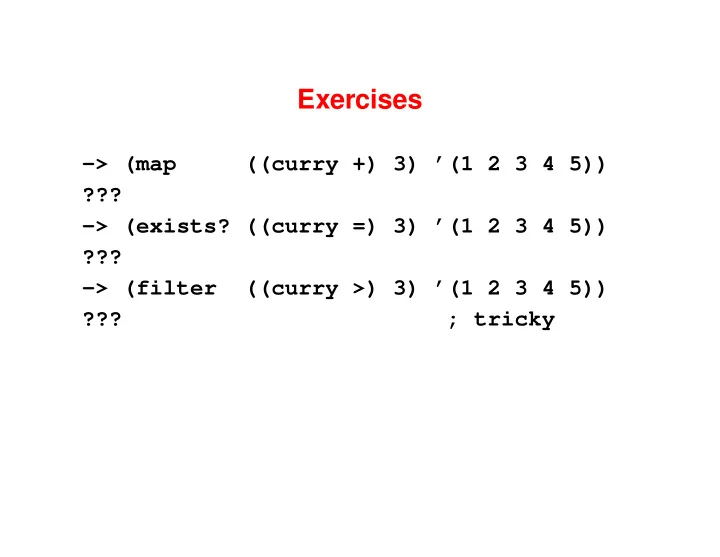
SLIDE 1 Exercises
((curry +) 3) ’(1 2 3 4 5)) ???
- > (exists? ((curry =) 3) ’(1 2 3 4 5))
???
((curry >) 3) ’(1 2 3 4 5)) ??? ; tricky
SLIDE 2 Answers
((curry +) 3) ’(1 2 3 4 5)) (4 5 6 7 8)
- > (exists? ((curry =) 3) ’(1 2 3 4 5))
#t
((curry >) 3) ’(1 2 3 4 5)) (1 2)
SLIDE 3 Defining exists?
- > (define exists? (p? xs)
(if (null? xs) #f (or (p? (car xs)) (exists? p? (cdr xs)))))
#f
- > (exists? even? ’(1 2 3))
#t
- > (exists? ((curry =) 0) ’(1 2 3))
#f
- > (exists? ((curry =) 0) ’(0 1 2 3))
#t
SLIDE 4
all?
SLIDE 5 Defining all?
(if (null? xs) #t (and (p? (car xs)) (all? p? (cdr xs)))))
#f
#t
- > (all? ((curry =) 0) ’(1 2 3))
#f
- > (all? ((curry =) 0) ’(0 0 0))
#t
SLIDE 6
Filter
SLIDE 7 Defining filter
(if (null? xs) ’() (if (p? (car xs)) (cons (car xs) (filter p? (cdr xs))) (filter p? (cdr xs)))))
n 0)) ’(1 2 -3 -4 5 6)) (1 2 5 6)
- > (filter (lambda (n) (<= n 0)) ’(1 2 -3 -4 5 6))
(-3 -4)
0) ’(1 2 -3 -4 5 6)) (1 2 5 6)
- > (filter ((curry >=) 0) ’(1 2 -3 -4 5 6))
(-3 -4)
SLIDE 8 Composition Revisited: List Filtering
- > (val positive? ((curry <) 0))
<procedure>
’(1 2 -3 -4 5 6)) (1 2 5 6)
- > (filter (o not positive?) ’(1 2 -3 -4 5 6))
(-3 -4)
SLIDE 9
Map
SLIDE 10 Defining map
(if (null? xs) ’() (cons (f (car xs)) (map f (cdr xs)))))
- > (map number? ’(3 a b (5 6)))
(#t #f #f #f)
- > (map ((curry *) 100) ’(5 6 7))
(500 600 700)
- > (val square* ((curry map) (lambda (n) (* n n))))
<procedure>
(1 4 9 16 25)
SLIDE 11
Foldr
SLIDE 12 Algebraic laws for foldr
Idea:
+ : :x1 +
+ 0
(foldr (plus zero ’())) = zero (foldr (plus zero (cons y ys))) = (plus y (foldr plus zero ys))
Note: Binary operator + associates to the right. Note: zero should be identity of plus.
SLIDE 13 Code for foldr
Idea:
+ : :x1 +
+ 0
- > (define foldr (plus zero xs)
(if (null? xs) zero (plus (car xs) (foldr plus zero (cdr xs)))))
(lambda (xs) (foldr + 0 xs)))
10
- > (val prod (lambda (xs) (foldr * 1 xs)))
- > (prod ’(1 2 3 4))
24
SLIDE 14
Another view of operator folding
’(1 2 3 4) = (cons 1 (cons 2 (cons 3 (cons 4 ’())))) (foldr + 0 ’(1 2 3 4)) = (+ 1 (+ 2 (+ 3 (+ 4 0 )))) (foldr f z ’(1 2 3 4)) = (f 1 (f 2 (f 3 (f 4 z ))))
SLIDE 15 Exercise
Idea:
+ : :x1 +
+ 0
- > (define combine (x a) (+ 1 a))
- > (foldr combine 0 ’(2 3 4 1))
???
SLIDE 16 Answer
Idea:
+ : :x1 +
+ 0
- > (define combine (x a) (+ 1 a))
- > (foldr combine 0 ’(2 3 4 1))
4
SLIDE 17 What is tail position?
Tail position is defined inductively:
- The body of a function is in tail position
- When (if e1 e2 e3) is in tail position, so are
e2 and e3
- When (let (...) e) is in tail position, so is e,
and similary for letrec and let*.
- When (begin e1 ... en) is in tail position, so
is en. Idea: The last thing that happens
SLIDE 18
Tail-call optimization
Before executing a call in tail position, abandon your stack frame Results in asymptotic space savings Works for any call!
SLIDE 19
Example of tail position
(define reverse (xs) (if (null? xs) ’() (append (reverse (cdr xs)) (list1 (car xs)))))
SLIDE 20
Example of tail position
(define reverse (xs) (if (null? xs) ’() (append (reverse (cdr xs)) (list1 (car xs)))))
SLIDE 21
Another example of tail position
(define revapp (xs zs) (if (null? xs) zs (revapp (cdr xs) (cons (car xs) zs))))
SLIDE 22
Another example of tail position
(define revapp (xs zs) (if (null? xs) zs (revapp (cdr xs) (cons (car xs) zs))))
SLIDE 23 Question
In your previous life, what did you call a construct that
- 1. Transfers control to an arbitrary point in the
code?