Exercises First order Logic Universit` a di Trento 17 March 2014 - - PDF document

exercises first order logic
SMART_READER_LITE
LIVE PREVIEW

Exercises First order Logic Universit` a di Trento 17 March 2014 - - PDF document

Exercises First order Logic Universit` a di Trento 17 March 2014 Exercise 1: Language For each of the following formulas indicate: (a) whether it is a negation, a conjunction, a disjunction, an implication, a universal formula, or an


slide-1
SLIDE 1

Exercises First order Logic

Universit` a di Trento 17 March 2014

Exercise 1: Language

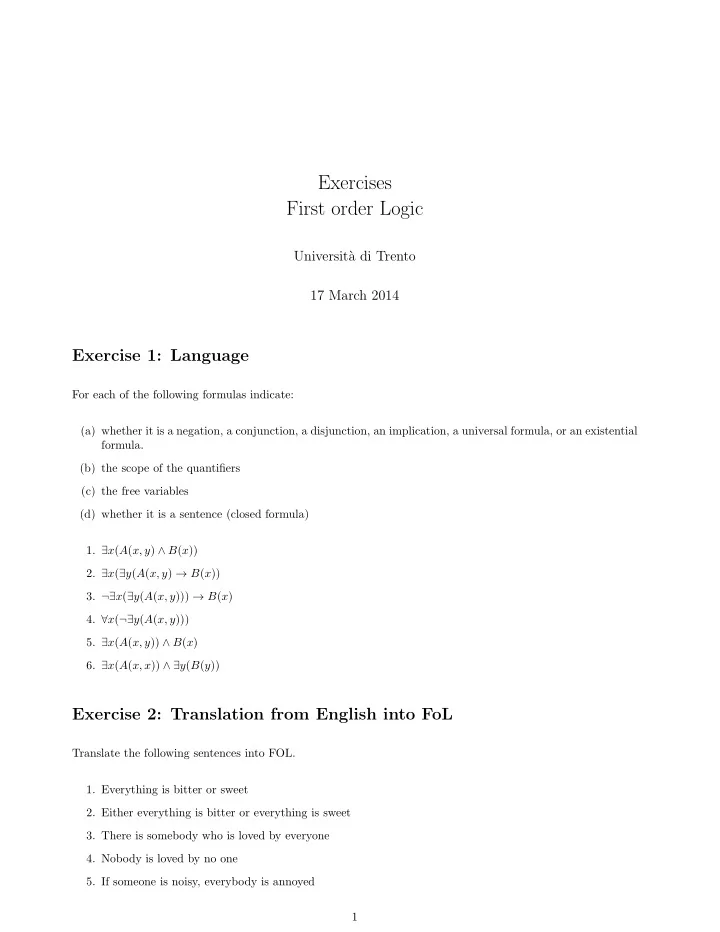
For each of the following formulas indicate: (a) whether it is a negation, a conjunction, a disjunction, an implication, a universal formula, or an existential formula. (b) the scope of the quantifiers (c) the free variables (d) whether it is a sentence (closed formula)

  • 1. ∃x(A(x, y) ∧ B(x))
  • 2. ∃x(∃y(A(x, y) → B(x))
  • 3. ¬∃x(∃y(A(x, y))) → B(x)
  • 4. ∀x(¬∃y(A(x, y)))
  • 5. ∃x(A(x, y)) ∧ B(x)
  • 6. ∃x(A(x, x)) ∧ ∃y(B(y))

Exercise 2: Translation from English into FoL

Translate the following sentences into FOL.

  • 1. Everything is bitter or sweet
  • 2. Either everything is bitter or everything is sweet
  • 3. There is somebody who is loved by everyone
  • 4. Nobody is loved by no one
  • 5. If someone is noisy, everybody is annoyed

1

slide-2
SLIDE 2
  • 6. Frogs are green.
  • 7. Frogs are not green.
  • 8. No frog is green.
  • 9. Some frogs are not green.
  • 10. A mechanic likes Bob.
  • 11. A mechanic likes herself.
  • 12. Every mechanic likes Bob.
  • 13. Some mechanic likes every nurse.
  • 14. There is a mechanic who is liked by every nurse.

Exercise 3: Models

(a) and (c) done in class on Monday. (b) to be done at home by Wednesday. (a) Check whether the formulas below are true within the model M with domain {Italo Calvino, Roberto Baggio, torre Eiffel } and interpretation:

  • I(c) =
  • I(e) =
  • I(b) =
  • I(P) = {c, b}
  • I(S) = {c}
  • I(A) = {(c, b), (e, c), (e, b)}
  • I(C) = {b}
  • 1. P(c)
  • 2. P(e)
  • 3. S(e)
  • 4. A(c, e)
  • 5. A(e, c)
  • 6. A(e, e)
  • 7. (P(c) ∧ A(c, e)) ∨ (¬P(c) ∧ A(e, c))
  • 8. ∀x.S(x)
  • 9. ∃x.S(x)
  • 10. ∀x(P(x) → S(x))

2

slide-3
SLIDE 3
  • 11. ∃x(¬P(x) ∨ S(x))
  • 12. ∃x(¬P(x) ∧ S(x))
  • 13. ∀x.P(x) ∨ ∀x.S(x)
  • 14. ∀x.P(x) ∨ ∀z.S(z)
  • 15. ∀x(P(x) ∨ S(x))

(b) Given the model M defined by D = {0, 1}, and the interpretation:

  • I(P) = {0, 1}
  • I(R) = {(0, 0), (0, 1)}

Verify whether the following formulas are true in M:

  • 1. ∀xP(x)
  • 2. P(0)
  • 3. ¬R(0, 0)
  • 4. ∃xR(x, x)
  • 5. ∀xR(x, x)
  • 6. ∀xR(x, x) → P(x)
  • 7. ∀x¬R(x, x) → P(x)
  • 8. ∀x(Px → ¬R(x, x))

(c) Find a model in which the following formula is true and a model in which it is false: ∃y( P(y) ∧ ¬Q(y) ) ∧ ∀z( P(z) ∨ Q(z) ) 3

slide-4
SLIDE 4

1 Solutions

Exercise 1

Kind of formula Scope for Free var. Sentence

  • 1. Existential

∃x : A(x, y) ∧ B(x) y no

  • 2. Existential

∃x : ∃y(A(x, y) → B(x)) none yes ∃y : A(x, y)

  • 3. Implication

∃x : ∃y(A(x, y)) x in B(x) no ∃y : A(x, y)

  • 4. Universal

∀x : ¬∃y(A(x, y)) no yes ∃y : A(x, y)

  • 5. Conjunction

∃x : A(x, y) x free in B(x) no

  • 6. Conjunction

∃x : A(x, x) no yes ∃y : B(y)

Exercise 2

  • 1. ∀x(B(x) ∨ S(x))
  • 2. ∀x(B(x) ∨ ∀x(S(x))
  • 3. ∃x(∀y(L(y, x)))
  • 4. ¬∃x(¬∃y(L(y, x)))
  • 5. ∃x(N(x) → ∀y(A(y)))
  • 6. ∀x(Fx → Gx)
  • 7. ∀x(Fx → ¬Gx) = ¬∃x(Fx ∧ Gx)
  • 8. ¬∃x(Fx ∧ Gx) = ∀x(Fx → Gx)
  • 9. ∃x(Fx ∧ ¬Gx)
  • 10. ∃X(Mx ∧ L(x, b))
  • 11. ∃x(Mx ∧ L(x, x))
  • 12. ∀x(Mx → L(x, b))
  • 13. ∃x(Mx ∧ ∀y(Ny → L(x, y)))
  • 14. ∃x(Mx ∧ ∀y(Ny → L(y, x)))

Exercise 3

(a)

  • 1. true
  • 2. false
  • 3. false
  • 4. false
  • 5. true

4

slide-5
SLIDE 5
  • 6. false
  • 7. false
  • 8. false
  • 9. true, x = c
  • 10. false
  • 11. true, x = e
  • 12. false
  • 13. false
  • 14. false
  • 15. false

(b)

  • 1. true
  • 2. true
  • 3. false
  • 4. true
  • 5. false, x = 1
  • 6. true
  • 7. true

8. (c) The formula is true in the following M: D = (a), I(P) = {a}, I(Q) = {} The formula is false in the following M: D = (a), I(P) = {a}, I(Q) = {a} 5