Executable Object Modelling analysis use cases class diagrams - - PowerPoint PPT Presentation

executable object modelling
SMART_READER_LITE
LIVE PREVIEW

Executable Object Modelling analysis use cases class diagrams - - PowerPoint PPT Presentation

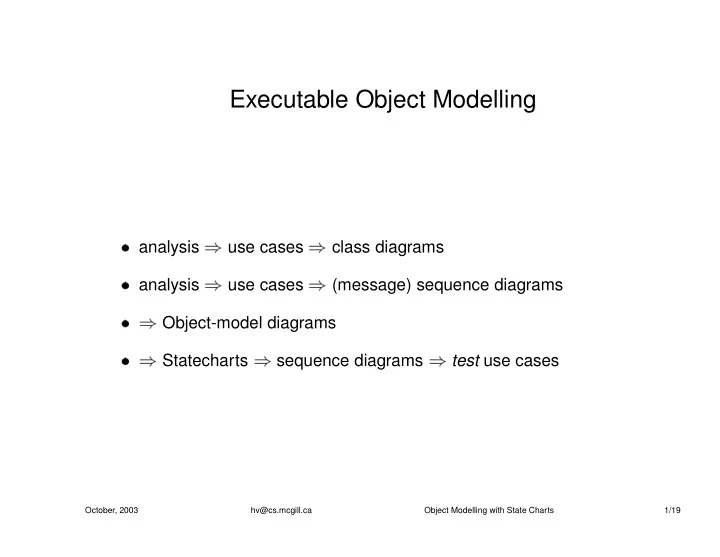
Executable Object Modelling analysis use cases class diagrams analysis use cases (message) sequence diagrams Object-model diagrams Statecharts sequence diagrams test use cases


slide-1
SLIDE 1

Executable Object Modelling

  • analysis

use cases

class diagrams

  • analysis

use cases

(message) sequence diagrams

Object-model diagrams

Statecharts

sequence diagrams

test use cases

October, 2003 hv@cs.mcgill.ca Object Modelling with State Charts 1/19

slide-2
SLIDE 2

Executable Object Modelling with Statecharts

  • OO development: intuitive/graphical and rigourous
  • fully executable models (simulation)
  • code synthesis

October, 2003 hv@cs.mcgill.ca Object Modelling with State Charts 2/19

slide-3
SLIDE 3

Executable Object Modelling with Statecharts

  • Structure (classes, multiplicities, relationships)

Object-model diagrams (higraph version of ER-diagrams)

  • Behaviour

StateCharts

October, 2003 hv@cs.mcgill.ca Object Modelling with State Charts 3/19

slide-4
SLIDE 4

Automated Railcar System: Physical View

October, 2003 hv@cs.mcgill.ca Object Modelling with State Charts 4/19

slide-5
SLIDE 5

October, 2003 hv@cs.mcgill.ca Object Modelling with State Charts 5/19

slide-6
SLIDE 6

Scenarios (Use Cases)

  • 1. Car approaches terminal
  • 2. Car departs from terminal
  • 3. Passenger in terminal

October, 2003 hv@cs.mcgill.ca Object Modelling with State Charts 6/19

slide-7
SLIDE 7

Use Case: Car approaches terminal

When the car is 100 yards from the terminal, the system allocates it a platform and an entrance segment, which connects it to the incoming track. If the car is to pass through without stopping, the system also allocates it an exit segment. If the allocation is not completed within 80 yards from the terminal, the system delays the car untill all is ready.

October, 2003 hv@cs.mcgill.ca Object Modelling with State Charts 7/19

slide-8
SLIDE 8

Use Case: Car departs from terminal

A car departs the terminal after being parked fro 90 seconds. The system connects the platform to the outgoing track via the exit segment, engages the car’s engine, and turns off the destination indicators on the terminal destination board. The car can then depart unlesss it is within 100 yards of another car; if so, the system delays departure.

October, 2003 hv@cs.mcgill.ca Object Modelling with State Charts 8/19

slide-9
SLIDE 9

Use Case: Passenger in terminal

A passenger in a terminal wishes to travel to some destination terminal, and there is no available car in the terminal travelling in the right direction. The passenger pushes the destination button and waits until a car arrives. If the terminal contains an idle car, the system will assign it to that

  • destination. If not, the system will send a car in from some other terminal.

The system indicates that a car is available with a flashing sign on the destination board.

October, 2003 hv@cs.mcgill.ca Object Modelling with State Charts 9/19

slide-10
SLIDE 10

Toplevel object-model diagram

  • bject classes
  • bject multiplicities
  • structural relationships (including navigatability and arity)

October, 2003 hv@cs.mcgill.ca Object Modelling with State Charts 10/19

slide-11
SLIDE 11

Object Navigation, Creation/Initialization

  • navigatability

– no relation name

its

– Passenger->itsCar->stopsAt – toplevel: System->itsTerminal[1:6]

  • Code synthesis: creation/initialization

dynamics over time

  • Object multiplicity
  • Associations
  • 1. unambiguous: multiplicities match
  • 2. ambiguous but bounded: any subset
  • 3. unworkable: canonical mappings or user defined (scripts)

October, 2003 hv@cs.mcgill.ca Object Modelling with State Charts 11/19

slide-12
SLIDE 12

Zoom out: aggregation

October, 2003 hv@cs.mcgill.ca Object Modelling with State Charts 12/19

slide-13
SLIDE 13

Dynamics of Object Communication and Collaboration

  • 1. Objects generate events which are queued

serverObject->gen(event(<params>))

  • 2. Objects can directly invoke an operation/method

serverObject->method(<params>)

October, 2003 hv@cs.mcgill.ca Object Modelling with State Charts 13/19

slide-14
SLIDE 14

Car dynamics

October, 2003 hv@cs.mcgill.ca Object Modelling with State Charts 14/19

slide-15
SLIDE 15

October, 2003 hv@cs.mcgill.ca Object Modelling with State Charts 15/19

slide-16
SLIDE 16

Arrival dynamics

October, 2003 hv@cs.mcgill.ca Object Modelling with State Charts 16/19

slide-17
SLIDE 17

CarHandler lifecycle

October, 2003 hv@cs.mcgill.ca Object Modelling with State Charts 17/19

slide-18
SLIDE 18

Zooming

October, 2003 hv@cs.mcgill.ca Object Modelling with State Charts 18/19

slide-19
SLIDE 19

Inheritance

  • structural or behavioural conformity
  • interface subtyping (plug in)
  • Modify states

– Decompose state in OR or AND components – Add sub-states to OR state – Add orthogonal components to any state

October, 2003 hv@cs.mcgill.ca Object Modelling with State Charts 19/19