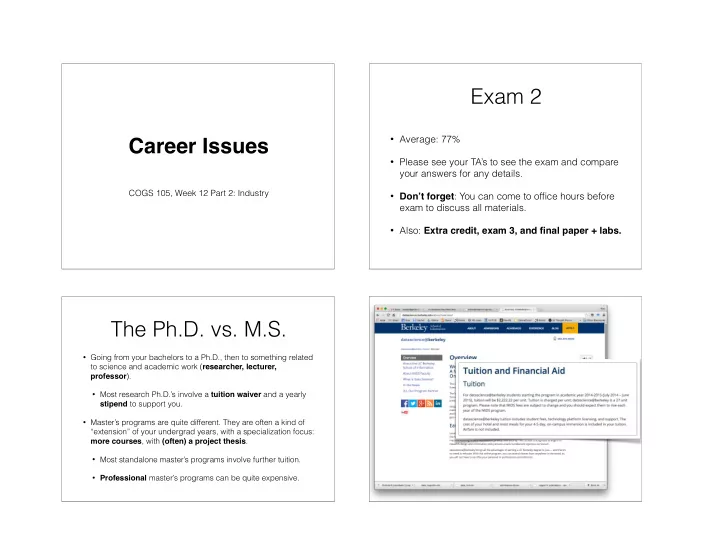
Exam 2 Average: 77% Career Issues Please see your TAs to see the - - PowerPoint PPT Presentation

exam 2
SMART_READER_LITE
LIVE PREVIEW

Exam 2 Average: 77% Career Issues Please see your TAs to see the - - PowerPoint PPT Presentation

Exam 2 Average: 77% Career Issues Please see your TAs to see the exam and compare your answers for any details. COGS 105, Week 12 Part 2: Industry Dont forget : You can come to office hours before exam to discuss all materials.


slide-1
SLIDE 1

Career Issues

COGS 105, Week 12 Part 2: Industry

Exam 2

  • Average: 77%
  • Please see your TA’s to see the exam and compare
your answers for any details.
  • Don’t forget: You can come to office hours before
exam to discuss all materials.
  • Also: Extra credit, exam 3, and final paper + labs.

The Ph.D. vs. M.S.

  • Going from your bachelors to a Ph.D., then to something related
to science and academic work (researcher, lecturer, professor).
  • Most research Ph.D.’s involve a tuition waiver and a yearly
stipend to support you.
  • Master’s programs are quite different. They are often a kind of
“extension” of your undergrad years, with a specialization focus: more courses, with (often) a project thesis.
  • Most standalone master’s programs involve further tuition.
  • Professional master’s programs can be quite expensive.
slide-2
SLIDE 2

“Industry”

  • Often used as a short-form for “anything outside
academia and research.”
  • Most commonly: Working for a business in some
fashion.
  • Sometimes “government” or “non-profits” are treated
as separate categories.
  • All 3 of these categories may involve a research
component (often they do not), so you can still get your “research kick” from heading out into the “real world.”

COGS?

  • Examples:
  • LIWC and LSA: analysis of text
  • Neurosynth: meta-analysis of brain function
  • RT tasks: design of experiments and research
  • All these topics are relevant to real-world
applications, from both a skill and content levels.

Example…

linkedin.com

LIWC / LSA

  • Forensic analysis of text or meaning in order to
explore patterns of language use in various contexts.
slide-3
SLIDE 3

Neurosynth

  • Exploring data related to brain imagining and
cognitive processes or dysfunction. Being able to sift through lots of ideas and data orbiting brain function.

RT and Research Design

  • How to carefully setup a study with conditions and
control of confounds, how to measure behavior, interpreting results, etc.
slide-4
SLIDE 4

data

An Example: Data Science

  • An example analytics problem at Yammer
(Microsoft-owned social network system for companies).

The Problem

slide-5
SLIDE 5

The Data Hypotheses Hypotheses Hypotheses

slide-6
SLIDE 6

Result CogSci All the Way

  • These questions often orbited issues of human
cognition:
  • Usability of an interface
  • Interest in the product
  • User access and product behavior

Final Paper

slide-7
SLIDE 7

Next Time

  • Class canceled Tuesday! I’ll be at Stanford for a
presentation with a Ph.D. student.
  • Lab next week: You will work on something to help
final paper plans.
  • Another extra-credit posted (1-page preliminary
final project idea).
  • Thursday next week: Shreya Gupta, UCM COGS
B.S. will discuss User Experience Design research!