
SLIDE 1
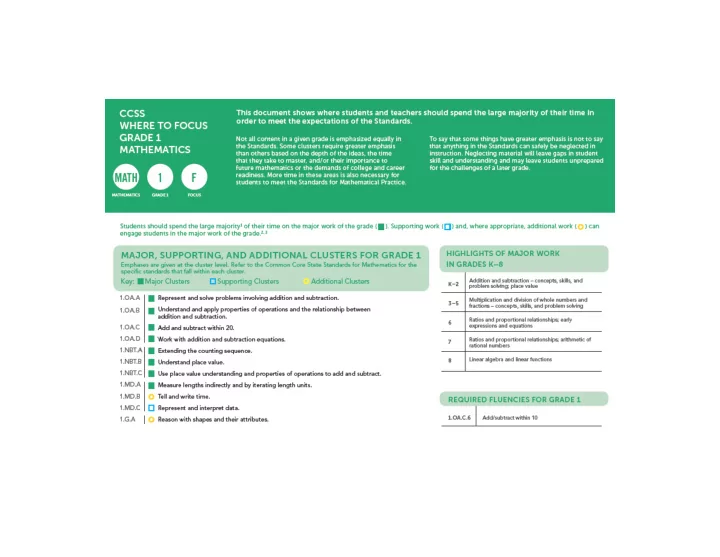
Evidence Centered Design Claims Claims Structure: Mathematics Master - - PowerPoint PPT Presentation
Evidence Centered Design Claims Claims Structure: Mathematics Master Claim: On Track for college and career readiness. The degree to which a student is college and career ready (or on track to being ready) in mathematics. The student
Evidence Centered Design Claims
Master Claim: On‐Track for college and career readiness. The degree to which a student is college and career ready (or “on‐ track” to being ready) in mathematics. The student solves grade‐level /course‐level problems in mathematics as set forth in the Standards for Mathematical Content with connections to the Standards for Mathematical Practice.
Sub‐Claim A: Major Content1 with Connections to Practices The student solves problems involving the Major Content1 for her grade/course with connections to the Standards for Mathematical Practice. Sub‐Claim B: Additional & Supporting Content2 with Connections to Practices The student solves problems involving the Additional and Supporting Content2 for her grade/course with connections to the Standards for Mathematical Practice. Sub‐Claim E: Fluency in applicable grades (3‐6) The student demonstrates fluency as set forth in the Standards for Mathematical Content in her grade.
Claims Structure: Mathematics
Sub‐Claim C: Highlighted Practices MP.3,6 with Connections to Content3 (expressing mathematical reasoning) The student expresses grade/course‐ level appropriate mathematical reasoning by constructing viable arguments, critiquing the reasoning of
when making mathematical statements. Sub‐Claim D: Highlighted Practice MP.4 with Connections to Content (modeling/application) The student solves real‐world problems with a degree of difficulty appropriate to the grade/course by applying knowledge and skills articulated in the standards for the current grade/course (or for more complex problems, knowledge and skills articulated in the standards for previous grades/courses), engaging particularly in the Modeling practice, and where helpful making sense of problems and persevering to solve them (MP. 1),reasoning abstractly and quantitatively (MP. 2), using appropriate tools strategically (MP.5), looking for and making use of structure (MP.7), and/or looking for and expressing regularity in repeated reasoning (MP.8).
Total Exam Score Points: 82 (Grades 3‐8), 97 or 107(HS) 12 pts (3‐8), 18 pts (HS) 6 pts (Alg II/Math 3 CCR) ~37 pts (3‐8), ~42 pts (HS) ~14 pts (3‐8), ~23 pts (HS) 14 pts (3‐8), 14 pts (HS) 4 pts (Alg II/Math 3 CCR) 7‐9 pts (3‐6) 1 For the purposes of the PARCC Mathematics assessments, the Major Content in a grade/course is determined by that grade level’s Major Clusters as identified in the PARCC Model Content Frameworks v.3.0 for Mathematics. Note that tasks on PARCC assessments providing evidence for this claim will sometimes require the student to apply the knowledge, skills, and understandings from across several Major Clusters. 2 The Additional and Supporting Content in a grade/course is determined by that grade level’s Additional and Supporting Clusters as identified in the PARCC Model Content Frameworks v.3.0 for Mathematics. 3 For 3 – 8, Sub-Claim C includes only Major Content. For High School, Sub-Claim C includes Major, Additional and Supporting Content. O Students will take assessments online O Performance Based Assessment
O March O Two 60-minute sessions
O End of Course
O May O Two 60-minute sessions
Grades 3 – 8 points High School points
Claim A (Major Content) ≈37 ≈42 Claim B (Add. & Supporting) ≈14 ≈23 Claim C (MP 3 & 6) 14 (only Major Content) 14 (+4 on Alg. 2 – CCR) Claim D (MP 4 & others) 12 18 (+6 on Alg. 2 – CCR) Claim E (Fluency) 7 – 9 (Grades 3 – 6)
TOTAL POINTS
82 97 (107 for CCR)
Summative Assessment Components:
O Performanc
e-Based Assessment (PBA) ad administ ministered ered af after appr r approx. 75% . 75% of the school y
PBA will focus on writing effectively when analyzing text. . The mathematic The mathematics PBA will f s PBA will focus on applying skills, cus on applying skills, concepts, an concepts, and un d understandings t tandings to solv solve multi-st e multi-step ep pr problems
requiring abstract reasoning, precision, iring abstract reasoning, precision, per perseveranc erance, and strat , and strategic use of t gic use of tools
O End-of
End-of-Year Assessment (EO ear Assessment (EOY) ) administered after
will focus on reading comprehension. The math EOY will be comprised of innovative, machine-scorable items
Create High Quality Assessments
What are the benefits?
O Immediate results on the End of Year tests. O Built in accommodations O Engaging assessments that will help learners
really show what they know.
O No more paper/pencil books that have to be
shipped, counted, locked up
O Larger testing window O Technology enhanced items allow for multiple
answers, modeling of thinking, use of simulations, embedded video or sound
O Test questions will provide scaffolding for
students.
O Higher expectations
O Click/Tap O Select object O Select task O Select area O Select and drag/slide O Unselect O Scroll O Plot points O Drag and drop O Type with text editor O Use text highlighter O Use calculator O Use protractor O Use ruler O Use video player
Examples of Student Item Interactions and Tools
Calculator Policy
Requisite Knowledge
Reference Sheet – Grade 5
Reference Sheet – Grade 6
12
3.OA.7
3.NF .1
O Draw points on the number line for 1/2, 1/3, 1/4, 1/5 .
Label the points. Be as exact as possible.
Number Line Tasks
1/2 1 1/3 1/4 1/5
1 / 2 1 / 3 1 / 4 1 / 5
16
4.NBT.5
17
5.NF .5
Grade 8: EE, ER
19
PARCC Comprehensive Accessibility Policies
20
Features f atures for All r All Students Students Accessibility ccessibility Features* atures*
Identi Identifie fied in in adv advanc nce
Accommodations** ccommodations**
* Available to all participating students **For students with disabilities, English learners, and English learners with disabilities
Accessibility Features for All Students
21
Accessibility ccessibility Features f atures for All Students r All Students
Audio Am udio Amplif plification ication Blank P Blank Paper per (p
(pro rovided b ded by test a admin ministrat rator) r)
Eliminat Eliminate Answ e Answer Choices er Choices Flag Flag It Items f ems for R r Revie view General A General Administration Directions Clarif ministration Directions Clarified ied (b
(by tes est a t admin ministrat rator) r)
General A General Administration ministration Directions R Directions Read Aloud and R ad Aloud and Repeat peated ed (by t
test st administ strator)
Highligh Highlight T Tool
Headphones Magnif Magnification/Enlargement ication/Enlargement Device ice No NotePad Pop-Up Glossar p-Up Glossary Redirect Student t edirect Student to T Test st (by t
test st administ strator)
Spell Check Spell Checker er Writing iting Tools
PARCC Resources for Parents
For parent resources, go to: www.parcconline.org/for‐parents