everyone How paying for yourself is better for society and the - - PowerPoint PPT Presentation

everyone
SMART_READER_LITE
LIVE PREVIEW

everyone How paying for yourself is better for society and the - - PowerPoint PPT Presentation

Green and fair mobility for everyone How paying for yourself is better for society and the environment Created by Rayan Aebi, Panos Alamanos, Giannis Alexou October 15, 2015 Presented by Mario Malzacher Growth expectations for private


slide-1
SLIDE 1

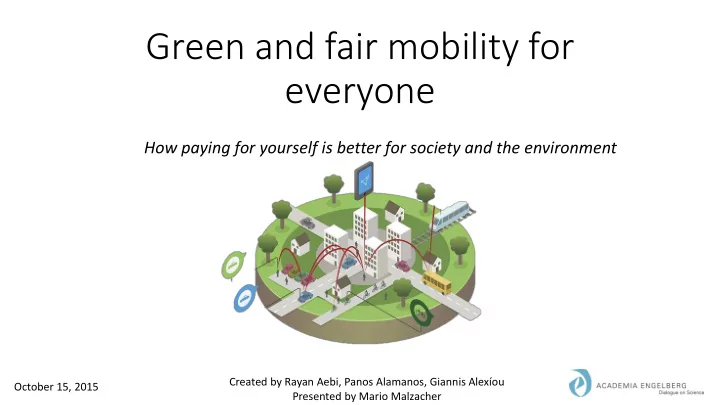
Green and fair mobility for everyone

How paying for yourself is better for society and the environment

Created by Rayan Aebi, Panos Alamanos, Giannis Alexíou Presented by Mario Malzacher October 15, 2015
slide-2
SLIDE 2

Growth expectations for private mobility

Non-OECD: Increase by a factor of 2.5 to 3.5 (i.e. 350%) OECD: Increase by 30% in average

slide-3
SLIDE 3

Externalities of transport

Positive effects

Negative effects - Externalities Uncompensated negative cost that affects a party who did not choose to incur that cost

slide-4
SLIDE 4
  • Climate-change is the biggest threat to

economic recovery (Angel Gurria, OECD, 2009)

  • Failure of climate-change adaptation is in the

top 5 risks in terms of Impact (WEF, 2015)

  • The insurance industry estimates the potential

economic damage, caused by the impacts of global warming, to be hundreds of billions of dollars each year. (WWF, 2015)

Global warming

A A serious economic th threat

slide-5
SLIDE 5

Fossil fuel and transportation

  • Fossil fuel use accounts for 57% of global

greenhouse gas emissions (IPCC, 2007)

  • Almost all (95%) of the world's

transportation energy comes from petroleum-based fuels, largely gasoline and diesel. (EPA, 2013)

slide-6
SLIDE 6

Growth expectations for mobility and transport

slide-7
SLIDE 7

Growth expectations for mobility and transport

Global car gridlock will impose a lot of costs on society that drivers don't pay for

slide-8
SLIDE 8

Externalities due to transportation

58% 21% 13% 8%

Externalities by mean of transportation (EEA, 2002)

Car (private vehicle) Heavy-duty vehicles Other road vehicles Rail and water transport

slide-9
SLIDE 9

Costs of externalities

  • Environmental damage (for CH approx. 9bn, ARE, 2010)
  • Local, regional as well as international
  • Congestion (opportunity costs; for CH approx. 3bn, ARE, 2010)
  • In the EU + Norway and Switzerland (EU+2) external costs from transport

were estimated at 8 % of GDP (Infras/IWW, 2000)

slide-10
SLIDE 10

Stop subsidizing mobility

Who should pay for th the ext xternalities ?

Government? Tax payers? Victims?

slide-11
SLIDE 11

Stop subsidizing mobility

How to solve th the problem?

  • Often proposed solution: Invest in public transport (subsidize public

transport) and environmental regulations (enforcement)

  • But -> COSTLY (unfair taxation, for CH approx. 8bn), uncompensated

externalities of public transport exist as well (for CH approx. 1bn), etc.

slide-12
SLIDE 12

Stop subsidizing mobility

User-pays pri rinciple

Cost-effective solution Internalizing externality costs

  • Individual users pay!
  • > Use price system to internalize externalities
  • If individual users pay for externalities of their own mobility
  • > no subsidies for public transport is necessary
slide-13
SLIDE 13

Stop subsidizing mobility

User pays pri rinciple

  • Everyone pays his fair share
  • No free riders
  • All costs are incorporated -> no externalities anymore
slide-14
SLIDE 14

Internalize mobility’s externalities

Put t a pri rice on mobility

Phase out fossil fuel subsidies

Stop subsidizing mobility

Tax on mobility

Use money to reduce taxes

slide-15
SLIDE 15

Internalize mobility’s externalities

Put t a pri rice on mobility

Phase out fossil fuel subsidies

Stop subsidizing mobility

Tax on mobility

Use money to reduce taxes

slide-16
SLIDE 16

Phase out fossil fuel subsidies

  • Phasing out fossil fuel energy subsidies would have benefits more

than 15 times the cost (Copenhagen Consensus, 2015)

  • Implementable today across the entire world
  • Especially in developing countries

with extensive oil & gas subsidies

slide-17
SLIDE 17

Internalize mobility’s externalities

Put t a pri rice on mobility

Phase out fossil fuel subsidies

Stop subsidizing mobility

Tax on mobility

Use money to reduce taxes

slide-18
SLIDE 18

Stop subsidizing mobility

Pri rivatize th the public tr transportation sector

  • Subsidies are generally inefficient
  • Subsidies are in essence payments by the government to keep an

ineffective firm in business

  • Subsidies are dangerous
  • Set incentives for overuse of public transport
  • Urban sprawl (additional increase in mobility)
  • Do not compensate externalities
  • Discard public transportation subsidies
  • Transparent and fair pricing
  • Producers’ incentives aligned with their business model
slide-19
SLIDE 19

Internalize mobility’s externalities

Put t a pri rice on mobility

Phase out fossil fuel subsidies

Stop subsidizing mobility

Tax on mobility

Use money to reduce taxes

slide-20
SLIDE 20

Tax on mobility Ext xternalities

  • Noise nuisance
  • Air pollution
  • Climate warming
  • Water & Soil contamination
  • Shrink of biodiversity
  • Land take
  • Traffic jams
  • Accidents
  • Production externalities of vehicles
slide-21
SLIDE 21

Tax on mobility Ext xternalities

Defined by personal mobility data according to means of transportation and local levels of taxation

TAX FULL EXTERNALITY COST

=

slide-22
SLIDE 22

Tax on mobility Fair pricing – Smart algorithm

Factors Evaluation + measurement Peak hour (congestion time) Time of the day Distance GPS location Location GPS location Fuel efficiency Car reference Noise level Car reference Particles and greenhouse gases levels Car reference Amortized production externality Car reference (Life cycle assessment)

Impartial transparent measurement agency: NGO

slide-23
SLIDE 23

Tax on mobility

In Incentives

35 45 60 60 40 15

CAR BUS TRAIN

Cost of use w/o externality cost (CHF) Externality cost (CHF)

NB: Estimation for a given distance

slide-24
SLIDE 24
  • Easily implementable today across the entire world
  • GPS technology is widespread and relatively cheap around the globe
  • Price incentives for the consumer to pursue the most efficient

mobility solution

  • Strong incentive to innovate

Tax on mobility

In Incentives

slide-25
SLIDE 25

Tax on mobility

In Innovation and smarter business solutions

  • Sharing economy
  • Self driving cars
  • Clean tech (e.g batteries, cars, buses, trains, planes)
  • New means of transportation (e.g. hyperloop by Elon Musk)
slide-26
SLIDE 26

Internalize mobility’s externalities

Put t a pri rice on mobility

Phase out fossil fuel subsidies

Stop subsidizing mobility

Tax on mobility

Use money to reduce taxes

slide-27
SLIDE 27

Better tax system

Use money to reduce taxes

  • Allow for a better tax system -> Reduce detrimental taxes (e.g. income tax in CH)

Local Global

  • Commune
  • Canton
  • Federal
  • (International)

Tax redistribution

slide-28
SLIDE 28

A bright green future

Towards a a better world

This smart mobility policy will empower

  • More efficient, transparent and fair use of transit transportation despite mobility growth
  • Less production of externalities
  • Compensation of social cost of mobility through individual user
  • Save real money and invest in our future
slide-29
SLIDE 29

A bright green future

Towards a a better world

Phase out fossil fuel subsidies

Stop subsidizing mobility Tax on mobility Use money to reduce taxes Any questions ?

Please contact me at: rayan.aebi@gmail.com