Every Second Counts: Organise yourself through strategic and - - PDF document

every second counts organise yourself through strategic
SMART_READER_LITE
LIVE PREVIEW

Every Second Counts: Organise yourself through strategic and - - PDF document

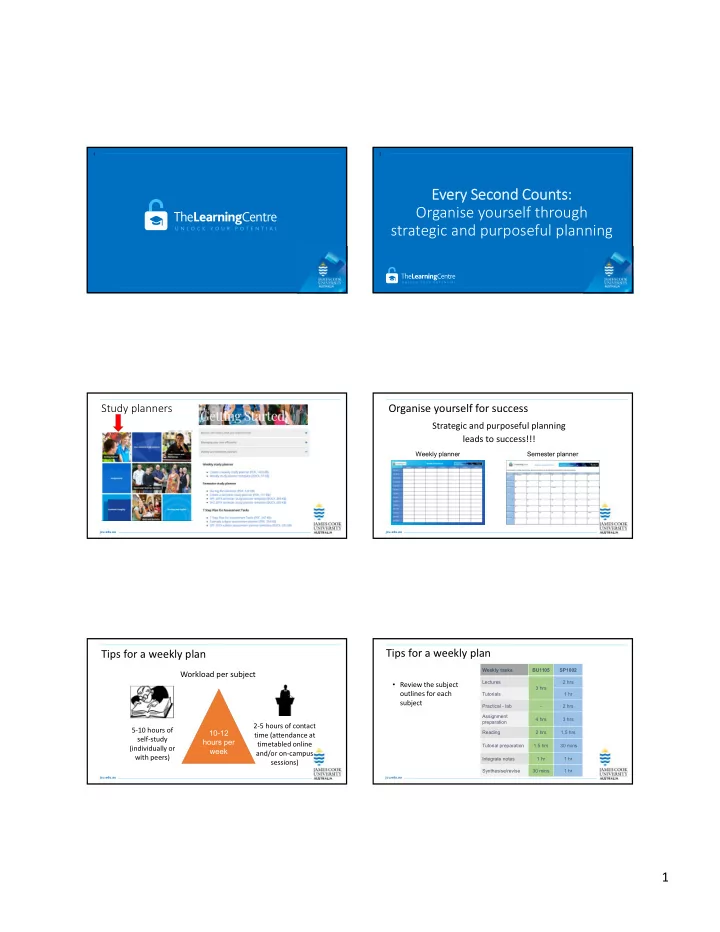
1 2 Every Second Counts: Organise yourself through strategic and purposeful planning jcu.edu.au jcu.edu.au Study planners Organise yourself for success Strategic and purposeful planning leads to success!!! Weekly planner Semester planner


slide-1
SLIDE 1

1

jcu.edu.au 1 jcu.edu.au 2

Every Second Counts: Organise yourself through strategic and purposeful planning

jcu.edu.au

Study planners

jcu.edu.au

Strategic and purposeful planning leads to success!!!

Organise yourself for success

Weekly planner Semester planner

jcu.edu.au

Workload per subject

Tips for a weekly plan

5‐10 hours of self‐study (individually or with peers) 2‐5 hours of contact time (attendance at timetabled online and/or on‐campus sessions) 10-12 hours per week

jcu.edu.au

Tips for a weekly plan

Weekly tasks BU1105 SP1002 Lectures 3 hrs 2 hrs Tutorials 1 hr Practical - lab

  • 2 hrs

Assignment preparation 4 hrs 3 hrs Reading 2 hrs 1.5 hrs Tutorial preparation 1.5 hrs 30 mins Integrate notes 1 hr 1 hr Synthesise/revise 30 mins 1 hr

  • Review the subject
  • utlines for each

subject

slide-2
SLIDE 2

2

jcu.edu.au

Weekly planner example

1. Lectures, tutorials and practicals 2. Work, sport 3. Study times; summarise notes, pre reading, draft assignments 4. Social activities

jcu.edu.au

  • Avoid feeling overwhelmed
  • Create a semester long study plan
  • Look at the subject outline for each of your subjects
  • Record due dates of each assessment
  • Include assessment type, % value and word limit

Tips for a semester plan

jcu.edu.au

Semester plan example

jcu.edu.au 10

7 Steps to Success

jcu.edu.au

Complete degree in … Develop a weekly planner Develop a semester planner Complete 4 subjects in SP1

Setting Goals

11

Long term Medium term

Short term

Aim for at least a credit in all subjects Keep up with readings

jcu.edu.au

Semester plan:

  • mark assessment due dates on

your calendar

Assessment timeline:

  • 1/3 of your time to unpacking and researching
  • 1/3 of your time to planning and drafting
  • 1/3 of your time to editing your assessments

Assessment planning

slide-3
SLIDE 3

3

jcu.edu.au

7 steps to assessment planning

Understand the task

  • Read the task description and the assessment criteria.
  • What are the key terms? Word count?

Research

  • Locate peer reviewed articles.
  • Understand key terms and locate example or evidence to

substantiate your claims. Essay plan

  • Outline the structure of your assignment.
  • What is the focus of each body paragraph/section?

Write a first draft

  • Include evidence and examples to support your claim.

Critical reflection

  • Ask a critical friend to read through your draft using the

criteria sheet. Edit and redraft

  • Respond to the feedback.
  • Edit and proofread draft. Attend to spelling, punctuation,

grammar and referencing. Submit

  • Due date?
  • Safe assign? Hard copy?

jcu.edu.au

Example of an essay due on March 23

  • Backward map from due date.
  • An assessment timeline is an effective tool that will save you

time and help you stay on track.

  • Use a timeline for each assessment piece to help organise your

semester.

Assessment planning

jcu.edu.au 15

Successful Students Connect: What A‐grade students do

jcu.edu.au

Successful Students Connect

  • Study buddy
  • Talk
  • Share ideas
  • Subject Outline
  • LearnJCU
  • Discussion boards

Reading

  • Purposely
  • Critically

Writing

  • Assignments
  • Take and make notes

jcu.edu.au

What’s your purpose for reading? Are you…

  • following up a lecture?
  • preparing for a

workshop?

  • researching for an

assignment?

Reading for a reason

jcu.edu.au

Follow a reading technique ‐ SQ3R

  • SURVEY: Scan / Skim
  • Use the text structure
  • QUESTION
  • READ section by section
  • RECITE answer your questions
  • REVIEW
  • Make notes
  • Check definitions
  • Learn new words

Reading for a reason

slide-4
SLIDE 4

4

jcu.edu.au

To read critically, you need to develop skills in:

  • interpreting: understanding the significance of data and

clarifying its meaning

  • analysing: breaking information down and recombining it in

different ways

  • evaluating: judging the worth, credibility or strength of accounts
  • reasoning: creating an argument through logical steps

Reading critically

jcu.edu.au

  • 1. What? Where? Who? When?
  • These result in description.
  • 2. How? Why? What if?
  • These result in analysis.
  • 3. So what? What next?
  • These result in evaluation.

Questions to ask about a text

Adapted from Briguglio, Dooey, Watson, Critical Analysis for Business (1) Retrieved from https://www.teacherspayteachers.com/Product/Free-Downloads-1327003

How? How?

jcu.edu.au

JCU reading template

Note‐taking for reading

jcu.edu.au

Listening & note‐taking

Repeat Paraphrase Reflect Use similar words for the same message. Summarise information Write what you hear word-for- word. Use for key words, terms and definitions. Think about what you hear. Write notes in your

  • wn words.

Combine multiple sources of information

jcu.edu.au

Linear notes

Note‐taking

jcu.edu.au

Mind maps

Source: Learning Fundamentals http://learningfundamentals.com.au http://classroom.synonym.com/difference‐between‐linear‐notetaking‐mind‐mapping‐5559.html

Note‐taking

slide-5
SLIDE 5

5

jcu.edu.au

Concept maps

Note‐taking

jcu.edu.au

Cornell/ split page notes

Note‐taking

jcu.edu.au Onenote.com

Examples:

  • OneNote
  • Evernote
  • Google Notes
  • Uber note
  • Simplenote
  • Fetchnote
  • Springnote

Digital notes

Electronic note‐taking

jcu.edu.au

Taking notes in Lectures

Limit notes to the important points Clarify and add to your notes as soon as possible after a lecture File each week and then file each section Develop abbreviations and symbols that make sense to you Always write down where you are taking notes from for later referencing Refer to subject

  • bjectives to make

links

Note‐taking tips

jcu.edu.au

Whichever note‐taking system you use, remember that the important thing is that you paraphrase and reflect, not just repeat.

http://www.phase2technology.com/blog/active-listening-a-real-life-jedi-mind-trick/

Remember to connect with other students Try to explain your notes to your study buddy!

Note‐taking