Evaluation Synthesis on IFADs Support to Scaling Up of Results 96 th - - PowerPoint PPT Presentation

evaluation synthesis on ifad s support to scaling up of
SMART_READER_LITE
LIVE PREVIEW

Evaluation Synthesis on IFADs Support to Scaling Up of Results 96 th - - PowerPoint PPT Presentation

Evaluation Synthesis on IFADs Support to Scaling Up of Results 96 th Session of the Evaluation Committee 23 March 2017 Introduction Definition (2015): expanding, adapting and supporting successful policies, programmes and knowledge, so


slide-1
SLIDE 1

96th Session of the Evaluation Committee 23 March 2017
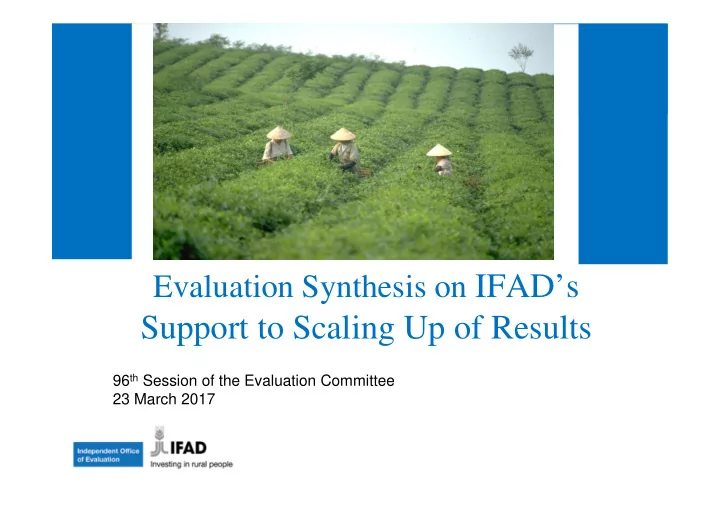
Evaluation Synthesis on IFAD’s

Support to Scaling Up of Results

slide-2
SLIDE 2

Introduction

2

  • Definition (2015): “expanding, adapting and supporting successful

policies, programmes and knowledge, so that they can leverage resources and partners to deliver larger results for a greater number of rural poor in a sustainable way”.

  • Key recent corporate documents concerning scaling up

 Brookings Review of IFAD’s Scaling Up Approach (2010)  Operational Framework for Scaling Up of Results (2015)

slide-3
SLIDE 3

Sources of this synthesis

3

  • Review of: (i) Management documents;

(ii) Independent evaluation reports and ARRI database

  • Document content analysis and coding of findings
  • Interviews with IFAD Management and staff; and

comparator organizations (e.g., WB, IADB, UNDP, GIZ)

  • E-survey of IFAD operational staff
slide-4
SLIDE 4

IFAD 2015 Operational Framework for Scaling-up of results

4

slide-5
SLIDE 5

The conceptualization and IFAD’s business model

 Full conceptualization of scaling up came with 2010 Review and 2015 Operational Framework – overall sound

  • Informed by past evaluations and Brookings Review
  • Helped IFAD lead international events and discussions
  • Scalability not addressed explicitly (some interventions are not scale-neutral)

 IFAD’s project cycle and business model. Opportunities but also challenges

  • Project design can be complicated
  • When project implementation is slow and M&E is weak, information on

performance and scalability comes late

  • Non-lending activities are crucial but in the past limited resources

5

slide-6
SLIDE 6

All the 35 COSOPs prepared since 2010 make reference to scaling up. Two have articulated a dedicated strategy.  Good example: Vietnam COSOP 2012

  • Specification of desired scale (number of farmers, number and scale of

public-private producers’ platforms)

  • Identification of key actors (public, private) at the national and

district/commune level.

  • Requirements, for financial, policy and technical support and regular

monitoring

  • Costing of IFAD, public and private support

6

Scaling-up in COSOPs

slide-7
SLIDE 7

 Half of CPEs and PPEs conducted since 2010 presented cases of scaling up

  • Scaling up more likely to be observed where IFAD had a country office
  • Country status (e.g., LIC, MIC) not clearly correlated with scaling-up

 But some opportunities may have been missed

  • Projects with positive performance ratings but without scaling up evidence

 Factors enabling scaling up

  • Government ownership: (i) institutions; (ii) support of like-minded

individuals

  • IFAD’s extended engagement through multiple phases
  • Non-lending activities: (i) avoid working in isolation; (ii) need to prove it is

worth scaling-up

7

Scaling-up in Projects

slide-8
SLIDE 8
  • Long scaling up journey, still “work in progress”.

Improved clarity after 2010 Brookings Review and 2015 Operational Framework

  • Challenging elements in the IFAD project cycle:
  • Complicated project design
  • Delays in implementation and weak M&E
  • In the past, limited emphasis on non-lending activities
  • Evaluations show good examples of scaling, along with some

missed opportunities

  • Key enablers: Government ownership, IFAD’s long-term

commitment, engagement in non-lending activities, country presence

Main Conclusions

8

slide-9
SLIDE 9

Key Recommendations

  • 1. Strengthen the country programme and project cycle to

enhance scalability.

  • Design: Scalability assessment (COSOP, project) on a more selective basis
  • Implementation: monitor progress and scalability conditions
  • Beyond project completion: non-lending activities and follow-up financing
  • 2. Build stronger consensus and incentives in-house in support
  • f scaling up
  • 3. Set corporate targets based on achievements and evidence on

scaling up pathway rather than “potential”

  • 4. IOE to rate innovation and scaling up separately

9