Evaluation of the Childrens Orthotic Project www.footscape.com.au - - PowerPoint PPT Presentation

evaluation of the children s orthotic project
SMART_READER_LITE
LIVE PREVIEW

Evaluation of the Childrens Orthotic Project www.footscape.com.au - - PowerPoint PPT Presentation

Evaluation of the Childrens Orthotic Project www.footscape.com.au What is Footscape? Footscape is a non-profit organisation that recognises disadvantaged communities are predisposed to debilitating foot pathology and endeavours to assist


slide-1
SLIDE 1

Evaluation of the

Children’s Orthotic Project

What is Footscape?

Footscape is a non-profit organisation that recognises disadvantaged communities are predisposed to debilitating foot pathology and endeavours to assist affected individuals sustain quality of life. The organisation is registered with Consumer Affairs Victoria and the Australian Charities and Not-for-profits

  • Commission. Current projects include:

Shoes for the Needy

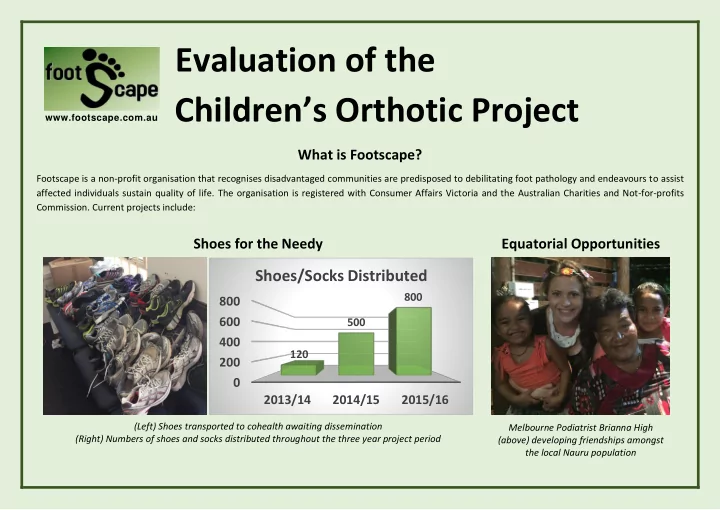
(Left) Shoes transported to cohealth awaiting dissemination (Right) Numbers of shoes and socks distributed throughout the three year project period

200 400 600 800 2013/14 2014/15 2015/16

120 500 800

Shoes/Socks Distributed

Equatorial Opportunities

Melbourne Podiatrist Brianna High (above) developing friendships amongst the local Nauru population

www.footscape.com.au

slide-2
SLIDE 2

Community Engagement

Footscape President and Melbourne Podiatrist Anthony Lewis (above) responding to University of Western Sydney Podiatry Students

Children’s Orthotic Project

Aim

Footscape initiated the Children’s Orthotic Project during 2013 with the purpose to fund

  • rthoses for financially disadvantaged children encountering foot pathology.

Methodology

Working parameters for practical implementation of the Children’s Orthotic Project were determined and approved in devised Memorandum of Understanding documentation. Key points of order with participating organisations included: a) Footscape would grant the partnering organisation funds to purchase orthoses for clients - under the age of eighteen - encountering foot pathology. b) Clients classified as low income as per Department of Health and Human Services guidelines would be eligible for funding. c) Orthoses purchased would be either customised or off-the-shelf design. However custom made orthoses could be obtained if extenuating circumstances were apparent.

Evaluation

Although Memorandum of Understanding documentation had been established with eight community health organisations only working relationships with ISIS Primary Care and Plenty Valley Community Health had extended beyond twelve months of practical

  • peration and incorporated a project review at the time of preparing this evaluation.

Evaluation was undertaken via three mediums:

  • 1. Annual reports submitted by partnering organisations comprising completed

Footscape ‘Paediatric Orthoses Assessment Forms’ and corresponding invoices/ receipts.

  • 2. Memorandum of Understanding documentation review between Footscape and

respective partnering organisations.

  • 3. Survey of participating Podiatrists employed by our partnering organisations.

Asylum Seeker Resource Centre

One hundred foot care kits (above) have been distributed for asylum seekers diagnosed with diabetes

slide-3
SLIDE 3

About the Author

Since completing his Bachelor of Podiatry at La Trobe University in 2000 Anthony Lewis has worked in a range of Australian healthcare settings serving marginalised population groups predisposed to foot

  • pathology. His passion for working with

disadvantaged communities deepened during four respective volunteer experiences abroad in India, Samoa, Kiribati and Nauru. Observing first-hand the startling implications

  • f

debilitating foot pathology upon the most vulnerable has motivated Anthony to establish Footscape and systemically alleviate this increasing burden.

10 20 30 40 50 60 2013 2014 2015 8 12 51

Orthoses Funded Conclusion

Ascertained findings determine the project has positively impacted all stakeholders with benefits extending to financially disadvantaged children (and their families), participating Podiatrists, partnering community health services and Footscape. However, as a limited amount of data has been accumulated these findings are unable to generate statistical inferences. Nevertheless the evaluation provided valuable insight as to the strengths and weaknesses of the initial project design in order to generate recommendations for future delivery.

Acknowledgements

Footscape recognises the following organisations participating in the Children’s Orthotic Project: cohealth Darebin Community Health Inner East Community Health Inner South Community Health Service ISIS Primary Care Manningham Community Health Services Merri Community Health Services Plenty Valley Community Health

This project evaluation was funded by the Lord Mayor’s Charitable Foundation (Capacity Building Grant 2014)