Evaluating MT Quality Evaluation of Why do we want to do it? - - PDF document

evaluating mt quality evaluation of
SMART_READER_LITE
LIVE PREVIEW

Evaluating MT Quality Evaluation of Why do we want to do it? - - PDF document

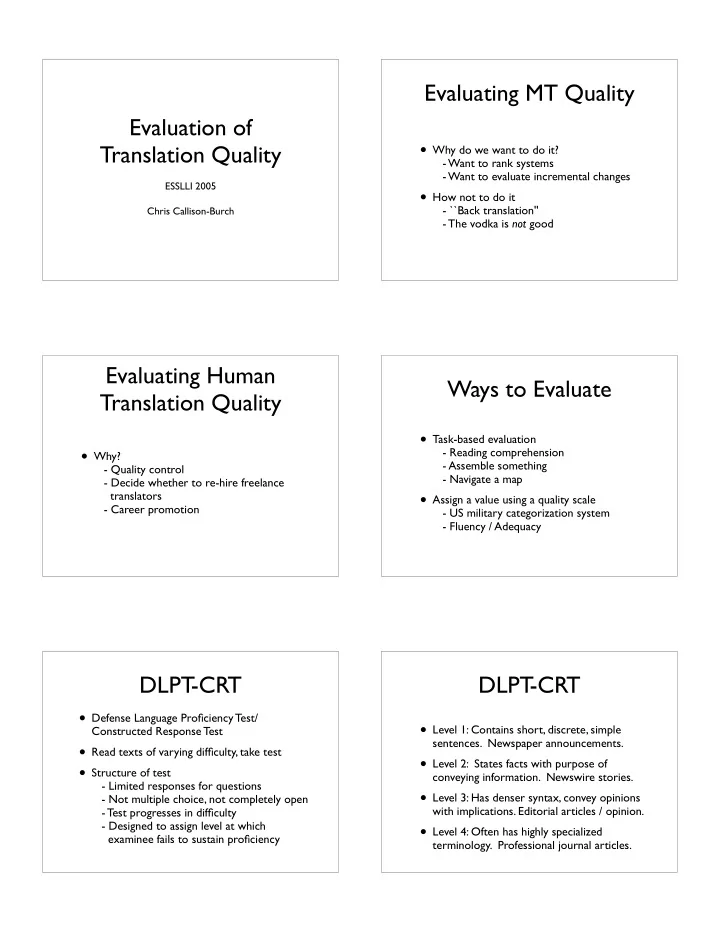
Evaluating MT Quality Evaluation of Why do we want to do it? Translation Quality - Want to rank systems - Want to evaluate incremental changes ESSLLI 2005 How not to do it - ``Back translation'' Chris Callison-Burch - The vodka is not


slide-1
SLIDE 1

Evaluation of Translation Quality

ESSLLI 2005 Chris Callison-Burch

Evaluating MT Quality

  • Why do we want to do it?
  • Want to rank systems
  • Want to evaluate incremental changes
  • How not to do it
  • ``Back translation''
  • The vodka is not good

Evaluating Human Translation Quality

  • Why?
  • Quality control
  • Decide whether to re-hire freelance

translators

  • Career promotion

Ways to Evaluate

  • Task-based evaluation
  • Reading comprehension
  • Assemble something
  • Navigate a map
  • Assign a value using a quality scale
  • US military categorization system
  • Fluency / Adequacy

DLPT

  • CRT
  • Defense Language Proficiency Test/

Constructed Response Test

  • Read texts of varying difficulty, take test
  • Structure of test
  • Limited responses for questions
  • Not multiple choice, not completely open
  • Test progresses in difficulty
  • Designed to assign level at which

examinee fails to sustain proficiency

DLPT

  • CRT
  • Level 1: Contains short, discrete, simple
  • sentences. Newspaper announcements.
  • Level 2: States facts with purpose of

conveying information. Newswire stories.

  • Level 3: Has denser syntax, convey opinions

with implications. Editorial articles / opinion.

  • Level 4: Often has highly specialized
  • terminology. Professional journal articles.
slide-2
SLIDE 2

Human Evaluation of Machine Translation

  • One group has tried applying DLPT
  • CRT to

machine translation

  • Translate texts using MT system
  • Have monolingual individuals take test
  • See what level they perform at
  • Much more common to have human

evaluators simply assign a scale directly using fluency / adequacy scales

Fluency

  • 5 point scale
  • 5) Flawless English

4) Good English 3) Non-native English 2) Disfluent 1) Incomprehensible

Adequacy

  • This text contains how much of the

information in the reference translation:

  • 5) All

4) Most 3) Much 2) Little 1) None

Human Evaluation of MT

  • v. Automatic Evaluation
  • Human evaluation is
  • Ultimately what we're interested in, but
  • Very time consuming
  • Not re-usable
  • Automatic evaluation is
  • Cheap and reusable, but
  • Not necessarily reliable

Goals for Automatic Evaluation

  • No cost evaluation for incremental changes
  • Ability to rank systems
  • Ability to identify which sentences we're

doing poorly on, and categorize errors

  • Correlation with human judgments
  • Interpretability of the score

Methodology

  • Comparison against reference translations
  • Intuition: closer we get to human

translations, the better we're doing

  • Could use WER like in speech recognition
slide-3
SLIDE 3

Word Error Rate

  • Levenshtein Distance (also "edit distance")
  • Minimum number of insertions,

substitutions, and deletions needed to transform one string into another

  • Useful measure in speech recognition
  • Shows how easy it is to recognize speech
  • Shows how easy it is to wreck a nice beach

Problems with WER

  • Unlike speech recognition we don't have the

assumptions of

  • linearity
  • exact match against the referece
  • In machine translation there can be many

possible (and equally valid) ways of translating a sentence

  • Also, clauses can move around, since we're

not doing transcription

Solutions

  • Compare against lots of test sentences
  • Use multiple reference translations for each

test sentence

  • Look for phrase / n-gram matches, allow

movement

Metrics

  • Exact sentence match
  • WER
  • PI-WER
  • Bleu
  • Precision / Recall
  • Meteor

Bleu

  • Use multiple reference translations
  • Look for n-grams that occur anywhere in

the sentence

  • Also has ``brevity penalty"
  • Goal: Distinguish which system has better

quality (correlation with human judgments)

Example Bleu

R1: It is a guide to action that ensures that the military will forever heed Party commands. R2: It is the Guiding Principle which guarantees the military forces always being under the command of the Party. R3: It is the practical guide for the army always to heed the directions of the party. C1: It is to insure the troops forever hearing the activity guidebook that party direct. C2: It is a guide to action which ensures that the military always obeys the command of the party.

slide-4
SLIDE 4

Example Bleu

R1: It is a guide to action that ensures that the military will forever heed Party commands. R2: It is the Guiding Principle which guarantees the military forces always being under the command of the Party. R3: It is the practical guide for the army always to heed the directions of the party. C1: It is to insure the troops forever hearing the activity guidebook that party direct.

Example Bleu

R1: It is a guide to action that ensures that the military will forever heed Party commands. R2: It is the Guiding Principle which guarantees the military forces always being under the command of the Party. R3: It is the practical guide for the army always to heed the directions of the party. C2: It is a guide to action which ensures that the military always obeys the command of the party.

Automated evaluation

  • Because C2 has more n-grams and longer

n-grams than C1 it receives a higher score

  • Bleu has been shown to correlate with

human judgments of translation quality

  • Bleu has been adopted by DARPA in its

annual machine translation evaluation

Interpretability

  • f the score
  • How many errors are we making?
  • How much better is one system compared

to another?

  • How useful is it?
  • How much would we have to improve to be

useful?

Evaluating an evaluation metric

  • How well does it correlate with human

judgments?

  • On a system level
  • On a per sentence level
  • Data for testing correlation with human

judgments of translation quality

NIST MT Evaluation

  • Annual Arabic-English and Chinese-English

competitions

  • 10 systems
  • 1000+ sentences each
  • Scored by Bleu and human judgments
  • Human judgments for translations produced

by each system

slide-5
SLIDE 5

Tricks with automatic evaluation

  • Learning curves -- show how increasing

training data improves statistical MT

  • Euromatrix -- create translation systems for

every pair of European languages, and give performance scores

  • Finite state graphs from multi-reference

translations -- Exact sentence matches possible?

Multi-reference Evaluation

  • Pang and Knight (2003) suggest using multi-

reference evaluation to do exact match

  • Combine references into a word graph with

hundreds of paths through it

  • Most paths correspond to good sentences

at during last the least last week battle fighting were died lost killed in their 12 persons *e* people the battle fighting lives in at ’s least fighting fight people twelve at least week fighting ’s 12 killed took the at

  • f

last week

Final thoughts on Evaluation When writing a paper

  • If you're writing a paper that claims that
  • one approach to machine translation is

better than another, or that

  • some modification you've made to a

system has improved translation quality

  • Then you need to back up that claim
  • Evaluation metrics can help, but good

experimental design is also critical

Experimental Design

  • Importance of separating out training / test /

development sets

  • Importance of standardized data sets
  • Importance of standardized evaluation

metric

  • Error analysis
  • Statistical significance tests for differences

between systems

Invent your own evaluation metric

  • If you think that Bleu is inadequate then

invent your own automatic evaluation metric

  • Can it be applied automatically?
  • Does it correlate better with human

judgment?

  • Does it give a finer grained analysis of

mistakes?

slide-6
SLIDE 6

Evaluation drives MT research

  • Metrics can drive the research for the topics

that they evaluate

  • NIST MT Eval / DARPA Sponsorship
  • Bleu has lead to a focus on phrase-based

translation

  • Minimum error rate training
  • Other metrics may similarly change the

community's focus

Other Uses for Parallel Corpora

Chris Callison-Burch ESSLLI 2005

Statistical NLP and Training Data

  • Most statistical natural language processing

applications require training data

  • Statistical parsing requires treebanks
  • WSD requires text labeled w/ word senses
  • NER requires text w/named entities
  • SMT requires parallel corpora

Cost of Creating Training Data

  • Creating this training data is usually time

consuming and expensive

  • As a result the amount of training data is
  • ften limited
  • SMT is different
  • Parallel corpora are created by other

human industry

  • For some language pairs huge data sets

are available

Exploiting Parallel Corpora

  • Can we use this abundant resource for tasks
  • ther than machine translation?
  • Can we use it to alleviate the cost of

creating training data?

  • Can we use it to port resources to other

languages?

Three Applications of Parallel Corpora

  • Automatic generation of paraphrases
  • Creating training data for WSD
  • "Projecting" annotations through parallel

corpora so that they can be applied to new languages

slide-7
SLIDE 7

Paraphrasing with Bilingual Parallel Corpora Paraphrasing

  • Paraphrases are alternative ways of

conveying the same information

  • Useful in NLP application such as:
  • Generation: more varied and fluent text
  • Multidocument summarization: allows

repeated information to be condensed

  • Question answering: paraphrases of same

answer provide evidence of correctness

Previous Approaches

  • Used monolingual parallel corpora
  • Multiple translations of the same thing
  • Multiple translations of classic French

novels into English

  • Evaluation data for Bleu MT Eval metric
  • People have also used comparable corpora

(encyclopedia articles on the same topic)

Paraphrasing with monolingual parallel data

  • Methodology:
  • Align sentences across translations
  • Identify similar contexts in aligned sentences
  • Phrases that appear in similar contexts may

be paraphrases

Emma burst into tears and he tried to comfort her, saying things to make her smile. Emma cried, and he tried to console her, adorning his words with puns.

burst into tears = cried, console = comfort

Problems

  • Monolingual parallel corpora are very

uncommon

  • This fact might limit what paraphrases we

are able to generate

Paraphrasing with bilingual parallel data

  • Our Methodology:
  • Use MT techniques to align English-

German parallel text

  • Get German phrase aligned with the

English phrase we want to paraphrase

  • Find other English phrases that German

phrases align with

  • Treat those English phrases as

paraphrases, and rank them

slide-8
SLIDE 8

Example

what is more, the relevant cost dynamic is completely under control im übrigen ist die diesbezügliche kostenentwicklung völlig unter kontrolle we

  • we

it to the taxpayers to keep in check the costs wir sind es den steuerzahlern die kosten zu haben schuldig unter kontrolle

Extracted Paraphrases

  • military force armed forces, defence, force, forces, peace-

keeping personnel, military forces

  • sooner or later at some point, eventually
  • great care a careful approach, greater emphasis,

particular attention, specific attention, special attention, very careful

  • at work at the workplace, employment, held, holding, in

the work sphere, organised, operate, taken place, took place, working

Word Sense Disambiguation with Parallel Corpora Word Sense Disambiguation

  • Define a set of senses for words, or draw

them from a dictionary

  • plant1=foliage, plant2= factory, plant3= to put

something in the ground

  • Develop an algorithm to assign a sense to a

word in context

Data for WSD

  • Statistical approaches to WSD generally use

a large set of labeled training data, where each of the words to be disambiguated has been labeled with its sense

  • The Senseval competitions create such data,

for training and for evaluation

  • Generally label 1,000s of instances of

around 30 vocabulary items

Problem

  • Data is costly to create
  • Consequently only a few vocabulary items

get labeled

  • There is a bottleneck in the process of

creating statistical WSD systems

slide-9
SLIDE 9

Breaking the Bottleneck

  • Rather than doing WSD with explicitly

labeled data we could do it with parallel corpora

  • Treat words as polysemous when they

translate to more than one foreign word

drugs1 regards classification as medicinal products or drugs , en particulier par rapport aux médicaments et autres produits pharmaceutiques , drugs2 in my country we have 2 million people on illegal drugs , dans mon pays , 2 millions de personnes consomment des drogues illicites ,

Just say no to hard drugs!

Senseless Violence

  • Two options:
  • Either use the foreign words as the senses
  • Or keep using the senses as given

dictionary and use the foreign words as a way of acquiring more labeled data

  • When a particular dictionary sense only
  • ccurs with one of the foreign word then

use sentence pairs which have that contain that word as additional data points

Annotation Projection for Parsing Statistical Parsing

  • Statistical parsers are trained on treebanks

containing sentences annotated with parse trees

  • Developing treebanks requires linguistics

expertise and is a time consuming, expesive process

  • Treebanks exist only for a limited number of

languages, and are often constrained in size

Development time for Treebanks

Language Treebank Dev Time Size of corpus Parser Performance English Penn Treebank 5 Years 1M words 40k sentences 90% Chinese Chinese Treebank v2 2 Years 100k words 4k sentences 75% Chinese Chinese Treebank v2 4 Years 400k words 15k sentences ~80% Others (Farsi, Hindi) ? ? ? ?

Exploit Resources for New Languages

  • Use high accuracy English parsers to parse

English section of a parallel corpus

  • Align the parallel corpus
  • Project the trees onto the other language
  • Use that to train a foreign language parser
slide-10
SLIDE 10

Create an English Dependency Parse Project the Dependency Parse Automatically Create a Foreign Treebank

  • Continue repeating those steps for all of the

sentences in the parallel corpus

  • Use the project trees to train a Chinese

parser

Potential Problems

  • Low quality word alignments may cause

problems

  • Mis-matches between the syntax of

languages complicate things

  • Differences between text that English parser

was trained on (newswire) and parallel corpus (gov't) may exacerbate things

Results

  • With manually created alignments, a 67%

accuracy was achieved

  • With automatic alignments, a 57% accuracy

was achieved

  • Equivalent to manually creating a treebank

containing 3000 sentences

Conclusions

  • Parallel data can be exploited to supplement

data for a number of statistical NLP tasks

  • Many different tasks can be treated using

annotation projection

  • Increases the feasibility of developing NLP

technologies for other languages

  • As quality of word alignment algorithms

improve, these techniques will become more viable