Ethiopia and Saudi Arabia Ethiopia, Africas highest growth country, - - PowerPoint PPT Presentation

ethiopia and saudi arabia
SMART_READER_LITE
LIVE PREVIEW

Ethiopia and Saudi Arabia Ethiopia, Africas highest growth country, - - PowerPoint PPT Presentation

Swiss Mining Institute November 2018 Arabian Nubian Shield Ethiopia and Saudi Arabia Ethiopia, Africas highest growth country, Strong platform of partners, contractors & company management base for African Union, worlds largest


slide-1
SLIDE 1

Arabian Nubian Shield Ethiopia and Saudi Arabia

1

Swiss Mining Institute

November 2018

  • Strong platform of partners, contractors & company management
  • Development ready project – starting at ~ 140koz p.a. with potential uplift to 200koz p.a.
  • Currently assembling development finance for construction 2019, commissioning 2020
  • Extensive exploration portfolio in Arabian-Nubian Shield, in Ethiopia and Saudi Arabia

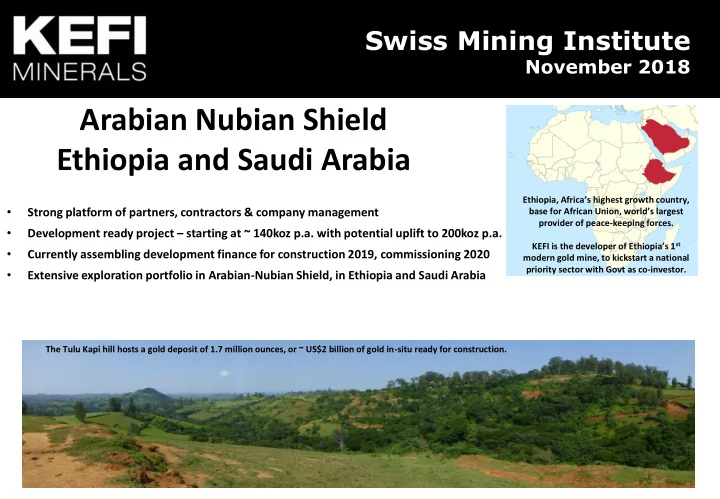
The Tulu Kapi hill hosts a gold deposit of 1.7 million ounces, or ~ US$2 billion of gold in-situ ready for construction. Ethiopia, Africa’s highest growth country, base for African Union, world’s largest provider of peace-keeping forces. KEFI is the developer of Ethiopia’s 1st modern gold mine, to kickstart a national priority sector with Govt as co-investor.

slide-2
SLIDE 2

2

The information contained in this document (“Presentation”) has been prepared by KEFI Minerals plc (the “Company”). While the information contained herein has been prepared in good faith, neither the Company nor any of its shareholders, directors, officers, agents, employees or advisers give, have given or have authority to give, any representations or warranties (express or implied) as to, or in relation to, the accuracy, reliability or completeness of the information in this Presentation, or any revision thereof, or of any other written or oral information made or to be made available to any interested party or its advisers (all such information being referred to as “Information”) and liability therefore is expressly disclaimed. Accordingly, neither the Company nor any of its shareholders, directors, officers, agents, employees or advisers take any responsibility for, or will accept any liability whether direct or indirect, express or implied, contractual, tortious, statutory or otherwise, in respect of, the accuracy or completeness of the Information or for any of the opinions contained herein or for any errors, omissions or misstatements or for any loss, howsoever arising, from the use of this Presentation. This Presentation may contain forward-looking statements that involve substantial risks and uncertainties, and actual results and developments may differ materially from those expressed or implied by these statements. These forward-looking statements are statements regarding the Company's intentions, beliefs or current expectations concerning, among other things, the Company's results of operations, financial condition, prospects, growth, strategies and the industry in which the Company operates. By their nature, forward-looking statements involve risks and uncertainties because they relate to events and depend on circumstances that may

  • r may not occur in the future. These forward-looking statements speak only as of the date of this Presentation and the Company does not undertake any obligation

to publicly release any revisions to these forward-looking statements to reflect events or circumstances after the date of this Presentation. This Presentation should not be considered as the giving of investment advice by the Company or any of its shareholders, directors, officers, agents, employees or

  • advisers. Each party to whom this Presentation is made available must make its own independent assessment of the Company after making such investigations and

taking such advice as may be deemed necessary. Neither this Presentation nor any copy of it may be (a) taken or transmitted into Canada, Japan, the Republic of Ireland, the Republic of South Africa or the United States of America (each a “Restricted Territory”), their territories or possessions; (b) distributed to any U.S. person (as defined in Regulation S under the United States Securities Act of 1933 (as amended)) or (c) distributed to any individual outside a Restricted Territory who is a resident thereof in any such case for the purpose of

  • ffer for sale or solicitation or invitation to buy or subscribe any securities or in the context where its distribution may be construed as such offer, solicitation or

invitation, in any such case except in compliance with any applicable exemption. The distribution of this document in or to persons subject to other jurisdictions may be restricted by law and persons into whose possession this document comes should inform themselves about, and observe, any such restrictions. Any failure to comply with these restrictions may constitute a violation of the laws of the relevant jurisdiction. Note: All references to $ within this presentation refer to US dollars.

slide-3
SLIDE 3

KEFI Overview

3

Location of KEFI’s portfolio within Ethiopia and Saudi Arabia, in the Arabian-Nubian Shield (ANS)

  • Focused on the two largest Arabian Nubian Shield countries: Ethiopia & KSA
  • Proprietary data base and locally-based experienced teams
  • KEFI Market Cap £9M at 1.7p on AIM (“KEFI”). 12-month high 5p.
  • Management & contractors own 15%. Special situation funds ~ 30%
  • $300M development funding is at project-level (contractor, equity, debt)
  • NPV of £44M now, or NPV £75M at start production. Open pit only,

at $1300/oz flat, net of debt, after tax, discounted at 8%.

  • Excludes value of underground deposit, district deposits adjacent to open pit

and exploration projects in Saudi Arabia

  • Strong local partners investing alongside KEFI into the local JV companies:

Ethiopia: Gov’t ($20M), banks&insurers ($30-38M), combined <49.9% Saudi: Al Rashid family conglomerate ARTAR, contributes 60% of JV costs

  • Ethiopian development-ready project in a district of drilled satellite deposits:
  • Extensive exploration portfolio in Ethiopia and Saudi Arabia
slide-4
SLIDE 4

4 Norman Ling, Non-Executive, Chair Nominations Review Committee – BA German and Economic History [Hons]

Norman was a member of the British diplomatic service for more than 30 years, for the last ten with the rank of ambassador. He has served in a wide range of countries in the Middle East and Africa. His last post, before retirement, was as Ambassador to Ethiopia, Djibouti and the African Union. For the last two years he has been actively involved with development of the mining industry in Ethiopia.

Mark Tyler – Non-Executive Director – Bsc (Eng) Mineral Processing, GDE (Mineral Economices)

Mark has over 20 years of mining finance experience, having participated in mining equity investments at the IDC of South Africa and as the Co Head of Resources Finance and subsequently a resources investment banker in London for Nedbank, a South African bank. He is currently also a resources adviser to Exotix Capital, an emerging markets investment bank and the London representative for Auramet International, an international precious metals financier.

Harry Anagnostaras-Adams – Managing Director – B. Comm, MBA, Fellow of Australian Institute of Company Directors

Harry was founder or co-founder of Citicorp Capital Investors Australia, investment company Pilatus Capital, Australian Gold Council, Atalaya (EMED), KEFI Minerals and Cyprus-based Semarang Enterprises. He has overseen a number of start-ups in those and their related organisations principally through the roles

  • f Chairman, Deputy Chairman or Managing Director. He qualified as a Chartered Accountant early in his career while working with PricewaterhouseCoopers.

Mark Wellesley-Wood, Non-Executive Chair, Chair Technical Review Committee – BEng (Mining)

Mark is a mining engineer, with over 40 years’ experience in both the mining industry and investment banking. He has been closely involved in mining activities in Africa, having started his career on the Zambian copper-belt. Mark is a former Executive Chairman and CEO of South African gold miner, DRDGold Limited, and a former director of Investec Investment Banking and Securities in London. He is currently Chairman of AIM quoted Tri-Star Resources plc.

Directors

John Leach – Finance Director – BA Ec, MBA, CA (Aust & Canada)

John has over 25 years’ experience in senior executive positions in the mining industry internationally and is a former non-executive Chairman of Australian- listed Pancontinental Oil and Gas NL. He is a Member of the Institute of Chartered Accountants (Australia), a Member of the Canadian Institute of Chartered Accountants, and is a Fellow of the Australian Institute of Directors.

slide-5
SLIDE 5

5 David Munro - Operations

David began his career as a mining engineer in underground mining and progressed to manage all parts of the minerals value chain. He has been responsible for mining and smelting operations

  • n five continents and every major commodity.

MD of Billiton BV. Under his leadership this business grew into one of the world’s largest and lowest cost integrated producers of primary

  • aluminium. After the merger of Billiton and BHP

to form the world’s largest mining company, he was appointed President of Strategy and Development. As CEO of the then ailing RMC Group plc, once a constituent of the FTSE 100 Index, he overhauled the company’s strategy and management. By 2005 the company’s prospects had improved and it was sold. He was also one of the original UK based directors of Kazakhmys plc, the first former Soviet mining company to list on the LSE main board in 2005. As Strategy Director he was instrumental in the establishment of their two major open pit copper projects in Kazakhstan, both of which are now in production.

Eddy Solbrandt - Systems

Eddy began his career in the mining industry in 1986 and has since worked in

  • pen

cut and underground metalliferous mines, as well as in coal, gold and mineral sands in Australia, New Zealand, USA, Canada, Mexico, UK, Ukraine, Russia, Kazakhstan, Indonesia, Thailand, South Africa, Mozambique and Namibia. Eddy is founder of GPR Dehler, an independent, international management consultancy which specialises in productivity improvement for mining companies worldwide, especially in the areas of human resources development and performance improvement. He is adept at providing swift assessment, analysis and development

  • f solutions and strategies for achieving

strategic, operational and financial

  • bjectives integrating process, people

and technology. He is a seasoned facilitator experienced in designing and conducting interactive strategy workshops.

Brian Hosking - Planning

Brian began his career as a geologist and technical planning in a variety of mining operations. In 1990 he set up his own human resource consulting firm, then led its growth and integration into Transearch, a large global search firm. In 1999 he was elected to serve on the Transearch Board as Executive Director and COO. In 2003 Brian set up Meyer Hosking and focused on the mining sector developing this niche in London providing strategic services including remuneration advice, management assessment and executive search to a wide range of clients. Brian has established a strong international reputation as a consultant with an in depth knowledge

  • f the industry. In this capacity he is

regularly retained as a strategic advisor to executive management teams and boards across the mining industry.

KEFI Senior Management Managing Director and Finance Director Plus Newly-Appointed Operations Specialists

Norman Green – Development

Norman is a graduate mechanical and professional engineer with the key experience of having managed large mining and refining construction projects from concept to completion with more than 30 years experience in this field. Major projects Hillside Aluminium smelter, the Skorpion Zinc project and the Husab Uranium mine are included in his handiwork, as well as a number of pure deep level underground mines. He founded and built Green Team International (GTI) into a successful project engineering firm providing or supporting construction implementation and other engineering support to mainly African mines. Projects studied or handled by GTI as the Project Implementation Team or “Owner’s Team” included major gold, uranium, copper, nickel, iron ore and platinum projects in Namibia, South Africa, DRC, Peru and Madagascar. Norman now conducts projects of special interest with his long-standing associates for long-established clients. …

Senior Management have been paid mainly in shares rather than cash
slide-6
SLIDE 6
  • The two largest countries in the Arabian-Nubian Shield, by land mass
  • Both have a long ancient history of mining
  • Both opened to modern mining during the past decade
  • Both recently installed younger national leaders and are demonstrably pro-development
  • In both countries:
  • KEFI has secured pole position for the mining sector
  • KEFI’s proprietary database and in-country teams provide early mover advantages

6

Ethiopia and Saudi Arabia

slide-7
SLIDE 7
  • To minimise ownership dilution from imminent development funding, have arranged

development funding at project-level.

  • Have also arranged a working capital facility for parent comprising £450K per month

available for drawdown from Jan 2019. Repayments half-convertible at floor price of 2p.

  • ~$300M development funding package at project level comprises:
  • $60M for mine (equipment & infrastructure) funded via Ausdrill mine services

agreement whereby capital is recouped from production cash flows at $/tonne

  • $110-118M project equity:
  • $60M already spent by KEFI Minerals (Ethiopia)
  • $50-58M commitments by local partners (Govt, Banks&Insurers) for up to 50%
  • $110M project lease-bond or loan for processing infrastructure (lease/bond mandated)

plus additional sums for costs and escrowed cash for debt service during construction

  • $20M working capital for ore stockpile funding

7

Ethiopia Development Funding at Project Level

slide-8
SLIDE 8

8

Market Capitalisation Statistics of Peers This compares EV (Mkt Cap+Debt) with NPV

“Pre-Construction”, “In Construction” and “New Producers”

0.0x 0.5x 1.0x 1.5x 2.0x 2.5x 3.0x

EV/NPV

In Construction Average 1.15x New Producers Average 1.14x KEFI 0.2x Feasibility Completed but Pre-Construction Average (ex KEFI) 0.55x KEFI’s market capitalization of $11M is only 20% of the NPV of its +50% of Tulu Kapi

slide-9
SLIDE 9
  • KEFI has been operator of the Gold & Minerals Joint Venture (G&M) since 2008
  • G&M has taken the opportunity of the past 2-3 years of regulatory overhaul by the Government
  • KEFI has assembled a cherry-picked exploration portfolio. The largest other than Ma’aden (Govt)
  • Field work is focused on starting drilling in 2019 at the same time as project-development in Ethiopia

View a video summarising KEFI’s projects in Saudi Arabia here

9

Saudi Arabia Operator of Largest Non-Govt Explorer

slide-10
SLIDE 10

10

G&M JV 1 MLA 1 EL 17 ELAs 4 ELAs pending Total ≈1,275km2

+3Moz +3Moz +3Moz +40Mt at 2.4% Cu +1Moz +6Moz 0.6Moz +0.5Moz

Tenement Locations in Saudi Arabia via the G&M Joint Venture with ARTAR

slide-11
SLIDE 11

15/11/2018 11

Comparison of 120km long Wadi Bidah VMS Belt (left) vs. the Bisha VMS Belt in Eritrea (right) (same scale).

Saudi Arabia Key Exploration Area for 2019 Wadi Bidah Mineral District

G&M JV (via ARTAR) has registered applications for most of Wadi Bidah VMS Belt. Contain 24 VMS systems and many historic workings

slide-12
SLIDE 12
  • Gossan 6km long, 5-40m wide
  • 53 Trenches across the gossan

along its entire length, samples average 2-3ppm or g/t gold

  • Drilling to start 2019
  • Potential for a very large VMS

copper-gold deposit

Hawiah Licence At top of Wadi Bidah Mineralised District

Geophysics identified an intense north-south trending self-potential (SP) anomaly located from surface to +300m depth with +2km strike length (consistent with the presence of a massive sulphide source)

slide-13
SLIDE 13
  • 2014: KEFI acquired Tulu Kapi Gold Project
  • 2015-2017: formalised permits, construction & operating contracts and community plans
  • The past 2-3 years of public calls for change in Ethiopia have resulted in recent very positive change
  • KEFI and now pressing the “go” trigger for 2019 construction and commencement of district exploration

View a video summarising KEFI’s projects in Ethiopia here

13

Ethiopia Developing the First Modern Mine

slide-14
SLIDE 14

Exploration Pre-feasibility Feasibility Construction Operation

Geological Risks Technical Risks Project Implementation Risks Country, Community and Price Risks Systems, People and Planning Resources and Technology

Sequential management of risk elements through project development

Contracting Commissioning Optimising

Phases of a Project for Risk Mitigation Tulu Kapi Ready to Start Construction 2019

TULU KAPI

slide-15
SLIDE 15

Tulu Kapi Project-Independent Validation For Project Financiers, at Nov 2018

Due Diligence Definitive Feasibility Study Resources & Reserves Environmental & Social Financial Model

TULU KAPI

slide-16
SLIDE 16

16

Project Definition & Evaluation Development / construction Operation and production Closure Value

100% 75% 50% 25% 0%

Time

Value build

M&A

Select target areas of exploration 1 Identify areas of likely mineralisation (sampling) 2 Drilling, channel sampling to establish mineralisation 3 Pre-feasibility study 6 Reserve definition 7 Closure 15 Environmental rehabilitation 16

Prospecting and exploration

Investment “sweet spot”

Commissioning 11 Begin commercial production 12 Reach steady state 13 Feasibility study 8 Raise funding 9 Project construction 10 Declining production 14 Secure permits, leases and licenses 4 Resource definition 5

KEFI’s project pipeline: Step 9 for Tulu Kapi open pit Step 4 for Tulu Kapi satellites Step 2 for Wadi Bidah VMS Belt

Mine Development Lifecycle

KEFI has a Project Pipeline Positioned From Step 1 to Step 9 Triggering Step 10 in Early 2019

New discoveries

KEFI’S share price reflects stage 3 whilst its project status is stage 9. Past 2-3 years of delays in both Ethiopia and Saudi Arabia and share issues to maintain progress have diluted the share price and worn shareholders’ patience.

VERSUS

slide-17
SLIDE 17

17

2009-14 Exploration drilling and engineering which cost c. $60M. KEFI takeover 2014, extra drilling and

  • verhauled plans led to

1.7Moz Resource and 1M

  • z reserve

NBE approved finance plan and Govt permitted the development plan including production, environmental protection and community plans to IFC standards Selected Plant and Mine contractors after 2 consecutive tenders with > 10 international firms competing Significant net cash generated for debt

  • reduction. At $1300,

debt repaid in 3 years. Plus will fund organic growth and dividends. 2015 2016 2017 2018 2019 2020 2021 2022 2023 2024 Complete the resettlement of community and start plant, road and power constr’n. Over 1000 people to be employed

TULU KAPI’S TIMETABLE

Appointed senior management team, arranged community resettlement, brought in local institutional partners Began to arrange

  • finance. Interrupted by

Ethiopian State of Emergency. Govt signed Shareholder Agreement to become co-shareholder in JV. Start mining and commission plant. Training operations personnel. Gold production start First full year of production. Community development programs to start

slide-18
SLIDE 18

18

  • April 18: new Prime Minister Dr Abiy Ahmed – a smooth leadership change. Lifted the State of Emergency that
  • f > 2 years and introduced a series of initiatives that have been welcomed inside and outside Ethiopia.
  • April-Aug 18: new Mines Ministry, new central bank Governors and new V.P. of Oromia Regional Govt. Peace

Agreement with Eritrea, reconciliation with Oromia Liberation Front, commitment to privatisation and deregulation of major Government enterprises. Rapid and far-reaching changes across many dimensions.

  • An impressive refreshed commitment to development and democratisation. Note that Ethiopia has been in top

10 growth countries for over 15 years of change and development. This year, Africa’s highest growth country.

  • Tulu Kapi Gold Project has full permit for its development, operation, social & environmental plans.
  • Remaining administrative consents for development trigger are:
  • Oromia Regional Govt to trigger detailed community resettlement action plan - done
  • Ministry of Mines to endorse all past equity investment (+US$60M) and refined project plan – mostly done
  • Central bank to approve finance plan details (security, leasing components, cash control) - happening

Ethiopia 2018 Political Developments

slide-19
SLIDE 19

19

  • Govt committed in 2017 as KEFI’s initial partner: Ministry of Finance & Economic Cooperation to invest $20M
  • ANS formed in 2018 to be KEFI’s second local partner in Tulu Kapi Gold Mine
  • ANS founders have committed 10% of the ANS investment of $30-38M
  • Investors into ANS mainly comprise major Ethiopian banks and Insurance companies
  • Ethiopia investors cannot invest outside Ethiopia and seekexposore to gold-hard-currency based assets
  • The gold sector is a national priority (dropped from 400Koz in 2017 to nil today)
  • Tulu Kapi starts at 140Kpa
  • The cash flow outlook for Tulu Kapi indicates rapid debt-repayment, organic growth & good potential dividends

ANS Mining S.C (“ANS”) KEFI’s Local Institutional Partners

slide-20
SLIDE 20

20

Artisanal mines, prospects and major Au and Cu deposits in Ethiopia

KEFI’s Cornerstone Asset Tulu Kapi is in Ethiopia’s largest gold region

slide-21
SLIDE 21

21

KEFI Equity Finance Structure

KEFI Minerals plc Institutions 30%

Board/Management/Contractors 15%

Public 55% KEFI Ethiopia Past $60M equity Tula Kapi Gold Mines (TKGM) 54%

  • Govt. of Ethiopia

New $20M equity

23% 100% Ausdrill Mining Services Contractor Lycopodium Plant Constr & Ops support ANS Mining New $30M equity 23% G&M Saudi Arabia Artar Saudi Arabia 60%

  • All consortium parties are either listed companies or government entities (thereby providing transparency, suitable regulation and accountability at

all levels). All parties will undertake both a project responsibility role and a project investment role:

  • TKGM – $110M of equity funding and management of the project (past equity is $60M and additional planned is $50-60M)
  • Government of Ethiopia – to invest new equity $20M funding and operate all off-site infrastructure
  • ANS – signed binding agreement to invest new equity $30-38M (£22.5-£28.5M) in TKGM
  • Ausdrill – to supply and operate the mining fleet (on a cost per tonne basis)
  • Lycopodium – performance guarantee on process plant designed and supplied for fixed price. Cost-based assembly with incentivised targets

40%

slide-22
SLIDE 22

Email: info@kefiminerals.com Website: www.kefi-minerals.com

22

@kefiminerals KEFI Minerals plc

Local community consultation before development starts at Tulu Kapi

Contacts

slide-23
SLIDE 23

APPENDICES

23

slide-24
SLIDE 24

Project development- 1930’s to present day

The Tulu Kapi project lies 360 km due west of Ethiopian capital, Addis Ababa. Access is via a sealed road and the site benefits from main electricity grid access within 50km of the project. Tula Kapi has a probable ore reserve of 1.05Moz and mineral resources totalling 1.72Moz. The project is fully permitted – the mining agreement formalised in Apr-15, with terms including a 20-year mining licence, 5% Government free carried interest and full permitting for development and operation. Minor ancillary licences are being processed for issuance once community resettled. Planned gold production is 144koz p.a. for the first 3 years, with net operating cash flow c.$78M p.a. (at assumed gold price $1,300/oz) and life of mine

  • pen-pit gold production of 980koz at an AISC of c. $800/oz.

24

Tula Kapi Gold Project

Project Timeline

  • 1930s

Discovered and mined on a small scale by an Italian consortium

  • 2009

Nyota Minerals Limited acquired the licences and undertook extensive exploration and drilling

  • 2012

Nyota Minerals publish an initial DFS based on a 2.0 Mtpa processing plant, capex $290M for ~100 Koz pa gold over 10 years

  • Dec-13

KEFI acquires 100% of the project for ⁓$10M, equating to a cost of Jun-14 ⁓$10/oz reserves for a project with ⁓$50M historical expenditure

  • 2015

Mining Licence Granted

  • 2015

DFS completed, evaluated conventional open-pit mining

  • peration and carbon-in leach (CIL) processing
  • 2016

International tenders to select project contractors

  • May-17

DFS update, incorporates due diligence and refinements on the 2015 DFS. Process plant capacity of 1.7-1.9Mtpa

  • Oct-17

KEFI announced increased process plant capacity to 1.9-2.1Mtpa, capex c. $160M for ~140Koz pa gold over 7 years

  • 2018

Financing to start development

slide-25
SLIDE 25

Geological Overview

  • The Tulu Kapi region comprises typical greenstone characterised by

prominent hills of intrusive rocks and deeply incised valleys hosting both metasediments and metavolcanic material

  • Gold is hosted in quartz-albite alteration zones as stacked sub-horizontal

lenses in a syenite pluton into which a swarm of dolerite dykes and sills have intruded

  • Gold mineralisation extends over a 1,500m by 400m zone and is open at a

depth of over 400m

  • Relatively simple mineralogy comprises gold, silver, pyrite and minor

sphalerite and galena – metallurgical recoveries of gold average ~ 93% 25

Tula Kapi - Resources & Reserves

(JORC 2012)

Resource

Tonnage Gold Grade

  • Cont. Gold

(millions) (g/t) (Moz) Indicated Below 1,400m 17.7 2.49 1.4 Inferred 1.3 2.05 0.1 19.0 2.46 1.5 Indicated Above 1,400m 1.1 5.63 0.2 Inferred 0.1 6.25 0.0 1.2 5.69 0.2 Indicated Total 18.8 2.67 1.6 Inferred 1.4 2.40 0.1 20.2 2.65 1.7

Reserves

Cut-off Tonnage Gold Grade

  • Cont. Gold

(g/t) (millions) (g/t) (Moz) High grade 0.90 12.0 2.52 1.0 Low grade 0.50 - 0.90 3.3 0.73 0.1 15.4 2.12 1.05 Note: Resources were reported above and below 1,400m RL to reasonably reflect the portion of the resource that would likely be exploited via either open-pit or underground methods.

Examples of Mineralised Tula Kapi Drill Core

slide-26
SLIDE 26

As part of the due diligence for financing, KEFI has agreed the 2018 Plan with the preferred financier and contractors. Whilst resources and reserves and the mine plan remain essentially unchanged, the planned process plant has been expanded to a nameplate

  • f 1.9-2.1Mtpa, to reduce stockpiles and expand cash flows.

The 2018 Plan is supported by the:

  • draft mining services agreement with Ausdrill/African Mining Services
  • draft plant design, supply and construction contracts with Lycopodium
  • confirmations of commitment and schedule from Ethiopian Roads

Authority and Ethiopian Electricity & Power Corp’n for roads and power

  • draft operational arrangements with the explosives, fuel, laboratory

services and other ancillary support services

  • the draft report by the independent technical experts for the lenders

The implementation plans have been agreed on a base schedule of 24 months from drawdown of project finance to 1st gold pour. Incentivised arrangements are proposed for faster start-up. 26

Tulu Kapi Gold Project Overview of Post-DFS Refinements 2018 Plan Agreed with Contractors & Financier

2018 Plan 2017 DFS Update Stripping Ratio 7.4 7.4 Total Ore Processed 15,400 kt 15,400 kt LOM Head Grade 2.1 g/t 2.1 g/t Gold Recovery 93.3% 93.3% Total Gold Production 980 koz 980 koz Process Plant Throughput 1.9-2.1 Mtpa 1.5-1.7 Mtpa

  • Avg. Gold Production (first 8 years)

135koz p.a. 115 koz p.a. Cash Operating Costs $701/oz $684/oz All-in Sustaining Costs $793/oz $801/oz All-in Costs (incl. initial capex) $973/oz $937/oz NPV at start of construction (8% real discount rate) (after debt) $115M/£82M $69M NPV at start of production (8% real discount rate) (after debt) $192M/£137M $159M NPV at start of production (8% real discount rate) (before debt) $337M $289M Payback Period 3 years 3 years Net Operating Cash Flow (average for first 8 years) $73M p.a. $60M p.a.

2018 Plan compared with most recent DFS

Key mining and financial parameters from these studies are summarised in the table below.

Note: Both cases at a gold price of $1,300/oz.

slide-27
SLIDE 27

Government and Community

  • Mining Licence issued, bilateral agreement signed, permitted for development, operating, environmental and social
  • Project Company (TKGM) shareholders agreement signed – Mining Licence transferred to TKGM
  • Roads and power authorities have committed to construct and operate required off-site infrastructure
  • Community resettlement plans and compensation agreed and ready for implementation upon drawdown
  • Finance Ministry and Central Bank has approved tax treatments and capital ratios
  • Currently reviewing draft documentation for $160M infrastructure bond finance

Contractors

  • Have confirmed updated costs for financing agreements
  • Have agreed base case 2-year construction schedule, with incentivisation for quicker schedule and lower cost

27

Tulu Kapi - Project Development Progress

slide-28
SLIDE 28

The mining fleet and operators will be provided by Ausdrill/African Mining Services Planning and Control by KEFI/TKGM

Ausdrill / African Mining Services has developed a mainly African based business over a 27 year period where 97% of employees are nationals. It currently conducts mining operations for clients in Ghana, Mali, Bukino Faso, Senegal and drilling services in other countries also.

slide-29
SLIDE 29

Another African Mining Services Open Pit Mine

slide-30
SLIDE 30

LYCOPODIUM process plant construction contractor

Lycopodium is mainly African-based, having built 57 gold plants and worked in over 20 African countries over a period of over 20 years. It has also worked in Australia, Asia and Europe. Lycopodium will be co-ordinated and controlled by KEFI/TKGM.

30

slide-31
SLIDE 31

THANK YOU

31