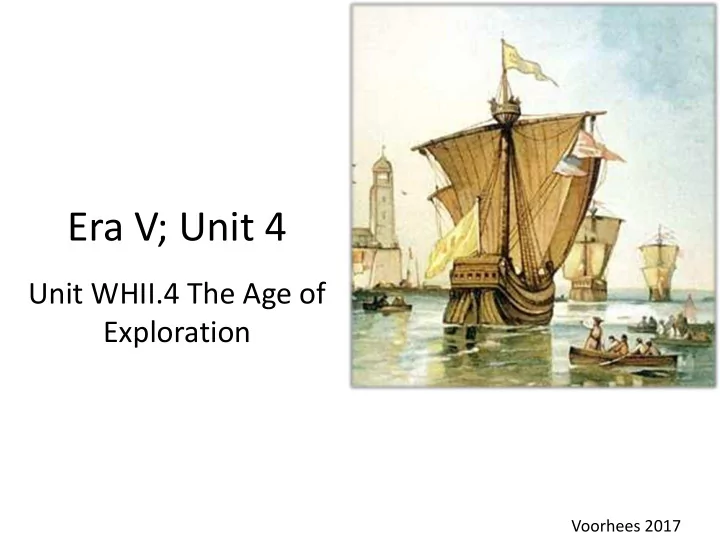
SLIDE 1 Era V; Unit 4
Unit WHII.4 The Age of Exploration
Voorhees 2017
SLIDE 2 The student will apply social science skills to understand of the impact of the European Age of Exploration by
- a) explaining the political and economic goals
- f European exploration and colonization;
SLIDE 3
WHII.4a) Factors
Factors contributing to the European discovery of lands in the Western Hemisphere
SLIDE 4 WHII.4a) Factors for discovery
- Demand for gold, spices, and natural
resources in Europe (European demand for resources)
- Support for the diffusion of Christianity
(Spread of Christianity)
- Political and economic competition between
European empires (European political and economic competition)
SLIDE 5 WHII.4a) Factors for discovery
navigational arts (European and Islamic
- rigins) (Technology)
- Pioneering role of Prince
Henry the Navigator (Prince Henry the Navigator)
SLIDE 6 Gold, Glory, and God
- Gold:
- Europeans wanted to get rich
– 1.Getting gold – 2.Trading spices – 3.Finding natural resources Q: Why did the Europeans want to explore for trade routes… Why wouldn’t they just travel through the Middle East to Asia?
SLIDE 7 Gold, Glory, and God, continued…
– Europeans competed to be richest and biggest
SLIDE 8 Gold, Glory, and God, continued…
- God:
- Europeans wanted diffusion of Christianity
SLIDE 9
WHII.4a) Explorers
Establishment of overseas empire and the decimation of indigenous populations
SLIDE 10 Prince Henry the Navigator
- Portugal
- Brought experts together to study navigation
- Paid for exploration
- (Prince Henry Paid 4
Portuguese to X-Plore)
SLIDE 11 Vasco Da Gama
- Portugal
- sailed around tip of Africa to India
- 1st water route to Asia
- (Da Gama & Da Portuguese
Sailed to Da India)
SLIDE 12 Christopher Columbus
- Spain
- Sailed west to Asia but landed in Bahamas
- 1st European to find “New World”
- Spain wanted to be in India but Chris landed
in the Americas
he kinda missed)
SLIDE 13 Ferdinand Magellan
- Spain
- Captained the crew- 1st to circumnavigate
the world
- He named the Pacific
- (Around the world,
Magellan led… too bad when they made it, he was dead)
SLIDE 14 Hernando Cortez
- Spain
- Conquered the Aztecs & took over Mexico
- (In Mexico,
the Aztecs were bold but Cortez & Spain took their gold)
SLIDE 15 Francisco Pizarro
- Spain
- Conquered Incas
- Took over Peru & Chile
- (Spain sent Pizarro to the Andes…
he conquered the Incas w/out sayin’ please)
SLIDE 16 Francis Drake
- England
- 1st Englishman to circumnavigate
the globe
circumnavigate, go around the world and have some cake)
SLIDE 17 Jacques Cartier
- France
- Claimed Eastern Canada
(Quebec) for France
- (Cartier - he liked to dance –
he claimed Canada 4 his France)
SLIDE 18
WHII.4a) ESSENTIAL UNDERSTANDINGS WRAP-UP
The expanding economies of European states stimulated increased trade with markets in Asia.
SLIDE 19
SLIDE 20 The student will apply social science skills to understand of the impact of the European Age of Exploration by
- b) describing the geographic expansion into
Africa, Asia, and the Americas;
SLIDE 21
SLIDE 22 WHII.4b) Americas
- Expansion of Spanish Empire into South and
Central America
- Expansion of British Empire into North
America
- Expansion of Portuguese Empire into South
America
- Expansion of French Empire into North
America
SLIDE 23
Spain South America Central America British North America (East Coast) Portuguese South America (Brazil) French North America (Canada)
WHII.4b) Americas
SLIDE 24 WHII.4b) Africa and Asia
Africa
- Expansion of trade between Europe and
Africa (gold, slaves, and other resources)
- European trading posts along the coast
Asia
- Colonization by small groups of
merchants (India, the Indies, China)
- Establishment of trading companies
(Portuguese, Dutch, British)
SLIDE 25
WHII.4b) ESSENTIAL UNDERSTANDINGS WRAP-UP
European powers sought to establish empires in North, South, and Central America. European powers sought to establish economic relationships with Africa and Asia.
SLIDE 26
SLIDE 27 The student will apply social science skills to understand of the impact of the European Age of Exploration by
- c) comparing and contrasting the social and
cultural influences of European settlement on Africa, Asia, and the Americas;
SLIDE 28
SLIDE 29 WHII.4c) European influence
–European emigration to North and South America –Demise of Aztec and Inca Empires –Forced migration of Africans who had been enslaved
SLIDE 30
Americas
–Colonies’ imitation of the culture and social patterns of their parent countries –Influence of Catholic and Protestant colonists who carried their faith, language, and cultures to new lands –Religious conversion of indigenous peoples
SLIDE 31 WHII.4c) European influence
Africa
- Expansion of the slave trade
- Introduction of firearms to African society
- Destruction of families as a result of the slave
trade
- Loss of fittest members of society to the slave
trade
SLIDE 32
“The Middle Passage”
More than 10 million Africans were forcibly transported to the Americas before the importation of slaves was abolished in the United States in 1808
SLIDE 33 WHII.4c) European influence
Asia
- European influence was not welcomed
- Conflict over attempts to spread Christianity
- Restrictions on European trade and cultural
influence
SLIDE 34
WHII.4c) ESSENTIAL UNDERSTANDINGS WRAP-UP
Europeans migrated to new colonies in the Americas, creating new cultural and social patterns.
SLIDE 35 The student will apply social science skills to understand of the impact of the European Age of Exploration by
- d) analyzing how competition for colonies
changed the economic system of Europe;
SLIDE 36 Mercantilism
India
America
Africa
West Indies
England
SLIDE 37 WHII.4d) Competition for colonies
–Western Hemisphere agricultural products, such as corn, potatoes, and tobacco, changed European lifestyles. –European horses and cattle changed the lifestyles of American Indians. –European diseases, such as smallpox, killed many more than half of American Indians
SLIDE 38
SLIDE 39
Columbian Exchange
New World Old World
cattle
SLIDE 40 WHII.4d) Competition for colonies
- Impact of the Columbian Exchange
–Shortage of labor to grow cash crops led to the use of African slaves. –Slavery was based on race. –European plantation system in the Caribbean and the Americas destroyed indigenous economics and damaged the environment.
SLIDE 41
SLIDE 42 WHII.4d) Competition for colonies
- Export of precious metals
–Gold and silver exported to Europe and Asia –Impact on indigenous empires of the Americas –Impact on Spain and international trade (Gold from the Americas makes Spain rich and #1 in the world)
SLIDE 43 WHII.4d) Competition for colonies
–Linked Europe, Africa, and the Americas –Slaves, sugar, and rum were traded.
rum slaves sugar
SLIDE 44
SLIDE 45
SLIDE 46
SLIDE 47
WHII.4d) ESSENTIAL UNDERSTANDINGS WRAP-UP
The discovery of the Americas by Europeans resulted in an exchange of products and resources between the Eastern and Western Hemispheres.
SLIDE 48 The student will apply social science skills to understand of the impact of the European Age of Exploration by
- e) defining and describing how the Scientific
Revolution led to social and technological changes that influenced the European view
SLIDE 49 WHII.4e Scientific Revolution
- Pioneers of the Scientific Revolution
SLIDE 50 WHII.4e) Pioneers
- Nicolaus Copernicus developed heliocentric
theory.
- Johannes Kepler discovered planetary
motion.
- Galileo Galilei used telescope to support
heliocentric theory.
- Isaac Newton formulated law of gravity.
- William Harvey discovered circulation of the
blood.
SLIDE 51
Ptolemy and Aristotle
The Geocentric Theory
Ptolemy Aristotle
SLIDE 52 Nicholas Copernicus
The Copernican view
SLIDE 53 GEOCENTRIC VS. HELIOCENTRIC
SLIDE 54 Galileo Galilei
“The Leaning Tower of Pisa” Galileo experiments with gravity
SLIDE 55 Galileo Galilei
Starry Messenger
Galileo on trial before The Inquisition Galileo’s Telescope
SLIDE 56 Johannes Kepler
Elliptic Orbits
SLIDE 57 Rene Descartes
The Discourse on Method
SLIDE 58 Francis Bacon
“Scientific Method”
Cambridge University
SLIDE 59 Scientific Method
- Inductive reasoning by making:
- Careful systematic observations
- Producing quality facts
- Making generalizations
- Gathering additional data
- Repeat
- Ex: is bacon delicious?
SLIDE 60
Sir Isaac Newton
SLIDE 61 Sir Isaac Newton
- Invented Calculus
- Developed “Laws of
Motion and Gravitation”
- Write Principia
- “Invented” Optics
- President of the Royal
Society
telescope
SLIDE 62
William Harvey
The circulation of blood
SLIDE 63 Other notable: Robert Boyle
“Father of Chemistry”?
four elements
- Critic of “Alchemy”
- Wrote The Skeptical
Chymist
behaviors of gas are still in use today
SLIDE 64 Other notable: Antoine and Marie Lavoisier
- Set the foundations for the
Periodic Table
- Isolated Oxygen
- Executed during the French
Revolution
SLIDE 65
SLIDE 66 5 Pioneers of the Scientific Revolution:
- 1. Nicolaus Copernicus
- 2. Johannes Kepler
- 3. Galileo Galilei
- 4. Isaac Newton
- 5. William Harvey
developed heliocentric theory discovered planetary motion used telescope to support heliocentric theory discovered Laws of Gravity discovered circulation of the blood
SLIDE 67 WHII.4e) Importance of the Scientific Revolution
- Emphasis on reason and systematic
- bservation of nature
- Formulation of the scientific method
- Expansion of scientific knowledge
SLIDE 68
WHII.4e) ESSENTIAL UNDERSTANDINGS WRAP-UP
European exploration of new lands and cultures raised new questions about nature and society and encouraged a new emphasis on experimental technology. With its emphasis on reasoned observation and systematic measurement, the Scientific Revolution changed the way people viewed the world and their place in it.
SLIDE 69 QUIZ…
for review
SLIDE 70 Which of the following factors contributed to the discovery of lands in the Western Hemisphere?
- A Economic competition between European empires
- B Support for the spread of Islam
- C Spanish desire for prison colonies
- D Asian demand for tobacco
SLIDE 71 Which explorer was from Portugal?
- A Jacques Cartier
- B Vasco da Gama
- C Hernando Cortez
- D Francis Drake
SLIDE 72 European migration to the Americas resulted in
- A the demise of the Aztec, Maya, and Inca empires.
- B the establishment of democratic rule in Latin
America.
- C the diffusion of the American culture back to
Europe.
- D Asian trading posts along the Americas.
SLIDE 73 The impact of the Columbian Exchange included
- A the death of many American Indians from smallpox.
- B the introduction of small farm animals from the
Americas to Europe.
- C the exchange of products such as porcelain and silk.
- D an improvement in the environment in the Caribbean
as a result of the plantation system.
SLIDE 74 Ferdinand Magellan explored for
- A Portugal.
- B Spain.
- C England.
- D France.
SLIDE 75 Which explorer received credit for establishing the first permanent colonies in the Americas?
- A Cortez
- B Pizarro
- C Columbus
- D Magellan
SLIDE 76 The second person to circumnavigate the globe was
- A Cartier
- B da Gama
- C Cortez
- D Drake
SLIDE 77 Where were the majority of seventeenth-century African slaves sent in the New World?
- A Caribbean Islands
- B Brazil
- C Mexico
- D Canada
SLIDE 78 The global transfer of plants, animals, disease, and food, between the Eastern and Western hemispheres during the colonization of the Americas is called the
- A Middle Passage.
- B Columbian Exchange.
- C Triangular Trade.
- D Inter-hemisphere Exchange.
SLIDE 79 All of the following were reasons for exploration EXCEPT
- A God.
- B gold.
- C glory.
- D grain.